
By ProHobby™ | Ecological Systems Authority
Marine flukes are the parasite that hides inside every other diagnosis. They make a fish scratch, as Cryptocaryon does. They make it breathe fast, as marine velvet and bacterial gill disease do. They produce excess mucus and cloudy skin that resembles Brooklynella, and the wounds they leave are the entry points for Vibriosis and Uronema. And they survive the copper course that clears ich and velvet, which is why a keeper can finish treatment, watch every spot disappear, and still have a fish that scratches and sulks. In that situation the keeper has often cured the right disease and missed the one that was running alongside it.
For Indian keepers the problem is concentrated by the supply chain. Most marine fish sold in India are wild-caught, they pass through crowded shared holding systems on the way to the shop, and flukes have a direct lifecycle that needs nothing except fish, water and a few days. Wild-caught fish should be assumed to carry flukes until quarantine shows otherwise. This guide covers what these parasites are, why their eggs dictate every treatment decision, how to confirm them, what works and what does not, and how to stop them reaching a display where the options are far narrower.
Table of Contents
- What “Fluke” Means — Two Very Different Groups
- The Marine Monogeneans That Matter — Skin Flukes and Gill Flukes
- The Lifecycle — Why Eggs Dictate Every Treatment Decision
- Why the Trade Spreads Flukes So Effectively
- Symptoms — Skin, Eyes and Gills
- The Diagnostic Trap — Why Flukes Hide Behind Other Diagnoses
- Confirming Flukes — The Dip Examination and the Gill Biopsy
- Why Copper and the Tank Transfer Method Do Not Solve Flukes
- Treatment — Praziquantel, Formalin and Dips
- The Repeat-Course Logic and the Temperature Effect
- Treat in Quarantine, Not the Display — and Do Not Confuse Flukes With Reef Flatworms
- Secondary Infection at Fluke Wounds
- If Flukes Reach the Display — The Fish-Free Fallow
- Prevention — Quarantine, Hygiene and Egg Control
- Digenean Flukes — The Ones You Do Not Have to Treat
- India — Wild-Caught Supply and Practical Realities
- Where Professional Guidance Helps
- Frequently Asked Questions
1. What “Fluke” Means — Two Very Different Groups
“Fluke” is a common name for parasitic flatworms, and it covers two groups that share a name and almost nothing else in practical terms.
Monogeneans are external parasites of the skin, fins, eyes and gills. They complete their entire lifecycle in a single host species, spread directly from fish to fish through shared water, and are the group this guide is about. Their freshwater counterparts, Dactylogyrus and Gyrodactylus, are covered in Gill Flukes — Complete Treatment Guide, and the biology below parallels that guide while differing in the details that matter for marine fish.
Digeneans are internal parasites with an indirect lifecycle that needs a snail and other hosts to complete, and wild-caught fish can carry their larval stages encysted in tissue. They cannot complete their lifecycle in an aquarium and are not transmitted from fish to fish, which makes them a different kind of problem entirely, covered briefly in Section 15.
Keeping the two apart matters because the word “flukes” in a keeper’s mind often covers both, and only one of them requires a treatment plan.
2. The Marine Monogeneans That Matter — Skin Flukes and Gill Flukes
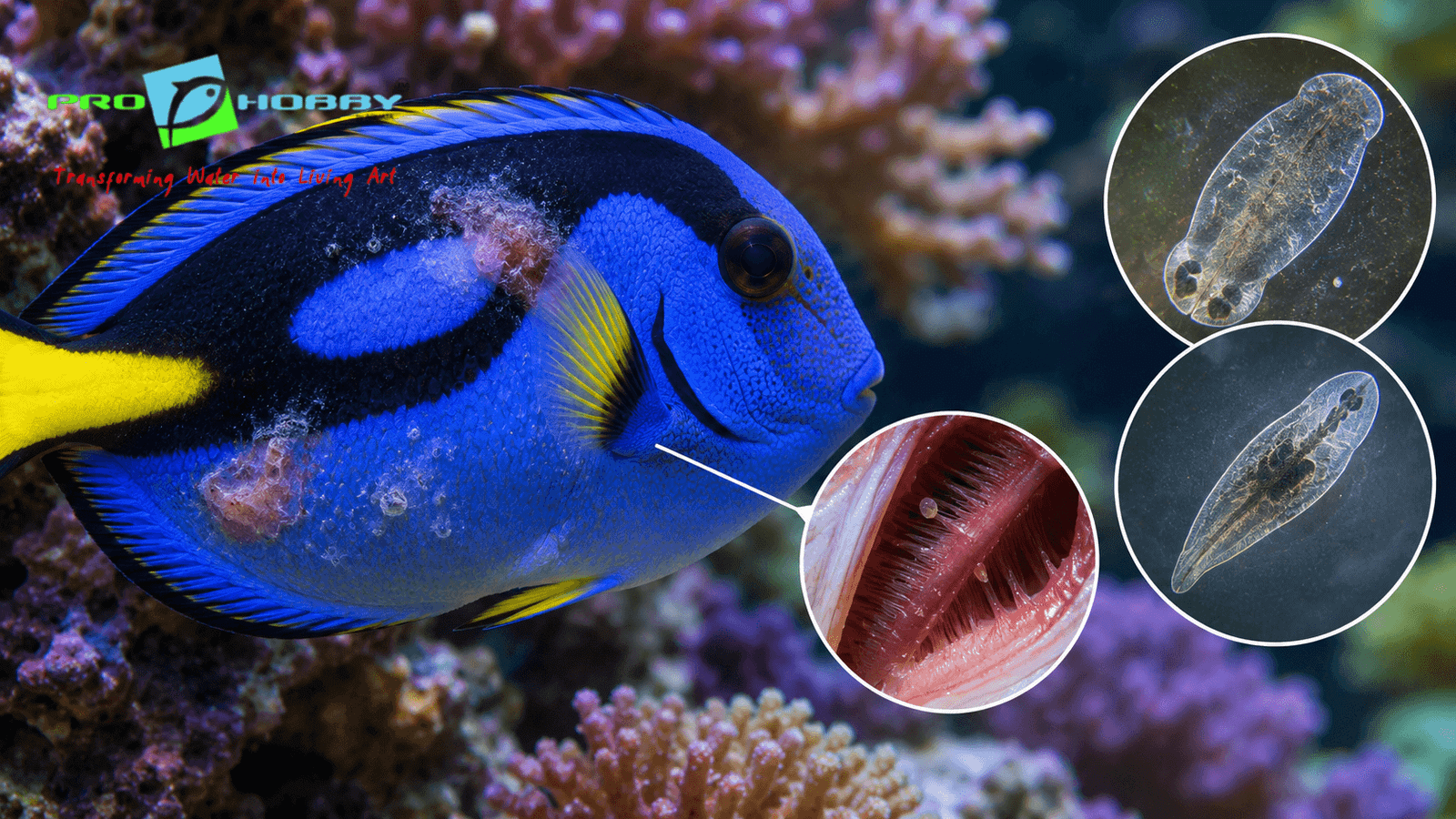
Skin flukes are the group most associated with marine ornamental fish. Neobenedenia is the notorious generalist, reported across a very wide range of marine fish species, living on the skin and fins and, importantly, on the eyes, where it can cause clouding and corneal damage. Adults are flat, translucent and small, a few millimetres at most, and are easily overlooked on a fish even when present in numbers. Related species in the same family cause similar problems.
Gill flukes belong to several different families and attach to the gill filaments. They are smaller and harder to see, they irritate and damage the gill tissue, and they impair the gas exchange the fish depends on, which is why a heavy gill infestation presents as respiratory distress.
Both groups attach using a posterior organ equipped with hooks, and both feed on mucus and surface tissue. Their attachment and feeding irritate the host, trigger excess mucus production and damage the protective barrier the fish depends on, which is the mechanism behind both the visible signs in Section 5 and the secondary infections in Section 12.
3. The Lifecycle — Why Eggs Dictate Every Treatment Decision
Everything about treating marine flukes follows from the lifecycle, in the same way that Cryptocaryon treatment follows from its four stages.
Adults live on the fish and produce eggs continuously. In the skin fluke group the eggs typically carry fine filaments that cling to surfaces, so eggs accumulate on the fish itself, on tank walls, on equipment and in nets, rather than simply drifting away. Eggs hatch after a period that depends on temperature, in days to over a week, into free-swimming larvae that must find a host within a short time or die. A larva that finds a fish attaches and develops into an adult over the following days to weeks, again depending on temperature, and begins laying eggs of its own.
Three consequences follow, and they explain most of what goes wrong:
The eggs are not killed by the standard fluke treatment. The drugs used against flukes act on the adult and larval stages, so a single course leaves eggs behind that hatch afterwards and restart the infestation. This is why symptoms return a week or two after a course that appeared to work, and why every protocol involves repeating the treatment.
Adults stay on the fish. Unlike Cryptocaryon, whose feeding stage leaves the fish to reproduce on surfaces, fluke adults remain attached and keep reproducing on the host. This is the reason the Tank Transfer Method does not work against them, covered in Section 8.
The lifecycle needs a fish. Larvae die without a host within a short time, so a tank with no fish in it eventually stops being infectious, which is the basis of the fallow in Section 13.
4. Why the Trade Spreads Flukes So Effectively
Flukes are almost perfectly suited to the way marine fish are collected and sold. A direct lifecycle needs no intermediate host. Eggs cling to nets, containers and surfaces, so they travel with the equipment. Crowded holding systems, often with water shared between many tanks through common plumbing, put every fish in contact with every larva. And stress suppresses a fish’s defences, as covered in The Science of Fish Stress, which lets a light infestation build into a heavy one.
This is the same holding-system pathway that drives Brooklynella outbreaks and the same chain that makes quarantine non-negotiable throughout the marine cluster, as established in the marine quarantine guide. A fish that has passed through a shared-system holding tank has had every opportunity to pick up flukes, whether or not it shows anything on the day it is sold.
5. Symptoms — Skin, Eyes and Gills
Skin flukes most often show as flashing and scratching, where the fish rubs against rock or the tank floor in a quick, repeated, seemingly compulsive way. Other signs are excess mucus, which can make patches of skin look cloudy, dull or greyish, ragged or eroded fins, reddening and, in heavier cases, ulcers. Clouded or swollen eyes are a particular warning, because skin flukes frequently settle on the eyes. Affected fish are often restless, hide more than usual and eat less.
Gill flukes show primarily as respiratory distress: fast breathing, flared gill covers, pale or mucus-coated gills, a fish hanging near the surface or in the flow, and lethargy. There may be little or nothing visible on the body, which is exactly the same silent gill-dominant presentation described for marine velvet and bacterial gill disease, and it is why gill flukes belong in the same diagnostic conversation.
Heat makes everything worse. Warm water accelerates the parasite’s lifecycle and reduces the oxygen available to a fish whose gills are already compromised, as covered in Aquarium Chillers in India, so the combination of flukes and a hot tank is dangerous in a way neither is alone.
6. The Diagnostic Trap — Why Flukes Hide Behind Other Diagnoses
The practical danger of flukes is not that they are exotic. It is that their signs overlap with almost everything else in this cluster, and a keeper who reaches for the more familiar diagnosis can treat the wrong disease for weeks.
| Condition | Typical visible sign | Distinguishing clue | Response to copper |
|---|---|---|---|
| Flukes | Scratching, excess mucus, cloudy eyes or skin, no spots or dust | Worms in dip water; signs persist after copper | Not regarded as a reliable treatment |
| Cryptocaryon | Discrete white salt-grain spots | The spots themselves | Responds |
| Marine velvet | Fine gold dust, fast breathing | Torch at a low angle; very rapid decline | Responds |
| Brooklynella | Whole-body mucus and sloughing | Extreme speed; formalin is first-line | Not first-line |
| Bacterial gill disease | Fast breathing, no parasite on a gill biopsy | Water quality driven, often gradual | No effect |
| Uronema | Ulcers at damaged sites | Often follows another disease | Formalin rather than copper |
The single most useful rule: a fish that is still scratching or breathing fast after a completed copper course for ich or velvet, with the spots and dust gone, should be assessed for flukes before the keeper assumes the original treatment failed. The copper cleared one parasite and left another untouched. A slow, chronic erosion confined to the head and lateral line of a tang or angelfish, in a fish that is otherwise eating and behaving normally, points to Head and Lateral Line Erosion rather than to flukes.
Ruling out the environment comes first, as always. Test ammonia, temperature and salinity before treating any parasite, since irritated gills and flashing are also the signature of poor water quality, covered in Ammonia in Aquariums.
7. Confirming Flukes — The Dip Examination and the Gill Biopsy
Because the symptoms overlap, confirmation is worth more than guesswork, and there are two practical routes.
The dip examination uses the freshwater dip technique described in the Brooklynella guide: a short immersion in temperature- and pH-matched dechlorinated freshwater, with the fish watched continuously and removed at any sign of distress. Skin flukes that detach in the dip fall into the water, and the dip water can then be examined in a clear container against a dark background with good light and a magnifier. Small, translucent, worm-like specks, sometimes moving, are flukes. Finding them confirms the diagnosis. Finding none does not exclude gill flukes, which grip tightly and do not necessarily release, and it does not exclude a light skin infestation. Dips stress the fish and are not suitable for every fish, particularly fragile or heavily stressed ones.
The gill biopsy is the definitive method for gill flukes, as described in the bacterial gill disease guide: a small sample examined under a microscope shows attached flukes and eggs where they are present, and also shows whether the respiratory distress has a bacterial or environmental origin instead. It is a specialist technique and not a routine home procedure.
Where confirmation is not practical, treating empirically in quarantine is reasonable for a wild-caught fish with a suggestive picture, which is the approach built into the quarantine protocol.
8. Why Copper and the Tank Transfer Method Do Not Solve Flukes
This section matters because it explains why a perfectly executed quarantine can still deliver a fluke-infested fish into a display.
Copper acts on the free-swimming stages of parasites like Cryptocaryon and Amyloodinium, as established in the Cryptocaryon guide. Adult flukes attached to the fish are not reliably killed by it. A fish put through a long copper course may therefore finish quarantine free of ich and velvet and still carrying flukes, with the keeper reasonably but wrongly concluding that the quarantine has cleared it.
The Tank Transfer Method fails for a lifecycle reason. TTM works against Cryptocaryon by moving the fish away from the surfaces where the parasite encysts and reproduces, so each transfer strands the parasite population in the previous tank. Fluke adults do not leave the fish. They stay attached and keep laying eggs wherever the fish goes, so moving the fish does not remove them. TTM can leave eggs behind in each tank, but it does not clear the adults, and used alone it cannot be relied on to eliminate flukes.
The consequence is that a quarantine protocol built only around copper or TTM has a blind spot for exactly the parasite most likely to be on a wild-caught fish. This is why the quarantine guide includes a fluke-specific agent for wild-caught stock.
9. Treatment — Praziquantel, Formalin and Dips
Praziquantel is the standard treatment for monogenean flukes. It is an anthelmintic that disrupts the neuromuscular function of flatworms, causing paralysis and detachment, which is the same mechanism described for freshwater flukes in the gill flukes guide. It acts on adults and larvae but not on eggs, which drives the repeat logic in Section 10. It is typically used as a prolonged immersion in a quarantine or hospital tank, with dosing and duration specific to the product and set by its label, and the practical points in the freshwater guide, such as dissolving it according to the label and removing activated carbon during treatment, apply here too. It is generally considered gentler on biological filtration than copper, though ammonia should still be monitored throughout, as covered in the quarantine guide.
Formalin baths are an effective alternative or adjunct against skin flukes, applied as short baths following the product-specific protocol described in the Brooklynella guide, with strong aeration, continuous observation, and the same caution about handling a respiratory irritant.
Freshwater dips provide supportive relief by physically removing some skin flukes and excess mucus, as covered in Section 7, but they do not reach gill flukes or eggs and are not a standalone treatment.
One course at a time. As established in the quarantine guide, stacking several medications at once adds stress and makes it impossible to tell what is working, so fluke treatment is planned as its own course, sequenced with any copper or other treatment rather than layered on top of it.
Antibiotics are reserved for a genuine secondary bacterial infection, covered in Section 12, and are not part of the fluke treatment itself.
10. The Repeat-Course Logic and the Temperature Effect
Because the standard treatment kills adults and larvae but not eggs, a single course almost always leaves a population waiting to hatch. The treatment is therefore repeated after the eggs have had time to hatch, and the sequence continues until a full hatching cycle has passed with no new parasites appearing. The freshwater guide describes the same pattern, with the signature failure being symptoms returning a week or two after a course that seemed to work, and the same logic applies in marine fish.
Temperature changes the timing. Egg hatching and larval development slow in cooler water, so the interval between courses needs to be long enough to cover the hatching window at the temperature the tank actually runs at. Product intervals are often written with warmer tanks in mind, and the 22–24°C target that applies to marine systems in Indian conditions sits at the cooler end. A keeper who simply copies an interval written for warmer water may repeat the treatment before the eggs have hatched, and the repeat then lands on nothing. Planning an additional repeat, rather than assuming one will do, is the safer approach.
Physical egg removal helps. A bare quarantine tank can be siphoned daily to remove eggs and larvae from the floor, and the walls can be wiped, which reduces the number of eggs waiting to hatch. Frequent partial water changes, covered in How to Do a Water Change, remove free-swimming larvae. This is another reason the bare design in the quarantine guide is so much more effective than a decorated tank.
Observation continues after the course. A return of flashing, mucus or fast breathing after an apparently successful course is the signal of a hatch wave, not a new infection, and the course continues rather than being declared a failure.
11. Treat in Quarantine, Not the Display — and Do Not Confuse Flukes With Reef Flatworms
Treat in the quarantine or hospital system. In the freshwater world, treating the main tank for flukes is sometimes reasonable because praziquantel is gentle on biological filtration. In a marine display the position is different. Praziquantel is an anthelmintic aimed at flatworms, and the effects of a treatment dose on non-target invertebrates, on corals and on the beneficial worms and flatworm fauna living in live rock are not fully characterised. A fish-only system is a more forgiving case than a reef, but the live rock and its inhabitants are still part of the system, so the controlled approach is to treat the fish in quarantine and not to find out in the display.
Flukes are not the flatworms in your reef tank. This is a frequent source of confusion, because both are called flatworms. The pests covered in Marine Flatworms, including the Acropora-eating flatworm and nuisance bloom species, are free-living animals that live on rock and coral and threaten coral, not fish. Flukes are parasites that live on fish and do not infect corals. They need different treatments, and a treatment aimed at one is not a treatment for the other. A reef keeper who searches for a flatworm remedy and uses a fluke treatment, or the other way round, has applied the wrong tool to the wrong animal.
12. Secondary Infection at Fluke Wounds
Fluke attachment and feeding damage the skin and gill surface, and a damaged surface is an entry point for opportunistic bacteria. This is the same pattern covered for every parasite wound in this cluster: Vibriosis colonises damaged tissue, and Uronema can establish as a second wave at sites of tissue damage left by another disease. A fish that clears its flukes and then develops reddening, spreading lesions or a new ulcer at a previous attachment site should be assessed for a bacterial or Uronema complication rather than assumed to be a fluke relapse.
The order of treatment follows the cause. Clear the flukes first, since they are producing the wounds, then address any bacterial or ciliate complication that has established at them, using the relevant guide.
13. If Flukes Reach the Display — The Fish-Free Fallow
If flukes reach a display, the lifecycle in Section 3 shows the way out. Adult flukes live only on fish and larvae die within a short time without a host, so a display with no fish in it gradually stops being infectious. The approach is the same as the one described for Cryptocaryon: remove all the fish to quarantine for treatment, and leave the display running without fish for long enough that eggs have hatched and the resulting larvae have died without finding a host. At the cooler 22–24°C target the hatching window is longer, so the fallow period should be generous.
Flukes do not infect corals or other invertebrates, which means the display’s coral and invertebrate population is not at risk from the parasite and need not be removed. The caution is the one in Section 11: the treatment is given to the fish in quarantine, not to the display. The fish return only after quarantine has run its course with no recurrence, per the release criteria in the quarantine guide.
14. Prevention — Quarantine, Hygiene and Egg Control
Quarantine is the primary prevention, with the duration and the shared-clock rule set out in the quarantine guide. For wild-caught fish a course aimed at flukes is part of the default protocol, because a fish that looks clean on day three can be carrying a population that has not yet become visible.
Buy with the supply chain in mind. Examine a fish at purchase for scratching, cloudy eyes, excess mucus and fast breathing. Ask whether the tank it is in shares a system with other tanks, since a shared system means any fluke in the shop has had access to every fish on it.
Control the equipment. Eggs cling to surfaces and nets, so quarantine equipment is dedicated and never shared with the display, in line with the two-system principle in the quarantine guide, and quarantine tanks are scrubbed and dried completely between uses.
Do not transfer water. Transport and quarantine water carries eggs and larvae, and it should never be poured into the display.
Keep stress low and temperature in range. A stressed fish carries heavier infestations, and heat accelerates the parasite. The temperature control in Aquarium Chillers in India and the Saltwater Aquarium for Beginners guide is part of fluke prevention as much as of general husbandry.
Do not mistake feeding failure for a feeding problem. A wild-caught fish that is scratching, producing excess mucus or breathing fast and refusing food may have flukes rather than a weaning difficulty, which is why Weaning Wild-Caught Marine Fish tells keepers to rule out disease before treating a refusal to eat as a feeding problem.
15. Digenean Flukes — The Ones You Do Not Have to Treat
The second group of flukes behaves very differently. Digeneans have an indirect lifecycle: they pass through a snail and other hosts, and fish can carry their larval stages encysted in tissue. In an aquarium, the intermediate hosts and the final host the lifecycle needs are absent, so these parasites cannot complete their development and cannot spread from one fish to another. They are a dead end, in the same sense as the encysted nematode larvae in the Raphidascaris and Contracaecum guide, and the larval stages in tissue are largely out of reach of aquarium treatments in any case. The freshwater counterpart is touched on in the Internal Parasites guide.
The practical point is that finding an unfamiliar encysted structure in a wild-caught fish does not call for a fluke treatment course. That is a plan for monogeneans, and it is the monogeneans that spread, damage the skin and gills, and need the repeat-course approach in this guide. Wild snails that arrive on live rock are also a reminder of why hitchhiker identification matters, covered in Marine and Reef Snails.
16. India — Wild-Caught Supply and Practical Realities
Assume wild-caught means flukes until proven otherwise. As established in Saltwater Aquarium for Beginners, most marine fish sold in India are wild-caught and travel a long chain, often through shared holding systems, before they reach a buyer. That is the setting in which a direct-lifecycle parasite thrives, and a supplier’s own holding period reduces the risk but does not remove the need for the buyer’s own quarantine.
Heat accelerates the lifecycle. In much of India the temperature a tank reaches without active cooling speeds hatching and larval development and reduces the oxygen available to a fish with damaged gills. A chiller or a reliably air-conditioned room is part of managing flukes as well as everything else, as set out in Aquarium Chillers in India and Aquarium Water Temperature in Indian Summer.
Treatment stock needs sourcing before it is needed. The availability of aquarium-specific fluke treatments varies by city and supplier across India, so establishing where to obtain them, and keeping them as part of the quarantine kit described in the quarantine guide, is better done in advance than during a crisis. The supplier-evaluation framework in Aquarium Shop Delhi NCR — What a Specialist Looks Like applies to marine livestock and treatment supply as much as to anything else.
17. Where Professional Guidance Helps
The framework in this guide is the reasoning behind fluke management. Applying it to a specific fish, in a specific system, is where a generic guide stops being enough: choosing the order and timing of treatment courses for a mixed batch of wild-caught fish with different sensitivities, setting repeat intervals for the temperature the system actually runs at, deciding whether a symptomatic fish has flukes, another parasite or a water quality problem, and managing a fallow and re-introduction for a display that has been affected.
Getting these wrong rarely announces itself immediately. A repeat that lands before the eggs have hatched, a quarantine that cleared ich but not flukes, or a fish released with a hidden population all look like success until the infestation returns in the display. This is the layer at which ProHobby™ design and consultation work, covered across Aquarium Shop Delhi NCR, makes the difference between a quarantine process that is followed and one that works.
Frequently Asked Questions
How do I know if my marine fish has flukes? Typical signs are scratching or flashing, excess mucus, cloudy or dull patches of skin, clouded eyes, and fast breathing, usually with no spots or gold dust. Confirmation comes from finding small translucent worms in the water after a freshwater dip, or from a gill biopsy for gill flukes. A fish that keeps scratching after a completed copper course for ich or velvet should be assessed for flukes.
My fish is still scratching after copper treatment. Is it flukes? Quite possibly. Copper acts on the free-swimming stages of parasites like Cryptocaryon and Amyloodinium and is not regarded as a reliable fluke treatment, so a fish can clear its ich and still carry flukes. Check water quality first, then consider flukes before assuming the copper course failed.
Is praziquantel reef safe? Treat the fish in quarantine rather than the display. Praziquantel is aimed at flatworms, and its effects on non-target invertebrates, corals and the beneficial worm and flatworm fauna in live rock are not fully characterised, so the display is not the place to find out.
How long does it take to clear flukes? Longer than a single course. The standard treatment kills adults and larvae but not eggs, so it is repeated after the eggs have hatched, and the sequence continues until a full hatching cycle has passed with no new parasites. In cooler water the hatching window is longer, so the repeats need to be spaced accordingly.
Are marine flukes the same as the flatworms in my reef tank? No. Reef flatworm pests such as the Acropora-eating flatworm are free-living animals that threaten coral. Flukes are parasites that live on fish and do not infect corals. They need different treatments, and a remedy for one does not address the other.