
By ProHobby™ | Ecological Systems Authority
The aquarium hobby in Delhi NCR has a specific problem that no general aquarium guide addresses: most livestock, plants, and advice sold in this region is not calibrated for Delhi NCR conditions. Fish arrive from suppliers who packaged them for generic tropical conditions. Plants are emersed-grown, desiccate in transit, and melt within days of planting. Advice about water chemistry comes from guides written for European soft water. Equipment is selected by price rather than appropriateness for the local environment.
The hobbyist who buys from a general pet market, follows generic internet advice, and then loses fish or plants to conditions specific to Delhi NCR — hard alkaline tap water, chloramine treatment, extreme summer heat, the Ca:Mg imbalance that stunts plants — typically concludes that fish keeping is too difficult.
It is not.
The problem is sourcing and advice calibrated for somewhere else.
This is what a genuine Delhi NCR aquarium specialist looks like — and the questions to ask before trusting any supplier with a tank that will live in your home for years.
“Anyone can sell you a glass box with a few pieces of equipment thrown in. Most of them do. What we build at ProHobby™ are living systems — and a living system doesn’t just last years, it gets better every year it matures. Before you buy anything, ask yourself honestly which one you’re actually looking for.”
— Sunny Banerjee, ProHobby™
Why Delhi NCR Specifically Is Different
Before evaluating any aquarium supplier, understand what makes this region’s conditions distinct:
Hard, alkaline water (pH 7.6–8.5, GH 10–16 dGH, KH 8–12 dKH) that is incompatible with soft-water species, creates CO₂ injection challenges in planted tanks, and requires specific remineralisation approaches for shrimp, discus, and softwater biotopes. A supplier advising you to keep discus in Delhi NCR tap water without RO treatment is not a specialist.
Chloramine water treatment — Indian municipal water uses chloramine, not free chlorine. Standard dechlorinators release the ammonia component into the tank with every water change. A specialist knows this. A general pet shop sells sodium thiosulfate and calls it dechlorinator.
Extreme summer temperatures where uncontrolled room temperatures reach 40–45°C, requiring active cooling strategies for most tropical species and effectively prohibiting cold water species like goldfish without a chiller. A supplier who sells goldfish without mentioning this is not advising in your best interest.
Seasonal water chemistry variation — Delhi NCR tap water shifts between groundwater and canal sources seasonally, producing measurable changes in KH and TDS between February and August that affect planted tanks, CO₂ calibration, and shrimp breeding. Only a supplier tracking these local variables can advise meaningfully on them.
The complete Delhi NCR water chemistry framework: Hard Water Aquariums in Delhi NCR.
Livestock — What Grade “A” Stock Looks Like
The quality of aquarium livestock is one of the most significant and least transparent variables in the hobby. Two fish of the same species from different supply chains can have dramatically different health status, immune history, and life expectancy — and they are visually indistinguishable to most buyers at the point of purchase.
Source Quality and Farm Standards
Grade-A aquarium livestock is sourced from specialist breeding farms — predominantly in Southeast Asia (Singapore, Thailand, Malaysia, Indonesia, Taiwan) — that maintain controlled breeding conditions, species-specific water parameters, proper nutrition, and documented health management. These farms produce fish with established immune competence, known health histories, and consistent genetic quality.
The alternative is livestock from domestic collection points, mass-market consolidators, or farms that prioritise volume over husbandry standards. These fish arrive at the retailer already stressed from transit in suboptimal conditions, with compromised immune function and often subclinical disease loads that manifest weeks after purchase — by which time the buyer has no recourse and no understanding of why their fish died.
A serious specialist stocks Grade-A imports from the best regional farms — not because premium livestock costs more (though it does), but because it is the only livestock worth selling to hobbyists who are investing in long-term aquarium systems.
Ethical Sourcing and Certification
Species-appropriate certifications matter for three reasons: legal compliance, ecological responsibility, and livestock quality. Certified captive-bred specimens — as distinct from wild-caught fish of unknown provenance — have established feeding habits, are adapted to captive water parameters, and do not contribute to pressure on wild populations.
For specific species, certification is a legal requirement. Asian arowana (CITES Appendix I), Indian star tortoise (Schedule IV, Wildlife Protection Act 1972), and various protected species are sold illegally through uncertified channels. A specialist can provide documentation on request. A seller who cannot is operating without it.
Ethical sourcing also means stocking only species that can be legally and appropriately kept in Indian conditions — not selling species that require permits, create invasive risks if released, or cannot be humanely maintained by the average hobbyist.
Quarantine — The Standard That Protects You
A supplier who sends fish directly from a holding tank to your bag to your aquarium is not a specialist, regardless of how they represent themselves.
All livestock should complete a minimum quarantine period before sale. This serves two functions: disease detection (many conditions become visible only after the stress of transit, typically within 5–14 days of arrival) and acclimatisation (allowing immune function to recover from transport stress before the fish faces the additional stress of a new tank).
The science of what stress does to fish immunity — and why post-transport immune suppression makes fish acquired without quarantine significantly more likely to introduce disease — is in The Science of Fish Stress and Quarantine and Biosecurity in Aquariums.
Ask any supplier directly: How long is the quarantine period for your livestock? What are they quarantined for? What do you do if a batch shows symptoms during quarantine? A specialist has clear, specific answers. A general pet shop has none.
Plants — The Submerged-Grown Difference
The majority of aquarium plants sold in India are emersed-grown — cultivated above water in humid greenhouse conditions because it is significantly faster and cheaper than growing plants submerged. Emersed plants develop leaves morphologically suited to aerial conditions: different stomatal structure, different cell composition, different chlorophyll density. When placed underwater, these leaves are incompatible with the aquatic environment and die — the process known as plant melt.
Plant melt is not a sign of bad luck or inadequate care. It is the predictable physiological response of an air-adapted plant being placed in water. The plant survives and sends out new submerged-adapted leaves over 2–4 weeks — but the process is visually alarming and loses a significant proportion of the original plant mass.
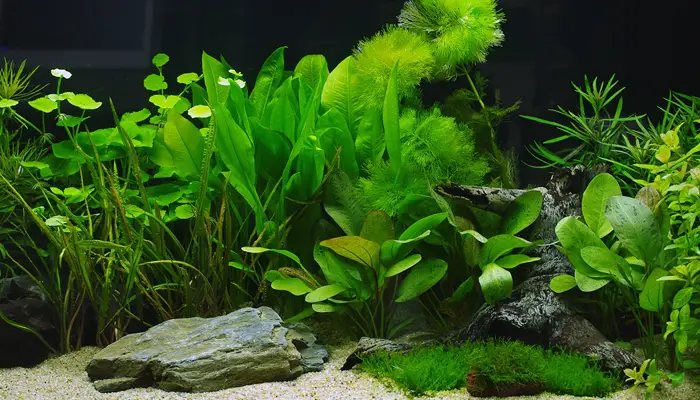
Submerged-grown plants are cultivated underwater from the beginning. They arrive in a buyer’s tank with leaves already adapted to the aquatic environment — no melt, no transition period, immediate active growth. The visual and performance difference is immediate and significant.
A no-melt assurance is only meaningful from a supplier who is genuinely growing submerged. It is not a marketing claim — it is a description of a production process that costs more time and resource than emersed cultivation.
Additionally, tissue culture plants (tissue culture cups sealed before sale) are free of pest snails, algae spores, and pathogens that are routinely introduced by conventional aquarium plants. That said, the problem with TC plants is that they are grown in a sterile laboratory medium — and given Delhi NCR’s water conditions and extreme temperatures, they almost never adapt and transition to natural aquarium conditions. Extreme patience and careful acclimatisation is mandatory before the plants can establish.
Best Aquarium Plants for Delhi NCR Water.
Equipment — Global Brands vs Generic
Aquarium equipment quality varies enormously. A heater that fails hot (overheating the tank to 40°C) is not a minor inconvenience — it is a tank crash. A filter that fails during a 48-hour power outage cycle kills the entire biological filtration of a mature tank. A UV clarifier that leaches harmful wavelengths is actively damaging.
A specialist stocks equipment from brands with documented engineering standards, customer service infrastructure, and replacement parts available in the Indian market. Filtration from Eheim, Fluval, Oase, Hydor; lighting from Chihiros, Twinstar, Kessil; dosing from Arka, GHL; skimmers from Bubble Magus, Reef Octopus — these are brands with years of field performance data and the engineering philosophy that produced them.
The alternative is white-label generic equipment at lower price points that may perform adequately for months and then fail without recourse or replacement. In a ₹50,000 custom planted tank or a ₹2,00,000 reef build, the cost difference between quality and generic filtration is a small fraction of the total investment and a significant fraction of the risk management.
Custom Fertiliser Service
Planted tanks in Delhi NCR have specific nutritional challenges that generic off-the-shelf fertilisers do not address. The Ca:Mg imbalance in Delhi NCR tap water (Ca:Mg ratios of 5:1–8:1) produces effective magnesium deficiency in planted tanks that presents as interveinal chlorosis — a symptom ubiquitous in Delhi NCR planted tanks that most hobbyists treat incorrectly with standard micro-fertilisers. The correct response is Mg supplementation calibrated to the specific tap water chemistry of the tank’s location.
A custom fertiliser service — calibrated to the specific water chemistry, plant load, lighting, and CO₂ level of an individual tank — produces better outcomes than any generic product dosed at manufacturer recommendations. The Fertiliser Dosing Calculator provides the quantitative framework; a specialist translates this into a personalised dosing protocol.
Advanced nutrient chemistry for planted systems: Advanced Nutrient Dynamics — Carbon Chemistry in Planted Aquariums.
Custom Tank Design and Builds
The majority of aquariums sold through general pet shops in Delhi NCR and online marketplaces are mass-produced tanks from Chinese manufacturers — thin glass or scratch-prone acrylic, unknown silicone, and tolerances that are barely acceptable and reveal their limitations within 12–18 months of active use.
The silicone joints yellow and peel. The glass thickness is calculated for minimal material cost, not for the water pressure of a full tank at temperature over years. The bracing is cosmetic rather than structural. The inbuilt LED strips produce light in the wrong spectrum and at inadequate intensity for anything beyond the most basic fish-only setup, and cannot support either plant growth or coral growth. The bundled internal filter is sized for the box dimensions rather than the actual biological load the tank will carry — typically a small powerhead with top sump allowing only filter pads and/or minimal media volume that is inadequate. These tanks are priced to sell quickly — not to last, not to grow plants, and not to support anything approaching a functioning ecosystem.
The consequences are not always dramatic. A cheap tank does not always fail catastrophically. It degrades — slow silicone weeping that produces mineral deposits and eventual joint failure, glass flex under full load that stresses the seals from day one, base panels that are not flat enough to seat evenly without a proper mat. Moreover, with temperature extremities in Delhi NCR, acrylic tanks tend to yellow over time compromising visibility. In a ₹50,000 planted aquascape or a livestock collection built over years, the tank failure is not a ₹2,000 problem. It is a total-loss event.
Custom-fabricated glass aquariums use glass thickness calculated for the actual dimensions and water column height of the specific tank — not the thinnest glass that will not visibly bow. The silicone is aquarium-grade and applied with joint geometry designed for longevity. The bracing is structural. A tank built to these standards does not have a 2-year horizon — it has a 15-year one.
An aquarium does not need to be a standard rectangular box in a standard dimension. A specialist with design and fabrication capability can produce tanks calibrated to the exact space, orientation, and visual requirements of a home, office, or hospitality environment — floor-to-ceiling columns, peninsula setups open on three sides, curved front glass, under-staircase ecosystems, room dividers, built-in cabinetry integration.
Custom design also means the system is engineered from the beginning for the intended livestock and ecosystem type — the filtration capacity, sump design, lighting rig, CO₂ system, and maintenance access are all designed together rather than assembled from generic components that may or may not work well in combination. The Glass Thickness Calculator illustrates the engineering difference between correctly specified and underspecified glass for any given tank dimension.
Hybrid and Habitat Systems
Beyond standard aquariums: paludariums (aquatic and terrestrial zones in the same system), ripariums (vertical planting along emergent zones), vivariums with aquatic sections, open-top jungle setups with overhead canopy — these are specialist design and build projects that require ecological understanding of how aquatic and terrestrial interfaces function, not just aquarium construction skills.
Hybrid Aquarium Ecosystems: Paludariums, Ripariums and Interface Design and Biotope Aquariums: An Ecological Reference represent the depth of ecological understanding these systems require.
Vastu Shastra and Feng Shui Expertise
The significance of aquariums in Indian Vastu Shastra — placement, direction, species selection, tank shape, number of fish, colour — is substantial and the demand for authoritative guidance on it is real. A general pet shop cannot advise on the Vastu implications of an aquarium in the northeast corner of a home versus the southeast. A specialist with genuine Vastu and Feng Shui expertise can.
This extends to species selection — the Vastu significance of arowana, flowerhorn, and goldfish, the auspicious combinations and configurations, and the relationship between tank design and the energetic intention of the space. Vastu Shastra and Feng Shui.
Annual Maintenance Contracts
A large custom aquarium or reef build is not a purchase — it is an ongoing system that requires regular skilled maintenance to remain at its best. Filter media management, water change chemistry calibration, coral placement and health assessment, planted tank trimming and replanting, livestock health monitoring, equipment servicing — these are not tasks that benefit from guesswork visits.
An Annual Maintenance Contract (AMC) provides scheduled professional maintenance at defined intervals, with the system knowledge of the team who designed and built the tank. For hospitality environments, office installations, and large residential builds where the tank is a design centrepiece, the AMC is what makes the system reliably beautiful rather than gradually declining.
Questions to Ask Any Aquarium Supplier in Delhi NCR
Before purchasing livestock, plants, equipment, or a system from any supplier:
- Where does your livestock come from — and do you have documentation for certified species?
- What is your quarantine protocol — duration, conditions, and what triggers a batch being withheld?
- Are your plants submerged-grown or emersed-grown?
- Do you understand Delhi NCR tap water chemistry and can you advise on management for my specific setup?
- Can you advise on the correct dechlorinator for chloramine-treated Delhi NCR water?
- Do you carry equipment from globally recognised brands with warranty and service support in India?
- If I have a problem after purchase — fish health, plant failure, equipment issue — what support do you provide?
A specialist answers all seven questions specifically and confidently. These questions are not unreasonable — they are the minimum expected of a professional aquarium supplier.
The ProHobby™ Standard
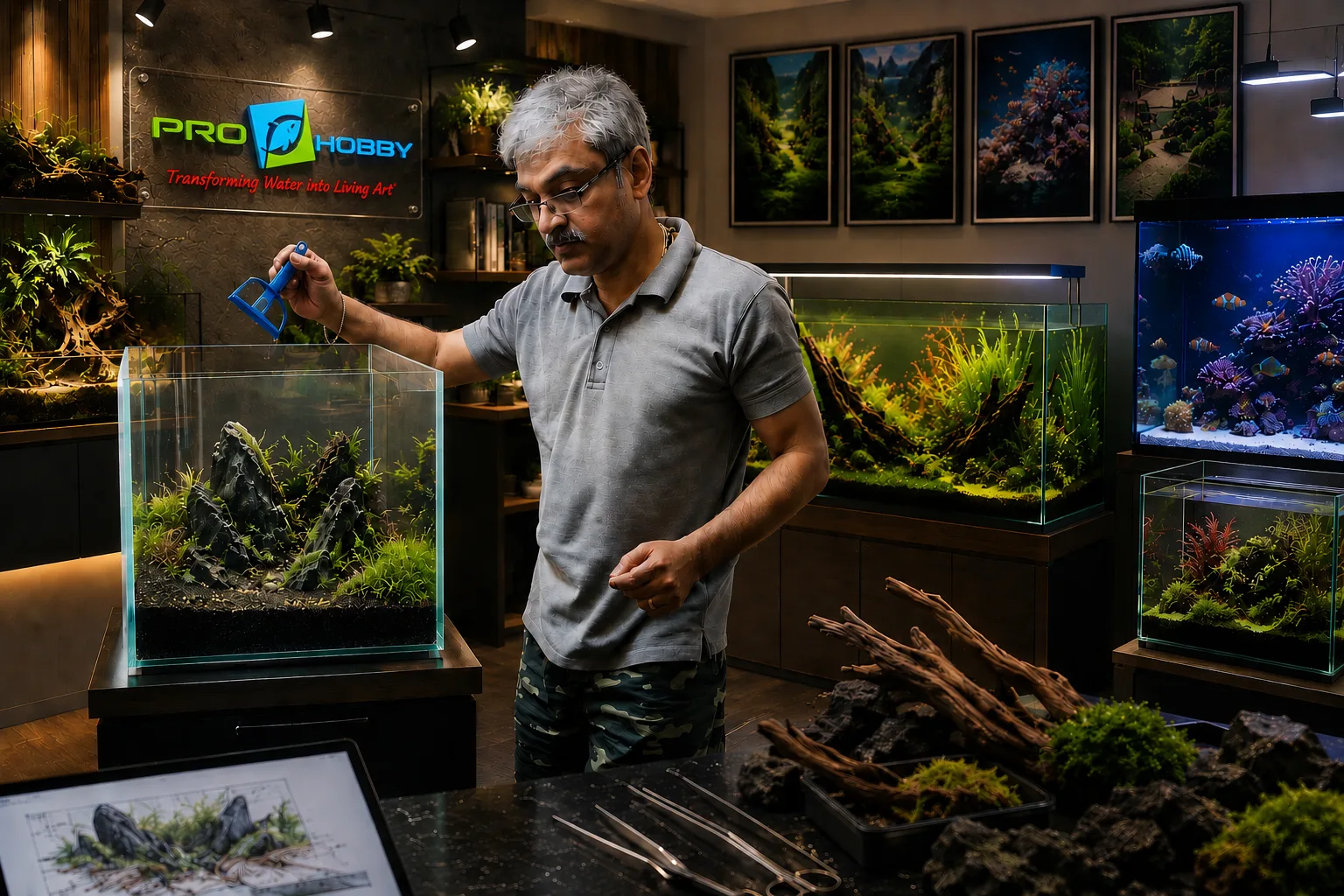
ProHobby™ is Delhi NCR’s ecological systems specialist — not a general aquarium shop. The distinction begins with what is behind it.
ProHobby is promoted by Aquata India — a captive water and ecosystem authority with over 27 years of project experience delivering some of the best captive water systems for zoos, institutions, commercial establishments, and hobbyists across India and South Asia. Over 125,000 paludariums, vivariums, terrariums, ripariums, aquaria, ponds, pools, greenwalls, and waterfall projects. That depth of experience — across every category of living aquatic and semi-aquatic system, at every scale, in every Indian climate condition — is the foundation on which ProHobby’s approach to every tank is built, bringing those two decades of institutional and project expertise to the retail hobbyist market — at accessible scale and price points, without compromising on the scientific rigour and quality standards that Aquata has built its reputation on.
The operating philosophy is simple and non-negotiable: Knowledge before commerce. Systems before sales.
In practice, this means: every livestock batch is Grade-A imported from the best regional farms in Asia, quarantined fully before sale, and ethically sourced with appropriate certifications. Plants are submerged-grown with a no-melt assurance. Equipment is curated from globally recognised brands with proven performance records. Custom fertiliser protocols are calibrated to Delhi NCR water chemistry, not generic international recommendations. Vastu and Feng Shui expertise is embedded in the design process for every installation where it is relevant.
Beyond supply: ProHobby designs and builds custom aquarium systems calibrated to the specific space, water chemistry, and ecological intent of each installation — from nano planted setups to large-scale marine, reef, hybrid habitat, and biotope builds. AMC coverage is available for all significant builds, ensuring the system that was designed with long-term stability as the goal is also maintained to that standard over time.
The scientific rigour that underpins every ProHobby™ system is reflected throughout this website — the water chemistry guides, disease management protocols, ecological stability frameworks, and India-specific guidance represent the same depth of knowledge applied to every tank we work with. That knowledge is not borrowed from international sources and applied generically. It has been developed, tested, and refined across 27 years of real-world aquatic system design in Indian conditions.
For species-specific guidance calibrated to Delhi NCR conditions: Best Fish for Delhi NCR Aquariums and Best Aquarium Plants for Delhi NCR Water. For diagnosis of why a tank is struggling in Delhi NCR: Why Aquariums Fail in Delhi NCR — System Diagnosis.
Frequently Asked Questions
What should I look for in an aquarium shop in Delhi NCR? Livestock quarantine protocols, Grade-A sourcing from certified farms, submerged-grown plants, equipment from recognised global brands, and specific knowledge of Delhi NCR water conditions — hard water management, chloramine dechlorination, summer temperature protocols. Ask specific questions before purchasing.
Why does fish from the same species die at home when it was fine in the shop? Most commonly: the shop water chemistry differs significantly from your tank; no quarantine means sub-clinical disease that manifests under the additional stress of a new environment; transport stress without recovery time compresses immune function at the point of introduction. Proper quarantine, drip acclimation, and source quality all directly affect survival after purchase.
What is the difference between submerged-grown and emersed-grown aquarium plants? Emersed-grown plants are cultivated above water — significantly faster and cheaper to produce. When placed in an aquarium, they undergo plant melt as the air-adapted leaves die off and the plant grows new aquatic leaves. Submerged-grown plants are cultivated underwater, arrive already adapted to the aquatic environment, and grow immediately without the melt transition.
Why do aquarium shops in Delhi NCR not always advise correctly for local water conditions? General aquarium advice is written for European or North American soft water conditions. Delhi NCR’s hard, alkaline, chloramine-treated water requires specific management that most generic advice does not address. A specialist with local water knowledge provides advice calibrated for what comes out of Delhi NCR taps.