
By ProHobby™ | Ecological Systems Authority
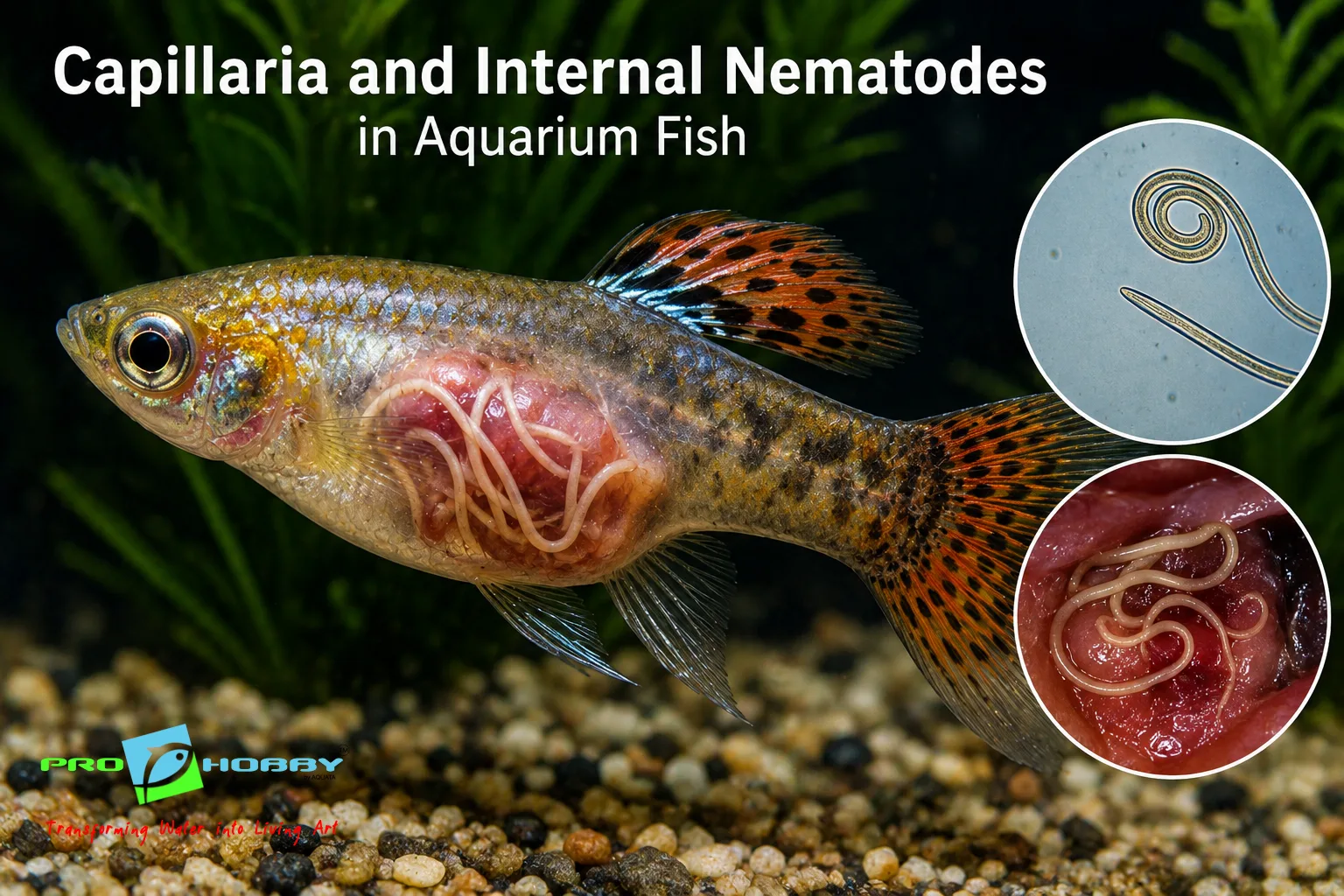
The internal nematode group in aquarium fish is more diverse than most disease guides acknowledge. Camallanus worms — the red-orange worms visible protruding from the vent — are the best-known, but they represent only one genus in a broader group of internal roundworms infecting freshwater fish. Capillaria, the hair-thin intestinal nematodes that are never visible at the vent, are arguably more prevalent in the hobby and more consistently undiagnosed precisely because they produce no visible worms — only a progressive, non-specific wasting syndrome that is routinely attributed to other causes. Understanding the full nematode picture, how different genera present differently, and why treatment protocols vary between groups is what separates a resolved infestation from months of failed treatment.
Table of Contents
- The Nematode Groups — An Overview of What Infects Aquarium Fish
- Capillaria — The Hair-Worm Nematode
- Raphidascaris, Contracaecum and Larval Nematodes
- Other Intestinal Nematodes — Spinitectus, Philonema and Cystidicola
- Camallanus — Cross-Reference
- Capillaria vs Camallanus — The Critical Comparison
- Diagnosis — Clinical and Microscopic
- Treatment — Group-Specific Protocols
- Whole-Tank Treatment — Why It Is Always Required
- Species Most Susceptible
- India and Delhi NCR — Specific Considerations
- Frequently Asked Questions
1. The Nematode Groups — An Overview of What Infects Aquarium Fish
Internal nematodes infecting freshwater aquarium fish fall into several distinct categories based on their location in the host, their lifecycle requirements, and their treatability:
Intestinal nematodes (most common, treatable):
- Capillaria spp. — hair-thin, infect the intestinal mucosa
- Camallanus spp. — thicker, visible at the vent in advanced infestations
Tissue/organ nematodes (less common, may not be treatable):
- Raphidascaris and Contracaecum larvae — encysted in muscle and organs from wild food sources
- Philonema — body cavity of coldwater fish
- Cystidicola — swim bladder nematode primarily in salmonids
The clinical significance hierarchy: Capillaria and Camallanus are the primary disease-causing nematodes in the ornamental freshwater hobby, both treatable with fenbendazole. The tissue-encysted larvae (Raphidascaris, Contracaecum) are diagnostically important but not treatable — and since they cannot complete their lifecycle in an aquarium, they do not spread between fish.
2. Capillaria — The Hair-Worm Nematode
Capillaria pterophylli is the primary Capillaria species infecting ornamental freshwater fish — particularly cichlids, discus, angelfish, and many other commonly kept species. The genus is named for its hair-like (capillary) adult worm structure — these are among the thinnest nematodes infecting fish, invisible to the naked eye and detected only by microscopic examination of faeces or post-mortem intestinal content.
Biology: Capillaria adults live in the intestinal mucosa — embedding in the intestinal wall rather than simply inhabiting the intestinal lumen as some other nematodes do. This tissue invasion produces direct intestinal damage beyond the nutritional competition of lumen-dwelling parasites. Females deposit characteristic barrel-shaped eggs with bipolar plugs into the intestinal lumen; these are shed in faeces and ingested by other fish to complete the lifecycle. No intermediate host is required — the direct lifecycle makes aquarium-to-aquarium and fish-to-fish transmission straightforward.
Why it is so commonly missed: Capillaria produces no visible worms at the vent. The clinical presentation — progressive weight loss, white stringy faeces, reduced appetite, eventual debilitation — is non-specific and shared by multiple internal parasite groups, bacterial infections, and water quality problems. Without faecal microscopy, clinical suspicion based on symptom pattern is the only available diagnostic.
Clinical signs:
- Progressive weight loss despite eating — the defining presentation. Fish continue showing feeding interest while losing body condition
- White, stringy, or mucoid faeces — different from the normal compact waste of healthy fish. The mucoid coating reflects intestinal inflammation from worm embedding
- Abdominal distension in some cases from intestinal inflammation
- Reduced activity and increasing lethargy as the infestation progresses
- Darkening of colouration — a general stress indicator common to many internal parasite infestations
Discus and Capillaria: Capillaria is one of the most common internal parasite findings in discus kept in India, and one of the most common explanations for the chronic wasting syndrome seen in discus that are being kept in otherwise correctly managed water. The combination of the demanding water chemistry requirements of discus with the immune suppression of suboptimal conditions creates a population highly susceptible to Capillaria establishment. Discus Fish Care Guide.
3. Raphidascaris, Contracaecum and Larval Nematodes
These are anisakid nematode larvae found encysted in the muscle tissue and internal organs of fish. They are acquired when fish consume infected intermediate hosts — small crustaceans, aquatic invertebrates, or smaller fish — in the food chain.
The lifecycle problem: Raphidascaris and Contracaecum require a piscivorous (fish-eating) bird or mammal as their definitive host to complete the lifecycle and reach sexual maturity. In an aquarium without access to such hosts, the larvae remain in the encysted larval stage indefinitely — they cannot develop to adults, cannot reproduce, and cannot spread to other fish. The fish is a dead-end host.
Clinical significance: Individual encysted larvae produce limited direct harm to the fish. Heavy burdens from wild-caught fish or fish from pond environments where the full lifecycle is present can cause organ damage, but this is uncommon in aquarium fish.
Presentation: Usually asymptomatic. White or yellowish nodules in muscle tissue, visible post-mortem. Occasionally associated with localised inflammation or reduced muscle function if a nodule is in a functionally significant site.
Treatability: These larvae are encysted — no aquarium medication penetrates the cyst reliably. Fortunately, since the lifecycle cannot complete in an aquarium, treatment is not usually necessary. The more important management question is whether the fish sourcing (wild-caught, from unknown ponds) creates ongoing exposure risk.
Zoonotic note: Raphidascaris and related anisakid larvae can cause anisakiasis in humans if infected fish are consumed raw or undercooked. This is relevant for edible fish (trout, tilapia, or ornamental fish accidentally consumed by predatory pets) but not for standard ornamental aquarium fish that are not eaten.
4. Other Intestinal Nematodes
Spinitectus: Intestinal nematode infecting various freshwater fish. Requires crustacean intermediate hosts. In closed aquariums without live intermediate hosts, established infestations do not expand rapidly. Responds to fenbendazole treatment.
Philonema: Infects the body cavity of coldwater salmonids. Not relevant for tropical ornamental aquariums. Mentioned for completeness.
Cystidicola farionis: Swim bladder nematode primarily in salmonids. Produces swim bladder dysfunction. Not relevant for standard tropical aquarium fish.
For tropical ornamental fish in India, Capillaria and Camallanus represent the clinically significant intestinal nematode burden. The other genera are encountered rarely and managed under the same general nematode treatment protocols.
5. Camallanus — Cross-Reference
Camallanus is covered in full detail in Camallanus Worms — Complete Treatment Guide. The cross-reference here is to ensure the key differential against Capillaria is clear, since both are common aquarium nematodes that produce similar general symptoms.
6. Capillaria vs Camallanus — The Critical Comparison
| Feature | Capillaria | Camallanus |
|---|---|---|
| Worms visible at vent | No — never | Yes — red/orange worms, 1–2 cm |
| Worm appearance | Hair-thin, microscopic | Visible to naked eye |
| Faeces | White, stringy, mucoid | May show worm sections |
| Eggs (microscopy) | Barrel-shaped with bipolar plugs — diagnostic | Larvae in uterus |
| Lifecycle | Direct — no intermediate host | Fish-to-fish via water column larvae (simplified in aquariums) |
| Primary host tissues | Intestinal mucosa — embedded | Intestinal lumen |
| First-line treatment | Fenbendazole | Fenbendazole or Levamisole |
| Whole-tank treatment | Essential | Essential |
The absence of visible vent worms does not mean nematode infestation is absent — it means Camallanus is not the nematode. Capillaria is the primary alternative.
7. Diagnosis — Clinical and Microscopic
Clinical diagnosis: Progressive weight loss in a feeding fish with white or stringy faeces, confirmed normal water parameters, no response to metronidazole (which treats Hexamita/flagellates, not nematodes), and a history of live food or new fish introduction. This clinical picture in a cichlid or discus is Capillaria until proven otherwise.
Faecal microscopy: The definitive diagnostic for Capillaria. Capillaria eggs are barrel-shaped (cylindrical with rounded ends) with a distinctive polar plug at each end — a plugged cap structure that makes them immediately identifiable at 200–400× magnification. A fresh faecal sample examined under a microscope shows these eggs when Capillaria is present. This examination requires a basic compound microscope and is achievable by hobbyists willing to invest in basic equipment.
Post-mortem: Hair-thin adult worms embedded in intestinal mucosa, visible with the naked eye on close inspection of the intestinal wall.
Cross-reference with Internal Parasites guide for the full internal parasite differential, including Hexamita/flagellates, tapeworms, and microsporidians.
8. Treatment — Group-Specific Protocols
Capillaria Treatment
Fenbendazole is the first-line treatment. As a benzimidazole anthelmintic, it disrupts nematode tubulin assembly, preventing cell division. Importantly, fenbendazole has good efficacy against Capillaria including the tissue-embedded adults — achieving penetration into intestinal mucosa that levamisole does not provide as reliably.
Dose: 50mg/kg body weight in food. Prepare medicated food by soaking pellets or frozen bloodworm in fenbendazole solution, allow to absorb, and feed as the daily ration for 3 consecutive days. Repeat the 3-day course after 14 days to address any surviving larvae or newly hatched worms from eggs present during the first course.
Levamisole — an alternative or addition. Water treatment at 2mg/L causes nematode paralysis. Less reliable against Capillaria than against Camallanus because Capillaria adults are embedded in intestinal mucosa and less accessible to water-based treatment than lumen-dwelling species. Levamisole is more appropriate as a primary treatment for Camallanus; fenbendazole is the primary choice for Capillaria.
Praziquantel has no activity against nematodes and should not be used for Capillaria treatment.
Tissue-Encysted Larval Nematodes (Raphidascaris, Contracaecum)
No effective aquarium treatment exists for encysted larvae. These do not require treatment in aquariums where the lifecycle cannot complete. Management focuses on sourcing fish from reputable suppliers and avoiding live food from unknown wild sources.
General Protocol
Treat in a hospital tank where possible. Monitor ammonia daily. How to Clean an Aquarium Filter Without Killing Bacteria applies throughout the treatment period.
9. Whole-Tank Treatment — Why It Is Always Required
Capillaria eggs are shed in faeces and remain viable in the aquarium substrate for extended periods. Other fish in the tank have been continuously exposed to these eggs. By the time one fish shows clinical symptoms, all fish in the tank have been ingesting Capillaria eggs for weeks to months.
Partial treatment — treating only the visibly affected fish and leaving the rest — produces reinfection of the treated fish from the continuing egg contamination in the substrate and from subclinically infected tank mates.
The correct protocol: Treat all fish simultaneously. Perform a thorough substrate vacuum during treatment to remove egg-containing faecal matter. Repeat treatment after 14 days. The Quarantine vs Medication decision framework applies — confirm water quality is not the primary driver of the immune suppression enabling the infestation before treating.
10. Species Most Susceptible
Discus: One of the most consistently Capillaria-affected species in the ornamental hobby. The combination of their demanding water chemistry requirements, the immune suppression of suboptimal Delhi NCR water conditions, and the common use of live bloodworm (a potential transmission vector) makes Capillaria a standard differential for any wasting discus.
Cichlids generally: Oscars, angelfish, and many other cichlid species are commonly affected. Oscar Fish Care. Angelfish Care.
Livebearers: Guppies and mollies with the wasting pattern that does not respond to standard treatments frequently have Capillaria. Guppy Breeding and Care.
Wild-caught fish: All wild-caught species should be assumed to carry potential Capillaria loads and quarantined with a prophylactic fenbendazole course before introduction.
11. India and Delhi NCR — Specific Considerations
Live bloodworm as transmission vector: Frozen bloodworm is safe. Live bloodworm from unknown sources — widely sold in Indian fish markets — is a documented Capillaria transmission pathway. The aquatic larvae that bloodworm (Chironomus midge larvae) coexist with in collection environments can carry Capillaria eggs. Sourcing frozen food from reputable suppliers eliminates this vector.
Discus and Capillaria in Delhi NCR: The combination of the water chemistry challenge of discus keeping in Delhi NCR hard water (creating baseline immune stress), the common use of live food for discus nutrition, and the import chain quality variation in fish entering the Indian market makes Capillaria a primary diagnostic consideration for any discus keeper in the region experiencing unexplained wasting. Discus Fish Care Guide. Hard Water Aquariums in Delhi NCR.
Import quarantine: ProHobby’s quarantine protocol specifically addresses internal parasite load in all incoming livestock. Fish that have completed a proper quarantine period including fenbendazole prophylaxis for high-risk species arrive with significantly reduced parasite burden compared to fish introduced directly from import containers. Aquarium Shop Delhi NCR — What a Specialist Looks Like.
Frequently Asked Questions
My fish is losing weight despite eating — could it be Capillaria? Yes — this is the primary Capillaria presentation. Confirm water parameters are normal first (ammonia, nitrite, temperature). Rule out internal flagellates with a metronidazole course (Capillaria does not respond to metronidazole; if the fish improves, flagellates were the cause; if not, nematodes are more likely). Treat with fenbendazole at 50mg/kg in food for 3 days, repeated at 14 days.
What is the difference between Capillaria and Camallanus? Camallanus produces red-orange worms 1–2cm long visible protruding from the vent. Capillaria produces hair-thin worms never visible at the vent — only detectable by faecal microscopy showing barrel-shaped eggs with bipolar plugs. Both cause wasting and both respond to fenbendazole, but the dosing and lifecycle management differ. Camallanus Worms — Complete Guide.
Do I need to treat the whole tank for Capillaria? Yes. Capillaria eggs shed in faeces remain viable in the substrate and have exposed all fish. Treating only the visibly affected fish leaves the others as a reinfection reservoir. Treat all fish simultaneously with fenbendazole in food, vacuum the substrate thoroughly during treatment, and repeat after 14 days.
What are the white nodules I found in my fish after it died? Encysted larval nematodes — Raphidascaris or Contracaecum. These are larvae acquired from live food or wild-caught fish that cannot complete their lifecycle in an aquarium and do not spread between aquarium fish. They are not treatable but do not require treatment in a closed aquarium system without the definitive bird or mammal host.
Can Capillaria be prevented? Reduce transmission vectors: use frozen rather than live bloodworm from unknown sources, quarantine all new fish before introduction with a prophylactic fenbendazole course for species known to be high-risk (discus, cichlids, wild-caught fish), and maintain optimal water quality to support immune function against subclinical infection.