
Aquarium Therapy | ProHobby™ Delhi NCR
At a Glance
| Condition | Evidence Level | Key Effect |
|---|---|---|
| Stress & anxiety | Strong — multiple RCTs | Cortisol reduction; measurable calm within minutes |
| High blood pressure | Strong — University of Exeter, PLOS One | Up to 7% reduction with fully stocked tanks |
| Insomnia & sleep disorders | Moderate | Improved sleep onset; reduced presleep arousal |
| Depression & low mood | Moderate | Dopamine and serotonin stimulation; improved affect |
| ADHD in children | Moderate | Improved concentration and reduced impulsivity |
| Autism spectrum conditions | Moderate | Reduced aggression; improved engagement |
| Alzheimer’s & dementia | Strong — multiple studies | Improved eating, reduced agitation, better behaviour |
| Chronic pain | Moderate | Reduced perceived pain; less medication required |
| Dental anxiety | Strong — PLOS One (2021) | Reduced heart rate in waiting room; improved patient experience |
| Workplace burnout | Emerging | Improved focus, creativity, and stress recovery |
Table of Contents
- What is Aquarium Therapy?
- The Neuroscience: What Happens in Your Brain When You Watch Fish
- Blue Mind Theory — The Science of Water and Human Wellbeing
- Biophilic Design — Why We Are Wired to Respond to Living Water
- Attention Restoration Theory — The Soft Fascination Effect
- Aquarium Therapy for Specific Conditions
- Therapeutic Aquariums in Clinical & Commercial Settings
- The Caring Dimension — Nurturing Fish as Therapy Itself
- The Auditory Component — The Therapeutic Sound of Water
- Designing a Therapeutic Aquarium — What the Science Says
- Aquarium Therapy, Vastu & Feng Shui — Where Three Sciences Converge
- ProHobby Therapeutic Aquarium Service
- Frequently Asked Questions
1. What is Aquarium Therapy?
Aquarium therapy is the deliberate use of fish tanks and aquatic environments to produce measurable physical and psychological therapeutic effects — reducing stress, lowering blood pressure, alleviating anxiety, improving concentration, and supporting the treatment of a range of clinical conditions from Alzheimer’s disease to ADHD.
It sits formally within the broader field of Animal Assisted Therapy (AAT) — a category of therapeutic interventions that use the presence of and interaction with animals as a component of a structured treatment plan. Unlike therapy involving dogs or horses, where physical interaction is central, aquarium therapy works primarily through observation — the act of watching fish move through water, the visual engagement with a living aquatic ecosystem, and the auditory experience of moving water.
What makes aquarium therapy notable — and what separates it from simply calling a fish tank relaxing — is that its effects are measurable. Multiple peer-reviewed clinical trials across dental clinics, hospital waiting rooms, Alzheimer’s care facilities, schools, and corporate environments have produced consistent, statistically significant results. The effects are not placebo. They are physiological: measurable reductions in cortisol levels, blood pressure, and heart rate; measurable improvements in mood, appetite, behaviour, and pain tolerance.
Aquarium therapy is not a fringe wellness concept. It is an emerging clinical discipline with an increasingly robust evidence base — one that ProHobby brings to the design of every therapeutic aquarium we build.
2. The Neuroscience: What Happens in Your Brain When You Watch Fish
Understanding why aquarium therapy works requires understanding what the brain is actually doing when a person watches fish. Modern neuroscience has made significant progress in mapping this response.
The Default Mode Network and Induced Calm
The human brain operates in two primary modes: the task-positive network, which activates during focused, goal-directed activity, and the default mode network (DMN), which activates during rest, daydreaming, and unfocused attention. Chronic stress, anxiety, and burnout are associated with a hyperactivated task-positive network that cannot disengage — the brain cannot stop “doing” and enter restorative rest.
Watching fish in an aquarium induces a shift toward the DMN without the mind going blank or disengaging entirely. The fish provide just enough visual stimulus to hold attention at a low level — preventing rumination (the intrusive thought loops of anxiety and depression) while simultaneously allowing the task-positive network to decompress. This is the neurological basis of what psychologists call “soft fascination.”
Neurochemical Effects
The neurochemical cascade triggered by aquarium observation has been studied through salivary cortisol measurements, blood assays, and EEG monitoring. The consistent findings:
Cortisol reduction: Cortisol — the primary stress hormone — decreases measurably during aquarium observation. The reduction begins within minutes and is sustained for the duration of exposure. Lower cortisol means reduced sympathetic nervous system activation: lower heart rate, reduced blood pressure, relaxed muscle tension, and a dampening of the fight-or-flight response.
Dopamine stimulation: The moving colours, novel behaviour, and visual complexity of fish in an aquarium trigger mild dopamine release — the neurotransmitter associated with reward, pleasure, and motivation. This is why watching an aquarium feels intrinsically pleasurable rather than merely neutral. The dopamine response is modest (unlike the intense spikes of addictive substances or high-stimulation media) but sustained — creating a sense of gentle wellbeing rather than excitement.
Serotonin stabilisation: Serotonin — the neurotransmitter most directly associated with mood stability, social wellbeing, and feelings of belonging — is modulated by the kind of calm, positive sensory environment an aquarium provides. Environments that are visually rich, safe, and naturally ordered support serotonin function; harsh, chaotic, or threatening environments suppress it.
Oxytocin: Sometimes called the “bonding hormone,” oxytocin is released during social connection and in response to gentle, caring interactions with living beings. Aquarium owners who interact regularly with their fish — feeding them, observing their behaviour, recognising individuals — experience mild oxytocin responses that reinforce the sense of connection and responsibility that is itself therapeutic.
The Visual Processing Component
The human visual system evolved in natural environments — tracking movement in water, reading the behaviour of animals, scanning complex, organically structured landscapes. These are the visual tasks the brain is optimised for. A screen displaying static content or text activates a very different and more cognitively demanding visual processing pathway than watching fish move through three-dimensional, organically lit water.
Watching fish gives the visual cortex something it is evolutionarily prepared for — natural movement, organic colour variation, three-dimensional space, unpredictable but non-threatening behaviour. The result is a state of effortful visual engagement that paradoxically produces rest, because the brain is doing work it is optimised for rather than work it is straining against.
3. Blue Mind Theory — The Science of Water and Human Wellbeing
The most influential framework for understanding why proximity to water — including aquarium water — produces such consistent therapeutic effects comes from marine biologist Dr Wallace J. Nichols, whose landmark book Blue Mind (2014) synthesised decades of neuroscience, psychology, and personal testimony into a unified theory of water’s effect on the human mind.
Blue Mind refers to the mildly meditative state that people enter when they are near, in, on, or simply observing water — characterised by calm, peacefulness, a sense of unity, and general satisfaction with the present moment. It is not a state of passive blankness; it is an alert, open, receptive state in which the brain’s stress response is lowered, creativity increases, and the sense of connection to the wider world deepens.
Nichols contrasts Blue Mind with Red Mind — the anxious, overstimulated, deadline-driven mental state that characterises modern urban life — and argues that water is the most accessible, most powerful natural counterpoint to Red Mind available to most people.
The relevance to aquarium therapy is direct and important: you do not need to be at a beach, a river, or a swimming pool to enter Blue Mind. Research has found that observing an aquarium for at least 10 minutes can significantly lower blood pressure and heart rate — the same physiological markers that distinguish Blue Mind from Red Mind. An aquarium brings the Blue Mind effect indoors, on demand, into the home, the office, the clinic, and the school.
This insight — that the Blue Mind effect is available from a fish tank — is one of the most commercially and therapeutically significant findings in aquarium science. It means that the wellbeing benefits previously associated only with coastal living, riverside residences, or access to natural water bodies are now accessible to anyone, anywhere, through a well-designed aquarium.
Nichols also coined the phrase “nature on demand” in relation to aquariums — the idea that an aquarium makes a specific form of restorative natural experience available at any time, in any weather, without travel, without physical effort, and without leaving the building where you live or work.
4. Biophilic Design — Why We Are Wired to Respond to Living Water
Blue Mind theory sits within a broader scientific framework called biophilia — the innate human affinity for living systems and natural environments, first articulated by biologist Edward O. Wilson in 1984 and now a well-established principle in evolutionary psychology, architecture, and environmental design.
The biophilic hypothesis argues that humans evolved in intimate relationship with living systems — plants, animals, water, varied terrain — and that our nervous systems are calibrated to respond to these elements with reduced stress, improved cognitive performance, and enhanced wellbeing. Conversely, environments that are entirely artificial — blank walls, artificial light, no natural materials, no living elements — produce the physiological stress response of an organism in an abnormal environment.
This is why hospitals with views of nature have better patient recovery outcomes than hospitals without them. It is why office workers near windows or plants report better mood and productivity. And it is why an aquarium — a concentrated, intensely alive, naturally dynamic presence — produces such consistent and measurable wellbeing effects in the spaces it occupies.
Biophilic design is the application of biophilic principles to the built environment — designing homes, offices, healthcare facilities, schools, and commercial spaces in ways that incorporate natural elements, natural light, natural materials, and living systems. Aquariums are one of the most concentrated and versatile biophilic design elements available: a living ecosystem, self-contained, maintainable indoors, visually rich, auditorily soothing, and available in any size from a desk nano tank to a floor-to-ceiling installation.
ProHobby designs therapeutic aquariums within this biophilic framework — not simply as fish-and-water combinations, but as deliberately composed living environments whose species, scale, lighting, sound, and visual complexity are chosen to maximise the biophilic response for the specific human population that will experience them.
5. Attention Restoration Theory — The Soft Fascination Effect
The psychological mechanism by which aquariums restore cognitive capacity is explained by Attention Restoration Theory (ART), developed by environmental psychologists Rachel and Stephen Kaplan at the University of Michigan.
ART proposes that there are two types of attention: directed attention, which requires effort and depletes over time (used for reading, working, decision-making, and most modern tasks), and involuntary attention, which is effortlessly captured by inherently interesting stimuli without depleting cognitive resources.
Natural environments — including water, moving animals, and organic visual complexity — engage involuntary attention effortlessly and without fatigue. The Kaplans called this response to natural environments “soft fascination” — a state in which the mind is gently engaged but not strained, allowing directed attention resources to replenish.
An aquarium is a concentrated soft fascination environment. Fish move unpredictably but harmlessly. The water surface catches and refracts light continuously. Plants wave slowly. Colours shift. There is always something happening, but nothing that requires a response or creates demand. The directed attention systems rest; the involuntary attention systems engage; cognitive restoration occurs.
This is why aquariums in study rooms improve academic performance, why aquariums in corporate offices improve productivity and decision quality, and why aquariums in hospital waiting rooms improve patient experience — they restore the directed attention capacity that modern environments continuously deplete.
6. Aquarium Therapy for Specific Conditions
😮💨 Stress & Anxiety
Stress is the most extensively studied domain of aquarium therapy and the area with the strongest evidence base. Studies have found that aquarium-watching helps reduce stress and anxiety, increase feelings of relaxation, and decrease heart rate and muscle tension.
The mechanism is the cortisol reduction described in the neuroscience section — a reduction that begins within minutes of aquarium observation and is sustained for the duration of the session. In clinical trials, even partially stocked tanks (aquariums without fish) produced measurable stress reduction; fully stocked, actively maintained tanks with healthy fish produced the strongest effects.
For people experiencing chronic stress — the sustained, low-grade activation of the stress response that characterises modern professional and urban life — even brief daily periods of aquarium observation (10–20 minutes) provide meaningful physiological recovery. In the terms of Blue Mind theory, this is the shift from Red Mind toward Blue Mind — a recovery of the calm, open, connective state that chronic stress suppresses.
💓 High Blood Pressure & Cardiovascular Health
In one study, watching an aquarium display for ten minutes was linked to noticeable long-term reductions in blood pressure and heart rate. The study assessed the physical and mental responses of 112 random participants to a tank containing varying amounts of fish. The findings showed that people relaxed even when the tank was empty, with heart rates reducing by as much as 3 percent — and that a fully stocked tank produced proportionally greater reductions.
The cardiovascular benefit of aquarium observation operates through the same pathway as stress reduction: lower cortisol → reduced sympathetic nervous system activation → lower heart rate → reduced vascular resistance → reduced blood pressure. The sustained nature of this effect — not just acute relaxation but measurable reduction in resting cardiovascular parameters with regular exposure — makes aquariums a genuinely useful complementary support for people managing hypertension.
This does not replace medical treatment. But for the significant proportion of hypertension that is stress-mediated, an aquarium in the home or workplace is a daily, accessible, side-effect-free mechanism for reducing one of the primary physiological drivers of elevated blood pressure.
😴 Insomnia & Sleep Disorders
Insomnia and disrupted sleep are frequently downstream effects of chronic stress and hyperactivated sympathetic nervous system function — the same conditions that aquarium therapy directly addresses. Watching an aquarium for 15–20 minutes before bedtime reduces pre-sleep arousal: the racing thoughts, physical tension, and cortisol elevation that prevent the transition from wakefulness to sleep.
The Blue Mind state induced by aquarium observation is neurologically adjacent to the early stages of sleep — characterised by reduced directed attention, relaxed muscle tension, and the shift from beta brainwaves (active thinking) toward alpha waves (relaxed, pre-sleep alertness). For people whose insomnia is primarily anxiety-driven, this gentle neurological transition can meaningfully improve sleep onset time.
The auditory component matters here too — the gentle sound of a filter system creates a consistent, low-frequency white noise that masks environmental disturbances and provides an auditory anchor for the relaxing mind. Many aquarium owners report this as one of the most significant sleep benefits of having a tank in or near the bedroom — though vastu shastra advises against the bedroom for other energetic reasons, making study room or living room placement the better combined choice.
😔 Depression & Low Mood
Depression is characterised by a neurochemical environment that aquarium therapy partially addresses — specifically, reduced dopamine function (anhedonia: the inability to feel pleasure), reduced serotonin activity (persistent low mood, social withdrawal), and the rumination patterns that the aquarium’s soft fascination effect interrupts.
The pleasure derived from watching fish — the mild dopamine response — is small but real and, for people experiencing anhedonia, accessible. The natural colour and movement of an aquarium is a low-demand source of gentle pleasure that requires no effort, no social interaction, no motivation, and no energy — all of which are in short supply in depression.
The caring dimension of fish ownership adds a further layer: the daily feeding and maintenance of fish provides gentle structure, purpose, and the experience of being responsible for another living being — all of which counteract the purposelessness and social disconnection characteristic of depressive episodes.
Aquarium therapy is a supportive tool, not a treatment for clinical depression. It works best as a component of a broader approach that includes appropriate medical and psychological care.
🧠 ADHD in Children
Studies have shown that watching fish in aquariums brought significant calmness in children diagnosed with ADHD while improving their concentration.
The mechanism aligns precisely with Attention Restoration Theory: children with ADHD have impaired directed attention regulation — they cannot sustain focused attention on demand. But involuntary attention — the soft fascination response — functions normally. An aquarium engages the attention system that works without depleting the one that is impaired, providing a form of cognitive rest that allows the directed attention system to partially recover.
In educational settings, research has shown that brief aquarium observation sessions between learning tasks improve subsequent on-task behaviour in children with ADHD. A small aquarium in the classroom or study room, used strategically as a focus break rather than a distraction, can support both the ADHD child and their neurotypical peers.
For home setups, a small aquarium in the study room — North or East of the desk, per vastu principles — serves both the therapeutic focus-restoration function and the vastu activation of the learning zone simultaneously.
🌈 Autism Spectrum Conditions
Aquariums can also help adults and children with autism. Research in autism support settings has found that incorporating aquarium observation between structured therapy sessions helps reduce agitation and emotional dysregulation, creating a calmer baseline from which therapy sessions are more effective.
Several factors are particularly relevant to autism:
Predictable sensory environment: Many children on the autism spectrum are sensitive to unpredictable sensory input. An aquarium provides complex sensory stimulation — movement, colour, sound — that is varied but not threatening, novel but not overwhelming. The fish behave unpredictably but harmlessly, providing a safe context for practising tolerance of unpredictability.
Non-social engagement: Social interaction is cognitively and emotionally demanding for many autistic individuals. An aquarium provides rich, engaging stimulation that does not require social reciprocity — a resting context in which the autistic person can be engaged without the demands of human interaction.
Routines and systems: Many autistic individuals are drawn to systems, patterns, and routines. A well-maintained aquarium is a complex system with visible cause-and-effect relationships — feeding triggers fish behaviour; water changes affect clarity; plants grow over time. The ecosystem’s systematic nature can be genuinely captivating for autistic individuals who are system-oriented thinkers.
🧓 Alzheimer’s Disease & Dementia
Alzheimer’s and dementia care is one of the strongest and most consistently evidenced applications of therapeutic aquariums. The research in this area is striking.
Studies have found that fish tanks hold the attention of patients with Alzheimer’s disease and that they significantly gain weight and are less of a burden for others. Multiple studies in memory care facilities have found that:
- Residents exposed to aquariums with brightly coloured fish ate more food at mealtimes — a significant clinical benefit in a population prone to malnutrition and weight loss
- Residents displayed less agitated, disruptive, and aggressive behaviour in facilities with aquariums
- Overall mood and engagement improved measurably
- Supplementation requirements decreased as nutritional intake improved
The mechanism in Alzheimer’s care is somewhat different from other contexts. For dementia patients, the aquarium works primarily through its capacity to hold attention — even in significantly cognitively impaired individuals — and to provide a calm, non-threatening, non-demanding visual and auditory focus. The fish ask nothing of the patient. They do not require recognition, response, or coherent interaction. They simply exist, move, and provide gentle sensory stimulation.
This is why aquariums in memory care settings are often placed in dining rooms and common areas — the attention capture of the aquarium during mealtimes appears to improve food intake by providing pleasant sensory focus during eating, reducing the distraction and agitation that can interfere with mealtimes in dementia care.
🦷 Dental Anxiety & Procedural Fear
Additional studies confirm that watching fish in an aquarium can be effective in reducing anxiety in patients awaiting dental surgery.
A controlled clinical trial published in PLOS ONE (Lundberg & Srinivasan, 2021) at the University of Zurich assessed 392 geriatric dental patients across three conditions: no aquarium, a tank without fish, and a fully stocked aquarium. The presence of a fully stocked aquarium in the waiting room produced a measurable reduction in patient heart rate after 20 minutes of waiting — with patients in the aquarium group reporting a more positive waiting experience than the control group.
The clinical relevance is significant: patients who enter a dental procedure in a calmer physiological state require less anaesthetic, report less pain during and after procedures, and have better overall clinical outcomes. The aquarium in the waiting room is not merely a design choice — it is a clinical tool that improves patient experience and procedure outcomes.
This is why dental clinics, GP waiting rooms, and specialist medical practices that install aquariums report consistently positive patient feedback. The effect is real and measurable.
😣 Chronic Pain Management
Pain perception is modulated by attention, emotion, and stress — all of which the aquarium directly affects. When directed attention is occupied by a pleasant, non-demanding stimulus (soft fascination), the attentional resources available to process pain signals are reduced. When stress and anxiety are lowered, pain thresholds increase — the same nociceptive signal is perceived as less severe in a calm nervous system than in a stressed one.
Studies conducted in dental patients have shown less pain medication requirement, both before and after procedures in the presence of aquariums. This effect generalises beyond dental contexts: in any clinical setting where pain is being managed, the aquarium’s capacity to lower stress and capture attention constructively can contribute to reduced perceived pain and potentially reduced analgesic requirements.
For chronic pain patients at home, an aquarium in the primary living or resting space provides a daily source of gentle attention capture and stress reduction that supports, without replacing, medical pain management.
😤 Workplace Burnout & Cognitive Fatigue
Workplace burnout — the progressive depletion of cognitive, emotional, and motivational resources through sustained occupational stress — is one of the defining health challenges of modern professional life. In India’s urban professional centres, including Delhi NCR, the prevalence of burnout and stress-related cognitive impairment is significant and growing.
The Attention Restoration Theory framework applies directly: directed attention resources are depleted through sustained cognitive work; aquarium observation allows these resources to replenish without requiring physical distance from the workplace. An aquarium in a corporate office, co-working space, or break room provides on-demand cognitive restoration — the Blue Mind effect available during lunch, between meetings, or during the cognitive slumps of mid-afternoon.
Employees in workplaces with aquariums report better mood, reduced stress, and improved subjective wellbeing. The creative and lateral thinking that aquarium observation facilitates — through the reduced directed attention load and the mild dopamine stimulation of pleasant sensory experience — also supports the quality of thinking that knowledge work requires.
7. Therapeutic Aquariums in Clinical & Commercial Settings
The science of aquarium therapy has direct and practical implications for specific institutional contexts. ProHobby designs therapeutic aquariums for each of the following environments, with specifications informed by the research on what produces the strongest therapeutic effect in each setting.
🏥 Hospitals & Medical Clinics
Hospitals have placed aquariums in waiting areas, reception lobbies, and patient rooms for decades — but typically as aesthetic choices rather than clinical ones. The therapeutic evidence now supports a much more intentional, evidence-based approach to hospital aquarium design.
Key design considerations for hospital aquariums:
- High fish density and vivid colouring for maximum attention capture and strongest cardiovascular effect
- Larger tanks (200+ litres) for waiting rooms serving significant patient volumes
- Planted tanks with organic, natural aesthetics for maximum biophilic effect
- Reliable, low-maintenance filtration for consistent performance in institutional settings
- Position in the primary patient-facing waiting area, visible from all seating positions
🦷 Dental & Specialist Clinics
The dental waiting room evidence base (Lundberg & Srinivasan, 2021) is the single most directly applicable dataset for dental practice design. A fully stocked, well-maintained aquarium in the waiting area consistently improves patient physiological state before procedures.
The design consideration specific to dental settings: the aquarium should be within the sight line of all waiting room seating, large enough to hold the attention of multiple patients simultaneously (90–150 litres minimum for most dental waiting rooms), and maintained to a pristine standard — a cloudy or poorly maintained tank creates anxiety rather than reducing it.
🧠 Psychiatric & Mental Health Facilities
Mental health environments — inpatient units, day centres, therapy waiting areas, and outpatient clinics — are settings where the evidence for aquarium therapy is directly applicable: anxiety reduction, mood improvement, attention restoration, and the provision of a safe, non-demanding, pleasurable focus point for clients who may be in significant distress.
Design considerations: aquariums in psychiatric settings should emphasise calm, slow-moving species (Angelfish, Discus, planted tank with few fish) rather than high-activity setups. The goal is calm and gentle engagement, not stimulation. Tanks must be fully secured against any possibility of disturbance.
🕊️ Palliative Care & Hospice
Palliative care is an emerging but deeply appropriate application. For patients facing terminal illness, the therapeutic goals include reducing anxiety, improving mood, maintaining cognitive engagement, and providing comfort. All of these are within the documented effects of aquarium therapy.
Additionally, the presence of living, thriving natural systems — fish that are well and swimming, plants that are growing, water that is clean and moving — provides a specific form of comfort in the palliative context: the company of life, in environments where the focus is necessarily on death.
🏫 Schools & Learning Environments
The ADHD and general concentration evidence, combined with Attention Restoration Theory, supports aquarium placement in school environments — particularly in classrooms serving students with special educational needs, in library reading areas, and in school counselling offices.
School aquariums also serve an educational function that extends the therapeutic one: biology, ecology, water chemistry, responsibility, and the dynamics of living systems — all observable in a classroom aquarium and directly relevant to the science curriculum.
🏢 Corporate Offices & Co-Working Spaces
The evidence for workplace aquariums supports their inclusion in corporate wellness programmes — an increasingly common priority for Indian companies responding to rising rates of employee stress, burnout, and mental health challenges.
The optimal placement in corporate settings is the most-used common area — the café, the collaborative space, the central atrium — where the aquarium can affect the maximum number of employees throughout the working day. A reception lobby aquarium serves the additional function of creating an immediate positive first impression for clients and visitors.
👴👵 Elderly Care Homes & Retirement Communities
Seniors who were provided with an aquarium had significant reductions in their blood pressure. They also ate more and required less supplements after an aquarium was placed in the dining room. They were also found to be happier and relaxed within sight of a fish tank.
The dining room placement for elderly care is supported by the same evidence base as Alzheimer’s care — the aquarium during mealtimes improves attention, enjoyment of eating, and nutritional intake. For physically healthy but socially isolated elderly residents, the responsibility dimension of aquarium ownership (feeding the fish, watching them daily) also provides gentle purpose and routine.
8. The Caring Dimension — Nurturing Fish as Therapy Itself
Most discussions of aquarium therapy focus on the observation of fish — watching them swim. But the therapeutic benefits of fish ownership extend beyond observation to include the act of care itself.
Caring for fish — feeding them daily, monitoring their health, maintaining the tank, observing their individual personalities and behaviours over time — produces its own distinct therapeutic effects:
Routine and purpose: Regular care tasks provide structure to the day — particularly important for people experiencing depression, bereavement, retirement, or any period of reduced external structure. The fish must be fed, the water must be changed. This gentle daily obligation is a low-demand anchor that maintains routine without overwhelm.
Responsibility and efficacy: Successfully keeping fish alive and healthy produces a genuine sense of competence and efficacy — the experience of being someone who nurtures and protects living beings. For people whose self-esteem has been eroded by illness, unemployment, or life difficulty, this is quietly restorative.
Connection: Fish are more interactive than most people expect. Many species — Arowana, Flower Horn, Oscar, Betta — recognise their owners, respond to their presence at the glass, and develop observable individual personalities over time. This recognition and responsiveness produces mild oxytocin release and a genuine sense of connection with another living being.
Mindfulness in practice: The attentive observation required to monitor fish health — noticing behavioural changes, watching feeding responses, checking water clarity — is a practical form of mindfulness: deliberate, non-judgmental attention to the present moment. For people who find formal meditation difficult, aquarium observation and care provides a natural entry point into mindful awareness.
9. The Auditory Component — The Therapeutic Sound of Water
The visual effects of aquarium therapy are well-documented. The auditory effects are less frequently discussed but equally real.
The sound of moving water — the gentle gurgle of a filter outlet, the surface agitation of a return pump, the subtle trickle of a waterfall feature — is processed by the brain as a safety signal. In evolutionary terms, moving fresh water meant safety (drinkable water, productive land, absence of predators). The sound of moving water is therefore inherently calming — a signal that the environment is safe and resources are available.
Modern acoustic science has documented that water sounds:
- Mask stressful urban noise (traffic, voices, construction) more effectively than silence or white noise
- Reduce sympathetic nervous system activation
- Improve the speed of stress recovery after stressful events
- Support sleep onset and sleep depth when present at low volume in the sleeping or resting environment
A well-designed aquarium filter creates precisely this sound environment: present enough to mask environmental noise and signal safety, subtle enough not to create its own distraction. The result is an ambient auditory environment that supports the visual therapeutic effects of the aquarium rather than competing with them.
The auditory component is one of the reasons aquarium therapy works in settings where the aquarium cannot be seen — a filter sound audible from an adjacent room, or the sound of a water feature visible only intermittently, still produces measurable stress reduction effects.
10. Designing a Therapeutic Aquarium — What the Science Says
Not all aquariums are equally therapeutic. The research provides clear guidance on which design parameters produce the strongest therapeutic effects — and where the gap between “decorative fish tank” and “therapeutic aquarium” lies.
Fish density and species variety
The University of Exeter and National Marine Aquarium research found that higher fish numbers held attention for longer and produced greater cardiovascular reductions. Empty tanks and partially stocked tanks produced some effect; fully and richly stocked tanks produced the strongest. For therapeutic purposes, this argues for well-populated tanks with a diversity of species, colours, and sizes — a living ecosystem rather than a few fish in a large bare tank.
Colour
Vivid, warm colouring — the gold and orange of goldfish, the deep red of Red Arowana, the jewel-like blues and greens of tropical species — produces stronger attentional capture and greater dopamine stimulation than dull or monochrome fish. The vastu and feng shui recommendation of gold and orange fish is independently supported by the neuroscience of colour and attention.
Movement and activity
Active, healthy, freely swimming fish generate more soft fascination than sluggish, hiding, or stressed fish. A therapeutic aquarium must be large enough for the fish to swim freely and behave naturally. Overcrowded tanks, fish that hide chronically, or fish that show signs of stress are not therapeutic — they generate anxiety rather than calm.
Plants and naturalness
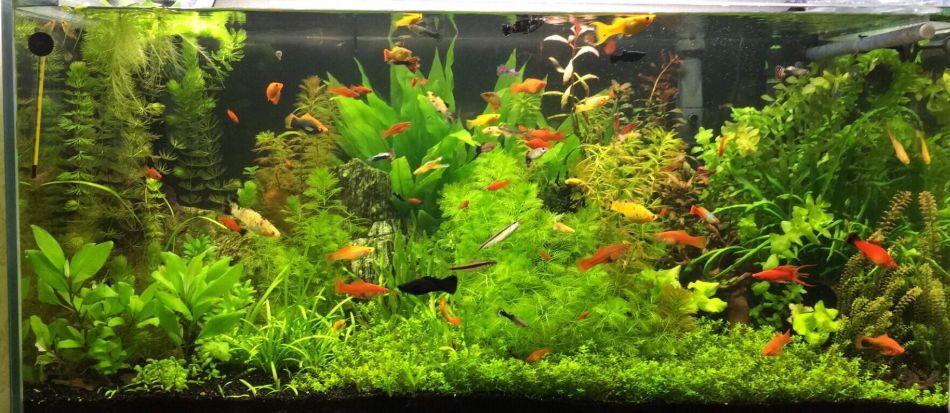
Research on biophilic design consistently shows that natural, organically complex environments produce stronger wellbeing effects than artificial or sparse ones. A planted aquarium — with live plants, natural substrate, driftwood, and river rocks — produces a more complete biophilic response than an equivalent tank with plastic plants and artificial decor.
Sound
A filter that creates gentle, consistent surface agitation without excessive noise contributes auditory therapeutic benefit. A completely silent tank (sealed lid with no surface movement) loses the auditory dimension. A very noisy, splashing filter creates its own stress. Gentle, consistent water movement sound is the therapeutic target.
Scale
The research supports larger tanks as more therapeutically effective in shared spaces — but the optimal size depends on the number of people being served and the viewing distance. A 90–150 litre tank is appropriate for a standard GP waiting room or dental practice. A 300–600 litre tank is appropriate for a hospital lobby or corporate reception. A 20–40 litre nano tank is appropriate for an individual desk or study space.
Maintenance
A poorly maintained therapeutic aquarium does not merely stop working — it actively reverses its effect. Dirty, cloudy water, sick or dying fish, and visible algae growth create an environment that clinical research associates with anxiety, disorder, and distress rather than calm. In a dental waiting room, a neglected tank does not reduce patient anxiety before procedures — it amplifies it. In an elderly care dining room, a tank with dead or visibly sick fish does not improve appetite and behaviour — it creates distress. In a corporate reception, a cloudy, algae-covered tank does not create a positive client impression — it signals neglect and disorder at the first point of contact with the business. We have assessed commercial spaces where a poorly maintained aquarium was actively harming the environment it was meant to improve — with no one having made the connection. A therapeutic aquarium that is not maintained to a consistently high standard is not a neutral object. It is a liability.
11. Aquarium Therapy, Vastu & Feng Shui — Where Three Sciences Converge
The convergence of aquarium therapy science with vastu shastra and feng shui is one of the most intellectually compelling aspects of ProHobby’s approach — and one of the reasons that combining these traditions produces recommendations more robust than any single framework alone.
On stress reduction and positive energy: Aquarium therapy documents measurable cortisol reduction and cardiovascular calming as effects of aquarium observation. Vastu shastra prescribes aquariums for generating positive prana and reducing negative energy in a space. Feng shui prescribes aquariums for creating smooth-flowing chi and preventing stagnation. Three frameworks, different vocabularies, describing what may be partially overlapping phenomena: the measurable calming and restorative effect of a well-maintained, living aquatic ecosystem in a human space.
On movement: All three frameworks emphasise the importance of moving water and active fish. Aquarium therapy research shows that fish density and activity level correlate with therapeutic benefit. Vastu holds that moving water represents flowing prosperity and that stagnant water represents stagnant fortune. Feng shui holds that circulating chi requires water in motion. The scientific and the traditional agree: a still, stagnant, inactive aquarium produces none of the effects — therapeutic, vastu, or feng shui — that a living, flowing, active one does.
On colour: Aquarium therapy neuroscience documents that vivid warm colouring (gold, orange, red) produces stronger attention capture and dopamine response. Vastu prescribes gold and orange fish as the most auspicious because they embody the fire element (wealth, vitality). Feng shui prescribes gold and red fish for wealth zone activation. The neurological and the energetic prescriptions align precisely.
On cleanliness and maintenance: Aquarium therapy research shows that dirty or neglected tanks create negative psychological responses. Vastu holds that cloudy water represents clouded finances. Feng shui holds that murky water is blocked chi. All three frameworks conclude: a neglected aquarium is worse than no aquarium.
The ProHobby synthesis: ProHobby designs aquariums that fulfil the therapeutic, vastu, and feng shui prescriptions simultaneously — because these three frameworks are largely describing the same phenomenon through different lenses. A tank that is large enough for fish to swim freely (therapeutic), placed in the North (vastu and feng shui), with vivid gold and orange fish (all three frameworks), live plants (all three), active filtration (all three), and maintained to a pristine standard (all three) is the most complete aquarium possible — serving the scientific, energetic, and spiritual dimensions of what a fish tank does in a human space.
12. ProHobby Therapeutic Aquarium Service
ProHobby designs, builds, and maintains therapeutic aquariums for the full range of commercial and residential contexts in which aquarium therapy is clinically and energetically relevant.
What distinguishes a ProHobby therapeutic aquarium
Evidence-informed design: Every therapeutic setup we design draws on the published research — fish density, species selection, colour composition, tank scale, plant selection, filtration sound, and viewing distance are all specified based on what the evidence shows produces the strongest therapeutic effect for the specific population being served.
Dual-science integration: For clients who also follow vastu shastra and feng shui, ProHobby integrates the therapeutic design with the directional and energetic prescriptions — producing aquariums that serve the scientific, vastu, and feng shui dimensions simultaneously. An aquarium in the North-East of a clinic waiting room, with 9 fish (8 gold, 1 black), live plants, natural substrate, and warm lighting serves therapeutic, vastu, and feng shui purposes at once.
Context-specific specification: The design parameters for a therapeutic aquarium in a paediatric dental clinic are different from those for a corporate reception, which are different from those for a memory care unit. We specify each setup for its specific human population and therapeutic goal.
Professional maintenance: A therapeutic aquarium that is not maintained is not therapeutic. ProHobby offers scheduled maintenance contracts for commercial and institutional therapeutic aquariums across Delhi NCR — ensuring that the aquarium continues to perform its therapeutic function consistently.
Contexts we serve
Homes and apartments · Corporate offices and co-working spaces · Hospitals and medical clinics · Dental practices · Psychiatric and mental health facilities · Palliative and hospice care · Schools and learning centres · Elderly care homes and retirement communities · Hotels and hospitality venues · Spas and wellness centres · Retail showrooms · Restaurants · Factories and industrial campuses
Book a therapeutic aquarium consultation or WhatsApp us: +91 81303 16186**
** NOTE: ProHobby’s vastu, feng shui, and therapeutic aquarium consultation visits are paid engagements and charges apply.
13. Frequently Asked Questions
What is aquarium therapy? Aquarium therapy is the deliberate use of fish tanks and aquatic environments to produce measurable physical and psychological therapeutic effects — including stress reduction, blood pressure lowering, improved concentration, mood improvement, and support for conditions including ADHD, Alzheimer’s disease, autism, chronic pain, and dental anxiety. It sits within the broader framework of Animal Assisted Therapy (AAT).
Is there scientific evidence for aquarium therapy? Yes — multiple peer-reviewed studies have documented measurable physiological effects. The University of Exeter and National Marine Aquarium research found blood pressure reductions of up to 7% with fully stocked tanks. A 2021 PLOS ONE controlled clinical trial (392 patients, University of Zurich) found measurable heart rate reduction in dental patients waiting with a fully stocked aquarium. Multiple studies in Alzheimer’s and dementia care have documented improved eating, reduced agitation, and better behaviour in residents exposed to aquariums.
How long do you need to watch fish for a therapeutic effect? Research suggests that measurable physiological effects begin within minutes of aquarium observation. The PLOS ONE dental study used a 20-minute observation period. Wallace Nichols’ research found significant blood pressure and heart rate reductions after 10 minutes. Regular daily exposure — even brief sessions of 10–20 minutes — produces sustained benefits over time.
What type of aquarium is most therapeutic? Fully stocked, richly coloured, actively maintained tanks produce the strongest therapeutic effects. Live plants, natural substrate, varied and active species, warm lighting, and gentle filter sound all enhance the therapeutic response. Larger tanks with higher fish numbers produce greater effects in shared spaces. Planted tanks with organic, natural aesthetics produce stronger biophilic responses than bare tanks with artificial decoration.
Can a small desktop aquarium be therapeutic? Yes — even small nano tanks (20–40 litres) on a desk or in a personal space produce measurable stress reduction and attention restoration effects. The scale of the effect is smaller than a large display tank, but the mechanism is the same. A well-planted, well-maintained nano tank with a Betta fish or small school of active nano fish is a legitimate therapeutic tool for individual use.
Is aquarium therapy the same as vastu shastra? No — they are different frameworks that arrive at some common prescriptions through different reasoning. Aquarium therapy is a scientific framework focused on measurable physiological and psychological effects. Vastu shastra is an ancient Indian spatial science concerned with elemental energy and directional harmony. Feng shui is an ancient Chinese system focused on chi flow and Bagua energy zones. All three recommend aquariums; all three emphasise active fish, moving water, clean maintenance, and vivid colouring — for different stated reasons that may be describing overlapping phenomena.
Which fish are most therapeutic? Active, vividly coloured, healthy fish produce the strongest therapeutic effects through attention capture and dopamine stimulation. Goldfish (orange, gold, red varieties), Koi, Betta, Guppy, and other active, brightly coloured species are excellent therapeutic choices. The vastu and feng shui recommendation of gold and orange fish is supported by the neuroscience of colour perception and attention.
Can aquarium therapy help with depression? Aquarium therapy provides supportive benefits relevant to depression — mild dopamine stimulation, serotonin-supportive calm environment, gentle purpose through fish care, and interruption of rumination through soft fascination. It is not a treatment for clinical depression and should not replace appropriate medical and psychological care. As a complement to treatment, it can meaningfully support daily wellbeing.
Do hospitals really use aquariums therapeutically? Yes — hospitals around the world have used aquariums in waiting rooms, patient areas, and clinical spaces for therapeutic benefit. The evidence base for this practice has strengthened significantly with the publication of multiple controlled clinical trials. ProHobby designs, installs, and maintains therapeutic aquariums for hospitals, clinics, dental practices, and other healthcare facilities across Delhi NCR.
How is a therapeutic aquarium different from a regular fish tank? A therapeutic aquarium is specifically designed to maximise the documented therapeutic effects of aquarium observation — through fish density, species and colour selection, plant composition, scale, filtration sound, lighting, and positioning for optimal viewing by the specific human population being served. It is maintained to a higher standard than a hobbyist tank. The design is informed by research rather than purely by aesthetic preference. ProHobby designs therapeutic aquariums distinct from — though often combining with — vastu and feng shui specifications.
Related reading: Vastu Shastra & Feng Shui Aquarium Guide · Custom Aquarium Setups · Desktop & Nano Aquariums · Planted Aquariums