
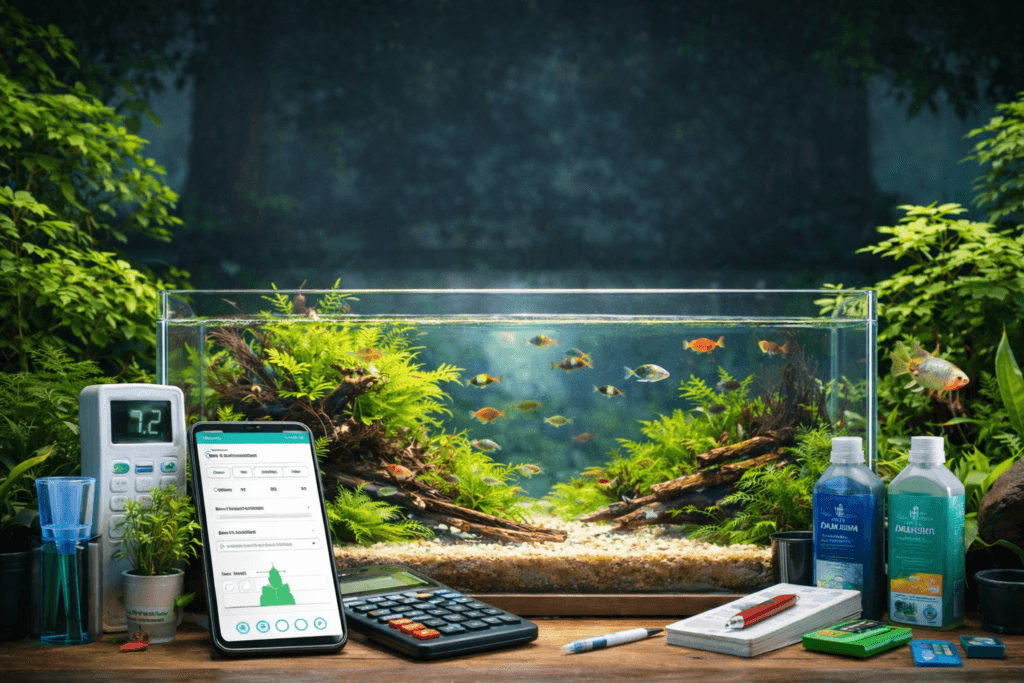
Aquarium Calculators & Tools — The Most Comprehensive System Planning Suite Online
Every aquarium failure has a calculation behind it. A tank that crashes three months after setup was almost certainly overstocked, underfiltrated, or built with glass that was too thin for the water column it was holding. A reef that never stabilises despite weekly maintenance is usually fighting tap water nitrate that the hobbyist never measured. A planted tank that burns through CO₂ with no visible benefit is losing it all through a spray bar aimed at the wrong angle. These are not bad luck — they are solvable problems, and they are solved with numbers before the water goes in, not with emergency interventions after something goes wrong.
ProHobby™ has built what we believe is the most comprehensive free aquarium calculator toolkit available in India, and among the most detailed available anywhere. Seven interconnected tools cover every critical planning variable: tank volume, fish stocking and compatibility, glass panel thickness and structural safety, water change scheduling and chemistry, fertilization dosing frequency and nutrient concentrations, lighting intensity and photoperiod length, and complete flow and filtration system design. Every tool outputs results in litres, US gallons and UK gallons simultaneously. Every cost figure has US Dollar, Pound Sterling, Euro and Indian Rupees as options.
No sign-up. No paywall. No ads.
Designing a successful aquarium isn’t guesswork — it’s about balance, precision, and system thinking. Whether you’re starting your first tank or refining an advanced setup, these tools help you make clear, confident decisions.
🧊 Tank Volume Calculator
Calculate the actual water volume in your aquarium.
Most tanks don’t hold their full labeled capacity due to:
- Substrate
- Hardscape
- Water level
Why this matters:
- Accurate dosing
- Correct stocking
- Proper filtration planning
🧮 Aquarium Stocking Calculator
Plan how many fish your aquarium can safely support.
Avoid:
- Overstocking
- Fish stress
- Sudden ammonia spikes
What it considers:
- Tank size
- Fish type & activity level
- Filtration efficiency
👉 Ideal for beginners and community tanks.
🧱 Aquarium Glass Thickness Calculator
Determine the correct glass thickness for building a safe aquarium
Avoid:
- Tank bowing
- Glass failure
- Leaks or catastrophic breakage
Calculates based on:
- Tank dimensions
- Safety factor
- Rimless vs braced design
👉 Essential for DIY builders and custom tanks.
💧 Water Change Calculator
Know exactly how much water to change — and how often.
Avoid:
- Overchanging (stress to fish)
- Underchanging (toxin buildup)
Calculates:
- Water change percentage
- Suggested frequency
🌊 Aquarium Water Flow & Filtration Calculator
Determine the optimal flow rate and filtration capacity for your aquarium.
Avoid:
- Under-filtration (waste buildup)
- Dead zones and poor circulation
- Excessive flow stressing fish
Calculates:
- Tank volume
- Filter flow rate (L/h or GPH)
- Turnover rate (x per hour)
👉 Best for all aquariums — freshwater, planted, and marine systems
🌿 Fertilizer Dosing Calculator
Get precise nutrient dosing for planted aquariums.
Avoid:
- Algae outbreaks
- Nutrient deficiencies
- Overdosing
Calculates:
- Macronutrients (NPK)
- Micronutrients
- Tank-specific dosing
👉 Ideal for planted tank hobbyists.
💡 Aquarium Lighting Calculator
Find the right lighting balance for your aquarium.
Avoid:
- Excess algae
- Weak plant growth
Helps determine:
- Photoperiod (daily lighting duration)
- Light intensity guidance
The Seven Calculators — What Each One Does and Why It Matters
Aquarium Tank Volume Calculator — Litres, US Gallons & UK Gallons
The volume figure printed on a tank box, or listed in a product description, is always the outer geometric volume — the number the manufacturer wants you to see. The actual water volume your fish live in is meaningfully smaller once you subtract glass thickness from all dimensions, substrate depth, headspace at the top to prevent jumping and allow gas exchange, and the displacement from rocks, driftwood, and equipment. For a typical 200-litre display tank, the real usable water volume is often closer to 155 to 165 litres. That 20 to 25 percent difference matters when you are calculating a medication dose, setting up an automatic top-off system, or trying to understand why your filter is struggling despite being rated for your tank size.
The ProHobby™ Aquarium Tank Volume Calculator supports seven tank shapes — rectangular, bow front, cylinder, sphere, hexagon, corner pentagon, and L-shape — because Indian hobbyists increasingly build and buy non-standard tanks. Dimensions can be entered in either inches or centimetres. Glass thickness presets cover all seven standard panel thicknesses from 5 mm nano tanks to 19 mm commercial-scale builds. Sliders for substrate depth, headspace, decoration volume, and equipment displacement give you usable water volume — the only figure that matters for fishkeeping decisions. The 25 percent water change volume displays instantly in all three unit systems so you know exactly how much to prepare each week. Filled tank weight in kilograms and pounds is shown as a practical floor-load reference.
Aquarium Stocking Calculator — 400+ Species, Live Compatibility Warnings, Bioload Scoring
The old one-inch-per-gallon rule is not just outdated — it is genuinely harmful. It treats a 10 cm oscar and a 10 cm school of neon tetras as producing identical biological load, which they do not by any measure. It ignores aggression, predation risk, schooling requirements, territorial behaviour, and the difference between a fish’s juvenile size at purchase and its adult size six months later. Most stocking guides online use this rule because it is simple to explain. We use it nowhere.
The ProHobby™ Aquarium Stocking Calculator uses a bioload-based scoring system applied to a database of 400+ freshwater, saltwater, and brackish species — one of the most extensive publicly available stocking databases in India. Each species carries individual values for adult size, waste production rate, minimum school size, aggression profile, and specific compatibility conflicts with named other species. The calculator checks your entire fish community simultaneously and flags problems in real time: fin-nipping species added to tanks with long-finned fish, predators paired with fish small enough to eat, territorial species in insufficient space, and schooling fish kept in groups below welfare minimums.
Freshwater categories include tetras, corydoras, plecos, cichlids, gouramis, killifish, loaches, oddballs, and all invertebrate groups. Saltwater categories include clownfish, tangs, angelfish, triggers, lionfish, groupers, gobies, wrasses, dottybacks, butterflyfish, and reef invertebrates. Brackish species including puffers, gobies, archerfish, and mudskippers are covered with their specific salinity requirements.
Aquarium Glass Thickness Calculator — Structural Safety for DIY and Custom Builds
More custom aquariums are built in India than almost anywhere else in the world, because local glass fabrication and silicone assembly is affordable and widely available. The problem is that most hobbyists and many local builders choose glass thickness by habit, rule of thumb, or guesswork rather than by structural calculation. A 60 cm tall tank exerts more than double the glass stress of a 30 cm tall tank of the same volume, because water pressure increases with depth and the bending stress on panels increases faster than the height alone. Getting this wrong does not produce a warning — it produces a failure, and glass failures are catastrophic, not gradual.
The ProHobby™ Glass Thickness Calculator covers all seven standard glass thicknesses from 5 mm to 19 mm, supports float glass, tempered glass, and cast acrylic, and applies a structural safety factor you control — from 2.5 at the minimum to 6.0 for very conservative builds, with 3.8 being the industry standard for DIY aquariums. Four bracing styles are modelled: rimless with no brace, euro-bracing with perimeter strips, a centre cross-brace, and full frame combining both. Each bracing configuration genuinely changes the structural analysis — a properly bonded centre brace halves the effective panel span and dramatically reduces stress on the front and back glass. The results panel shows the safety factor achieved for each of the seven thickness presets in colour-coded form so you can immediately see which option is adequate, borderline, or over-engineered for your specific dimensions. A complete five-panel cutting list — front, back, two sides, and bottom — generates automatically with exact dimensions in both millimetres and inches, ready to hand to your glass supplier.
Aquarium Water Change Calculator — Nitrate Chemistry, Dechlorinator Dose, RO Blending & Running Cost
Most Indian hobbyists performing regular water changes are unaware of one critical variable: municipal tap water in Delhi and many other Indian cities contains between 20 and 45 parts per million of nitrate. If your tap water reads 30 ppm and your tank reads 60 ppm, a 25 percent water change does not take you to 45 ppm — it takes you to 52.5 ppm, because the new water you add carries its own nitrate load. Your tank can never reach a nitrate level below your tap water level through water changes alone, no matter how large or how frequent. This is the hidden cause of persistent nitrate problems that no amount of filter maintenance or water change discipline will resolve.
The ProHobby™ Water Change Calculator has four modules that address the complete water management picture. The volume and schedule module calculates exact change volumes in litres, US gallons, and UK gallons, shows the weight of water being handled in kilograms, gives bucket count and per-trip weight with an ergonomic warning if a full bucket exceeds safe manual carry weight, and calculates your annual dechlorinator usage and cost in multiple currencies including Indian Rupees. The parameter planner module takes your current tank readings and your tap water readings for nitrate, phosphate, general hardness, carbonate hardness, and total dissolved solids, then shows projected post-change values for all five parameters simultaneously, with stability risk alerts if any parameter will shift by more than a safe margin in one change. The source water preparation module calculates dechlorinator dose for both chlorine and chloramine-treated water — a critical distinction because chloramine, used by many modern Indian utilities, does not dissipate by leaving water out overnight and requires chemical neutralisation. The module also calculates the exact blend of RO water and tap water needed to hit a target hardness and TDS level for soft water species. The top-off versus water change module shows clearly what each action does and does not do to your tank chemistry, and includes a saltwater evaporation and salinity drift calculator for marine hobbyists.
Aquarium Flow and Filtration Calculator — Turnover Rate, Head Pressure, Dead Zone Planner & Annual Running Cost
The flow rate printed on a filter or pump box is measured at zero resistance — no vertical rise, no elbows, no valves, no inline equipment. A pump rated at 2,000 litres per hour sitting in a sump 120 centimetres below the display tank, pushing water through three elbows and a check valve, may deliver 1,100 to 1,300 litres per hour in practice. Most Indian hobbyists buy a pump based on the box rating, install it, wonder why the tank is not performing as expected, and buy a larger pump — often repeating the same calculation error twice. The flow and filtration calculator eliminates this guesswork entirely.
Five modules cover the complete filtration system. The turnover and filtration module calculates the required filter flow rate adjusted for tank type, stocking density, feeding frequency, and filter type efficiency — a canister filter, a sump, a fluidised bed, and a hang-on-back filter all deliver different fractions of their rated flow as usable biological filtration, and the calculator corrects for each. A single-filter warning appears on tanks over 100 litres where one filter failure would cause a rapid ammonia spike before the hobbyist could respond. The head pressure module builds your complete plumbing layout fitting by fitting — vertical rise, pipe diameter, every elbow, ball valve, check valve, UV steriliser, chiller, and reactor — and shows you exactly how much flow you are losing and what pump rated flow you actually need. The dead zone planner generates a live colour-coded top-view map of your tank showing estimated flow coverage based on the positions of your filter return and up to three powerheads, with specific placement advice for your tank type. The filter media volume module calculates the minimum biological filter media needed based on your actual fish stock — comparing ceramic rings, sintered glass, K1 fluidised media, and bio-balls side by side. The running cost module accepts your electricity rate in Indian Rupees per unit and calculates daily, monthly, and annual costs for every pump and piece of electrical equipment in your system, including a DC pump saving estimator showing how much you would save by switching from traditional AC pumps to modern controllable DC equivalents.
Aquarium Fertilizer Dosing Calculator
Nutrient dosing in planted aquariums has two failure modes and they are mirror images: overdose and you feed algae; underdose and plants develop visible deficiency symptoms — yellowing new leaves, holes in foliage, stunted growth — that most beginners misidentify as disease or lighting failure. Both problems share the same cause: dosing by the generic starting recommendations on a fertilizer bottle rather than by the actual volume, plant load, and nutrient demand of a specific tank.
The ProHobby™ Fertilizer Dosing Calculator outputs precise dose volumes in millilitres for macronutrients — nitrogen as nitrate, phosphorus as phosphate, and potassium — and micronutrients including chelated iron, manganese, and trace elements, calibrated to your tank’s usable water volume and your chosen dosing method. The calculator supports Estimative Index, Perpetual Preservation System, and custom dosing regimes, adjusting dose size automatically for daily, every-other-day, or weekly schedules so the weekly total remains consistent regardless of frequency. It accounts for your CO₂ method and lighting level to adjust target concentration recommendations, flags when your setup creates conditions where fertilizer additions risk feeding algae rather than plants, and supports both liquid fertilizers entered as millilitres of a known concentration and dry fertilizers entered as grams of a known compound with cost-per-dose comparison between the two approaches.
Aquarium Lighting Calculator
The most reliable way to eliminate persistent algae in a planted tank is usually not to add more algae eaters, reduce fertilizer, or clean more frequently — it is to reduce the photoperiod. An aquarium light running for more hours than the tank’s biology can productively use does not grow better plants. It grows algae, because algae evolved to exploit any available light at lower CO₂ and nutrient thresholds than most aquarium plants require. The correct photoperiod is the one matched to your CO₂ method, plant density, and lighting intensity — not the maximum your timer allows.
The ProHobby™ Lighting Calculator covers planted freshwater tanks at all technology levels from no CO₂ through pressurised injection, reef systems from soft coral through SPS, and fish-only displays. Enter your tank dimensions, tank type, plant or coral categories, CO₂ method, and current photoperiod, and the calculator outputs a recommended daily duration, a relative intensity guide, a siesta scheduling option for tanks with active algae problems, a coral acclimation schedule for reef tanks, and specific alerts for the most common lighting errors in your setup type. Depth-adjusted PAR estimates based on your tank dimensions and light type give a practical intensity assessment without requiring specialist measurement equipment. Ambient window light input is included as a variable — in Indian residential and office settings, indirect natural light through windows is frequently a meaningful contribution to tank light exposure that generic lighting guides ignore entirely.
Why ProHobby™ Calculators Are Different From Everything Else Available Online
Every aquarium calculator on the internet does one thing: it multiplies a number by another number and shows you the result. Tank volume times a stocking multiplier. Tank gallons times a turnover multiplier. These tools exist in the dozens, and they all produce the same oversimplified output because they are all built on the same oversimplified assumptions.
The ProHobby™ calculators are built on the opposite principle. They start from the actual variables that determine whether a tank succeeds or fails. The bioload production rate of specific fish species, not abstract size proxies. The real head pressure loss of actual named fittings and inline equipment, not a generic percentage. Post-change chemistry projections that account for your tap water’s specific parameter levels, not just the dilution fraction. The minimum school size requirements of individual species, not a blanket community fish category. The structural safety factor of a specific glass thickness at specific panel dimensions with a specific bracing configuration, not a lookup table for common sizes only. Nutrient dose calculations that factor your CO₂ method and lighting level because fertilizer dosing cannot be separated from photosynthesis capacity. Lighting recommendations that account for ambient window light because in real Indian homes and offices this variable matters.
Results display in litres, US gallons, and UK gallons simultaneously throughout — every output, every reference table, every scenario — because Indian hobbyists work across all three systems depending on where their equipment was manufactured and where their fishkeeping education came from. Running costs display in Indian Rupees, US Dollars, Pounds Sterling, and Euros as selected — because the hobby is global, but household electricity bills are local.
No tools on the internet do all of this together in a single integrated toolkit.
How to Use the Seven Calculators as a Complete Planning System
Each calculator works as a standalone tool for a specific question. Used together in sequence they form a complete planning system that eliminates the most common causes of aquarium failure before the water goes in.
Start with the Tank Volume Calculator to establish your true usable water volume — this number feeds into every other calculation. Use the Stocking Calculator to plan your fish community against that volume, checking bioload, compatibility, and school sizes before purchasing anything. If you are building a custom tank, run the Glass Thickness Calculator before ordering glass — the cutting list it generates goes directly to your fabricator. Use the Water Change Calculator to establish your maintenance schedule, check whether your tap water nitrate will limit your chemistry targets, and calculate your dechlorinator dose and annual cost. Use the Flow and Filtration Calculator to select and size your return pump and powerheads based on real delivered flow after head pressure losses, and to verify your biological filter media is adequate for your stocking level. If you are running a planted tank, use the Fertilizer Dosing Calculator to establish a dose regime matched to your plant load, water volume, CO₂ method, and dosing frequency. Use the Lighting Calculator to verify your photoperiod and intensity are matched to your biology — the most overlooked planning variable and the most common cause of ongoing algae problems in otherwise well-managed tanks.
Frequently Asked Questions About the ProHobby™ Aquarium Calculators
Are these calculators suitable for Indian tap water and Indian conditions?
Yes, and this was a specific design consideration. The water change calculator’s parameter planner accounts for your actual tap water readings for nitrate, phosphate, GH, KH, and TDS — because Indian municipal water varies significantly by city and season, and in many parts of Delhi NCR and other major cities, tap water nitrate alone can make standard water change schedules ineffective. The dechlorinator module distinguishes between chlorine and chloramine treatment because Indian utilities increasingly use chloramine, which does not dissipate by leaving water out and requires a different treatment approach. The running cost calculators default to Indian Rupees and are designed to reflect electricity rates in the Indian range. The lighting calculator includes ambient window light as a variable because in Indian homes and offices this is a real contribution to tank light exposure rather than a negligible factor.
Do I need to use all seven calculators together?
No. Each tool is standalone for its specific purpose. If you are planning a new custom build, the glass thickness and volume calculators are the natural starting points. If you are troubleshooting persistent water quality issues in an existing tank, the stocking calculator and water change parameter planner are most relevant. If you are designing a sump system, the flow and filtration calculator’s head pressure module answers your pump sizing question. If your planted tank has ongoing algae problems, the lighting calculator is the first place to look. If your plants are showing deficiency symptoms, the fertilizer dosing calculator gives you the specific dose your tank needs. Used together they form a complete planning system — used individually they each answer specific questions.
Are these tools accurate enough for professional and commercial use?
TThe volume, glass thickness, and flow and filtration calculators are built on the same engineering principles used by professional aquarium builders. The structural safety factor modelling in the glass calculator, the head pressure loss calculations in the flow calculator, and the bioload-adjusted turnover recommendations in the filtration module all reflect current practice for professional installations. For tanks over 400 litres or taller than 80 centimetres we recommend consulting a structural engineer before finalising glass specifications — the calculator provides a sound starting point and helps you have an informed conversation with your fabricator. The stocking database of 349 species reflects the same bioload-based methodology used by serious hobbyists and professional aquarists rather than the oversimplified rules of thumb found in most online resources.
How does the stocking calculator handle Indian fish species and the Indian aquarium trade?
The 350+ species database covers the large majority of species commonly available in the Indian aquarium trade, including brackish species widely kept in India — figure-eight puffers, archerfish, mudskippers, Indian glass perch, Colombian shark catfish. Freshwater species common in Indian fish markets including various cichlid types, corydoras, plecos, loaches, rainbowfish, killifish, and all common invertebrates are included with species-specific bioload values and compatibility data. The database does not yet cover every wild-caught local species available in regional Indian fish markets, which stock an enormous variety including many native Indian river species not commonly found in the global hobby literature — this is an area we are actively expanding.
Can the glass thickness calculator be used for tanks built by local fabricators in India?
Yes, this is precisely the scenario it was designed for. The calculator generates a complete five-panel cutting list with exact dimensions in millimetres — the unit Indian glass suppliers work in — accounting for your chosen assembly style, glass thickness, and silicone joint gap. The safety factor slider allows you to set a more conservative target when using glass from a supplier whose quality consistency you are less certain of, or a standard target when working with a known quality supplier. Float glass, which is what the large majority of Indian fabricators use, is the default material in the calculator.
What is the difference between the water change volume result and the usable water volume from the volume calculator?
he volume calculator’s usable water figure is the water volume your fish actually live in, after subtracting glass thickness, substrate, headspace, and decoration displacement from the gross tank volume. This is the figure to use for stocking calculations, medication dosing, and fertilizer dosing. The water change calculator then takes this usable volume and calculates the specific amount to remove and replace based on your target change percentage — for example 25 percent of 165 litres usable volume is 41.25 litres per change. Always use usable water volume as your input to the water change calculator rather than the nominal tank size to ensure your change volumes and dechlorinator doses are accurate.
Why does my tap water nitrate matter so much for water changes?
Because water changes are a dilution process, not a removal process. When you do a 25 percent water change, you replace 25 percent of your tank water with tap water. The resulting nitrate level is a blend of 75 percent of the old tank water and 25 percent of the tap water. If your tap water contains 30 parts per million of nitrate, every change you do pulls your tank nitrate toward 30 ppm — it can never go below that level no matter how large or frequent your water changes. Many Indian hobbyists perform diligent weekly changes and cannot understand why their nitrate stays persistently elevated. Testing tap water for nitrate is the first diagnostic step for any tank with nitrate that does not respond normally to water changes.
How does the fertilizer dosing calculator handle the difference between liquid and dry fertilizers?
The calculator accepts liquid fertilizers as millilitres of a known concentration — you enter the nutrient content of your specific product in grams per litre — and dry fertilizers as grams of a known compound. For common dry fertilizer compounds used in the hobby such as potassium nitrate, monopotassium phosphate, potassium sulphate, and chelated trace mixes, the calculator includes the relevant elemental content automatically. It outputs the dose in whichever format you are working with and shows a cost-per-dose comparison between equivalent liquid and dry approaches so you can make an informed decision about which format suits your budget and maintenance routine. Dry fertilizers are typically significantly more cost-effective per equivalent dose than branded liquid products, particularly for larger tanks.
Why does the lighting calculator ask about window light?
Because in many Indian homes and offices, indirect natural light through windows makes a real contribution to tank light exposure — especially in south-facing rooms or during summer months when ambient light intensity is high. Generic lighting guides assume the tank is in a controlled environment where the only light source is the tank light itself. In practice, a tank near a window receiving several hours of indirect daylight per day is receiving additional photosynthetically active radiation that adds to the total daily light dose. Including this in the calculation prevents the common situation where a correctly programmed tank light is producing algae because the total light exposure — artificial plus ambient — exceeds what the tank’s biology can productively use.
What does the dead zone planner in the flow and filtration calculator actually show?
The dead zone planner generates a colour-coded top-view map of your tank based on the positions of your active flow sources — filter return outlet and up to three powerheads. Areas shown in green are receiving adequate water movement and will not accumulate detritus. Areas shown in amber are receiving reduced flow and may collect fine particles over time. Areas shown in red are effectively stagnant under your current equipment layout and are likely to accumulate waste, develop anaerobic conditions, and produce the hydrogen sulphide and cyanobacteria that indicate a dead zone. The map updates instantly as you change the position or number of active flow sources, letting you optimise powerhead placement before buying equipment or repositioning anything in an established tank.
From Planning to Reality — ProHobby™ Custom Aquarium Builds in Delhi NCR
These calculators exist because we believe accurate planning prevents the failures that end aquarium hobbies. A tank that is correctly stocked, correctly filtered, structurally sound, chemically managed, and lit appropriately for its biology will stabilise naturally and stay stable with routine maintenance. A tank that was assembled without that planning will require constant intervention and will eventually fail regardless of how much effort goes into managing it reactively.
If your planning is pointing toward a system that would benefit from professional design and installation — a large reef, a complex planted display, a brackish biotope, a paludarium, or any installation where long-term stability matters more than initial cost — ProHobby™ custom aquarium builds in Delhi NCR start where these tools end. We use the same system-first principles that power every calculator on this page, applied to your specific space, water supply, maintenance availability, and aesthetic vision. Every ProHobby™ system is designed as an integrated biological ecosystem, not assembled from a shopping list.
👉 Explore ProHobby’s custom aquarium solutions tailored to your goals!