
By ProHobby™ | Ecological Systems Authority
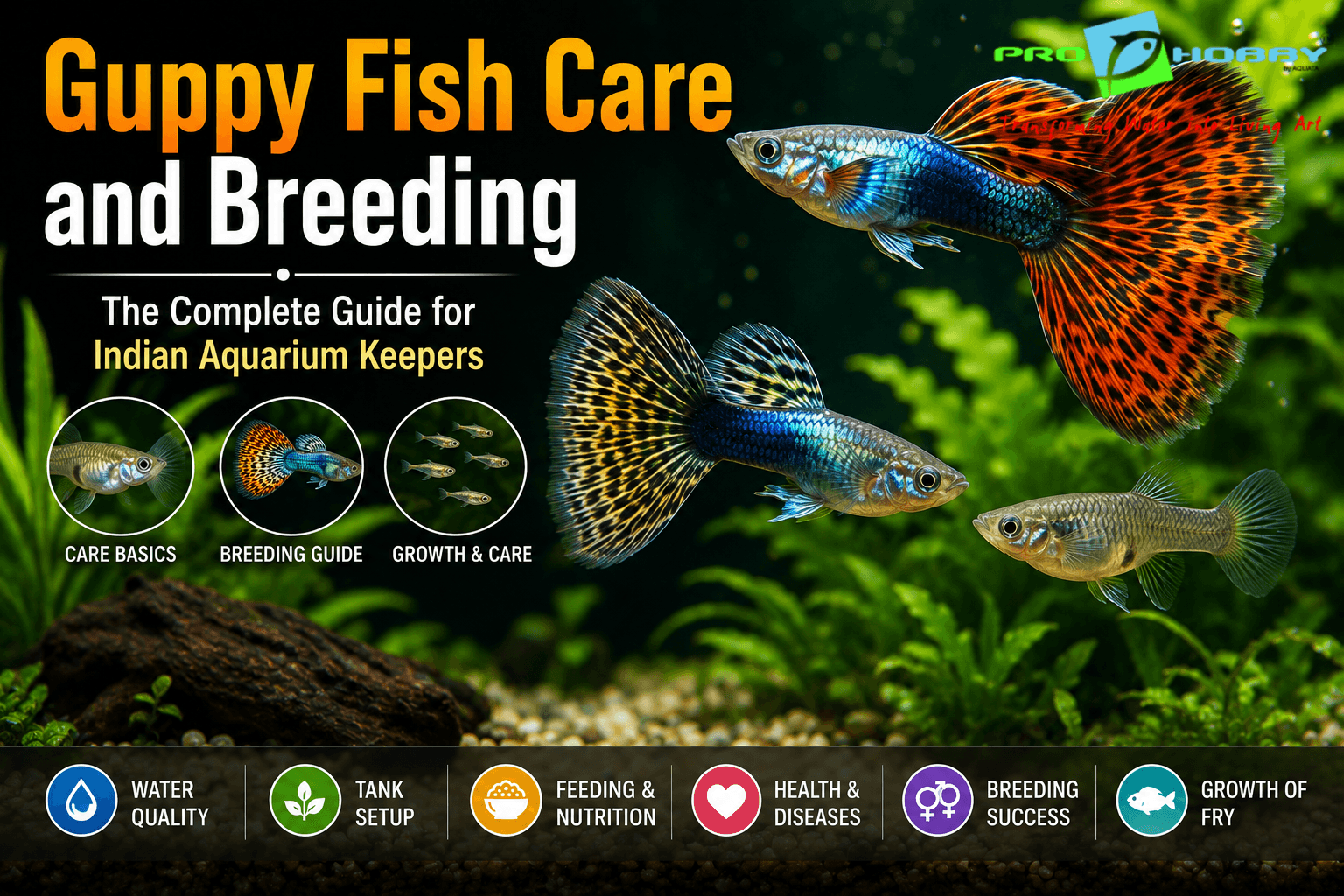
Guppies occupy a unique position among aquarium fish kept in India: they are one of the few species that genuinely thrives in Delhi NCR’s hard, alkaline tap water without modification. Wild guppies originate from hard, alkaline Caribbean and South American freshwater systems — the mineral-rich water of the Indo-Gangetic Plain suits them well. For Indian hobbyists in hard water regions, guppies are the path of least resistance — beautiful, active, prolific breeders, and naturally suited to local conditions.
Natural Habitat and Biology
Guppies (Poecilia reticulata) originate from Trinidad, Barbados, Venezuela, and parts of northeastern South America — tropical freshwater streams and coastal drains ranging from slightly brackish to fresh. Wild guppies live in hard, alkaline conditions (pH 7.0–8.5, GH 10–20 dGH) closely resembling Indian municipal water. They are livebearers — females give birth to free-swimming fry.
Tank Requirements
Minimum size: 40 litres for a small group. 60–80 litres allows a stable colony with room for fry survival.
Male to female ratio: Critical — minimum 1:3 male to female, ideally 1:4. A single male with one female stresses the female to death. Alternatively, keep all males (display group) or all females (peaceful, less colourful).
Filtration: Sponge filter preferred. Guppy fry are small enough to be drawn into or injured by power filter intakes.
Water Parameters
| Parameter | Target Range |
|---|---|
| Temperature | 24–28°C |
| pH | 7.0–8.0 |
| KH | 4–10 dKH |
| GH | 8–16 dGH |
| Ammonia | 0 ppm |
| Nitrite | 0 ppm |
| Nitrate | Below 20 ppm |
Delhi NCR tap water (pH 7.6–8.2, KH 8–12, GH 10–16 dGH) falls within ideal guppy parameters. Complete Aquarium Water Chemistry Guide.
Plants for a Guppy Tank
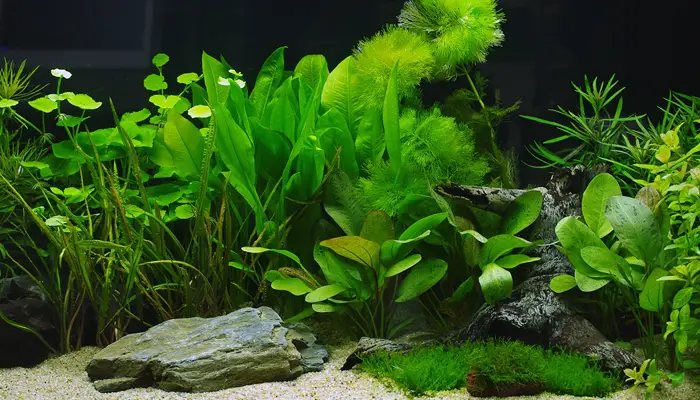
Plants are functional requirements for guppy keeping, not decorative options — they provide female refuge from male harassment and fry survival cover.
Best plants for guppy tanks:
- Java moss: The most important guppy plant. Dense mats provide fry hiding cover that passive survival depends on. Floating or attached to hardscape.
- Hornwort: Fast-growing, excellent nitrate absorption, provides mid-water cover. Can be floated or loosely weighted.
- Floating plants (water lettuce, frogbit, duckweed): Surface cover for fry and refuge for females. Duckweed in particular grows fast enough to provide genuinely dense cover rapidly.
- Guppy grass (Najas guadalupensis): Named for its use in guppy breeding. Very fine, dense growth that fry navigate through but adults cannot easily search.
- Amazon sword: Broad leaves provide resting cover for females.
A guppy tank without plants — particularly without floating plants or Java moss — produces very low fry survival rates and stressed females. Dense planting is the passive fry survival strategy that reduces the need for breeder boxes.
Guppy tanks with shrimp: Java moss and fine-leafed plants also benefit shrimp. Guppies and shrimp coexist in planted tanks — adult shrimp are not eaten, though shrimp fry may be. Dense planting provides the same fry/juvenile shrimp protection it provides for guppy fry.
Male vs Female Guppy — How to Tell Them Apart
This is one of the most important identification skills in guppy keeping, directly affecting population management.
| Feature | Male | Female |
|---|---|---|
| Size | Smaller (3–4 cm) | Larger (4–6 cm) |
| Colour | Vivid, coloured tail and body | Duller, transparent or pale tail |
| Tail | Large, ornate — the variety’s defining feature | Small, simple |
| Anal fin | Modified into gonopodium — thin, pointed | Fan-shaped |
| Abdomen | Flat | Rounded; gravid spot visible when pregnant |
The gonopodium (modified anal fin) is the definitive male identifier and is visible from approximately 4–6 weeks of age. Before this age, all guppies look female.
Feeding
Primary: High-quality micro-pellets or crushed flake for tropical fish. Supplements: Frozen baby brine shrimp, daphnia, micro-worms — essential for colour development and breeding conditioning. Frequency: 2–3 times daily, only what is consumed in 1–2 minutes.
Guppy not eating: Temperature below 22°C suppresses appetite. Water quality failure — test ammonia and nitrite. Disease — velvet, wasting, or parasitic infection. A guppy that was eating and suddenly stops should prompt water testing immediately.
Guppy Breeding
Guppies breed without intervention if male and female coexist. The challenge is managing the resulting population.
Gestation: 26–31 days at 26–28°C.
Identifying pregnancy: Gravid spot darkens and enlarges progressively. Abdomen becomes boxy rather than smoothly rounded. Female seeks hiding before birth.
Fry survival options:
- Dense planting (passive — lower survival rate but zero intervention)
- Breeder box (female isolated for birth, then returned — moderate survival)
- Separate fry tank (best survival, requires management)
Fry care: Baby brine shrimp or commercial fry food from day one. Ammonia management critical — 10–15% daily water changes using the Water Change Calculator.
Population control: Guppies overpopulate rapidly. Options: all-male tank, sell/give away excess fish, allow natural predation in a community tank, separate male and female colonies. An unmanaged guppy population in a small tank leads to water quality collapse from overstocking.
Guppy Lifespan
1.5–3 years for most guppies. Wild-type and domestic strains live toward the longer end; heavily selected fancy strains toward the shorter end. Females typically live slightly longer than males.
Colour Change — What It Means
Fading colour in males: Stress (parameters, male competition, temperature), illness, or age. Test water first. Clamped fins: Stress or early disease — observe closely and test water. Female darkening significantly at gravid spot: Normal — approaching birth. White or grey patches on body: Ich, Columnaris, or fungal infection — examine closely.
Fancy Guppy Varieties
Moscow blue, cobra, tuxedo, snakeskin, delta tail, halfmoon tail, sword tail. Heavily selected fancy strains have compromised immune function — locally bred fish are more robust than imported show strains.
Guppy price in India: Common guppies ₹20–80. Locally bred fancy guppies ₹80–300. Imported show-quality strains ₹300–1,500+.
Common Health Issues
Fin rot: Long fins susceptible to bacterial erosion. Fin Rot — Treatment Guide. Ich: Rapid in small bodies — treat immediately. Ich — Treatment Guide. Velvet: Extremely fast in guppies — emergency treatment. Velvet Disease. Camallanus worms: Internal worms causing wasting. Whole-tank treatment required. Camallanus Worms — Treatment Guide.
All treatment through a hospital tank.
Frequently Asked Questions
How do I breed guppies? Maintain a 1:3 male to female ratio in a planted tank with dense Java moss or floating plants. Guppies breed without intervention. Dense planting provides fry cover. For controlled breeding, isolate pregnant females before birth.
How do I tell male from female guppies? Males are smaller with vivid colours and a pointed gonopodium (modified anal fin). Females are larger, duller, with a fan-shaped anal fin and a visible gravid spot. Sexes are distinguishable from approximately 4–6 weeks of age.
How do I control guppy population? Keep an all-male tank, separate males from females into different tanks, sell or give away excess fish, or allow natural predation in a community tank with compatible larger fish.
Can guppies live with shrimp? Yes in a planted tank. Adult shrimp are too large to be eaten by guppies. Juvenile shrimp and shrimp fry are at risk — dense planting provides protection. Java moss is particularly effective for both guppy fry and shrimp juveniles.
What is guppy lifespan? 1.5–3 years. Heavily selected fancy strains tend toward the shorter end; domestic and wild-type strains toward the longer end.