
By ProHobby™ | Ecological Systems Authority
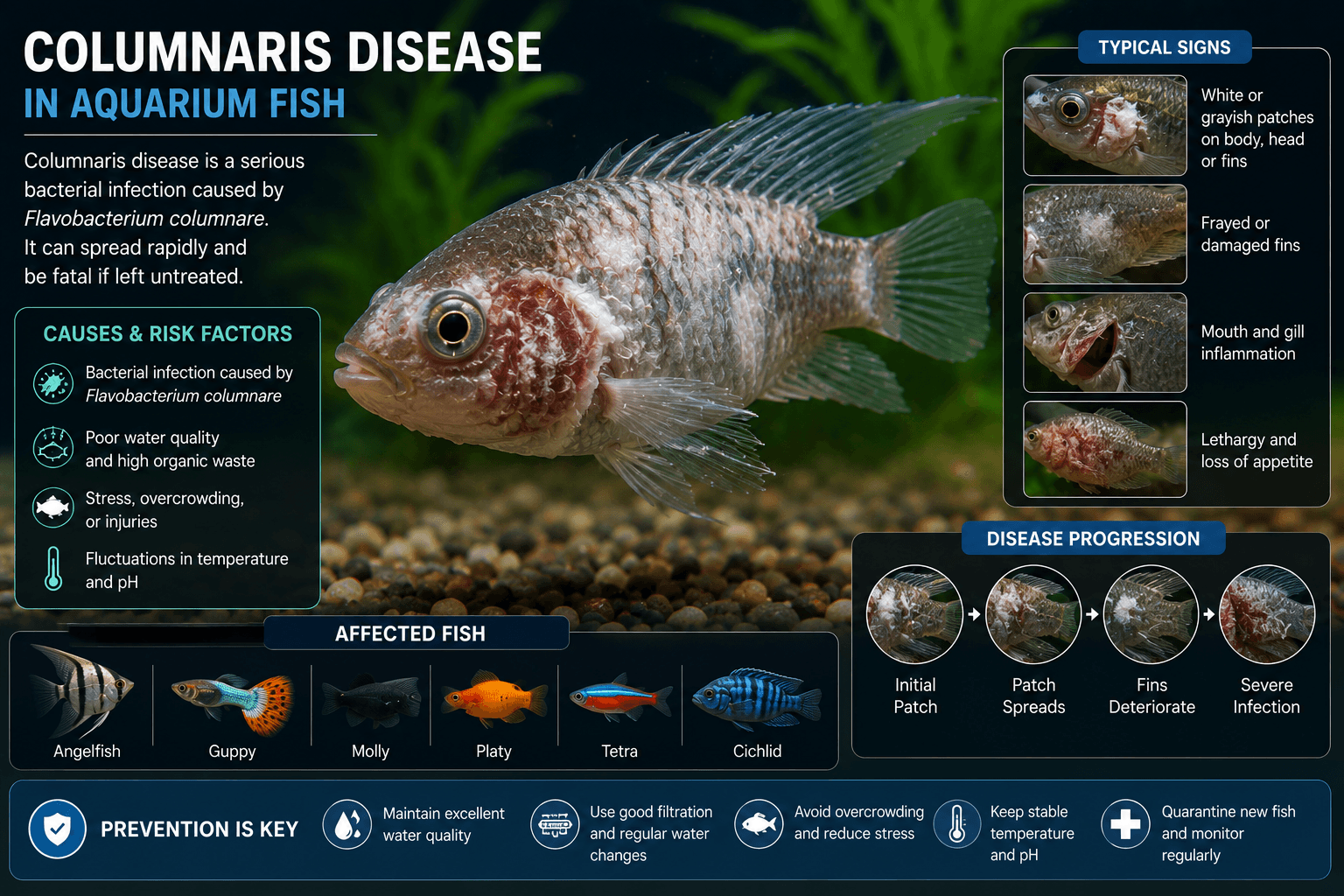
Columnaris is responsible for more mismanaged fish deaths than almost any other aquarium disease — not because treatment is difficult, but because the disease consistently mimics fungal infection and is routinely treated with antifungals that have no effect on bacteria. The cottony-white patches, the fraying edges, the grey-white erosions on the body surface: these look like Saprolegnia mould. They are not. They are Flavobacterium columnare, a gram-negative bacterium that requires gram-negative antibiotics and is completely unresponsive to every antifungal product on the market.
This misdiagnosis is the central problem with columnaris management. A hobbyist who diagnoses “fungal infection” and treats with methylene blue or pimafix typically sees two to seven days of apparent stability followed by rapid deterioration and death — the antifungal did nothing while the bacteria continued advancing, and by the time the diagnosis is corrected the infection has progressed beyond what treatment can reverse. At warm water temperatures (above 28°C), columnaris can kill fish within 24–48 hours of first visible symptoms. It is among the fastest-progressing bacterial diseases in the freshwater hobby.
What Columnaris Is
Flavobacterium columnare is an aerobic gram-negative bacterium that is ubiquitous in aquatic environments and present at subclinical levels in most aquarium fish populations. It establishes disease when immune function falls — the same stress-immunity dynamic that underlies fin rot, popeye, and dropsy. What distinguishes columnaris from those conditions is the speed of progression and the specific tissue tropism: F. columnare has a strong preference for gill tissue and body surface epithelium, producing distinctive lesions that are rapidly identifiable once the pattern is recognised.
The bacterium produces characteristic columnar aggregates (visible under microscopy as stacks of cells) — hence the name. These aggregates, combined with the progressive tissue necrosis, produce the white-grey cottony appearance that causes the fungal misdiagnosis.
Recognising Columnaris — The Key Presentations
Saddleback lesion: A pale, white-grey or yellowish patch across the dorsal surface, typically spanning the dorsal fin base. The lesion has defined edges and a characteristic saddle-like shape across the fish’s back. This is the most pathognomonic presentation — nothing else produces quite this pattern. By the time the saddleback is visible, infection is already moderately advanced.
Mouth rot (cotton mouth): White or grey necrotic tissue at the mouth — frayed, cottony-looking, sometimes with a visible haemorrhagic margin. This presentation is most commonly confused with fungal infection or physical mouth injury. Fish with mouth rot struggle to eat, and the lesion advances rapidly toward the jaw tissue and beyond if untreated.
Fin involvement: White or grey erosion at fin edges, often with a halo of reddened tissue at the margin between living and necrotic tissue. Distinguished from bacterial fin rot by the more cottony appearance and the faster rate of progression.
Gill involvement: Gill tissue becomes pale, then necrotic. Fish with significant gill involvement show respiratory distress — surface gasping, rapid gill movement, clamped fins — without other visible external lesions. This presentation is hardest to diagnose without physical examination of the gill tissue.
Distinguishing columnaris from fungal infection:
| Feature | Columnaris | Saprolegnia (Fungus) |
|---|---|---|
| Appearance | Flat, attached, slight texture | Three-dimensional fluffy tufts extending outward |
| Colour | White-grey to yellowish | White or grey |
| Location | Body surface, fins, mouth, gills | Typically at wound sites |
| Progression | Rapid — hours to days | Slower — days to weeks |
| Response to antifungal | None | Effective |
| Response to gram-negative antibiotic | Effective | None |
Distinguishing columnaris from ich: Ich produces discrete 1mm white spots distributed across the body surface and fins. Columnaris produces patches — irregular, erosive, typically at fin edges, mouth, or dorsal surface. The progression speed also distinguishes them: ich rarely kills in under a week; columnaris can kill in 24–48 hours at warm temperatures.
Temperature and Columnaris Virulence
Temperature dramatically affects columnaris virulence. F. columnare has optimal growth at approximately 25–32°C — the range used for most tropical aquariums. At 28°C and above, the disease can progress from first visible lesions to death in 24–48 hours. At cooler temperatures (below 20°C), progression slows significantly, giving more treatment time.
This has practical implications for treatment response: a fish showing early columnaris lesions at 30°C has much less time before the infection becomes irreversible than the same fish at 24°C. Treatment at warm temperatures is an emergency requiring immediate action, not a scheduled treatment course.
The temperature-virulence relationship also means that attempts to raise temperature as a general disease response (as is appropriate for ich) are contraindicated for columnaris — raising temperature accelerates bacterial growth and worsens the prognosis.
Treatment
Immediate isolation in a hospital tank is critical. Columnaris spreads between fish through the water column, and an infected fish in the display tank is a source for other fish. Remove the infected fish before beginning treatment.
Correct antibiotic selection is the single most important management decision. Columnaris requires antibiotics effective against gram-negative bacteria:
- Kanamycin sulphate at 40–50mg/L
- Nitrofurazone at manufacturer’s recommended dose
- Tetracycline (less reliable but available)
- Trimethoprim-sulfa combination products
Do not use: erythromycin (primarily gram-positive spectrum), pimafix, melafix, methylene blue, or any product marketed as antifungal. These have no activity against F. columnare and waste the critical early treatment window.
Remove activated carbon before treatment. It adsorbs antibiotics, making them ineffective. Monitor ammonia and nitrite daily throughout the antibiotic course — antibiotics damage biological filtration. Manage water quality as covered in How to Clean an Aquarium Filter Without Killing Bacteria and monitor with the protocols in Ammonia in Aquariums.
Salt at 1–2g/L reduces osmotic stress on damaged epithelium and has mild antibacterial properties as an adjunct. Not a replacement for antibiotics.
Treatment duration: Minimum 7–10 days of antibiotic treatment. Early visible improvement (lesion colour change from active grey-white to healing pink-red, cessation of lesion expansion) should be seen within 3–4 days of correct antibiotic treatment. If no improvement is visible within 4–5 days, the antibiotic may be ineffective against this strain — columnaris shows geographic variation in antibiotic sensitivity.
After Treatment — Preventing Recurrence
Columnaris recurrence is almost always a water quality signal. The bacteria are permanently present; they establish disease only when immunity fails. The cortisol-immunity mechanism — why any environmental stressor creates the window for Flavobacterium columnare to establish — is in The Science of Fish Stress. Quarantine all new fish before main tank introduction — new arrivals with subclinical columnaris are the primary introduction vector. The quarantine protocol is in Quarantine and Biosecurity in Aquariums. In warm months when tank temperature exceeds 28°C, columnaris virulence increases dramatically — Aquarium Water Temperature in Indian Summer covers temperature management.
Any tank experiencing columnaris should be audited for:
Water quality — ammonia, nitrite, pH stability, and KH depletion. The Complete Aquarium Water Chemistry Guide provides the diagnostic framework. Any parameter consistently outside optimal range is chronic immune suppression made measurable.
Overcrowding and aggression — territorial stress is a sustained cortisol elevation that chronically suppresses immune function. The Quarantine vs Medication framework identifies whether the problem is environmental or truly pathogenic.
Frequently Asked Questions
Why isn’t the antifungal medication working? Because columnaris is a bacterium, not a fungus. The cottony appearance is the consistent source of misdiagnosis. Antifungals have no activity against Flavobacterium columnare. Stop antifungal treatment immediately and switch to a gram-negative antibiotic — kanamycin or nitrofurazone. Every day on the wrong treatment is disease progression.
How do I tell columnaris from fin rot? Both are bacterial diseases caused by gram-negative opportunists. Columnaris tends to progress faster, produce a more cottony/patchy appearance rather than simple fin margin erosion, and often appears on the body surface (especially the saddleback pattern) rather than confined to fin edges. Both respond to gram-negative antibiotics. When in doubt, treat as columnaris — the more urgent condition.
Can columnaris kill fish overnight? Yes, at temperatures above 28°C. The 24–48 hour mortality window at warm temperatures is well-documented. Any fish showing early columnaris symptoms at tropical temperatures should be isolated and antibiotic treatment begun the same day. should be isolated and antibiotic treatment begun the same day.