
By ProHobby™ | Ecological Systems Authority
Dropsy is the diagnosis aquarium hobbyists dread most — not because it is always fatal, but because by the time most hobbyists recognise it, it usually is. The characteristic pinecone appearance of raised scales surrounding a swollen body has become synonymous with “fish that cannot be saved,” and while this is not universally true, it is true often enough that any guide to dropsy must begin with honesty about prognosis rather than a treatment protocol presented as though survival were the expected outcome.
This guide covers what dropsy actually is, why the pinecone stage represents severe internal damage rather than the beginning of a treatable condition, what realistic treatment options exist, and when humane euthanasia is the kinder choice. It also covers early-stage dropsy — fluid accumulation before full scale protrusion — where the prognosis is meaningfully better and treatment more likely to succeed.
Table of Contents
- What Dropsy Actually Is — Symptom, Not Disease
- What Causes Dropsy — The Underlying Conditions
- Why Dropsy Is Not Contagious
- Recognising Dropsy — Early vs Late Presentation
- The Honest Prognosis — Why Pinecone Stage Survival Is Low
- Treatment — What Actually Helps
- Epsom Salt — Mechanism and Protocol
- Antibiotic Treatment — When and What
- Supportive Care — Water Quality and Nutrition
- When to Consider Euthanasia
- Preventing Dropsy
- Frequently Asked Questions
1. What Dropsy Actually Is — Symptom, Not Disease
Dropsy is not a disease. It is a clinical syndrome — a set of visible symptoms caused by fluid accumulation within the fish’s body cavity and tissues. The medical term is oedema or ascites. The fluid accumulates because the kidneys have failed or are failing to regulate the fish’s internal fluid balance effectively.
A healthy fish maintains its internal fluid composition against its environment through constant active work at the gills and kidneys — the osmoregulation process covered in Aquarium GH — General Hardness Complete Guide. When kidney function is severely impaired, this regulation fails. Fluid drawn in from the surrounding water through osmosis cannot be expelled. It accumulates in the body cavity (producing the swollen abdomen) and eventually in the tissue spaces between cells (producing the scale protrusion, as fluid pressure pushes scales away from the body surface).
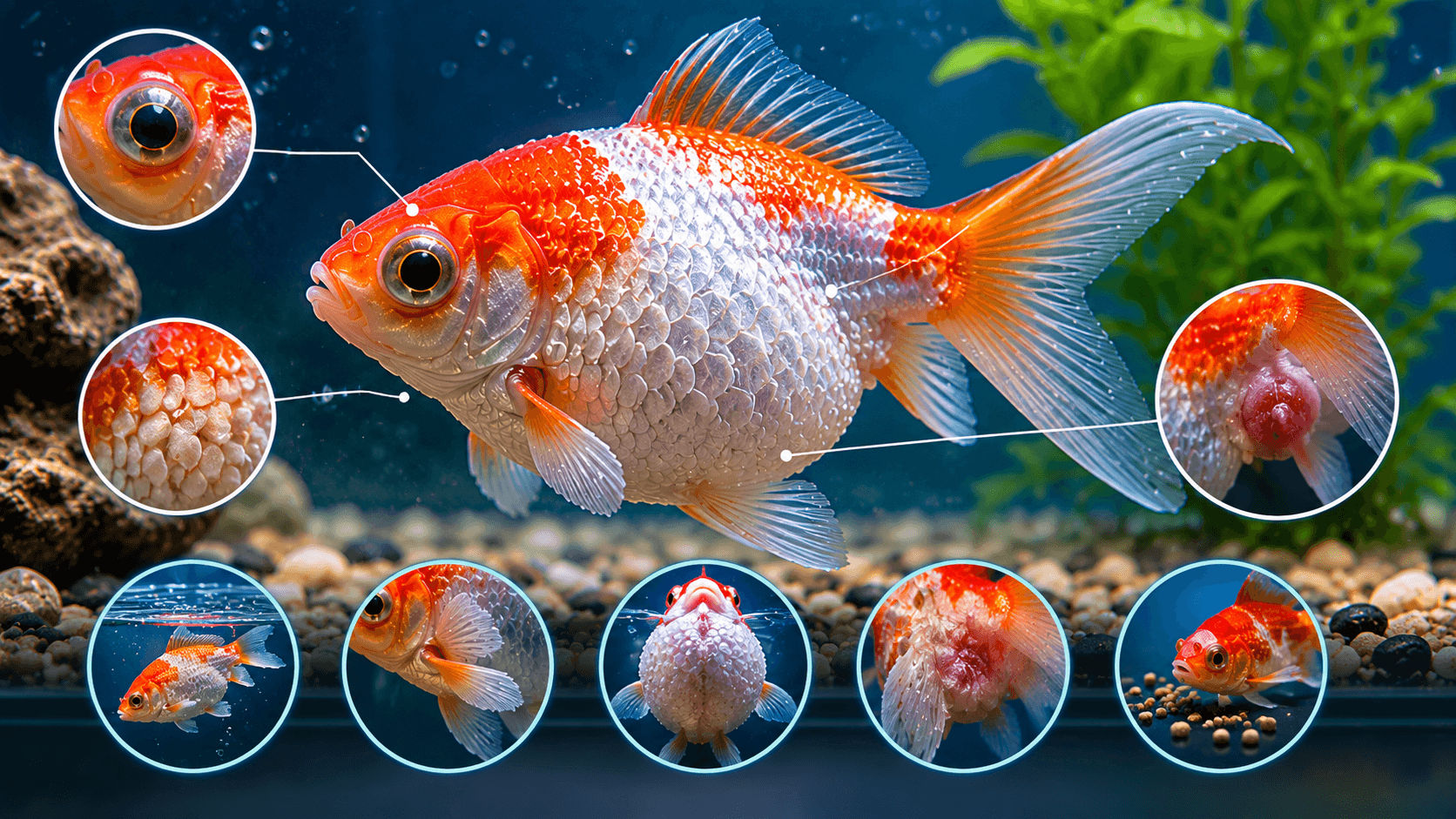
The pinecone appearance — scales raised uniformly around a swollen body, visible when viewed from above — is not an early sign. It is the visible endpoint of a process that has been progressing internally for some time before the scales become visibly elevated. By the time scales are clearly pineconing, the fish has already experienced significant internal organ damage.
2. What Causes Dropsy — The Underlying Conditions
Because dropsy is a symptom rather than a disease, it has multiple possible causes. Identifying the cause determines whether treatment is likely to succeed.
Bacterial infection — the most common cause Aeromonas hydrophila and related gram-negative bacteria are the most frequent cause of dropsy in aquarium fish. These are the same opportunistic bacteria responsible for bacterial fin rot and popeye — present in every established tank, establishing clinical infection when fish immunity is suppressed. The infection targets internal organs, particularly the kidneys. As kidney function deteriorates, fluid regulation fails and dropsy develops.
The mechanism connecting environmental stress to bacterial dropsy is the same as for fin rot: chronic poor water quality, overcrowding, temperature instability, or any significant stress event elevates cortisol, suppresses immunity, and gives opportunistic bacteria the advantage. The complete framework is in The Science of Fish Stress.
Viral infection Some viral diseases cause kidney damage that produces dropsy as a secondary consequence. Viral dropsy does not respond to antibiotic treatment. There is no reliable way to distinguish bacterial from viral dropsy without laboratory testing, which is not practical for most hobbyists.
Parasitic infection Internal parasites can damage kidney tissue and cause dropsy in heavily infected fish. Metronidazole treats some parasitic causes alongside bacterial infection, which is one reason the kanamycin-metronidazole combination is the standard treatment protocol.
Kidney failure from other causes Old age, genetic predisposition (particularly common in fancy goldfish variants selectively bred for extreme body shapes), chronic toxin exposure (heavy metals, persistent ammonia), and physical injury can all cause kidney damage leading to dropsy without any infectious component. These cases do not respond to antimicrobial treatment.
Tumours and cysts Abdominal swelling from cysts or tumours can resemble early dropsy. The distinction matters because these conditions require no antimicrobial treatment and have different prognoses. True dropsy with scale protrusion is distinctive; simple abdominal swelling without scale elevation may have other causes. In African cichlids specifically, Malawi bloat produces rapid-onset abdominal swelling that is frequently mistaken for dropsy — but responds to metronidazole, has a much better prognosis if caught early, and often affects multiple fish simultaneously. The differential diagnosis matters critically for cichlid keepers.
3. Why Dropsy Is Not Contagious
This is one of the most commonly asked questions and the answer requires qualification: dropsy itself — the fluid accumulation — is not contagious. One fish with dropsy does not cause dropsy in another fish.
However, if the dropsy is caused by a bacterial infection (the most common cause), those bacteria are present in the tank water and could theoretically establish infection in other fish — particularly any that are immunocompromised. This is not contagion in the way that ich is contagious. The bacteria (Aeromonas) are already in every tank at all times. The risk is not meaningfully higher with a dropsy fish present than it is normally.
The correct response is not necessarily to panic about tankmates but to isolate the affected fish in a hospital tank (both to provide targeted treatment and to remove one environmental stressor from the main tank), and to check and correct any water quality issues that may have created the immune suppression allowing Aeromonas to establish in the first place.
4. Recognising Dropsy — Early vs Late Presentation
The distinction between early and late-stage dropsy is the most important diagnostic skill in dropsy management, because prognosis and treatment approach differ significantly.
Early-stage dropsy (better prognosis): Mild abdominal swelling — the fish appears slightly rounded or bloated compared to its normal body shape. Scales are not yet elevated or only barely beginning to lift at the sides. The fish may still be eating. Colour and activity may be normal or only slightly reduced. Unilateral swelling (one-sided) rather than bilateral (both sides) often indicates earlier or more localised disease.
At this stage, aggressive treatment gives the fish a meaningful chance of recovery. The internal damage is less severe, kidney function may partially remain, and removing the bacterial load with antibiotics alongside supportive care has produced recoveries.
Late-stage dropsy (poor prognosis): Clear bilateral swelling with the characteristic pinecone scale elevation visible from above. The fish has stopped eating. It is lethargic, may be lying on the substrate or hovering in one position. Spine curvature (scoliosis) may accompany severe cases. The eyes may protrude (exophthalmia — see the companion Popeye — Complete Guide for when this appears independently vs as part of systemic disease).
At this stage, extensive kidney damage is almost certain. The prognosis for recovery is poor even with aggressive treatment. Many fish at this stage will not survive regardless of intervention. This is when the euthanasia question becomes appropriate.
5. The Honest Prognosis — Why Pinecone Stage Survival Is Low
Full pinecone-stage dropsy in an otherwise previously healthy adult fish has an approximate survival rate of 10–25% with aggressive treatment. Some sources suggest higher; most experienced aquarists report lower. The variation reflects differences in cause — bacterial dropsy in a young fish caught relatively early has better odds than viral dropsy in an aged fish with underlying health issues.
The reason survival is low even with treatment:
By the time scales are visibly raised across the body, the kidneys have lost substantial function. Kidneys cannot regenerate in fish the way some mammalian tissue can regenerate partially — severe kidney damage in fish is largely irreversible. Even if antibiotic treatment eliminates the bacterial infection, the kidney damage that allowed fluid accumulation to develop may be permanent. The fluid imbalance persists because the organ responsible for correcting it can no longer function normally.
Treatment at the pinecone stage is not futile — recoveries do occur. But pursuing aggressive treatment should be a considered decision rather than an automatic response, weighed against the fish’s visible quality of life and the likelihood of a good outcome. A fish that is actively distressed, unable to maintain normal posture, and showing no feeding response despite treatment has a much lower chance of recovery than a fish that is still attempting to eat and maintaining reasonable body posture despite the swelling.
6. Treatment — What Actually Helps
Immediate isolation Transfer the affected fish to a hospital tank immediately. This is not primarily about protecting tankmates (dropsy is not directly contagious) but about providing a controlled treatment environment and removing the stress of the display tank social environment. The Hospital Tank Setup guide covers the complete setup.
The hospital tank for a dropsy case needs clean, well-oxygenated water at stable temperature within the species’ optimal range. Avoid temperature elevation to the upper end of tolerance — a slightly lower temperature (for tropical fish, 25–26°C rather than 28°C) may reduce metabolic demand on already-compromised organs.
Epsom salt Epsom salt (magnesium sulphate, MgSO₄) is an osmotic agent — it draws fluid from body tissues across osmotic gradients. Unlike aquarium salt (sodium chloride, NaCl), Epsom salt’s osmotic action specifically helps reduce oedema and assists fluid drainage from swollen body tissue.
Dose: 1 level teaspoon (approximately 6g) per 19 litres of hospital tank water. This is a low dose — sufficient for osmotic benefit without causing additional physiological stress. Epsom salt does not need to be replaced with each water change at the same rate as aquarium salt — dissolve half the dose amount in replacement water for each partial water change.
Note: Epsom salt is not interchangeable with aquarium salt for nitrite treatment. It does not raise chloride levels and does not provide the protective effect against nitrite uptake. Use aquarium salt (NaCl) for nitrite management and Epsom salt for dropsy.
Antibiotic treatment For bacterial dropsy, antibiotic treatment is the core medical intervention. The standard protocol where available is:
Kanamycin (40–50mg/L) combined with metronidazole (25mg/L) administered in the hospital tank. This combination addresses the most common gram-negative bacterial causes (kanamycin) alongside any parasitic or anaerobic bacterial component (metronidazole). Treat for 10 days minimum, performing 25–30% water changes every other day and re-dosing to maintain therapeutic concentration.
Where kanamycin is unavailable: other broad-spectrum antibiotics effective against gram-negative bacteria — tetracycline, chloramphenicol (where legally available), or trimethoprim-sulfa combinations — have been used. The specific antibiotic matters less than ensuring gram-negative coverage. Use the Aquarium Volume Calculator for accurate dosing calculations.
What does not help: Salt at high doses (3g/L or above) adds osmotic stress to already-compromised kidneys without providing the fluid-drawing benefit of Epsom salt. Standard aquarium salt at low doses neither helps nor harms significantly.
Commercial “dropsy treatments” that do not specify antibiotic content provide no demonstrated benefit beyond supportive care. Most are relabelled general tonics.
7. Epsom Salt — Mechanism and Protocol
Epsom salt deserves its own section because it is frequently confused with aquarium salt and the mechanism is worth understanding.
Magnesium sulphate (MgSO₄) is a laxative and osmotic agent in mammalian medicine — it draws water from tissues by increasing osmotic pressure in the gut. In aquatic medicine, it performs a similar function: it raises the osmotic concentration of the water slightly, creating an osmotic gradient that draws fluid from swollen tissue back through cell membranes and out through the fish’s normal excretory routes.
This is not a cure — it does not address the underlying kidney failure causing the fluid accumulation. It reduces the immediate fluid pressure within the body cavity, potentially reducing the discomfort and physical pressure on internal organs, and may help maintain the fish’s quality of life and activity level during antibiotic treatment.
Hospital tank Epsom salt protocol:
- Initial dose: 1 level teaspoon (approximately 6g) per 19 litres of hospital tank water, dissolved in a small amount of tank water before adding
- Water change replacement: for each 25% water change, add 25% of the original dose dissolved in the replacement water
- Duration: throughout treatment and until the swelling visibly reduces
- Do not use Epsom salt in the main display tank — at treatment concentration it affects water chemistry and is unnecessary for healthy fish
8. Antibiotic Treatment — When and What
Antibiotic treatment is appropriate when:
- The fish is early to mid-stage (swollen abdomen, scales beginning to lift but not fully pineconing)
- The fish is still eating or has eaten within the past 24 hours
- The fish can maintain normal swimming posture
- The cause is likely bacterial (most common scenario)
Antibiotic treatment is less likely to be beneficial when:
- The fish is fully pinecone-stage, not eating, and cannot maintain posture
- Swelling has been progressive for more than 2 weeks despite previous treatment
- The fish shows signs of severe systemic failure (extreme lethargy, lying on substrate, loss of gill movement)
The complete decision framework for when environmental management is sufficient versus when medication is needed — and which medication for which diagnosis — is in Quarantine vs Medication in Aquariums.
During any antibiotic course, monitor ammonia and nitrite in the hospital tank daily. Antibiotics damage biological filtration. Daily ammonia testing and water changes maintain safe water quality without compromising treatment. See How to Clean an Aquarium Filter Without Killing Bacteria for the context on why antibiotic treatment disrupts the biological cycle.
9. Supportive Care — Water Quality and Nutrition
The most reliable predictor of dropsy survival is whether the fish continues to eat during treatment. A fish that accepts food — even reduced amounts — is mobilising metabolic resources for recovery. Offer small amounts of high-quality food: frozen bloodworm, daphnia, or a quality pellet. Do not force-feed or offer large amounts — uneaten food in a hospital tank raises ammonia rapidly.
Maintain pristine water quality. The fish’s immune system and what remains of its kidney function are both compromised. Ammonia in the hospital tank adds further physiological stress to an already critical situation. Test daily and change water immediately if any positive reading appears. The Water Change Calculator helps calibrate appropriate change volumes.
Maintain stable temperature within the species’ comfort range. Do not raise temperature as a treatment adjunct (as is done for ich) — elevated temperature increases metabolic demand on organs that are already failing.
Ensure maximum dissolved oxygen through surface agitation. A swollen fish with compromised circulation has reduced oxygen delivery capacity. Aquarium Dissolved Oxygen — Complete Guide covers emergency oxygenation for compromised fish.
10. When to Consider Euthanasia
This section is in most disease guides but is rarely written honestly. Dropsy at advanced stages causes significant physical suffering — the pressure of fluid accumulation in the body cavity, the inability to maintain normal posture, and the distress of compromised respiration are measurable welfare concerns.
Euthanasia is the appropriate consideration when:
- The fish is fully pinecone-stage and not responding to 5–7 days of aggressive treatment
- The fish cannot maintain normal swimming posture and is resting on the substrate or floating at an abnormal angle
- The fish has stopped eating entirely and shows no interest in food
- The fish appears visibly distressed — rapid gill movement, loss of equilibrium, spasmodic movement
A fish that meets these criteria is suffering, the probability of recovery is very low, and continued treatment prolongs distress without a realistic prospect of improvement.
Humane euthanasia method: Clove oil (eugenol) is the standard humane method used in aquaculture and approved by most fish welfare organisations. Add 0.4mL of clove oil per litre of tank water to a small container of tank water. Clove oil does not dissolve directly in water — mix it first in a small amount of alcohol (vodka works) before adding to the water. Place the fish in this solution. Loss of consciousness occurs within 30–60 seconds. Allow at least 10 minutes after loss of visible gill movement before disposal.
This is not a pleasant topic. But allowing a fish to die slowly over days from a condition it cannot recover from is a welfare failure, not an act of care.
11. Preventing Dropsy
Dropsy prevention is water quality and stress management — identical to fin rot prevention, because the opportunistic bacteria are the same.
Maintain stable water parameters. Test weekly. Address any parameter outside acceptable range immediately. The Complete Water Chemistry Guide and Aquarium pH — Complete Diagnosis and Fix Guide provide the stability framework that prevents the immune suppression allowing opportunistic bacteria to establish.
Avoid overcrowding. Chronically stressed fish have chronically suppressed immunity. Verify stocking with the Aquarium Stocking Calculator.
Feed a varied, high-quality diet. Nutritional deficiencies — particularly vitamin C deficiency — impair immune function and wound healing. Rotate between quality flake or pellet, frozen foods, and occasional live food.
Quarantine all new fish. New arrivals are the most likely vector for introducing bacterial strains that established fish have no immunity to. Four weeks of observation in a quarantine tank before main tank introduction is the standard protocol — Quarantine and Biosecurity in Aquariums.
Frequently Asked Questions
Is dropsy contagious to other fish in the tank? Dropsy itself — the fluid accumulation — is not contagious. The most common cause, Aeromonas bacteria, is already present in every established tank. However, isolating the affected fish in a hospital tank is still the correct response: it provides a controlled treatment environment, removes one stressor from the main tank, and allows close monitoring. Check and improve water quality for the remaining tankmates.
My fish has dropsy — will it survive? Honestly: it depends on the stage. Early-stage dropsy with mild swelling and no scale protrusion, still eating, has a reasonable chance of recovery with aggressive treatment. Full pinecone-stage dropsy with clear scale elevation, not eating, and impaired posture has a poor prognosis — perhaps 10–25% survival with aggressive treatment, and often lower. Be honest with yourself about the fish’s quality of life when deciding whether to pursue treatment or consider euthanasia.
What is the difference between Epsom salt and aquarium salt for dropsy? Epsom salt (magnesium sulphate, MgSO₄) is an osmotic agent that draws fluid from swollen body tissue — it is specifically appropriate for dropsy. Aquarium salt (sodium chloride, NaCl) raises chloride concentration and is specifically appropriate for nitrite toxicity treatment. They are not interchangeable. For dropsy, use Epsom salt at 1 teaspoon per 19 litres. Do not use high-dose aquarium salt — it adds osmotic stress to already-compromised kidneys.
Can dropsy be cured? Sometimes. Early-stage bacterial dropsy treated aggressively with antibiotics and Epsom salt does produce recoveries. Late-stage dropsy with significant kidney damage is very difficult to reverse because kidney tissue does not regenerate effectively in fish. The prognosis worsens significantly once full scale protrusion is present.
Why are my fish’s scales sticking out? Scales lifting away from the body surface (giving the characteristic pinecone appearance viewed from above) indicates fluid accumulation in the subcutaneous tissue spaces — the late-stage presentation of dropsy. The fluid pressure pushes scales outward. This indicates significant internal organ compromise, typically kidney failure from bacterial infection. Isolate the fish immediately in a hospital tank and begin treatment. If the fish is also not eating and cannot maintain normal posture, consider whether treatment or humane euthanasia is the appropriate response.
How long does dropsy treatment take? A minimum of 10 days of antibiotic treatment. Visible improvement — reduction in swelling, scales beginning to lie flat — may take 7–14 days if it occurs at all. Some fish show gradual improvement over 3–4 weeks. If no improvement is visible after 10–14 days of aggressive treatment, the prognosis is poor and euthanasia should be considered.