
By ProHobby™ | Ecological Systems Authority
Aquarium pH is the parameter hobbyists worry about most and understand least. Countless aquarium crashes, unexplained fish deaths, and recurring algae problems trace back to pH mismanagement — not because the pH itself was wrong, but because the response to it was.
This article covers everything: what pH actually is, why it does what it does in aquariums, how to diagnose the specific problem you have, and what actually works to fix it. It deliberately covers the most searched pH queries together — pH too high, pH too low, pH crash, pH fluctuating, pH rising or dropping after water changes — because these are not separate problems. They are different expressions of the same underlying chemistry, and understanding that chemistry makes every diagnostic decision logical rather than arbitrary.
The Complete Water Chemistry Guide covers all water parameters together as an integrated system. This article goes deeper on pH specifically — its causes, its consequences, and every scenario where it causes problems.
Table of Contents
- What pH Actually Is — the Chemistry Without the Confusion
- The Most Important Thing Most Hobbyists Don’t Know: KH is the Foundation of pH
- The CO₂-pH Relationship — Why pH Changes Through the Day
- Why the Rate of pH Change Matters More Than the Absolute Value
- The pH-Ammonia Connection — Why pH Has Life-or-Death Consequences
- What is a “Safe” pH Range?
- Diagnosing Your Specific pH Problem
- 7a. pH Permanently Too High
- 7b. pH Permanently Too Low
- 7c. pH Unstable / Fluctuating
- 7d. pH Crash — Sudden Overnight Drop
- 7e. pH Drops After Water Change
- 7f. pH Rises After Water Change
- 7g. pH Different Morning vs Evening
- How to Raise pH — What Works and What Doesn’t
- How to Lower pH — What Works and What Doesn’t
- How to Stabilise pH — The KH Solution
- pH in Specific Tank Types
- pH Testing — Accuracy, Methods, and When to Test
- India and Delhi NCR — Specific Considerations
- Frequently Asked Questions
1. What pH Actually Is — the Chemistry Without the Confusion
pH measures the concentration of hydrogen ions (H⁺) in water on a logarithmic scale from 0 to 14. A pH of 7.0 is neutral. Below 7.0 is acidic (more hydrogen ions). Above 7.0 is alkaline (fewer hydrogen ions).
The logarithmic scale is critical to understand. A pH change of 1.0 unit represents a tenfold change in hydrogen ion concentration — not a 10% change, a 1000% change. A shift from pH 7.0 to pH 6.0 means the water contains ten times as many hydrogen ions. A shift from 7.0 to 5.0 means one hundred times as many. This is why even small pH movements can have large biological consequences.
In aquariums, pH is not an independent variable. It is the output of several interacting chemical processes:
Carbonate chemistry. Carbon dioxide (CO₂) dissolves in water to form carbonic acid (H₂CO₃), which dissociates to release hydrogen ions and lower pH. Removing CO₂ — through surface agitation, plant photosynthesis, or aeration — raises pH. Adding CO₂ lowers pH. The buffering capacity of the water (KH) determines how much CO₂ change is required to shift pH, and by how much.
Organic acid accumulation. Biological decomposition of organic matter (fish waste, uneaten food, decaying plant material) releases humic and fulvic acids that lower pH over time. Tannins from driftwood produce the same effect. The rate of organic acid accumulation determines how quickly pH drifts downward between water changes in unbuffered systems.
Biological activity. Nitrification — the conversion of ammonia to nitrite to nitrate — consumes alkalinity (KH), gradually depleting the buffer that maintains pH stability. As KH falls, pH becomes increasingly unstable and eventually crashes.
Understanding these three drivers explains every pH problem in aquariums. Most pH problems are not pH problems at all — they are CO₂ problems, KH problems, or organic acid problems that express themselves through pH change.
2. The Most Important Thing Most Hobbyists Don’t Know: KH is the Foundation of pH
KH (carbonate hardness, also called alkalinity) is the single most important parameter for long-term pH stability More important than pH itself. Yet most beginner guides barely mention it. The distinction between KH and GH — which is consistently confused in hobby discussions — is covered in full in Aquarium GH — General Hardness Complete Guide.
KH measures the concentration of bicarbonate and carbonate ions in the water. These ions act as a chemical buffer — they absorb both acids and bases, resisting pH change when either is introduced. In practical terms:
High KH = pH is resistant to change. A tank with KH of 8–10 dKH will barely move in pH even after a significant acid-producing event. This is why hard water aquariums in Delhi NCR are often remarkably pH-stable without any intervention — the naturally high KH buffers against all the pH-changing forces in the tank.
Low KH = pH is fragile. A tank with KH below 3 dKH has almost no buffering capacity. A single feeding event, a brief power cut stopping CO₂, a warmer day, or a slightly heavier bioload can shift pH by 0.5–1.0 units. This is the underlying cause of most pH crashes and most pH instability complaints.
KH depletes over time. The nitrification process consumes KH continuously. In a stocked tank without water changes, KH falls week by week. As it falls below 3 dKH, pH stability collapses. Below 2 dKH, pH crashes become possible. This is the cause of the mysterious pH crash in a “perfectly maintained” established tank — the KH has been silently depleted to zero by biological activity.
The intervention sequence that almost everyone gets wrong: Most hobbyists experiencing pH problems add pH-adjusting chemicals. These chemicals shift pH briefly and then it drifts back, because the KH that determines pH stability was never addressed. The correct sequence is: test KH first → correct KH to appropriate level → then assess whether pH correction is still needed.
A tank with appropriate KH almost never needs direct pH adjustment. The complete science of KH — what it is, how it depletes, how it differs from GH, and how to manage it for every tank type — is in Aquarium KH — Carbonate Hardness Complete Guide.
3. The CO₂-pH Relationship — Why pH Changes Through the Day
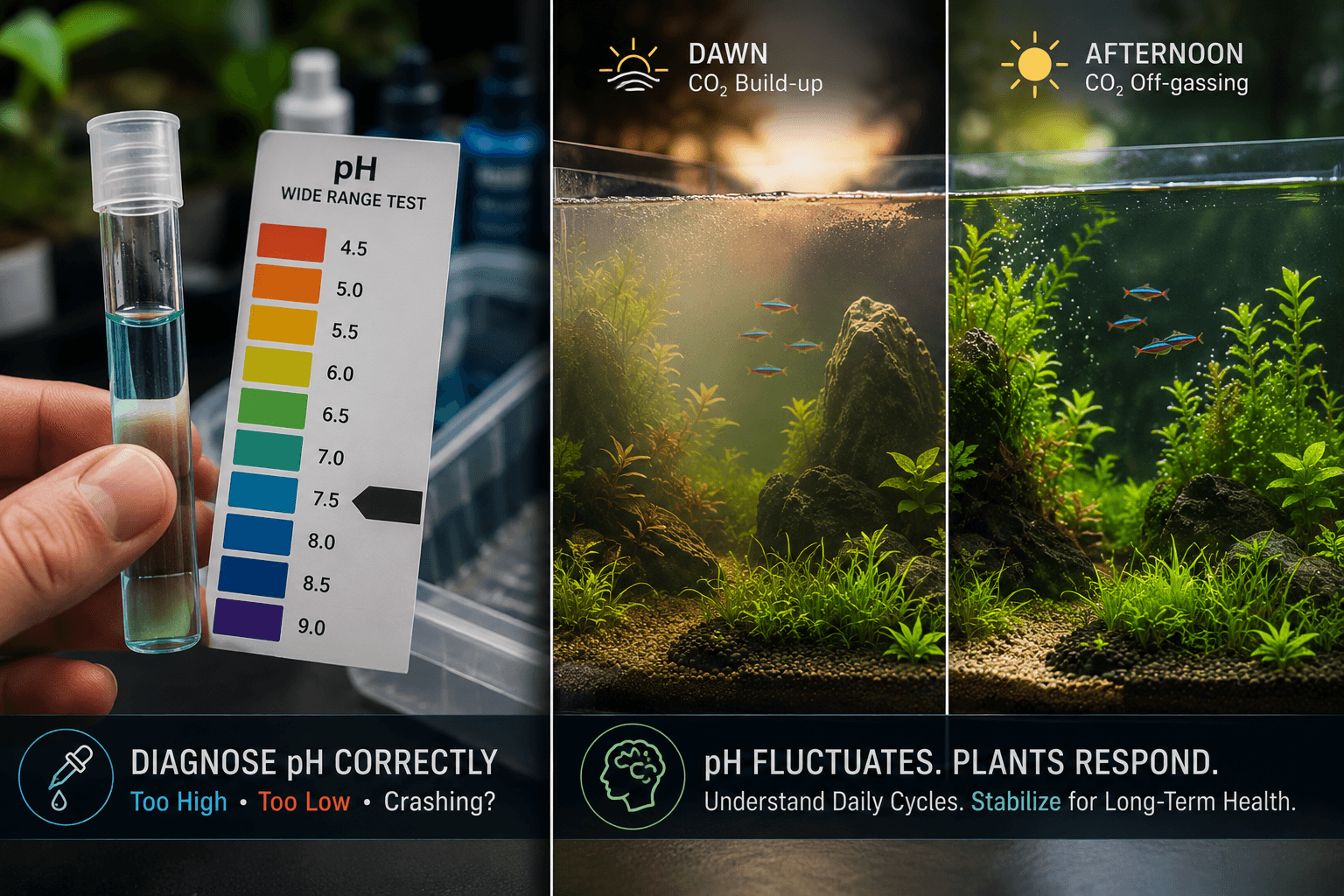
In any aquarium with aquatic plants or algae, pH changes predictably through the day-night cycle. This variation is not a problem — it is evidence of biological activity. Understanding it prevents a significant amount of unnecessary intervention.
During the light period: Plants and algae photosynthesise, consuming CO₂ from the water. As CO₂ falls, carbonic acid falls with it, and pH rises. In a densely planted tank under bright light, pH may rise 0.5–1.5 units during the photoperiod.
During the dark period: Photosynthesis stops. All organisms in the tank — fish, plants, bacteria — continue respiring, producing CO₂. CO₂ accumulates, carbonic acid rises, and pH falls back toward its morning minimum. By dawn, pH is at its daily low. By late afternoon, pH is at its daily high.
In CO₂-injected planted tanks: This variation is amplified. A CO₂-injected tank may swing 0.5–1.0 units daily under normal operation. This is expected and correct, not a malfunction. The evening-to-morning pH drop in a CO₂-injected tank is not a “pH crash” — it is the normal overnight CO₂ accumulation.
The key point: In a planted tank, a pH reading is only meaningful if you know what time of day it was taken and whether plants were in active photosynthesis. A pH of 6.8 measured at dawn in a CO₂-injected planted tank does not indicate an acidic tank — it indicates normal overnight CO₂ accumulation that will resolve when lights come on. The dissolved oxygen consequences of this same photosynthesis cycle — and why early morning is the most dangerous period for oxygen depletion in planted tanks — is examined in Aquarium Dissolved Oxygen — Complete Guide.
The relationship between CO₂, pH, and plant chemistry — including how KH buffers against CO₂-driven pH swings in planted tanks — is in Advanced Nutrient Dynamics — Carbon Chemistry in Planted Aquariums and the Nutrients, CO₂ and Algae guide.
4. Why the Rate of pH Change Matters More Than the Absolute Value
This is the insight that changes every pH management decision: fish are far more vulnerable to rapid pH change than to stable pH at an imperfect value.
Fish regulate their internal acid-base balance (blood pH) against their environment through their gills. This physiological regulation can adapt to a wide range of external pH values if the change is gradual enough — over days or weeks. It cannot adapt to rapid changes — over minutes or hours.
A fish adapted to pH 7.5 moved to a stable pH 8.0 environment gradually over two weeks will show no stress. The same fish dropped into pH 8.0 water in a water change will show acute osmotic stress, even though the destination pH is identical.
This means:
- A stable pH of 8.2 in a hard water aquarium is not a problem for most tropical fish, even though 8.2 is “too high” by many guideline tables.
- A pH that fluctuates between 7.0 and 7.8 within 24 hours is a significant problem, even though the range is “acceptable.”
- The water change that shifts pH by 0.8 units in 10 minutes causes more acute stress than a pH that has gradually drifted 0.8 units over a month.
The practical consequence: pH management is primarily about stability, not optimisation. Achieving a stable pH within a reasonable range for the species is the goal. Chasing a target pH number with chemicals while pH stability is poor is the wrong approach and typically makes stability worse.
Why pH fluctuation represents a systemic instability problem — and how it connects to the broader failure chain — is in Aquarium Stability Is Not Balance.
5. The pH-Ammonia Connection — Why pH Has Life-or-Death Consequences
pH directly determines how toxic ammonia is in your aquarium. This relationship is one of the most important and most under-discussed in hobby aquarium management.
Ammonia in water exists in two chemical forms: un-ionised ammonia (NH₃) and ammonium ion (NH₄⁺). Both are produced by fish metabolism and biological decomposition. Only un-ionised ammonia (NH₃) is toxic to fish. Ammonium ion (NH₄⁺) is relatively harmless.
The balance between these two forms is pH-dependent:
- At pH 7.0, approximately 0.5% of total ammonia is in the toxic NH₃ form
- At pH 7.5, approximately 1.5% is in NH₃ form
- At pH 8.0, approximately 5% is in NH₃ form
- At pH 8.5, approximately 15% is in NH₃ form
A standard ammonia test kit measures total ammonia (NH₃ + NH₄⁺). A reading of 1.0 ppm at pH 7.0 means approximately 0.005 ppm of toxic NH₃. The same 1.0 ppm reading at pH 8.5 means approximately 0.15 ppm of toxic NH₃ — thirty times more dangerous despite identical test results.
This has two critical implications:
High pH makes ammonia problems dramatically worse. If your pH is naturally high (hard water, alkaline substrate) and you have even a small ammonia reading, the actual toxicity is far higher than the test number suggests. Any ammonia in a high-pH tank should be treated as an emergency.
Lowering pH in a cycling tank reduces ammonia toxicity. Some hobbyists deliberately maintain slightly acidic conditions during cycling (pH 6.8–7.2) to reduce the toxicity of the ammonia that accumulates while the nitrogen cycle is establishing. The complete cycling guide that covers this is in How to Cycle a Fish Tank.
The complete guide to ammonia toxicity and gill damage — and why gill tissue damage from ammonia persists after ammonia is corrected — is in Ammonia in Aquariums — Spikes, Poisoning and How to Lower It. Incorrect filter cleaning is the most common cause of sudden biofilm loss and the ammonia crash that follows — the complete safe protocol is in How to Clean an Aquarium Filter Without Killing Bacteria. Nitrite causes a related but distinct crisis — brown blood disease — where fish cannot transport oxygen even in well-oxygenated water.
The complete guide to ammonia toxicity and gill damage — and why gill tissue damage from ammonia persists after ammonia is corrected — is in Ammonia in Aquariums — Spikes, Poisoning and How to Lower It.
6. What is a “Safe” pH Range?
There is no universal safe pH for aquariums. Different fish species are adapted to dramatically different natural water pH values:
| Species Group | Natural pH Range | Notes |
|---|---|---|
| Most tropical freshwater community fish | 6.5–7.5 | Wide tolerance; most adapt to 6.0–8.0 |
| African Rift Lake cichlids | 7.8–9.0 | Require alkaline hard water |
| Discus and cardinal tetras | 5.5–6.8 | Soft, acidic blackwater |
| Livebearers (guppies, mollies, platies) | 7.0–8.2 | Prefer slightly alkaline |
| Goldfish and koi | 7.0–8.4 | Wide tolerance for stable pH |
| Marine reef fish | 8.1–8.4 | Very narrow range; stability critical |
| Shrimp (Neocaridina/Cherry) | 7.0–7.8 | Moderate tolerance |
| Shrimp (Caridina/Crystal) | 5.8–6.8 | Soft acidic water required |
The more useful question than “what is the right pH?” is “what is a stable pH within the acceptable range for my species?“
For most community tropical fish, any stable pH between 6.5 and 8.0 is workable. The fish will adjust gradually. What they cannot adjust to is rapid change within that range. A guppy in a stable pH 8.0 hard water tank is healthy. The same guppy in a tank where pH swings from 7.0 to 8.0 daily is chronically stressed.
The specific pH tolerance information for species combinations and how pH interacts with other water parameters for species welfare is in Best Community Fish for Beginners.
7. Diagnosing Your Specific pH Problem
7a. pH Permanently Too High
Symptoms: pH consistently above 8.0 (in a freshwater tropical tank), not related to time of day.
Most common causes, in order of frequency:
Hard tap water. If your tap water naturally has high pH and KH, the tank will maintain that pH unless the substrate actively buffers it downward. This is the most common cause in India and Delhi NCR. It is often not a problem — see Section 6.
Calcareous substrate or hardscape. Crushed coral, limestone rocks, certain shells, calcium carbonate-containing gravels all dissolve slowly in water and raise both KH and pH. If your aquarium contains any of these, they are raising your pH.
Inadequate CO₂ in planted tanks. Without sufficient dissolved CO₂, the carbonic acid that would normally buffer pH downward is absent, and pH rises. In high-KH water, this effect is pronounced.
Correct response:
First: determine whether the pH is actually a problem for your species (see Section 6). Many hobbyists attempt to lower pH that is appropriate for the fish they are keeping.
If the pH genuinely needs lowering: identify and address the source. If tap water is the cause, RO water blending or an active buffering substrate is the correct approach. If calcareous hardscape is the cause, remove or replace it. Chemical pH-down products applied without addressing the source produce brief drops followed by rapid return to baseline — see Section 9.
7b. pH Permanently Too Low
Symptoms: pH consistently below 6.5 (in a community tropical tank), not recovering with water changes.
Most common causes:
KH depletion from nitrification. The nitrogen cycle consumes KH. In a tank without adequate KH replenishment from water changes, or a tank with soft, low-KH tap water, KH gradually depletes. As KH falls toward zero, pH falls with it and eventually crashes. Test KH — if below 3 dKH in a stocked tank, KH depletion is the cause.
Acidic substrate. Active buffering substrates like Aqua Soil, Fluval Stratum, and similar products are designed to acidify the water. After 12–24 months, their buffering capacity depletes and pH begins rising back — but while active, they maintain lower pH. If your substrate is an active buffering type, lower pH is expected.
Organic acid accumulation. In heavily stocked tanks with infrequent water changes, or tanks with driftwood and leaf litter, humic and fulvic acids accumulate and lower pH progressively. Regular water changes export these compounds.
Peat substrate or blackwater additives. Peat, Indian almond leaves, alder cones, and commercial blackwater additives deliberately lower pH by releasing tannins and humic acids.
Correct response:
Test KH first. If KH is below 3 dKH, add a KH buffer (sodium bicarbonate or commercial alkalinity buffer) to restore buffering capacity. pH will stabilise once KH is restored. If KH is adequate, identify the acid source — organic accumulation, acidic substrate, or blackwater additives — and adjust accordingly. See Section 10 for buffering strategy.
7c. pH Unstable / Fluctuating
Symptoms: pH varies by more than 0.5 units across the day in a non-planted or lightly planted tank, or by more than 1.0 unit across the day in a planted tank.
Most common cause: Low KH. When KH falls below 3 dKH, the buffering system that resists pH change is severely weakened. Normal biological activity — CO₂ production from respiration, organic acid generation from decomposition, nitrification consuming alkalinity — produces large pH swings.
Diagnosis: Test KH. If below 3 dKH in a non-planted tank with fluctuating pH, KH depletion is the cause with near certainty.
Correct response: Restore KH to 4–6 dKH minimum using sodium bicarbonate (see Section 10). pH stability will return as KH rises.
7d. pH Crash — Sudden Overnight Drop
Symptoms: pH normal in the evening, drastically lower (often below 6.5, sometimes below 6.0) in the morning. May cause fish deaths overnight or by morning.
The mechanism: A pH crash is almost always the endpoint of KH depletion. As KH is consumed over weeks by nitrification, it falls toward zero. With KH near zero, the buffering system is gone. Overnight CO₂ accumulation from fish and bacterial respiration — which is buffered entirely harmlessly in a properly mineralised tank — produces a catastrophic pH crash in a KH-depleted tank. The CO₂ production that would shift pH by 0.3 units in a buffered tank shifts it by 2.0 units in a KH-depleted tank.
Why this seems sudden: KH depletion is gradual and invisible. The tank operates normally as KH falls from 8 to 6 to 4 to 2 dKH over months. At 2 dKH, the tank is vulnerable. At 1 dKH, the next heavy night or bioload spike crashes pH. The crash itself is sudden; the underlying cause was months in development.
The nitrification process that drives KH depletion — and the biofilm biology performing it continuously in the filter and substrate — is examined in Biofilms — The Invisible Engine of Every Aquarium.
Emergency response:
- Immediately increase surface agitation to drive off CO₂ and raise pH as rapidly as possible
- Perform a 25–30% water change with KH-appropriate, dechlorinated water matched to tank temperature. This dilutes acid and introduces new KH
- Dose sodium bicarbonate (baking soda) to restore KH to 4–6 dKH — see Section 10 for dosing. Use the Aquarium Volume Calculator to calculate dosing to actual tank water volume
- Test ammonia — pH crashes often occur alongside elevated ammonia (from biological disruption and from the pH-ammonia relationship)
- Reduce feeding for 48 hours to reduce CO₂ and ammonia production while the system stabilises
Long-term fix: Regular KH testing and maintenance. In soft water areas or tanks with acidic substrates, test KH weekly until a reliable trend is established. Replenish KH with water changes or small sodium bicarbonate additions before it falls below 4 dKH.
The cascade from pH crash to ammonia spike to fish death is a systems failure event — the broader framework for understanding why these cascades propagate is in Why Aquariums Fail — A Systems-Level Diagnosis.
7e. pH Drops After Water Change
Symptoms: pH falls noticeably within hours of a water change.
Causes:
Tap water has lower pH than the tank. Water that has equilibrated in the tank over a week accumulates CO₂ and organic acids that slightly lower pH. Tap water that has been running through pipes at higher pH is then added, briefly raising pH — which then falls back. This is normal and not a problem unless the swing is large.
Large water change with soft/acidic tap water into a KH-depleted tank. If tap water has low KH and the tank’s KH is already depleted, the water change adds little buffering while diluting remaining KH further. pH then falls as biological CO₂ production resumes.
Organic acid release from disturbed substrate. Vacuuming substrate during a water change can release accumulated organic acids. In a KH-depleted tank, these produce a measurable pH drop.
Correct response: Test both tap water pH and KH, and tank water KH. If tap water has significantly lower KH than is needed to maintain stability, either add KH buffer to incoming water before adding it to the tank, or blend with harder water. Addressing the water change protocol is in How to Do a Water Change.
7f. pH Rises After Water Change
Symptoms: pH rises noticeably within hours of a water change, then gradually falls back over days.
Cause: Tap water has higher pH than the tank. This is very common in Delhi NCR and Indian hard water areas where tap water at pH 7.5–8.2 is added to acidified planted tanks, CO₂-injected systems, or tanks with active buffering substrate.
Whether this is a problem depends on the magnitude of the swing. A rise of 0.2–0.3 units that stabilises within hours and returns to baseline within 24–48 hours is normal. A rise of 0.8–1.0 units that causes visible fish stress is an acute pH shock event. See Fish Dying After Water Change for the complete water change shock diagnosis.
Correct response: Add incoming water gradually during water changes to slow the rate of change. Blend tap water with RO water to reduce its KH and pH before adding. In CO₂-injected planted tanks, confirm CO₂ is running at full rate before and during the water change to help buffer against the incoming alkaline water.
7g. pH Different Morning vs Evening — Planted Tank Variation
Symptoms: pH tests taken at different times of day show significantly different readings. Morning pH is lower than evening pH.
Cause: Normal, expected daily CO₂ variation in planted tanks. Not a problem. This is evidence that your plants are photosynthesising actively. See Section 3.
Whether this is a problem depends on the magnitude. Daily variation of 0.3–0.7 units in a low-tech planted tank and 0.5–1.0 units in a CO₂-injected planted tank is normal. Variation above 1.0 units in a non-CO₂ tank, or variation above 1.5 units in a CO₂ tank, indicates either insufficient KH (the swings are amplified by lack of buffering) or excessive CO₂ injection.
Correct response: For excessive variation: test and increase KH if below 4 dKH. If CO₂ is injected, verify the solenoid is turning off 1–2 hours before lights-off to prevent overnight CO₂ accumulation amplifying the morning pH drop.
8. How to Raise pH — What Works and What Doesn’t
What Works
Increasing KH (most reliable method for long-term stability) Sodium bicarbonate (baking soda, NaHCO₃) raises both KH and pH. It is inexpensive, food-safe, and precisely dosed. Dissolve in a cup of tank water before adding to avoid localised pH spikes. Add gradually — one dose, wait 24 hours, test, repeat if needed. Do not add large amounts at once.
Approximate effect: 1 level teaspoon (approximately 4–5g) of sodium bicarbonate per 40 litres raises KH by approximately 2–3 dKH and pH by 0.2–0.4 units in a soft water tank. In a hard water tank with existing KH, the pH effect is smaller.
Crushed coral or aragonite substrate Dissolves slowly in acidic conditions, releasing calcium carbonate that raises both KH and pH. Effective as a passive, long-term buffer. Place in a filter media bag in the filter or as a substrate layer. The rate of buffering is self-regulating: it dissolves faster when pH is low and slower when pH is already high.
Aeration and surface agitation Increases CO₂ off-gassing, raising pH. Effective in tanks where excess CO₂ is causing pH depression — morning pH recovery in planted tanks happens partly through CO₂ off-gassing as surface agitation resumes. Not effective for raising pH in tanks where the low pH is caused by organic acids or KH depletion rather than CO₂.
What Doesn’t Work Long-Term
Commercial pH-Up solutions (sodium hydroxide, potassium hydroxide) These raise pH immediately and reliably. They also produce no lasting effect on KH. Within 24–48 hours, the tank’s buffering chemistry returns pH toward its natural equilibrium. The result: repeated dosing required, with each dose potentially stressing fish from the rapid pH change. These products are not a solution; they are a symptom-suppression cycle.
Removing driftwood Driftwood does lower pH marginally through tannin release. But the effect is generally mild in a well-KH-buffered tank. Removing driftwood to raise pH typically produces minimal change while disrupting the tank’s established environment. If pH is a serious problem, the cause is almost certainly KH rather than driftwood.
9. How to Lower pH — What Works and What Doesn’t
What Works
CO₂ injection (planted tanks) The most reliable and biologically appropriate method for reducing pH in planted tanks. Dissolves CO₂ into the water, forming carbonic acid. Lowers pH consistently across the photoperiod while simultaneously benefiting plant growth. Requires proper calibration for local water KH (especially important in Delhi NCR hard water — see Section 13).
RO water blending Reverse osmosis water has near-zero KH, GH, and pH resistance. Blending RO water with tap water reduces the overall KH and softens the buffering resistance, allowing CO₂ or organic acids to lower pH more effectively. For fish requiring genuinely soft, acidic water (discus, cardinal tetras, Caridina shrimp), RO water blending is the only reliable approach in hard water areas.
Active buffering substrate (Aqua Soil and equivalents) Designed to lower and buffer pH to 6.5–7.0. Effective for 12–24 months before buffering capacity depletes. The most beginner-friendly approach for low-tech planted tanks requiring slightly acidic water. Does not require CO₂ injection to work.
Peat filtration or Indian almond leaves Releases humic acids that lower pH and simultaneously produce the soft, tannin-stained water that blackwater species originate from. pH-lowering effect is modest and gradual. More useful for species compatibility than for precise pH targeting.
What Doesn’t Work Long-Term
Commercial pH-Down solutions (phosphoric acid, citric acid) Same problem as pH-Up: immediate effect, no lasting KH change, rapid return to baseline in buffered water. In soft water with low KH, these can work — but they also lower KH further, reducing stability. Repeatedly using acid solutions to lower pH in a high-KH tank is chemically futile — the buffer immediately neutralises the acid.
Vinegar (acetic acid) Frequently suggested as a natural pH-down. Produces a brief pH drop followed by immediate bacterial decomposition of the acetic acid, which removes the acid from the water within hours. Net effect on pH: near zero after 24 hours. Simultaneously spikes organic load and oxygen demand in the tank.
10. How to Stabilise pH — The KH Solution
For most aquarium pH problems — whether pH too high, too low, or fluctuating — the correct intervention targets KH, not pH directly.
The stabilisation framework:
Target KH ranges by tank type:
- Freshwater community tank: 4–8 dKH
- CO₂-injected planted tank: 3–6 dKH (lower KH allows CO₂ to produce the pH drop that plants use as a CO₂ proxy)
- African cichlid tank: 8–15 dKH (naturally hard water species)
- Softwater species (discus, cardinal tetras, Caridina shrimp): 0–3 dKH with RO water blending
- Marine reef: managed separately through alkalinity (dKH 7–11) and calcium supplementation
Raising KH to correct instability:
Dissolve sodium bicarbonate in cup of tank water. Dose at 1 teaspoon per 40 litres for a modest 2–3 dKH increase. Add to tank over 30 minutes, not all at once. Test KH and pH 24 hours later. Repeat if needed.
Alternatively, add crushed coral to the filter media basket — passive, self-regulating, and requires no calculation.
Use the Aquarium Volume Calculator to calculate actual water volume before dosing any buffering compound. The difference between a tank’s labelled capacity and actual water volume (after substrate, hardscape, and water level adjustments) can easily be 20–30%, producing significant dosing errors if labelled capacity is used.
Maintaining KH through water changes:
Regular water changes with tap water replenish KH in hard water areas — this is one reason why hard water aquariums in Delhi NCR are often more pH-stable without any intervention than soft water aquariums requiring active management.
In soft water areas where tap water provides little KH, add sodium bicarbonate to incoming water before water changes to maintain target KH. The Water Change Calculator helps determine the correct water change volume and frequency for your stocking level and water chemistry.
The complete water chemistry parameter framework — how KH, pH, GH, TDS, and ammonia interact as an integrated system — is in the Complete Water Chemistry Guide.
11. pH in Specific Tank Types
Freshwater Community Tanks
The majority of popular tropical fish are remarkably pH-tolerant when the pH is stable. Most species sold in the hobby are captive-bred in neutral water and have adapted to a wide range. Prioritise stability over precision. A stable pH of 7.8 causes no problems for tetras, rasboras, corydoras, or most beginner fish.
KH maintenance at 4–8 dKH provides adequate buffering for most community tanks.
CO₂-Injected Planted Tanks
pH management in high-tech planted tanks is primarily CO₂ management. The target is stable CO₂ concentration throughout the photoperiod, assessed by drop checker colour (lime green = approximately 20–30 ppm), not by pH value. In high-KH water, pH may remain relatively high despite adequate CO₂. See Section 13 for the Delhi NCR-specific challenge.
Daily pH variation of 0.5–1.0 units is normal in CO₂-injected tanks and does not require intervention.
African Cichlid Tanks
Require stable, high pH (7.8–9.0) with high KH (8–15 dKH) replicating the chemistry of the African Rift Lakes. Crushed coral or aragonite substrate, regular water changes with moderately hard tap water, and sometimes Rift Lake salt mixes maintain appropriate chemistry. Do not use active buffering substrates that lower pH — they are chemically incompatible with African cichlid requirements.
Softwater and Blackwater Species — Discus, Cardinal Tetras, Caridina Shrimp
These species originate in water with pH 5.5–6.8, near-zero KH, and very low TDS. In hard water areas, achieving these conditions requires significant RO water blending (often 80–100% RO) or the use of active buffering substrates. Without water softening, these species remain chronically stressed in hard water regardless of how well other parameters are managed.
This is one of the few cases where RO water blending is not optional — it is a species welfare requirement.
Marine and Reef Systems
Marine pH management is substantially different from freshwater and is beyond the scope of this guide. Marine systems require stable pH of 8.1–8.4. The primary pH maintenance tool is alkalinity (measured in dKH, target 7–11 dKH for reef systems) supplemented through calcium reactors, kalkwasser, or two-part dosing. CO₂ scrubbers on sump intakes raise pH in indoor reef systems where atmospheric CO₂ is elevated.
12. pH Testing — Accuracy, Methods, and When to Test
Liquid test kits vs test strips
Liquid test kits (API, Salifert, JBL) provide the most reliable results. The colour comparison method introduces some human error but is far more accurate than test strips at the pH values where precision matters (6.5–8.5).
Test strips for pH are unreliable below pH 7.0 — where the colour gradations between values are too similar to distinguish reliably. For planted tanks operating at pH 6.5–7.0, liquid kits are the minimum standard.
Digital pH pens provide continuous, accurate readings when calibrated correctly with fresh buffer solution. They require calibration every 2–4 weeks with pH 7.0 and pH 4.0 (or 7.0 and 10.0) buffer solutions. An uncalibrated pH pen may read 0.3–0.5 units off actual pH — enough to produce incorrect management decisions.
For understanding how pH relates to TDS and the other dissolved parameters measured in aquarium water, see Aquarium TDS — Complete Guide.
When to test
For diagnosing daily variation: test at the same time each day for one week — both morning (before lights on) and afternoon (2–3 hours after lights on). This establishes your tank’s normal daily pH range, which is necessary context before interpreting any single reading.
For assessing overall pH: test at the same time of day each week — either consistently morning or consistently afternoon. Mixing morning and afternoon tests produces apparent variability that is simply the daily CO₂ cycle.
For emergency diagnosis: test pH and KH simultaneously. The combination of low pH + low KH confirms KH depletion as the cause. Low pH + adequate KH points to an acid source (CO₂, organic acids, acidic substrate) that is overwhelming the buffer.
Test kit accuracy over time
Liquid test kit reagents expire. The colour reference charts fade. A test kit more than 18–24 months old may produce readings 0.2–0.5 units off actual pH. Cross-check older kits against a freshly purchased kit or a known calibration solution.
13. India and Delhi NCR — Specific Considerations
High KH tap water is a pH advantage, not a problem
Delhi NCR tap water at KH 8–14 dKH is naturally high-buffered against pH swings. For fish-only and lightly planted tanks, this means pH stability is essentially automatic — the tap water’s KH replenishes buffering capacity with every water change. The pH stability complaints common in soft water regions simply do not occur in well-maintained Delhi NCR tanks.
This buffering advantage should be understood as a feature rather than a problem. Most tropical community fish do well in the resulting stable pH of 7.2–8.0.
The CO₂-KH challenge in planted tanks
The same KH that provides pH stability in fish-only tanks creates a challenge in CO₂-injected planted tanks. Standard planted tank CO₂ management uses pH drop as a proxy for CO₂ concentration — a 1-unit pH drop from baseline is used to estimate approximately 25–30 ppm CO₂. In soft water at 4 dKH, this works correctly.
In Delhi NCR water at 12 dKH, CO₂ injection must overcome three times the buffering resistance to produce the same pH drop. A hobbyist targeting a 1-unit pH drop may actually be achieving 60–90 ppm CO₂ — potentially harmful — or may be severely underinjecting and wondering why plants still have CO₂-deficiency symptoms.
The correct calibration: use a drop checker with 4 dKH reference solution (not your tank water as reference). The drop checker’s colour response is determined by the reference solution’s KH, not the tank’s. Target lime green. Ignore pH as a CO₂ indicator in high-KH water. The complete CO₂ management strategy for Delhi NCR hard water is in Hard Water Aquariums in Delhi NCR.
When Delhi NCR hobbyists need lower pH
For species genuinely requiring soft, acidic water: RO water blending is the only reliable approach in Delhi NCR. Attempting to lower pH through chemical additions in water with 12 dKH is chemically futile — the buffer neutralises the acid immediately. The RO blending ratio and remineralisation strategy for specific target parameters is covered in Hard Water Aquariums in Delhi NCR.
Seasonal pH variation
Delhi NCR tap water chemistry varies seasonally as water source mix changes between groundwater and surface water. The same tap water pH of 7.5 in October may shift to 7.8 in March as surface water input changes. Test tap water pH periodically through the year rather than relying on a measurement taken during setup.
Frequently Asked Questions
What is the ideal pH for a freshwater aquarium?
There is no single ideal pH for all freshwater aquariums — it depends on the species. Most tropical community fish (tetras, rasboras, corydoras, livebearers, most cichlids except Rift Lake species) thrive in any stable pH between 6.8 and 7.8. African Rift Lake cichlids need pH 7.8–9.0. Discus and cardinal tetras prefer pH 5.5–6.8. Stability matters more than the specific value: a stable pH of 8.0 causes far less stress than a pH that fluctuates between 7.0 and 8.0 daily.
Why does my aquarium pH keep dropping?
The most common cause of persistently dropping pH is KH depletion. The nitrification process that converts ammonia to nitrate continuously consumes KH (carbonate hardness/alkalinity). In tanks with soft tap water that doesn’t replenish KH adequately between water changes, KH gradually falls toward zero and pH follows. Test KH — if below 3 dKH, KH depletion is the cause. Restoring KH with sodium bicarbonate stabilises pH reliably.
My aquarium pH crashed overnight — what happened and what do I do?
A pH crash (sudden large overnight pH drop, often below 6.5 or lower) almost always indicates KH has been depleted to near zero. With no buffering, overnight CO₂ from fish and bacterial respiration crashes pH. Emergency response: increase surface agitation immediately to drive off CO₂, perform a 25–30% water change with properly conditioned water, and dose sodium bicarbonate to restore KH to 4–6 dKH. Calculate the correct dose from actual tank water volume using the Aquarium Volume Calculator. After stabilisation, test KH weekly to prevent recurrence.
Why does my pH change from morning to evening?
In planted tanks, this is completely normal. Plants photosynthesise during the light period, consuming CO₂ and raising pH. At night, all organisms respire, producing CO₂ and lowering pH back. A planted tank at pH 7.0 in the morning and pH 7.6 in the afternoon is exhibiting normal healthy variation. In a non-planted or fish-only tank, significant daily pH variation (more than 0.3–0.5 units) indicates low KH and should prompt a KH test and correction.
How do I raise the pH in my aquarium naturally?
The most reliable natural method is increasing KH using sodium bicarbonate (baking soda) — this raises pH by restoring buffering capacity rather than forcing a chemical change that will immediately reverse. Adding crushed coral to the filter is a slower but passive, self-regulating alternative. Increasing surface agitation drives off CO₂ and raises pH modestly. Commercial pH-Up products produce a short-lived effect in buffered water and are not a long-term solution.
How do I lower the pH in my aquarium naturally?
For planted tanks: CO₂ injection is the most reliable and beneficial method. For all tanks: RO water blending reduces the buffering capacity that keeps pH elevated, allowing biological CO₂ and organic acids to lower pH naturally. Indian almond leaves, peat in filter bags, and driftwood produce modest acidification through tannin release. Commercial pH-Down products applied to high-KH water are neutralised immediately by the buffer and are not effective long-term.
My pH test shows 8.5 — is this dangerous?
Not necessarily, if it is stable. Fish that have adapted to stable pH 8.5 are fine at that value. The danger is rapid pH change and the pH-ammonia relationship: at pH 8.5, even small ammonia readings represent very high toxic NH₃ concentrations. Test ammonia alongside pH. If ammonia is zero and pH is stable at 8.5, most fish handling this pH range are not in immediate danger. If ammonia is elevated at pH 8.5, treat as an emergency regardless of how small the ammonia reading appears.
Does pH affect ammonia toxicity?
Yes — dramatically. At pH 8.0, total ammonia is approximately ten times more toxic than at pH 7.0 because a higher proportion exists as un-ionised NH₃, the toxic form. A standard ammonia test kit measures total ammonia (NH₃ + NH₄⁺). A reading of 0.25 ppm at pH 8.0 is approximately equivalent in toxicity to 2.5 ppm at pH 7.0. Any positive ammonia reading in a high-pH aquarium should be treated as an immediate priority. For the complete parameter interaction picture — how pH, KH, nitrate, and phosphate relate as a system — see the Complete Water Chemistry Guide.
Why does my pH rise after a water change?
Your tap water has higher pH and/or KH than the tank water. This is common in Delhi NCR and other hard water areas where tap water at pH 7.5–8.2 is added to planted tanks operating at lower pH through CO₂ injection or active substrate buffering. If the rise is modest (0.2–0.4 units) and returns to baseline within 12–24 hours, it is normal water chemistry equilibration. If the rise is large (0.8+ units) and fish show visible stress, add water changes more slowly or blend with RO water to moderate the incoming water chemistry.