
By ProHobby™ | Ecological Systems Authority
KH is the most misunderstood parameter in freshwater aquarium keeping — and the most consequential. Hobbyists test pH regularly and panic when it drifts. They test ammonia and nitrite as part of the standard cycle check. They rarely test KH. And then their tank crashes overnight for no apparent reason, or their planted tank refuses to respond to CO₂ injection as expected, or their pH refuses to stay where they put it.
In almost all of these cases, KH is either the cause or the explanation.
This article covers aquarium KH completely: what it is chemically, how it works as a buffer, why it depletes, how it differs from GH, its relationship to pH and CO₂, and every scenario where KH problems manifest in aquariums — from the sudden overnight pH crash in a well-maintained established tank to the planted aquarium CO₂ calibration problem specific to Indian hard water.
If you have just experienced a pH crash or are trying to understand why your pH is unstable, begin with the companion article Aquarium pH — Complete Diagnosis and Fix Guide, which applies the framework covered here to specific pH scenarios.
Table of Contents
- What KH Actually Is — The Chemistry
- KH vs GH — The Difference Most Hobbyists Get Wrong
- How KH Works as a Buffer — The Mechanism
- KH and pH — Why KH Is the Foundation of pH Stability
- KH and CO₂ — The Planted Tank Connection
- Why KH Depletes Over Time — The Silent Threat
- Safe KH Levels by Tank Type
- Diagnosing Your KH Problem
- How to Raise KH — What Works
- How to Lower KH — What Works
- KH in Specific Tank Types
- KH Testing — Methods and Accuracy
- Units — dKH, ppm, meq/L Explained
- India and Delhi NCR — Specific Considerations
- Frequently Asked Questions
1. What Aquarium KH Actually Is — The Chemistry
KH stands for Karbonathärte — the German term for carbonate hardness. It is also called alkalinity, acid-buffering capacity, or temporary hardness. These terms all refer to the same measurement: the concentration of bicarbonate ions (HCO₃⁻) and carbonate ions (CO₃²⁻) dissolved in the water.
KH contributes to the total TDS (Total Dissolved Solids) reading of the water alongside calcium, magnesium, and other dissolved compounds — the relationship between KH, GH, and TDS as distinct but related parameters is in Aquarium TDS — Complete Guide.
At aquarium pH values (6.0–8.5), bicarbonate is the dominant form. Above pH 8.3, carbonates become significant. At typical aquarium pH (6.5–8.0), KH is essentially synonymous with bicarbonate concentration.
Where KH comes from in natural water: the dissolution of limestone and other calcium carbonate-containing rock. Rainwater absorbs CO₂ from the atmosphere forming a weak carbonic acid, which slowly dissolves limestone, releasing calcium ions (Ca²⁺), bicarbonate ions (HCO₃⁻), and carbonate ions (CO₃²⁻) into the water. Rivers and aquifers flowing through limestone bedrock accumulate KH over time. Rivers flowing through ancient ignite or heavily weathered geology have almost no limestone contact and very low KH — these are the origins of the soft, acidic water of the Amazon and Southeast Asian blackwater biotopes.
In tap water, KH comes from the same geological origins — the source aquifer or reservoir’s contact with calcium carbonate deposits — plus deliberate addition in some municipal water treatment systems where pH adjustment with lime or soda ash raises KH.
KH is expressed in several units that cause significant confusion — these are explained fully in Section 13.
2. KH vs GH — The Difference Most Hobbyists Get Wrong
KH and GH are routinely confused, used interchangeably, and treated as measuring the same thing. They do not. Understanding the difference is essential for correct water chemistry management.
GH (General Hardness) measures the total concentration of divalent cations — primarily calcium (Ca²⁺) and magnesium (Mg²⁺) — in the water. It is what most people mean when they say water is “hard” or “soft” in the domestic sense. Hard water leaves scale on kettles and taps because calcium and magnesium are precipitating. GH determines the osmotic challenge that fish face in osmoregulation and the calcium and magnesium availability for biological processes. GH affects fish physiology and plant nutrition.
KH (Carbonate Hardness / Alkalinity) measures bicarbonate and carbonate concentration. It has no direct connection to calcium or magnesium concentration. KH determines pH buffering capacity — the water’s resistance to pH change when acids or bases are introduced. KH does not directly affect osmotic pressure or calcium/magnesium availability for biological functions.
The crucial distinction: KH and GH often correlate in natural water because both tend to be elevated when water flows through limestone (which provides calcium, magnesium, bicarbonate, and carbonate simultaneously). But they are not the same measurement and do not necessarily move together.
Practical examples of the difference:
High GH, low KH: Water from gypsum (calcium sulphate) geology may have high calcium and GH but low bicarbonate and KH. The water is “hard” in the osmotic/scale-forming sense but poorly buffered against pH change. Adding acid drops pH easily despite high GH.
Low GH, moderate KH: Sodium bicarbonate added to RO water raises KH and pH buffering but not GH, since sodium is not a divalent cation measured by GH tests. The water has improved pH stability but low calcium and magnesium.
Both high: Typical limestone-derived hard water like Delhi NCR tap water — high GH and high KH, strongly buffered, hard for osmoregulation.
Both low: Rainwater, RO water, Amazon blackwater — soft, poorly buffered, requires remineralisation before aquarium use.
For fish welfare, GH determines physiological suitability (osmoregulation, calcium for bone development, magnesium for enzyme function). For aquarium stability, KH determines pH buffering capacity. Both must be managed, but they require different interventions and their effects are fundamentally different.
3. How KH Works as a Buffer — The Mechanism
A buffer is a chemical system that resists pH change when acid or base is introduced. KH functions as a buffer through the bicarbonate buffering system — one of the most important chemical equilibria in natural water.
The buffering reaction when acid (H⁺ ions) is introduced:
HCO₃⁻ + H⁺ → H₂CO₃ → H₂O + CO₂
The bicarbonate ion absorbs the hydrogen ion, forming carbonic acid, which then dissociates into water and carbon dioxide — which leaves the water through the surface. The net effect: acid is consumed, CO₂ is released, and pH changes far less than it would without the buffer present.
When base (OH⁻ ions) is introduced:
HCO₃⁻ → H⁺ + CO₃²⁻, then CO₃²⁻ + H₂O → HCO₃⁻ + OH⁻
The bicarbonate system works in both directions, absorbing both acids and bases, maintaining pH within a stable range.
The shock absorber analogy: Imagine KH as the suspension on a vehicle. A vehicle with good suspension (high KH) absorbs road bumps (acid-producing events in the aquarium) without jolting the passengers (fish). A vehicle with no suspension (KH near zero) transmits every bump directly — even a small acid input produces a large, immediate pH crash.
Buffering capacity is finite. Each time bicarbonate absorbs an acid, one bicarbonate ion is consumed. The buffer’s capacity is determined by how much bicarbonate is present. As bicarbonate is consumed without replenishment, KH falls. When KH reaches zero, the buffer is exhausted and pH is completely uncontrolled by the buffering system.
The buffering threshold: The bicarbonate buffer system is most effective above approximately 4 dKH. Between 2–4 dKH, buffering capacity is weak — pH still responds, but fluctuations are larger. Below 2 dKH, the buffer is effectively exhausted and pH becomes vulnerable to significant swings from normal biological activity. Below 1 dKH, a pH crash from overnight CO₂ accumulation is possible in any stocked tank.
The stability science that explains why KH depletion leads to system failure is in Aquarium Stability Is Not Balance and the Stability and Collapse in Aquarium Ecosystems cornerstone.
4. KH and pH — Why KH Is the Foundation of pH Stability
pH is the output of the buffering system. KH is the system itself.
This means: you cannot reliably and durably fix a pH problem without addressing KH. Adding pH-adjusting chemicals to a tank with KH problems produces temporary results followed by reversion to baseline, because the KH-determined equilibrium point reasserts itself within hours to days.
The KH-pH equilibrium:
At any given KH, the water has a characteristic pH equilibrium point — the pH toward which the water naturally gravitates given its CO₂ levels. Higher KH tends to produce higher equilibrium pH. Soft, low-KH water has a lower, less stable equilibrium.
How KH level affects pH stability:
| KH (dKH) | pH stability | Behaviour under biological activity |
|---|---|---|
| 0–1 | Essentially none | pH crashes possible from normal CO₂ production |
| 1–3 | Poor | Significant daily variation, vulnerable to any acid event |
| 3–6 | Moderate | Normal biological activity produces manageable variation |
| 6–10 | Good | Stable under most conditions without intervention |
| 10–15 | Very high | Highly resistant to pH change; CO₂ injection less effective |
The practical implication: A tank experiencing pH instability — fluctuating daily, crashing at night, drifting downward over weeks — almost always has low KH. Testing pH without testing KH gives incomplete information. Testing KH first gives the diagnosis before the symptom.
The complete application of this relationship — specific scenarios, causes, and fixes — is in Aquarium pH — Complete Diagnosis and Fix Guide.
5. KH and CO₂ — The Planted Tank Connection
The relationship between KH and CO₂ is the most important chemistry concept for planted aquarium management, and the one most commonly misunderstood in the hobby.
CO₂ dissolves in water to produce carbonic acid:
CO₂ + H₂O ⇌ H₂CO₃ ⇌ H⁺ + HCO₃⁻
The H⁺ lowers pH. The KH buffer absorbs the H⁺ (bicarbonate absorbs acid as described in Section 3), limiting the pH drop.
How much pH drops when CO₂ is injected depends directly on KH:
At KH 4 dKH: injecting CO₂ to achieve 25 ppm dissolved CO₂ drops pH by approximately 1.0 unit At KH 8 dKH: achieving the same 25 ppm CO₂ drops pH by approximately 0.5 units At KH 12 dKH: achieving 25 ppm CO₂ drops pH by approximately 0.3 units
The same CO₂ concentration produces less pH change in harder water because there is more buffer to absorb the carbonic acid.
Why this matters for CO₂ management:
Many planted tank hobbyists calibrate CO₂ injection by targeting a specific pH drop from baseline (the common “inject until pH drops by 1 unit” rule). In soft water at 4 dKH, a 1-unit pH drop approximately corresponds to 25 ppm CO₂ — adequate and safe for plants.
In hard water at 12 dKH, achieving a 1-unit pH drop from the same baseline requires injecting CO₂ to approximately 80–90 ppm — well above the safe threshold for fish (above 30–40 ppm CO₂, fish begin experiencing respiratory distress). A hobbyist following the pH-drop calibration rule in hard water may be severely over-injecting CO₂ without realising it.
The reverse: using pH drop as a proxy for CO₂ deficiency is equally misleading in hard water. A hobbyist seeing only a 0.2-unit pH drop after activating CO₂ might conclude CO₂ is not working, when actually CO₂ is at 20–25 ppm and the small pH drop is simply the buffer doing its job.
CO₂ injection also interacts with dissolved oxygen through the same day-night photosynthesis cycle — the oxygen dynamics are covered in Aquarium Dissolved Oxygen — Complete Guide.
The correct tool for CO₂ calibration is a drop checker with a known 4 dKH reference solution — not pH monitoring. The drop checker’s colour response is determined by the 4 dKH reference solution inside it, not by the tank’s KH. This makes it KH-independent: it shows lime green at approximately 25–30 ppm CO₂ regardless of whether the tank water is 4 dKH or 14 dKH.
The CO₂ chemistry of planted tanks — including the dissolved CO₂ equilibrium and why KH affects CO₂ availability — is in Advanced Nutrient Dynamics — Carbon Chemistry in Planted Aquariums.
6. Why KH Depletes Over Time — The Silent Threat
KH depletion is the cause of the majority of established tank pH crashes — and it is entirely invisible until the moment of collapse.
The biological mechanism:
The nitrogen cycle — the nitrification process performed by bacteria in the filter and substrate — produces acid as a byproduct. Specifically:
NH₄⁺ + 2O₂ → NO₃⁻ + H₂O + 2H⁺
Two hydrogen ions (H⁺) are released per ammonium ion converted. These H⁺ ions are absorbed by the KH buffer. Each buffering event consumes one bicarbonate ion. The buffer is gradually depleted by the continuous operation of biological filtration.
While nitrification depletes KH, it simultaneously produces nitrate — the endpoint compound that accumulates in all stocked aquariums. The complete guide to nitrate accumulation, toxicity, and reduction is Aquarium Nitrate.
The depletion rate depends on the biological load (more fish = more ammonia = more nitrification = more acid = faster KH depletion) and the KH replenishment rate (frequency and volume of water changes using hard water, or active KH supplementation).
The ammonia that initiates the nitrification process — and the acute toxicity emergency that occurs when nitrification is disrupted — is covered in Ammonia in Aquariums — Spikes, Poisoning and How to Lower It. Incorrect filter cleaning is the most common cause of sudden nitrification disruption and the KH-pH crash that follows — the complete protocol is in How to Clean an Aquarium Filter Without Killing Bacteria. The intermediate compound, nitrite, causes its own distinct crisis through brown blood disease — see Aquarium Nitrite.
In a moderately stocked 100-litre tank with 8 dKH tap water and 25% weekly water changes, KH typically remains stable because the water change replenishes approximately the same amount of KH that nitrification depletes in a week.
In a heavily stocked tank, a tank with infrequent water changes, or a tank in a soft water area where tap water adds minimal KH, nitrification consumes KH faster than it is replenished. KH falls week by week: 8 → 6 → 4 → 2 → 1 → crash.
Why the crash seems sudden:
At 6 dKH, the tank behaves normally. Fish are healthy, parameters are stable, the hobbyist has no reason to test KH. At 3 dKH, pH fluctuates slightly more than before — perhaps noticed as “pH seems a bit variable lately.” At 1 dKH, the buffer is essentially gone. The next warm night with heavy fish respiration, the next feeding that temporarily increases CO₂, the next cloudy day that reduces plant photosynthesis — any of these normally-buffered events produces a pH crash.
The crash is not sudden. The KH depletion was months in progress. The vulnerability was weeks in the making. The crash itself took hours. Everything before the crash looked normal.
CO₂ injection accelerates KH depletion:
In CO₂-injected planted tanks, KH depletion occurs faster because CO₂ itself consumes KH buffering capacity (carbonic acid formed from CO₂ is neutralised by the buffer). Additionally, healthy fast-growing plants take up calcium and other minerals, including those associated with KH in hard water. Test KH monthly in CO₂-injected planted tanks and weekly in soft water planted tanks with CO₂ injection.
Biofilm ecology and the role of nitrification in KH consumption is covered in Biofilms — The Invisible Engine of Every Aquarium.
7. Safe KH Levels by Tank Type
| Tank Type | Target KH Range | Notes |
|---|---|---|
| Community freshwater (general) | 4–8 dKH | Wide range tolerated; stability is primary goal |
| CO₂-injected planted tank | 3–6 dKH | Lower KH allows CO₂ to produce detectable pH drop at safe concentrations |
| Low-tech planted tank | 4–8 dKH | Standard buffering prevents pH crashes from organic acids |
| African Rift Lake cichlids | 8–15 dKH | High KH replicates Rift Lake chemistry; essential for species welfare |
| Livebearers (guppies, mollies, platies) | 6–12 dKH | Naturally prefer alkaline, buffered water |
| Softwater species (discus, Caridina shrimp) | 0–3 dKH | Requires RO water blending to achieve; remineralise with GH-only products |
| Neocaridina (cherry) shrimp | 4–8 dKH | Moderate KH tolerance; stability important |
| Goldfish | 6–12 dKH | Produces significant nitrogenous waste; adequate KH prevents pH swings |
| Marine reef | 7–11 dKH | Managed as alkalinity; critical for coral calcification |
8. Diagnosing Your KH Problem
KH Reads Zero or Near Zero
Immediate concern level: High. KH at zero means no buffering capacity exists. The tank is one biological event away from a pH crash.
Causes: Long period without adequate water changes in a stocked tank. Soft tap water that provides little KH replenishment. Active substrate (Aqua Soil, etc.) with depleted buffering capacity. Prolonged heavy CO₂ injection consuming buffer faster than water changes replenish it.
Response: Dose sodium bicarbonate to restore KH to target range (see Section 9). Do not attempt large or rapid KH increases — raise by 2–3 dKH per day maximum to avoid pH shock. Use the Aquarium Volume Calculator to calculate doses from actual tank volume. Monitor fish for signs of existing pH stress (surface gasping, lethargy, colour loss).
KH Keeps Dropping Between Tests
Cause: Nitrification consuming KH faster than water changes replenish it. Either the tank is overstocked for its filtration capacity, water change frequency/volume is insufficient, or tap water KH is too low to replenish adequately.
Response: Increase water change frequency or volume. Use the Water Change Calculator to determine the appropriate change schedule for your stocking. If tap water KH is very low (below 3 dKH), supplement incoming water with sodium bicarbonate to bring it to 4–6 dKH before adding to the tank.
KH Too High for Species Requirements
Context: High KH (above 8–10 dKH) is a problem primarily for softwater species (discus, cardinal tetras, Caridina shrimp, certain South American cichlids) and for CO₂-injected planted tanks where high KH prevents CO₂ from producing a detectable pH response.
For most community fish, KH of 8–12 dKH is not a problem. Before attempting to lower KH, confirm whether it is actually affecting your specific fish or setup.
For CO₂ planted tanks: High KH is managed through RO water blending. Blending 50% RO water with 50% tap water approximately halves the KH, bringing it to a range where CO₂ injection works at normal rates. See Section 10.
For softwater species: RO water with GH-only remineralisation (no KH addition) brings KH to near zero while maintaining appropriate calcium and magnesium for fish physiology. This is the only reliable approach in hard water areas.
KH Fine But pH Still Unstable
If KH is in an appropriate range (4+ dKH) but pH is still fluctuating significantly, causes include:
- Strong organic acid input overwhelming even moderate buffering (heavily stocked tank, significant driftwood, heavy leaf litter, or peat substrate)
- CO₂ injection inconsistency producing pH swings that exceed the buffer’s response speed
- Daily photosynthesis cycle in a very heavily planted tank producing swings larger than the moderate KH can fully dampen
In these cases, increasing KH to the higher end of the target range (6–8 dKH) provides more buffering margin. The photosynthesis-driven daily pH cycle is normal and generally acceptable as long as the swing remains below 1.0 unit in non-CO₂ tanks and 1.5 units in CO₂ tanks.
9. How to Raise KH — What Works
Sodium Bicarbonate (Baking Soda) — NaHCO₃
The simplest, most precise, and most controllable method. Food-grade baking soda is inexpensive, universally available, and produces predictable KH increases.
Dosing calculation: Approximately 1 level teaspoon (4–5g) of sodium bicarbonate per 40 litres of water raises KH by approximately 2–3 dKH. This is an approximation — actual effect depends on existing KH, pH, and water chemistry.
Always calculate from actual tank water volume, not labelled capacity, using the Aquarium Volume Calculator.
Method: Dissolve sodium bicarbonate completely in a cup of tank water before adding to the aquarium. Never add dry powder directly to the tank — localised pH spikes can stress fish near the addition point. Add slowly over 30–60 minutes. Test KH and pH 24 hours later before adding more.
Do not raise KH by more than 3–4 dKH in a single day. The associated pH rise occurs faster than fish can physiologically adapt. Raise KH gradually — 2–3 dKH per day — until the target is reached.
Long-term use: Sodium bicarbonate raises sodium concentration alongside KH. In most aquariums this is inconsequential. In very low-TDS softwater setups or systems with sodium-sensitive species, consider potassium bicarbonate (KHCO₃) as an alternative — identical buffering action without sodium addition.
The specific risks of water chemistry changes during water changes — including pH shock from high-KH incoming water — are covered in Fish Dying After Water Change.
Crushed Coral or Aragonite
Calcium carbonate (CaCO₃) that dissolves slowly in acidic water, releasing calcium and bicarbonate ions. Passive and self-regulating — dissolves faster when pH is low (more acid to react with) and slower when pH is already high.
Method: Add to a filter media bag and place in the filter (in the flow path, not the intake). In the substrate, crushed coral affects water chemistry less efficiently because the substrate’s contact with tank water is more limited.
Effect rate: Slow. Crushed coral typically takes 1–2 weeks to produce measurable KH increase from zero. Not appropriate for emergency KH correction — use sodium bicarbonate for fast raises.
Long-term use: Appropriate as a passive KH maintenance tool in fish-only and lightly planted tanks. Also raises GH and calcium concentration, which is beneficial for most fish but may be undesirable in softwater setups.
Commercial Alkalinity/KH Buffers
Products specifically formulated to raise KH and stabilise pH. These typically use sodium bicarbonate, potassium bicarbonate, or sodium carbonate as active ingredients with inert buffering compounds. More expensive than pure sodium bicarbonate for the same effect, but some include complementary minerals and are pre-measured for convenience.
Water Changes with Hard Tap Water
In hard water areas, regular water changes naturally replenish KH depleted by nitrification. This is the most sustainable long-term KH maintenance approach — the KH in tap water is free, automatic with each water change, and requires no additional calculation if water change schedule is consistent.
In soft water areas, tap water provides little KH replenishment and sodium bicarbonate supplementation of incoming water is needed.
10. How to Lower KH — What Works
KH is harder to lower than to raise, and most methods involve reducing KH input rather than removing existing KH.
RO Water Dilution
The most reliable and controllable method. Reverse osmosis water has near-zero KH, GH, and TDS. Blending RO water with tap water in specific ratios produces predictable KH dilution.
Example: Tap water at 12 dKH blended 50/50 with RO water produces approximately 6 dKH. The same blend 70% RO, 30% tap produces approximately 3.6 dKH.
For CO₂-injected planted tanks in hard water areas, 50/50 RO blending brings KH to a range where CO₂ injection operates at normal rates without overinjection risk.
For softwater species requiring KH near zero, 80–100% RO water with GH-only remineralisation (adding calcium and magnesium without bicarbonate) achieves very low KH with appropriate GH for fish physiology.
For planted tanks, reducing KH through RO blending is often paired with a review of phosphate and other nutrient levels — the Aquarium Phosphate guide covers the complete phosphate management framework.
Peat Filtration
Peat releases humic and fulvic acids that react with and consume bicarbonate, gradually lowering KH. The rate is slow and not precisely controllable. Peat also colours the water yellow-brown and lowers GH slightly. Appropriate for blackwater biotope setups and for hobbyists wanting gradual, natural KH reduction alongside the tannin staining effect.
Not appropriate for emergency KH reduction or precise KH targeting.
Driftwood
Driftwood releases tannins that mildly reduce KH over time. The effect is very slow and modest. Driftwood alone does not meaningfully reduce KH in moderately hard water. Do not rely on driftwood for KH management — it is a cosmetic and ecological choice with mild secondary chemistry effects.
Remove KH-Raising Decorations
If KH is elevated by calcareous hardscape — limestone rocks, marble, shells, certain types of commercially sold “natural” stones — removing them stops the KH input. KH will then gradually decline through nitrification depletion and water changes. This is appropriate when KH is being elevated by decor materials rather than by tap water.
11. KH in Specific Tank Types
Community Freshwater Tanks
The simplest KH management scenario. Tap water in most areas provides adequate KH replenishment through regular water changes. Test KH monthly for the first three months to establish the depletion rate in your specific tank. If KH is falling between water changes, slightly increase water change volume or supplement with sodium bicarbonate. If KH is stable in the target range (4–8 dKH) with regular water changes, no active management is needed.
CO₂-Injected Planted Tanks
The most complex KH management scenario. Lower KH (3–6 dKH) is desirable to allow CO₂ to produce a detectable pH response at safe concentrations. In hard water areas, this requires RO blending.
In soft water areas, the challenge is preventing KH from depleting to zero as CO₂ consumption of buffer combines with nitrification consumption. Test KH weekly. Add sodium bicarbonate to incoming water before water changes to maintain KH above 3 dKH.
Never let KH fall below 2 dKH in a CO₂-injected planted tank. The combination of injected CO₂ and near-zero buffer is a rapid crash scenario.
African Rift Lake Cichlid Tanks
Target KH 8–15 dKH, matching the chemistry of Lake Tanganyika, Lake Malawi, and Lake Victoria. Hard tap water in Delhi NCR and many Indian cities is naturally appropriate for these species with no KH modification. Use Rift Lake mineral salt mixes to further increase KH and GH if tap water is insufficient.
Softwater Species — Discus, Cardinal Tetras, Caridina Shrimp
These species require KH 0–3 dKH. Achieving this in hard water areas requires significant RO water use (80–100% RO). Remineralise with products that raise GH only, without adding KH — calcium chloride and magnesium sulphate (Epsom salt) individually, or dedicated GH+ mineral mixes that contain no sodium bicarbonate or potassium bicarbonate.
Test KH in these tanks weekly. In a heavily stocked softwater tank, nitrification can elevate KH even in RO water if tap water top-ups are used to compensate for evaporation — always top-up evaporation with RO water, not tap water, in softwater setups.
Shrimp Tanks (Neocaridina — Cherry Shrimp and Variants)
Cherry shrimp tolerate a reasonable KH range (4–8 dKH). KH stability is more important than precise value. Avoid dramatic KH changes — shrimp are significantly more sensitive to water chemistry changes than most fish. Make KH adjustments through water changes with appropriately pre-treated water rather than direct additions.
Copper sensitivity is a more critical concern for shrimp than KH in Delhi NCR tap water — ensure your water conditioner explicitly neutralises heavy metals including copper.
Marine and Reef Systems
Marine alkalinity is measured in dKH (the same unit as freshwater KH) but is chemically managed very differently. Marine reef alkalinity (target 7–11 dKH) is maintained through dedicated supplementation (kalkwasser, two-part dosing, calcium reactors) because reef corals consume alkalinity rapidly in calcification. This is a specialist topic beyond the scope of this guide.
12. KH Testing — Methods and Accuracy
Liquid Titration Test Kits
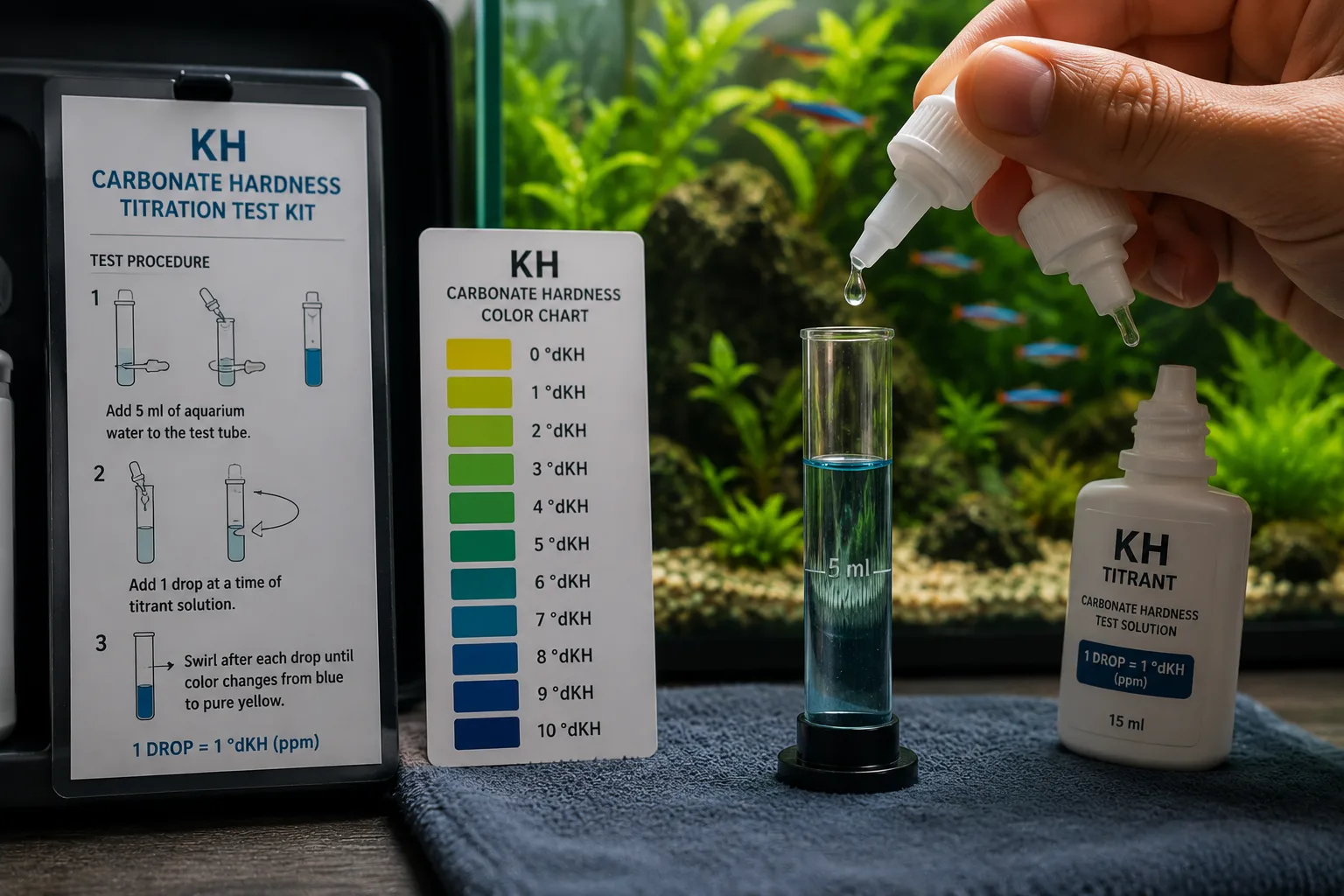
The standard method. API, JBL, Salifert, and other brands produce KH titration kits that work by adding drops of reagent to a water sample until the colour changes. The number of drops required corresponds to the KH value.
Accuracy: Good. Error is typically ±0.5–1 dKH, which is acceptable for aquarium management. The colour change point (from blue to yellow in most kits) should be sharp and clear — if the transition is gradual, the reagent may be old or the sample dilution incorrect.
Common errors: Using too little or too much sample volume (follow the kit instructions exactly), old or expired reagent that produces a faded or gradual colour change, and testing water that has just received a chemical addition (wait 24 hours after any chemical dosing before testing for an accurate baseline reading).
Test Strips
Less accurate than liquid kits for KH and should not be relied on for precision management. The colour gradations between KH values (particularly below 4 dKH where precision matters most) are often indistinguishable. Acceptable for confirming that KH is “in a reasonable range” in a stable, well-managed tank. Not acceptable for detecting low KH before a crash, where the difference between 2 dKH and 0 dKH is critical.
Digital Meters
No reliable consumer-grade digital meter directly measures KH. Some multiparameter testers include a KH reading that is inferred from conductivity or other measurements — these are unreliable for KH specifically. Use a liquid titration kit.
Testing Frequency
New tank in first 3 months: Weekly, to establish the KH depletion rate in your specific tank with your specific stocking and water change schedule.
Established tank, stable water changes: Monthly is sufficient if the previous monthly tests have shown stable KH.
Planted tank with CO₂ injection, soft water: Weekly during the first 6 months, then fortnightly once a stable pattern is established.
After any change to stocking, feeding, or water change schedule: Resume weekly testing for 4–6 weeks to re-establish the new depletion rate.
13. Units — dKH, ppm, meq/L Explained
KH is expressed in three units across different test kits and guides, causing significant confusion.
dKH (degrees of carbonate hardness / deutsche Karbonathärte) The most common unit in aquarium hobbyist contexts. One dKH equals the buffering equivalent of 17.8 mg/L (ppm) of calcium carbonate (CaCO₃).
ppm as CaCO₃ (parts per million expressed as calcium carbonate equivalents) Used in municipal water reports and some American aquarium products. Divide ppm CaCO₃ by 17.8 to convert to dKH.
Example: Delhi NCR tap water often reports alkalinity as 120–250 mg/L as CaCO₃. Dividing by 17.8 gives approximately 6.7–14 dKH.
meq/L (milliequivalents per litre) Used in scientific and marine contexts. 1 meq/L = approximately 2.8 dKH.
Quick conversion table:
| dKH | ppm as CaCO₃ | meq/L |
|---|---|---|
| 1 | 17.8 | 0.36 |
| 3 | 53 | 1.07 |
| 6 | 107 | 2.14 |
| 8 | 142 | 2.86 |
| 10 | 178 | 3.57 |
| 14 | 249 | 5.0 |
When reading municipal water quality reports or comparing across sources using different units, convert to dKH for consistency with aquarium management targets.
14. India and Delhi NCR — Specific Considerations
High tap water KH is a stability advantage
Delhi NCR tap water KH of 8–14 dKH means most Delhi NCR aquariums have robust pH buffering as a baseline feature of their water source. This is genuinely advantageous for fish-only and community tanks — pH crashes from KH depletion are rare in tanks receiving regular water changes with Delhi NCR tap water, because the replacement water continuously replenishes the buffer that nitrification depletes.
Hobbyists in Delhi NCR who experience pH crashes almost always have either: (a) not done water changes consistently, or (b) been using RO water or active substrates that deliberately reduce KH without supplementing to maintain adequate buffering.
The CO₂ planted tank challenge
The same high KH that protects fish-only tanks creates a specific challenge for CO₂-injected planted tanks. As explained in Section 5, CO₂ injection in high-KH water requires much higher CO₂ concentrations to produce a detectable pH drop. Standard CO₂ calibration methods (targeting a 1-unit pH drop) can produce dangerous CO₂ levels in Delhi NCR hard water.
The solution: RO water blending (50% RO + 50% tap water brings KH to approximately 4–7 dKH) and a drop checker with 4 dKH reference solution for CO₂ monitoring. The complete strategy for managing CO₂ in Delhi NCR hard water is in Hard Water Aquariums in Delhi NCR.
Seasonal KH variation
Delhi NCR tap water chemistry varies seasonally as the municipal water source mix shifts between groundwater (typically higher TDS, higher KH) and surface/canal water (typically lower TDS, lower KH). KH measured in October may be measurably different from KH measured in July. Test tap water KH periodically through the year rather than relying on a single measurement taken at tank setup.
RO water in Delhi NCR
Domestic RO purifiers are common in Delhi NCR homes for drinking water. The waste output of these systems (typically 3–4 times the purified volume) is tap water with approximately 10–20% of original TDS — retaining some KH. The purified output is near-zero KH and near-zero GH.
For aquarium use: RO purifier output is appropriate for softwater species blending and for CO₂ planted tank KH reduction. Always remineralise before adding to the tank — pure RO water with no KH and no GH added causes osmotic stress and is entirely inappropriate as an aquarium water source in its unmixed state.
For KH in the context of all water chemistry parameters as an integrated system, see the Complete Water Chemistry Guide.
Frequently Asked Questions
What does KH mean in aquarium keeping?
KH stands for carbonate hardness (from the German Karbonathärte). It measures the concentration of bicarbonate and carbonate ions in the water, expressed in degrees (dKH). KH determines the water’s buffering capacity — its ability to resist pH change when acids or bases are introduced. In aquariums, KH is the foundation of pH stability. Low KH means pH is vulnerable to swings and crashes. Adequate KH means pH remains stable despite normal biological acid production.
What is the difference between KH and GH?
GH (general hardness) measures calcium and magnesium concentration — the “scale-forming” minerals that determine whether water is hard or soft in the domestic sense. KH (carbonate hardness) measures bicarbonate concentration — the buffering system that determines pH stability. They are different measurements that happen to often correlate in natural water (limestone releases both calcium and bicarbonate) but are not the same thing. A water with high GH can have low KH (calcium sulphate water), and a water with low GH can have moderate KH (sodium bicarbonate added to soft water). Managing GH affects fish osmoregulation. Managing KH affects pH stability.
Why does my aquarium KH keep dropping?
The nitrification process — the biological conversion of ammonia to nitrate that makes tanks safe for fish — continuously produces acid as a byproduct. Your filter’s beneficial bacteria are consuming KH every hour they process ammonia. If water changes don’t replenish KH at the same rate as nitrification depletes it, KH falls steadily. Soft tap water (low KH), infrequent water changes, overstocking, or CO₂ injection all accelerate the rate at which KH falls relative to replenishment. Test KH monthly and adjust water change schedule or supplement with sodium bicarbonate before KH falls below 4 dKH.
How do I raise KH in my aquarium?
Sodium bicarbonate (baking soda, NaHCO₃) is the simplest and most controllable method. Dissolve 1 level teaspoon (4–5g) per 40 litres of actual tank water volume in a cup of tank water and add slowly over 30–60 minutes. This raises KH by approximately 2–3 dKH. Test 24 hours later and repeat if needed. Raise by no more than 3–4 dKH per day to avoid pH shock from the associated pH rise. Crushed coral in a filter media bag is a slower, passive alternative that is self-regulating over weeks.
How do I lower KH in my aquarium?
Blend tap water with RO (reverse osmosis) water in a specific ratio to dilute KH. A 50/50 blend approximately halves the KH. For softwater species requiring very low KH (0–2 dKH), 80–100% RO water with GH-only remineralisation is the correct approach. Peat filtration gradually reduces KH through organic acid release but is slow and imprecise. Do not attempt to lower KH with commercial products in hard water — the buffer neutralises added acids immediately and the effect is temporary.
What happens when KH reaches zero in an aquarium?
When KH reaches zero, the buffering system that resists pH change is completely exhausted. Normal biological CO₂ production from fish and bacteria that would produce a 0.2-unit pH change in a well-buffered tank now produces a 2.0-unit crash. A pH crash to 5.5–6.0 overnight is possible in a fully stocked tank with zero KH. Fish experience acute physiological stress, gill damage, and potentially death. The crash appears sudden but represents weeks of gradual KH depletion reaching its endpoint. If you test KH and get zero in a stocked tank, restore KH immediately with sodium bicarbonate before the next overnight period.
What KH should I have for a planted tank with CO₂?
Target 3–6 dKH for a CO₂-injected planted tank. This range provides enough buffering to prevent pH crashes from overnight CO₂ accumulation while being low enough that CO₂ injection produces a detectable pH response at safe concentrations. In hard water areas (KH 8–14 dKH from tap water), use RO water blending to bring KH into this range. Always calibrate CO₂ with a drop checker using 4 dKH reference solution rather than monitoring pH — pH is an unreliable CO₂ proxy in high-KH water.
Can KH be too high for fish?
High KH itself is not directly harmful to most fish — it is the elevated pH that typically accompanies high KH that can be problematic for certain species. Most community fish tolerate KH up to 10–12 dKH without difficulty. The species most sensitive to high KH/high pH are those adapted to soft, acidic water: discus, cardinal tetras, Caridina (crystal/bee) shrimp, and many South American dwarf cichlids. For these species, KH above 3–4 dKH combined with the associated pH elevation prevents comfortable osmoregulation. For most other species in a stable high-KH tank, high KH is more benefit (pH stability) than problem.
How does KH relate to marine alkalinity?
Marine aquarium alkalinity is measured in the same unit (dKH) as freshwater KH, but the management context is different. In reef systems, corals build their calcium carbonate skeletons from dissolved calcium and carbonate/bicarbonate, consuming both alkalinity (KH) and calcium from the water. Alkalinity in reef tanks (target 7–11 dKH) is actively supplemented through dedicated dosing systems (kalkwasser, two-part, calcium reactors) to replace what coral calcification consumes. The same bicarbonate buffering chemistry applies, but the consumption rate and management approach are specific to marine reef systems.