
By ProHobby™ | Ecological Systems Authority
Phosphate is the aquarium parameter most consistently blamed for algae and most consistently mismanaged as a result. The instinct — phosphate causes algae, therefore eliminate phosphate — is both partially correct and routinely counterproductive. Phosphate at excessive concentrations does support algae growth. But phosphate at zero is as much a problem as phosphate at high concentration, particularly in planted tanks where phosphorus is an essential plant nutrient. And in most aquariums, phosphate control through removal products addresses a symptom while leaving the cause unchanged. For phosphate in the context of all measurable water chemistry parameters as an integrated system, see the Complete Water Chemistry Guide.
This guide covers phosphate completely: what it is, where it comes from, how it behaves differently from nitrate, what concentration actually causes problems, the N:P ratio that determines whether plants or algae win the nutrient competition, and every effective management method — including the planted tank situations where phosphate needs to be added rather than removed.
Table of Contents
- What Phosphate Is and Where It Comes From
- How Phosphate Behaves — Different from Nitrate
- The N:P Ratio and Algae Competition — Why Both Matter
- How Toxic Is Phosphate to Fish?
- What Phosphate Level Is Safe — and What Is Too Low?
- Zero Phosphate — When It’s a Problem
- Why Phosphate Accumulates and Why It’s Hard to Remove
- Phosphate in Tap Water — The Hidden Input
- Diagnosing Your Phosphate Problem
- How to Reduce Phosphate — Methods That Work
- How to Add Phosphate — The Planted Tank Problem
- Phosphate in Specific Tank Types
- India and Delhi NCR — Specific Considerations
- Frequently Asked Questions
1. What Phosphate Is and Where It Comes From
Phosphate (PO₄³⁻) is the aquarium-relevant form of phosphorus — an essential element for all life. Phosphorus is a structural component of DNA, RNA, and ATP (the cellular energy currency), a major component of cell membranes (as phospholipids), and an essential nutrient for plant growth and fish physiology.
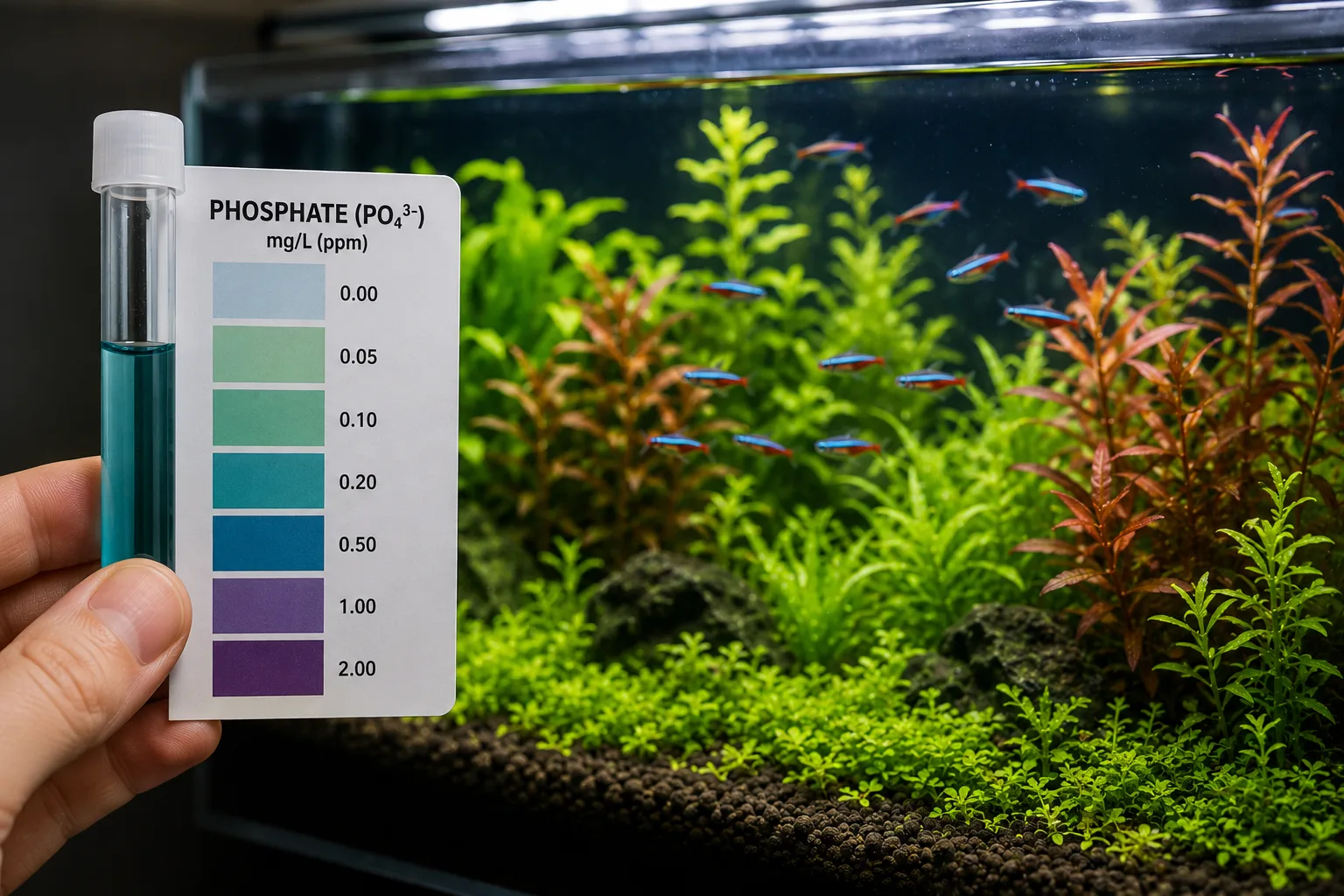
In aquariums, phosphate is measured as orthophosphate (PO₄³⁻), the dissolved, bioavailable form. Total phosphorus includes phosphate plus organic phosphorus compounds not yet broken down to orthophosphate — most test kits measure orthophosphate specifically.
Primary phosphate sources in aquariums:
Fish food. By far the largest phosphate input in any stocked aquarium. Fish food — flake, pellet, frozen, live — contains phosphorus at approximately 0.5–2% of dry weight. Fish absorb only 20–40% of dietary phosphorus; the remainder is excreted as phosphate directly into the water. Every meal is a phosphate addition to the water column. This is unavoidable — you cannot eliminate phosphate input while feeding fish. Nitrate accumulates through the same feeding pathway as phosphate and should be managed alongside it — the complete guide is Aquarium Nitrate.
Fish waste. Phosphate excreted through urine and gill excretion adds to the water column continuously.
Tap water. Some municipal water supplies contain phosphate from agricultural runoff or from deliberate addition — orthophosphate is added to some water supplies as a corrosion inhibitor to prevent lead and copper leaching from pipes. Tap water phosphate in India varies from near-zero to 0.5 ppm depending on source and treatment. See Section 8.
Decomposing organic matter. Uneaten food, dead plant tissue, and dead organisms decompose to release phosphate. A tank with significant organic accumulation in substrate or hardscape crevices has ongoing phosphate release that continues regardless of feeding reduction.
Substrate. Some substrates, particularly marine live sand and certain freshwater substrates, can release phosphate during establishment. Most established substrates in freshwater systems act more as phosphate sinks (adsorbing phosphate) than sources.
2. How Phosphate Behaves — Different from Nitrate
Phosphate and nitrate are both aquarium nutrient parameters requiring management, but they behave very differently in the aquarium environment.
Nitrate is highly water-soluble, remains dissolved in the water column, and is quantitatively exported through water changes (each water change removes proportional nitrate) and plant uptake. Nitrate from the water column is equally available to plants whether they are rooted in substrate or floating.
Phosphate has a more complex fate:
Precipitation and adsorption. Phosphate readily forms insoluble compounds with calcium, iron, and aluminium ions. In hard water at high pH — such as Delhi NCR tap water — phosphate forms calcium phosphate precipitates and is removed from the water column. This is why water column phosphate can test very low in hard water tanks despite significant phosphate input from feeding. The phosphate is not absent — it is precipitated and accumulated in substrate and sediment. The calcium hardness that drives phosphate precipitation is part of the KH system — the complete KH guide, including the Delhi NCR hard water context, is Aquarium KH — Carbonate Hardness Complete Guide. The calcium and magnesium concentrations (GH) that create the hard water precipitation effect are covered in Aquarium GH — General Hardness Complete Guide.
Substrate accumulation. Precipitated phosphate and adsorbed phosphate in substrate can be substantial — often orders of magnitude higher concentration in substrate than in the water column. This accumulated reservoir releases phosphate slowly back into the water column under certain conditions (reduced pH, disturbance of sediment, changes in redox chemistry).
Bioavailability varies. Phosphate precipitated with calcium at high pH is largely unavailable to plants — they cannot access it for uptake. This creates the counterintuitive situation where a planted tank in hard water may have adequate total phosphorus in the system but insufficient bioavailable water column phosphate for plant uptake.
Water changes export less efficiently. Because much phosphate is sequestered in substrate rather than dissolved in the water column, water changes export less phosphate per litre changed compared to nitrate. A 25% water change removes 25% of water column phosphate but essentially none of the substrate-adsorbed phosphate.
3. The N:P Ratio and Algae Competition — Why Both Matter
The relationship between nitrogen (as nitrate) and phosphorus (as phosphate) determines whether plants or algae have the competitive advantage in any aquatic system.
The Redfield ratio — named after oceanographer Alfred Redfield — describes the naturally occurring nitrogen-to-phosphorus ratio in marine plankton at approximately 16:1 by molar mass (approximately 7:1 by mass). This ratio reflects the proportional requirements of phytoplankton for growth.
When N:P ratio is above this threshold (excess nitrogen relative to phosphorus), phosphorus becomes the limiting nutrient — algae growth is constrained by phosphorus availability.
When N:P ratio is below this threshold (excess phosphorus relative to nitrogen), nitrogen becomes the limiting nutrient — algae growth is constrained by nitrogen availability.
In freshwater aquariums, the N:P dynamics are more complex than marine systems because of the multiple algae and plant species involved and the additional influence of light and CO₂. However, the general principle holds: ensuring neither nutrient is dramatically in excess relative to the other reduces algae competitive advantage.
Practical implications:
Very low phosphate with high nitrate → phosphorus limitation suppresses some algae growth, but also suppresses plant growth and may favour certain algae types that are more efficient at phosphorus scavenging.
Very low nitrate with adequate phosphate → nitrogen limitation suppresses overall algae growth. This is why very heavily planted tanks with near-zero nitrate often have minimal algae despite not controlling phosphate.
Both nutrients elevated → maximum algae growth potential, requiring light limitation and physical removal to control algae.
Both nutrients at appropriate levels for plant growth → the optimal planted tank condition, where plants outcompete algae through superior access to CO₂, light, and root-zone nutrients.
The complete nutrient competition framework — how light, CO₂, nitrogen, and phosphorus interact to determine whether plants or algae win — is in Nutrients, CO₂ and Algae — The Balancing Act. The practical application of the N:P competition principle — diagnosing which specific algae type you have and what is causing it — is in Why Algae Keeps Coming Back.
4. How Toxic Is Phosphate to Fish?
Phosphate is essentially non-toxic to fish at aquarium-relevant concentrations. Fish do not experience direct phosphate toxicity at any concentration that naturally occurs in aquariums — they regularly encounter phosphate at concentrations far higher than typical aquarium readings within their own gut during digestion.
This is the key distinction between phosphate and ammonia, nitrite, or even nitrate: phosphate does not harm fish directly at any concentration found in typical aquarium management contexts.
The biological concern with elevated phosphate is entirely indirect — phosphate is a plant nutrient that, at elevated concentrations and in combination with light and nitrogen, supports algae growth. The problem elevated phosphate creates is aesthetic (algae), ecological (algae outcompeting plants), and potentially secondary (algae die-off creating oxygen depletion or organic load), not direct toxicity.
For marine corals, phosphate is not toxic at low aquarium concentrations but inhibits calcification at concentrations above approximately 0.1 mg/L. This makes phosphate management genuinely critical for reef systems — not because of fish toxicity but because of coral physiology.
Practical consequence: Treating elevated phosphate as an urgent safety emergency (comparable to elevated ammonia or nitrite) is incorrect framing. Phosphate management is important for aesthetic and competitive ecology reasons, not because fish are at immediate physiological risk from elevated phosphate readings.
5. What Phosphate Level Is Safe — and What Is Too Low?
Freshwater fish-only tanks: No specific safety threshold — phosphate at any naturally occurring concentration is non-toxic to fish. Management target is based on algae prevention rather than fish welfare. Target below 0.5 mg/L for manageable algae pressure; below 0.25 mg/L reduces significant algae growth advantage.
Planted freshwater tanks: Target 0.1–1.0 mg/L for plant growth support. Below 0.05 mg/L may limit plant growth. Above 1.0–2.0 mg/L in combination with elevated nitrate and adequate light increases algae pressure significantly. The target is a productive range that supports plants without excessively favouring algae.
Marine fish-only: Below 1.0 mg/L acceptable; below 0.5 mg/L preferable to limit nuisance algae.
Marine reef: Below 0.1 mg/L is the standard target. Above 0.1 mg/L begins to inhibit coral calcification and zooxanthellae density. SPS (small polyp stony) corals target below 0.05 mg/L. This is where phosphate management is genuinely critical rather than primarily aesthetic.
Neocaridina and Caridina shrimp: Phosphate is not directly harmful to shrimp. The algae management targets for their tank type apply.
6. Zero Phosphate — When It’s a Problem
Zero phosphate tests in a planted freshwater aquarium with fish and regular feeding is almost always either a test accuracy issue or a substrate adsorption effect masking available phosphate — not genuine zero phosphate.
However, genuinely very low phosphate (below 0.05 mg/L) in a planted tank does occur, particularly in:
High-tech planted tanks with very fast-growing plant mass. Plants with sufficient light, CO₂, and other nutrients consume phosphate rapidly. If dosing does not keep pace with uptake, water column phosphate can drop to near zero. Plants show phosphate deficiency: older leaves develop purple or reddish tints (anthocyanin accumulation associated with phosphate stress), growth slows, and leaf texture may become thicker.
Tanks using aggressive phosphate removal media (GFO, lanthanum). Overdosing phosphate removal can deplete phosphate below plant requirements, producing deficiency symptoms while simultaneously stressing the biological system that requires phosphate for microbial activity.
RO water tanks without appropriate mineral supplementation. RO water contains essentially no phosphate. If dosing does not provide phosphate as part of the fertiliser programme, planted tanks on full RO can develop deficiency.
Phosphate deficiency symptoms in plants:
- Purple or red tints developing on leaves of species that are normally green (phosphate stress triggers anthocyanin production)
- Slow growth despite adequate light, CO₂, and nitrogen
- Older leaves developing spots or premature yellowing
The response is to add phosphate — monopotassium phosphate (KH₂PO₄) is the standard planted tank phosphate source. The Fertilizer Dosing Calculator calculates the correct dose for tank volume and target concentration.
7. Why Phosphate Accumulates and Why It’s Hard to Remove
Phosphate does not have a biological removal pathway equivalent to the nitrogen cycle.
Nitrogen is removed from the aquarium system through denitrification — anaerobic bacteria convert nitrate to N₂ gas that leaves the water. This biological nitrogen removal occurs continuously in well-established substrate and certain filter media.
Phosphorus has no equivalent gaseous export. The biological “removal” of phosphate is through assimilation into plant or algal biomass — but this is not true removal unless the biomass is physically extracted from the tank. When plants are trimmed and removed, the phosphorus in that biomass leaves the system. When algae die and decompose in the tank, the phosphorus is recycled back into the water.
The substrate phosphate reservoir:
In established aquariums, phosphate accumulates in the substrate at concentrations far exceeding water column levels. This reservoir is released back into the water column gradually as:
- Substrate is disturbed by vacuuming or fish activity
- pH drops into acidic range, increasing phosphate solubility
- Redox conditions change in deeper anaerobic substrate zones
- Existing substrate adsorption sites saturate (over years)
Decomposing organic matter that releases phosphate also produces ammonia as nitrogen mineralises — creating simultaneous phosphate and ammonia spikes after significant accumulation events. The complete guide is Ammonia in Aquariums — Spikes, Poisoning and How to Lower It. Regular filter maintenance removes accumulated organic matter before it contributes to both phosphate and ammonia load — the safe protocol is in How to Clean an Aquarium Filter Without Killing Bacteria. In new or disrupted tanks, nitrite also accumulates before the nitrogen cycle processes it to nitrate.
Substrate phosphate accumulation means that the “phosphate history” of a tank matters. A long-established tank that received high phosphate input for years may have a substrate reservoir that continuously releases phosphate into the water column regardless of feeding reduction — making rapid phosphate reduction difficult without physical substrate replacement.
Substrate phosphate accumulation also interacts with pH — lower pH increases phosphate solubility and can release substrate-adsorbed phosphate into the water column. The complete pH management guide is Aquarium pH — Complete Diagnosis and Fix Guide. The microbial communities in substrate biofilms both process and sequester phosphate — their ecology and how substrate management affects biological processing is in Biofilms — The Invisible Engine of Every Aquarium.
8. Phosphate in Tap Water — The Hidden Input
Tap water phosphate is an often-overlooked phosphate input that limits the minimum achievable water column phosphate regardless of feeding and removal measures.
Sources of phosphate in tap water:
Agricultural runoff. In agricultural areas and many regions drawing on river water with agricultural influence, tap water contains phosphate from fertiliser leaching. Common in Indian surface water systems.
Corrosion inhibitor addition. Some municipal water treatment systems add orthophosphate (typically 0.5–1.0 mg/L) deliberately to water supplies as a corrosion inhibitor. Phosphate at this concentration coats the interior of distribution pipes, reducing lead and copper leaching from ageing infrastructure. Delhi NCR municipal water may contain added orthophosphate for this purpose, though concentrations and treatment practices vary by area and season.
Natural geological input. Water flowing through phosphate-bearing geological formations accumulates phosphate naturally.
Testing tap water for phosphate:
Test your tap water directly before attempting phosphate management. If tap water reads 0.3+ mg/L phosphate, water changes will not reduce tank phosphate below that level — every water change is adding phosphate while simultaneously diluting existing tank phosphate.
The equilibrium phosphate from tap water input through water changes follows the same mathematics as tap water nitrate described in the nitrate article: at 25% weekly changes, equilibrium tank phosphate approaches 4× the tap water phosphate concentration from water changes alone, plus the additional input from feeding.
If tap water phosphate is significant:
- RO filtration before use removes phosphate from incoming water
- Phosphate-adsorbing media (GFO, aluminium oxide) in line or on the tap water treatment system removes phosphate before it enters the tank
- Adjust management expectations — achieving very low phosphate targets is not possible through water changes in high-phosphate tap water areas without tap water pre-treatment
9. Diagnosing Your Phosphate Problem
High phosphate with algae:
First verify it is truly a phosphate-driven problem. Algae can grow with adequate phosphate from fish feeding even when water column phosphate tests low — because algae can access substrate-adsorbed phosphate through root-like attachment. Algae can also grow with limiting phosphate if light and nitrogen are sufficient.
The diagnostic question is: after addressing light (is the photoperiod appropriate?), CO₂ (is the CO₂ adequate for the plant mass and light?), and nitrate (is N:P ratio appropriate?), is elevated phosphate still a plausible factor?
In fish-only tanks and tanks with limited plant mass, reducing phosphate input (less food, less stocking) and export (more water changes, phosphate removal media) directly addresses algae pressure.
In planted tanks, the approach is first to optimise plant growth (adequate light, CO₂, balanced nutrients including phosphate) so that plants outcompete algae at any given phosphate level.
Low phosphate with poor plant growth:
Purple-tinged leaves, slow growth despite adequate light and CO₂, and normal or elevated nitrate with tested phosphate below 0.05 mg/L points to phosphate deficiency. Dose monopotassium phosphate and observe over 2 weeks.
Phosphate rising despite water changes:
Test tap water. If tap water contains phosphate, the water change input is adding phosphate that may partially offset the removal from the water change itself. Calculate whether tap water phosphate input explains the rising trend. If yes, pre-treat tap water with RO or inline phosphate removal.
If tap water tests near zero for phosphate and levels are still rising despite water changes, the substrate reservoir is releasing accumulated phosphate. Consider increasing water change frequency or volume, or physical substrate intervention (selective vacuuming to export settled phosphate-adsorbing sediment).
10. How to Reduce Phosphate — Methods That Work
Reduce Input — The Most Effective Long-Term Strategy
Feed less. Since food is the primary phosphate input, reducing feeding reduces phosphate accumulation rate more effectively than any removal method. Feed only what fish consume in 2–3 minutes. Remove uneaten food promptly — uneaten food decomposes and releases phosphate regardless of whether it was consumed. See How Often to Feed Fish.
Reduce stocking. Fewer fish produce less phosphate per day. If phosphate is persistently elevated despite feeding reduction and regular water changes, overstocking relative to the tank’s export capacity is a likely cause. Use the Aquarium Stocking Calculator to determine whether current stocking is generating phosphate faster than the tank’s export capacity can handle.
Remove organic accumulation. Phosphate from decomposing matter in substrate crevices, behind equipment, and in filter sediment continues releasing phosphate. Regular substrate vacuuming and filter maintenance reduces this reservoir. Use the Water Change Calculator to calibrate water change schedule.
Water Changes — Partial Phosphate Export
Water changes remove dissolved water column phosphate in proportion to the volume changed. They do not remove substrate-adsorbed or precipitated phosphate. As a primary export method, water changes are more effective for phosphate in soft water (where less precipitates into substrate) than in hard water (where more precipitates). The Aquarium Volume Calculator ensures water changes are calculated from actual water volume for accurate dose replacement.
Plant Uptake and Biomass Removal
Fast-growing plants assimilate phosphate continuously. Trimming and removing plant cuttings physically exports the phosphorus incorporated into plant tissue. This is genuine phosphate removal from the system — unlike algae grazing where the consumed algae’s phosphate is recycled if the grazer’s waste remains in the tank.
Floating plants (hornwort, Salvinia, Pistia, duckweed) have particularly high phosphate uptake rates because their roots are in continuous contact with nutrient-laden water and their growth rate is rapid.
GFO (Granular Ferric Oxide)
The most effective phosphate removal media. GFO (also sold as iron hydroxide, ferric oxide, or under brand names like Two Little Fishies PhosGuard, Seachem PhosGuard, and others) adsorbs phosphate onto iron oxide surface sites.
How to use: Place GFO in a media reactor (tumbled GFO) or in a filter media bag with moderate flow over it. Change when GFO is exhausted — test phosphate; if phosphate is no longer being reduced, the GFO is saturated. In a reef system targeting very low phosphate, GFO may need replacement every 2–4 weeks. In a freshwater system with moderate phosphate, every 4–12 weeks.
Caution: GFO can reduce phosphate too aggressively in planted tanks, causing deficiency. Monitor phosphate weekly when first introducing GFO and stop or reduce when phosphate reaches the lower end of target range. Never use GFO in a planted tank without monitoring — deficiency symptoms develop within 1–2 weeks of phosphate dropping below plant requirements.
Aluminium Oxide-Based Removers
Similar mechanism to GFO but using aluminium oxide as the adsorption medium. Available as commercial products (Seachem Phosguard is aluminium oxide-based, not iron oxide). Effective for both phosphate and silicate removal. Safer for planted tanks than GFO in some formulations (lower total adsorption rate) but must still be monitored.
Lanthanum Chloride
Used primarily in advanced marine systems. Lanthanum ions form highly insoluble lanthanum phosphate precipitate on contact with dissolved phosphate, effectively pulling phosphate from the water column instantly. Extremely effective but requires careful dosing — excess lanthanum is toxic to fish and invertebrates. Not recommended for freshwater hobbyist use without expert guidance. Standard in large-scale aquaculture and commercial display systems.
11. How to Add Phosphate — The Planted Tank Problem
In high-growth planted tanks with adequate light, CO₂, and good plant mass, phosphate can deplete to deficiency levels. The correct response is to add phosphate as part of the fertiliser programme.
Monopotassium Phosphate (KH₂PO₄) — the standard planted tank phosphate source. Provides potassium alongside phosphate (both are required plant nutrients). Available as laboratory-grade chemical or within commercial planted tank fertiliser products.
Dosing calculation: A dose of 1g KH₂PO₄ per 100 litres of actual tank water volume raises phosphate concentration by approximately 4 mg/L. For most planted tanks targeting 0.2–0.5 mg/L phosphate, doses of 0.05–0.1g per 100 litres are appropriate — small, precise amounts. The Fertilizer Dosing Calculator and Aquarium Volume Calculator together provide accurate dosing from actual tank volume.
Frequency: Dose 2–3 times per week as part of the overall fertiliser programme, testing weekly until a stable target range is established. After the routine is calibrated, monthly testing is sufficient to confirm the target is being maintained.
Commercial all-in-one fertilisers for planted tanks typically include phosphate as part of their formulation. If using a complete AIO fertiliser like ProHobby™ SIGNATURE at recommended doses, separate phosphate supplementation may not be needed unless the tank shows deficiency symptoms.
12. Phosphate in Specific Tank Types
Fish-Only Freshwater Tanks
Phosphate management is purely algae-prevention motivated. The primary tools are feeding reduction, stocking management, and water changes. Phosphate removal media may help in tanks with persistent nuisance algae, but if the cause is overfeeding, removal media treats the symptom. Feed less, change more water regularly, and the algae that responds to phosphate excess typically improves within 2–4 weeks.
Community Planted Freshwater Tanks
Maintain phosphate in the 0.1–0.5 mg/L range. In lightly planted tanks, this is typically achieved by fish feeding input and regular water changes without active management. In densely planted high-growth tanks, dose phosphate as part of the fertiliser programme if testing shows depletion.
High-Tech CO₂ Planted Tanks
The most important phosphate management context in freshwater. Rapid plant growth depletes phosphate quickly. Monitor weekly and dose monopotassium phosphate to maintain 0.1–1.0 mg/L. Use GFO or other removal only if phosphate rises above 2 mg/L despite plant mass and feeding management — and monitor carefully to avoid deficiency.
Shrimp Tanks
Phosphate is not directly harmful to shrimp. Follow the algae management targets for the tank type. In shrimp tanks with dense moss or other plants, maintain phosphate in the low productive range (0.05–0.5 mg/L) as for planted tanks.
Marine Fish-Only
Target below 0.5 mg/L. Primary management through water changes (using pre-tested low-phosphate source water or RO) and feeding reduction. GFO supplementation for tanks with persistent nuisance algae.
Marine Reef
Target below 0.1 mg/L (below 0.05 mg/L for SPS corals). GFO is standard. Protein skimmer removes organic phosphorus before it converts to phosphate. Refugium macroalgae (Chaeto) provides biological phosphate export through biomass removal when harvested. Feeding ultra-low-phosphorus foods and using phosphate-tested RO water for water changes. Regular testing with a low-range phosphate kit (standard freshwater kits often cannot resolve concentrations below 0.1 mg/L accurately enough for reef management). Algae die-off events — whether from phosphate management or other intervention — temporarily spike biological oxygen demand. The complete oxygen management framework is in Aquarium Dissolved Oxygen — Complete Guide.
13. India and Delhi NCR — Specific Considerations
The complete Delhi NCR water chemistry profile — including how hard water affects phosphate precipitation, plant nutrient availability, and seasonal variation — is in Hard Water Aquariums in Delhi NCR.
Hard water and phosphate precipitation
Delhi NCR’s high-calcium hard water creates significant phosphate precipitation — calcium phosphate forming in the tank whenever phosphate is introduced. This means:
Water column phosphate may test very low despite significant phosphate input from feeding, because it is precipitating into substrate rapidly. The substrate accumulates calcium phosphate over time.
For planted tanks, this precipitation effect reduces the bioavailable phosphate below what plants can access — plants struggle with what appears to be adequate total system phosphorus but insufficient soluble water column phosphate. Supplementing with additional phosphate dosing and potentially reducing pH slightly (active substrate) improves phosphate availability.
For fish-only tanks, the precipitation effect provides a partial self-limiting mechanism — some phosphate is naturally removed from the water column, reducing algae pressure compared to soft water tanks at equivalent feeding rates.
Tap water phosphate from corrosion inhibition
Some Delhi NCR municipal supply areas add orthophosphate as a corrosion inhibitor. If tap water phosphate tests positive (test your tap water specifically), water changes add phosphate to the system. The volume of this input relative to the tank’s biological phosphate production depends on water change frequency and volume. RO pre-treatment of incoming water removes tap water phosphate before it enters the tank.
Summer organic load and phosphate
In summer, the combination of increased feeding to maintain fish health (higher metabolic demand) with reduced water change frequency (power cut disruption, temperature management challenges) can allow phosphate accumulation. The coincidence of peak summer organic load and peak algae conditions (longer daylight, higher temperature driving algae growth rates) creates the worst algae conditions of the year. Maintaining consistent water changes through summer, feeding conservatively, and ensuring plant health going into summer are the preventive measures.
The systemic framework for understanding how nutrient accumulation — phosphate and nitrate together — contributes to aquarium instability and the failure chain is in the Stability and Collapse in Aquarium Ecosystems cornerstone.
Frequently Asked Questions
What causes high phosphate in an aquarium?
Fish food is the primary phosphate source — phosphorus in food that is not absorbed by fish is excreted as phosphate directly into the water. Every feeding adds phosphate regardless of how clean the tank appears. Additional sources include tap water (some supplies contain phosphate from agricultural runoff or added as corrosion inhibitor), decomposing organic matter in substrate and hardscape crevices, and in some cases substrate or decor that releases phosphate during establishment.
Is phosphate harmful to aquarium fish?
Phosphate is essentially non-toxic to fish at any aquarium-relevant concentration. Fish are not at direct physiological risk from elevated phosphate. The concern with elevated phosphate is entirely indirect — it is a nutrient that supports algae growth in combination with light and nitrogen, creating aesthetic and ecological problems rather than direct fish toxicity.
Chronic elevated phosphate driving persistent algae creates environmental stress conditions that compromise fish immunity — the diagnostic framework for distinguishing environmental stress from genuine disease is in Quarantine vs Medication in Aquariums.
What is the ideal phosphate level for a planted aquarium?
For a planted freshwater tank, 0.1–1.0 mg/L is the productive range that supports plant growth without providing excessive algae advantage. Below 0.05 mg/L may produce phosphate deficiency symptoms in fast-growing plants (purple-red tints on leaves, slow growth). Above 2.0 mg/L in combination with elevated nitrate and adequate light significantly increases algae pressure.
How do I reduce phosphate in my aquarium?
The most effective approach is reducing phosphate input: feed less and remove uneaten food promptly. Regular water changes export dissolved water column phosphate. Fast-growing plants absorb phosphate, and trimming and removing plant biomass physically exports it from the system. GFO (granular ferric oxide) in a filter bag or reactor adsorbs phosphate effectively for more aggressive reduction. Phosphate removal media should be monitored carefully in planted tanks to avoid causing phosphate deficiency.
Why is my aquarium phosphate not going down despite water changes?
Several possible causes: tap water already contains phosphate (test your tap water — if positive, water changes add phosphate as well as remove it); substrate phosphate reservoir is releasing accumulated phosphate back into the water column (established tanks have significant substrate-adsorbed phosphate that releases gradually); or feeding rate and stocking are producing phosphate faster than water changes can export it. Address input (feed less) and consider GFO for faster reduction.
Does zero phosphate mean my aquarium is clean?
In a planted tank with fish, near-zero phosphate is more likely a sign that phosphate is being rapidly precipitated (in hard water) or that plants are consuming it very fast — not that the tank is pristine. True zero phosphate in a planted tank may actually indicate phosphate deficiency for plants. In a fish-only tank, very low phosphate is generally positive from an algae management perspective, though achieving it requires ongoing management input rather than indicating a naturally “clean” state.
Should I use GFO in my planted aquarium?
GFO can be used in planted tanks but requires careful monitoring. GFO is very effective at phosphate removal and can deplete phosphate below plant requirements within days to weeks. If phosphate genuinely needs reduction (above 2.0 mg/L despite feeding reduction and water changes), use GFO at half the recommended rate and test phosphate weekly. Stop GFO use when phosphate drops to the 0.1–0.5 mg/L target range for planted tanks. Do not use GFO indefinitely in a planted tank without testing.
What is GFO and how does it work?
GFO stands for Granular Ferric Oxide — iron oxide granules that adsorb phosphate onto their surface through a chemical binding process. Phosphate ions bond to the iron oxide surface sites, removing them from the water column. GFO is placed in a filter media bag or specialised reactor in the filter circuit. When all available surface sites are occupied (the GFO is exhausted), it is replaced. GFO is the most widely used and most effective phosphate removal media in both freshwater and marine systems.