
by ProHobby™ | Ecological Systems Authority
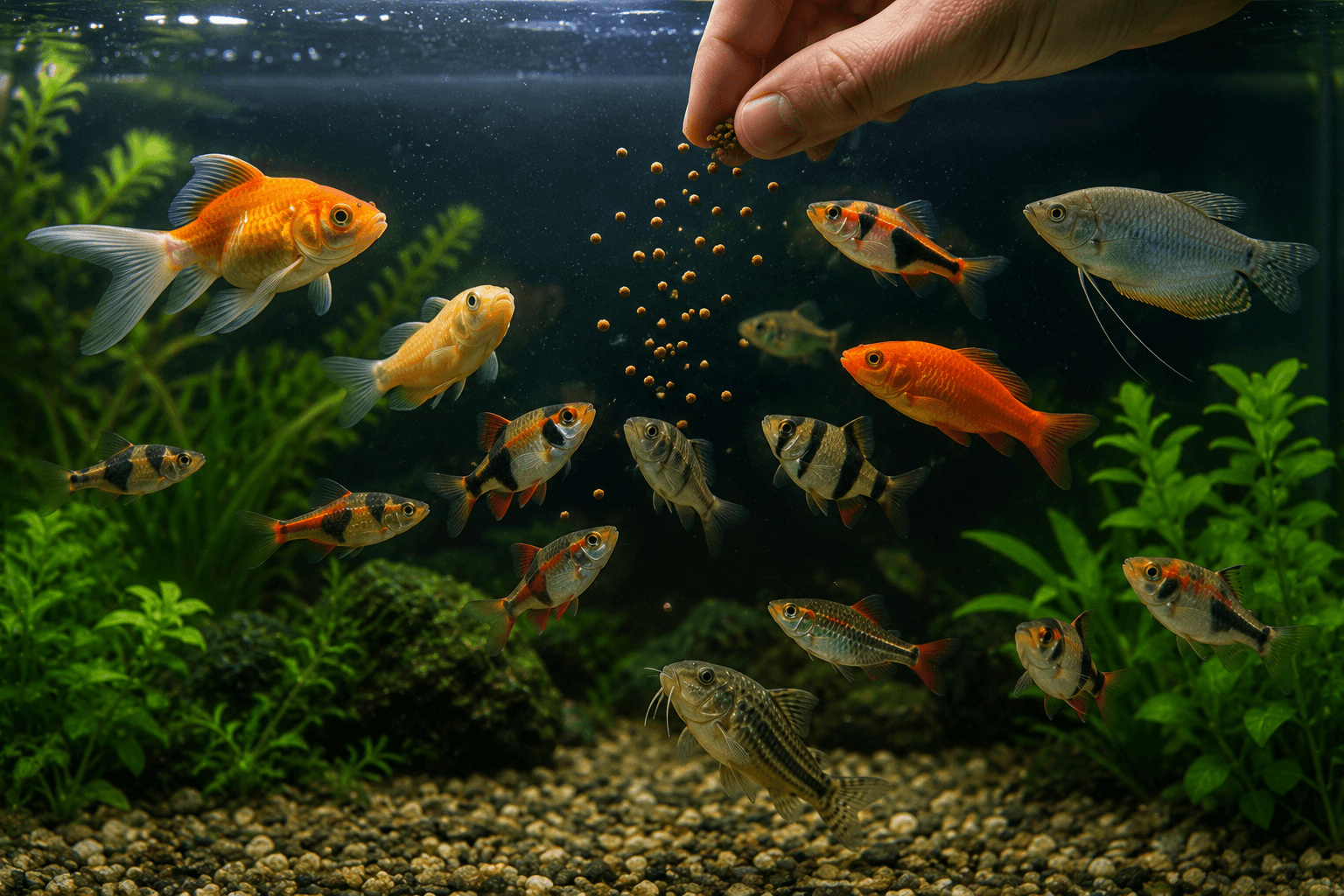
Feeding is the one variable in aquarium keeping that hobbyists control entirely, every day, and that connects directly to water quality, fish health, and tank stability more than almost any other single action. Yet most feeding advice reduces to a single line: feed once or twice a day, only what your fish can eat in two to three minutes.
This is incomplete at best. At worst it actively misleads — particularly for species that do not feed at the surface, species with digestive systems that work nothing like the goldfish the two-minute rule was designed for, and for Indian hobbyists managing tanks through a summer where elevated temperature changes the entire calculus of how much food a tank’s biology can process.
This guide covers the complete science and practice of aquarium feeding: what actually happens to food after it enters the tank, how to calculate appropriate quantities by species type and system, feeding schedules for different systems, food types with honest nutritional assessment, signs of both overfeeding and underfeeding, and India-specific adjustments that international guides do not address.
Table of Contents
- Feeding as Ecosystem Management — The Essential Reframe
- What Happens to Food After You Drop It In
- How Much to Feed — The Real Framework
- 3a. By Feeding Guild: Carnivore, Herbivore, Omnivore
- 3b. By Life Stage: Fry, Juvenile, Adult
- 3c. Temperature and Metabolism
- How Often to Feed — Schedules by System and Species Type
- 4a. Community Freshwater Tanks
- 4b. Predatory Species
- 4c. Herbivores and Grazers
- 4d. Bottom Feeders and Nocturnal Species
- 4e. Marine and Reef Systems
- Food Types — An Honest Assessment
- Signs of Overfeeding — The Complete List
- Signs of Underfeeding — The Commonly Missed Problem
- The Fasting Day — Why One Day Off Per Week Works
- Indian Summer and Feeding — Seasonal Adjustment
- Vacation Feeding — Every Option Assessed
- Automatic Feeders — When They Help and When They Don’t
- Feeding Mistakes That Kill Fish
- Frequently Asked Questions
1. Feeding as Ecosystem Management — The Essential Reframe
Every piece of food you drop into your aquarium is a future ammonia molecule.
This is not an exaggeration. Uneaten food decomposes and releases ammonia. Eaten food is digested and excreted — as ammonia, directly through the gills. The entire biological load that your filter processes daily is, at its origin, the food you put in the tank. Feed more and your biofilter works harder, water quality degrades faster between water changes, algae has more nutrients to exploit, and fish are exposed to higher cumulative ammonia loads. Feed less and the reverse is true.
This means that feeding quantity is not just a question of satisfying hunger — it is the primary lever hobbyists have for controlling the biological load on their tank system. The Carrying Capacity in Aquariums framework identifies waste accumulation rate as one of the four constraints on how many fish a tank can support. Feeding quantity directly controls that constraint. A tank at the upper limit of its carrying capacity can be made more manageable by reducing feeding; a tank under-filtered for its stocking level can be partially compensated for by feeding conservatively.
Understanding feeding this way — as nutrient input management rather than just animal care — transforms how you approach every feeding decision. The Aquarium Stability Is Not Balance cornerstone article explains how closed aquatic ecosystems maintain dynamic equilibrium, and feeding is one of the primary inputs that either supports or undermines that equilibrium. The complete science of how nutrients cycle through aquatic systems — from food input, through ammonia, through the nitrogen cycle, to export — is the subject of the Nutrient Cycles in Nature and Captivity cornerstone article. Feeding is where that cycle begins. For a complete guide to what happens to ammonia once it enters the system — including the pH-dependent toxicity that makes overfeeding more dangerous in Indian hard-water conditions — see Ammonia in Aquariums: Spikes, Poisoning and How to Lower It.
2. What Happens to Food After You Drop It In
Tracing the journey of food through a tank reveals why the conventional two-to-three-minute rule is inadequate for most systems.
Surface food — flakes, pellets, floating sticks — is available for surface and mid-water feeders for the duration of its float time. As it becomes waterlogged, it sinks. Bottom feeders access it once it reaches the substrate. If not consumed there, it enters the substrate and begins decomposing. Decomposition releases ammonia, consumes dissolved oxygen, and contributes to organic load in substrate pockets — processed ultimately by the biofilm communities in your filter and substrate that form the biological foundation of every tank. The science of how these communities manage organic load is covered in Biofilms — The Invisible Engine of Every Aquarium.
Sinking food — wafers, sinking pellets, tablets — bypasses the upper water column and is primarily available to bottom-dwelling species. Left unconsumed, it sits on the substrate and decomposes more slowly than surface food but with the same eventual consequences.
Live and frozen food — consumed rapidly by active fish, with very little entering the substrate unconsumed if sized and quantified correctly. The highest-value feeding method from a waste perspective, but also the highest effort.
The two-to-three-minute rule problem: This rule works reasonably for a standard community tank feeding surface flakes where all fish are surface or mid-water feeders. It fails in four situations that describe a large proportion of real aquarium setups:
First, it ignores bottom feeders entirely. Corydoras, plecos, loaches, and other substrate dwellers are not competing for surface food. They are waiting for it to sink, which takes longer than two minutes. By the rule’s logic, you stop feeding before bottom feeders have eaten.
Second, it assumes all fish feed at the same rate. In a community tank with both active surface feeders (danios) and slower mid-water feeders (gouramis), danios may consume all surface food within ninety seconds while gouramis have barely eaten.
Third, it does not account for water column visibility. A densely planted tank or a tank with multiple levels makes it genuinely difficult to observe whether all food has been consumed within any time window.
Fourth, it was designed for flake food. Frozen bloodworm, sinking wafers, and fresh vegetables have different consumption dynamics that the rule does not capture.
A more accurate framework: feed the quantity your fish can consume completely within the feeding period appropriate to the food type and feeding behaviour of the species — which varies, and is covered in the sections below.
3. How Much to Feed — The Real Framework
3a. By Feeding Guild
Carnivores (cichlids, bettas, most marine fish, puffers, arowana, oscars):
Carnivores have short, simple digestive tracts designed to process dense protein-rich food. They digest a large meal completely but do so less frequently than omnivores. In nature, carnivorous fish often go periods without eating and then consume a large meal — their physiology is adapted for this pattern.
In practice this means: feed carnivores a substantial amount less frequently rather than small amounts constantly. One larger feeding per day — or even once every two days for very large predatory species — is more appropriate than multiple small daily feedings. Overfeeding carnivores does not just cause water quality problems; it can cause fatty liver disease, a serious condition in species like arowana, oscars, and large cichlids that results from chronic excess protein consumption.
Herbivores (plecos, many cichlids, silver dollars, certain tetras, mollies):
Herbivores have long, complex digestive tracts designed to extract nutrition from low-density plant matter that requires high volume to provide adequate nutrition. In nature, herbivorous fish graze nearly continuously. A single daily feeding of flakes does not match their digestive physiology — they need more frequent access to appropriate food, or continuous access to supplementary plant matter.
For herbivores: feed multiple small amounts throughout the day, or provide continuous access to fresh vegetables (blanched courgette, cucumber, spinach, blanched peas for constipation management) or appropriate algae wafers. A herbivore that is eating its tankmates’ fins is likely underfed.
Omnivores (most community fish — tetras, rasboras, danios, barbs, Corydoras, live-bearers):
The majority of aquarium fish are omnivores. They eat a mix of plant material, small invertebrates, and whatever else is available. Their digestive systems are intermediate — neither as long as herbivores nor as short as carnivores. One to two feedings per day of varied food types is appropriate, with the quantity calibrated to consumption without significant waste.
Grazers (otocinclus, most plecos, nerite snails, amano shrimp):
Grazers feed on biofilm, algae, and organic matter on surfaces continuously. They are not target-fed in the traditional sense. Supplement with algae wafers, blanched vegetables, and occasional protein-based food (especially for shrimp and omnivorous catfish species). Assess whether they are adequately fed by their body condition — a visible concave belly in an otocinclus or a pleco that is clearly losing body mass indicates insufficient food.
3b. By Life Stage
Fry (0–4 weeks): Feed very small amounts multiple times per day — four to six feedings for young fry. Their metabolisms are high, their stomachs tiny, and their survival depends on continuous access to appropriate food. First foods: infusoria, vinegar eels, microworms, or commercially prepared fry food. Newly hatched brine shrimp (artemia) for slightly older fry.
Juveniles (1–6 months depending on species): Two to three feedings per day of size-appropriate food. Growing fish have higher nutritional demands than adults and benefit from more frequent feeding. This is also the life stage where overfeeding is most likely — juveniles eat enthusiastically and it is easy to misread this as needing more food.
Adults: One to two feedings per day for most species, calibrated to consumption patterns. Breeding pairs may need additional feeding to support egg production and conditioning.
Old fish: Older fish often have reduced appetites and slower metabolisms. Reduce quantity accordingly rather than trying to maintain the same feeding schedule. Uneaten food from a less-enthusiastic older fish creates unnecessary ammonia load.
3c. Temperature and Metabolism
Fish are ectotherms — their body temperature matches their environment, and their metabolic rate scales with it. At higher temperatures, fish digest food faster, process nutrients more rapidly, and produce more waste per unit of food consumed. At lower temperatures, digestion slows significantly — food sits in the gut longer, and overfeeding at low temperatures can cause constipation, bloating, and secondary bacterial infection.
In Indian summer conditions (tank above 28°C):
- Fish are metabolically active and digest quickly
- Appetite may appear higher than normal
- The biofilter is processing waste faster but also under greater stress
- Uneaten food decomposes faster in warm water, producing ammonia spikes more rapidly
- Reduce feeding slightly — 70–80% of normal quantity — not because fish are less hungry, but because the consequences of excess food in a warm tank are more severe and more rapid
In cooler months (tank below 24°C):
- Digestion is slower
- Reduce feeding frequency for species like goldfish or subtropical fish to every other day
- Allow adequate time between feedings for complete digestion
- Unconsumed food from slower digestion cycles is the primary cause of unexplained cloudy water in winter
4. How Often to Feed — Schedules by System and Species Type
4a. Community Freshwater Tanks
Standard recommendation: Once to twice daily, quantity consumed within 2–3 minutes at the surface for surface feeders, with additional bottom-feeder food added separately after lights-off or simultaneously.
The better framework:
Morning feeding — flake or pellet food appropriate for the surface and mid-water species. Observe carefully: food that reaches the bottom and sits unconsumed after five minutes is excess. Reduce quantity at the next feeding.
Concurrent or evening feeding — sinking wafer or pellet placed directly near Corydoras territory, after or alongside the surface feeding so bottom feeders access it before surface fish consume it all. Many experienced hobbyists feed sinking food at lights-off when surface fish are less competitive.
For planted tanks: the photoperiod determines feeding timing. Feed at or just after lights-on when fish activity peaks, and avoid feeding in the two hours before lights-off in a heavily planted tank to reduce overnight oxygen demand from decomposing food.
4b. Predatory Species
Oscars, large cichlids, puffers, bettas (as the primary or sole tank inhabitant), arowana, and large catfish species all benefit from:
- Once daily or once every other day feeding
- Larger individual portions relative to body size compared to community fish
- Higher protein food (live or frozen foods preferred, pellets acceptable)
- A regular fasting day — one day per week with no food at all
Predatory fish that are fed multiple times daily develop the same obesity and organ stress issues as any animal chronically overfed. A healthy oscar should have a visible body condition without being obviously rounded between feedings. If the belly appears permanently distended, reduce feeding immediately.
4c. Herbivores and Grazers
Mollies, silver dollars, and species with strong herbivore tendencies should receive:
- Two to three feedings of omnivore/herbivore food daily, or
- One main feeding supplemented by continuous access to plant matter — blanched courgette or cucumber slices, blanched spinach or lettuce (not iceberg), algae wafers
Plecos (specifically bristlenose plecos): supplement the tank’s natural algae and biofilm with a sinking wafer every two to three days. Larger wood-eating pleco species (ancistrus variants) benefit from access to driftwood at all times. Assess feeding adequacy by checking that the pleco’s belly is not concave — a pleco that appears hollow-sided is underfed.
Otocinclus: small soft algae grazers that are chronically underfed in most aquariums. They exhaust the tank’s biofilm rapidly and then slowly starve while appearing superficially healthy. Supplement with blanched courgette or cucumber directly on the glass or substrate daily. Body condition is the diagnostic — a healthy otocinclus has a gently rounded or flat belly, not a concave or pinched one.
4d. Bottom Feeders and Nocturnal Species
The single most consistently underfed category in community aquariums. Surface feeders at the top of the water column consume most of what is added during normal daylight feedings, leaving bottom dwellers with whatever flakes survive the journey down — which is variable and often insufficient.
Corydoras, loaches, and substrate-dwelling species should receive:
- Dedicated sinking food dropped to the bottom — pellets, wafers, or sinking granules
- Fed either at lights-off (when surface fish are less active) or in a portion of the tank where surface feeders are less concentrated
- At least once daily, with their feeding separate from or following the surface feeding
Many experienced hobbyists use a pipette or turkey baster to deliver sinking food directly to the substrate near Corydoras resting spots, bypassing surface competition entirely.
Nocturnal species — many loach species, certain catfish — are active feeders after lights-out. Dropping food in the few minutes after lights-off ensures they have access to food during their natural activity window rather than finding only the remains of what surface fish ignored.
4e. Marine and Reef Systems
Marine fish typically have higher protein requirements and benefit from:
- Once to twice daily feeding of appropriately sized food
- Target feeding for specific fish that are outcompeted — use a pipette or feeding stick to deliver food directly to less-aggressive individuals
- Reef systems: coral feeding (target feeding with meaty foods, liquid coral food, or phytoplankton) should occur separately from fish feeding, typically once or twice per week depending on coral type
Protein skimmer and feeding: On heavy feeding days in a marine system, the protein skimmer will work harder and may produce excess skimmate. This is expected and not a cause for concern. Some reef hobbyists turn the skimmer off for one to two hours after feeding to allow suspended food particles to reach corals before being removed from the water column.
5. Food Types — An Honest Assessment
Dry Foods (Flake, Pellets, Wafers, Granules)
Flakes: The most widely used beginner food. Nutritionally adequate for omnivores when high-quality flakes from reputable brands are used. Limitations: high air content, deteriorates quickly once opened (oxidation of fats within 4–6 weeks of opening), floats excessively before sinking, and the fine particles create significant water cloudiness in quantity. Store refrigerated in a sealed container after opening. Replace every 4–6 weeks.
Micro and nano pellets: Superior to flakes for most applications. Denser nutrition per piece, less waste, more targeted feeding. Pellets sized appropriately for the fish’s mouth produce less particulate waste than flakes. For small species (neon tetras, micro rasboras) use 0.5–1mm pellets; for medium species 1–2mm; for cichlids and larger fish 2–4mm.
Sinking wafers: The correct food for most bottom feeders and plecos. Algae wafers for herbivores; protein wafers for omnivorous catfish. The wafer should be sized for the species — a large wafer placed for a single bristlenose pleco in a community tank will be ignored by the pleco and hoarded or contaminated overnight.
Freeze-dried foods (bloodworm, tubifex, brine shrimp): Convenient but nutritionally inferior to their frozen equivalents due to processing. Tubifex, particularly freeze-dried, poses a bacterial contamination risk — it was historically a common vector for introducing pathogens into tanks, though modern processing has reduced but not eliminated this. Use sparingly as a supplement, not a staple.
Frozen Foods
The gold standard for supplementary and main feeding in most systems. Frozen bloodworm, brine shrimp, daphnia, mysis shrimp, cyclops, and chopped seafood provide excellent nutritional variety, are consumed rapidly with minimal waste, and can be fed in precise portions.
Defrost before feeding: Never drop a frozen block directly into the tank. The sudden temperature drop stresses fish and the slow-melting block sits on the bottom while oxygen is consumed in the defrost zone. Place the portion in a small cup of tank water for two to three minutes, then pour the water-and-food mix in directly. This also eliminates the preservation solution that some frozen foods are stored in, which can affect water chemistry.
Storage: Keep in a dedicated small freezer section or in a sealed container to avoid cross-contamination with human food. Use within three to four months of purchase for maximum nutritional value.
Live Foods
The highest nutritional value and the most behaviourally enriching feeding option for most species. Live foods trigger natural hunting behaviour, provide natural prey item nutrition, and are consumed with virtually zero waste. Primary options:
Daphnia (water fleas): Excellent for most freshwater fish. Easy to culture at home in a container of green water. Also functions as a mild laxative — beneficial for fish prone to constipation (bettas, goldfish, many cichlids).
Brine shrimp (artemia): Nutritious, widely accepted. Nauplii (newly hatched) are essential first food for fry. Adult brine shrimp are good for most mid-sized fish.
Bloodworm (midge larvae): Highly accepted by almost all fish. Can be cultured at home or purchased live from aquarium shops. In India, live bloodworm is available from most aquarium shops and is the most practical live food for everyday feeding.
The contamination caveat: Live food from wild-collected sources — tubifex from sewage-contaminated water, for instance — is a genuine disease vector. Cultured or commercially raised live food from reputable sources carries lower but non-zero risk. Quarantine live food in a separate container for 24 hours before feeding as a basic precaution.
Vegetables and Plant Matter
Underused by most hobbyists, essential for herbivorous species. Blanch (brief boiling to soften cell walls) before feeding:
- Courgette/zucchini — ideal for plecos, otocinclus, shrimp. Slice thinly, blanch 30 seconds, attach to tank glass with a clip or weight with a stainless steel fork
- Cucumber — similar use to courgette, higher water content
- Spinach, blanched — accepted by many species, good mineral content
- Peas (shelled, blanched) — specific use for treating constipation in goldfish and bettas; the outer skin is indigestible
- Nori/dried seaweed — ideal for marine herbivores and many freshwater species
Remove uneaten vegetables after 12–24 hours to prevent decomposition.
6. Signs of Overfeeding — The Complete List
In the water:
- Persistent cloudiness that recurs within days of a water change (bacterial bloom from excess organics)
- Ammonia consistently elevated above zero in an established cycled tank
- Nitrate climbing faster than expected between water changes
- Oily or filmy surface layer on the water
- Visible food particles settling on the substrate and remaining there for more than thirty minutes after feeding
On the substrate and surfaces:
- Uneaten food visible on the substrate between feeding sessions
- Algae growth accelerating suddenly without a change in lighting (phosphate from decomposing food fuelling algae — the full analysis is in Why Algae Keeps Coming Back)
- White fungal growth on substrate or decor near food landing zones
- Cyanobacteria (blue-green slime algae) appearing on substrate — a reliable indicator of excess organic matter
On the fish:
- Visible abdominal distension between feedings, particularly in carnivores and bettas
- Reduced activity, floating higher in the water column than normal
- Loss of interest in food at normal feeding time
- In long-term overfeeding: fatty deposits visible around organs in necropsy, abnormal body shape (rounded or swollen abdomen)
The most commonly missed sign: A tank that requires very frequent large water changes just to maintain acceptable nitrate levels is almost always being overfed. Nitrate accumulation rate is a direct reflection of organic input. If your water changes cannot keep pace with nitrate accumulation, reduce feeding before increasing change volume. For the full relationship between feeding, bioload, and water change requirements, the Aquarium Water Change Calculator helps model the specific numbers for your system.
7. Signs of Underfeeding — The Commonly Missed Problem
Underfeeding is significantly less discussed than overfeeding but is a genuine welfare concern, particularly for certain species and in community tanks where competition for food is uneven. Chronic undernutrition suppresses immune function through the same cortisol pathway as environmental stress — an underfed fish is an immunocompromised fish. The full mechanism is covered in The Science of Fish Stress.
Physical signs:
- Concave or hollow-sided belly — the most reliable indicator across all species
- Visible spine from above — in small fish like tetras and rasboras, a visible spine ridge indicates significant weight loss
- Dull or faded colouration — nutritional deficiency manifests as colour loss before other symptoms
- Lethargy inconsistent with species norm — a danio that is not actively swimming is often unwell, and chronic undernutrition is a common cause
- Slow growth in juveniles that should be visibly growing week to week
Behavioural signs:
- Fish actively searching the bottom for food long after feeding is complete
- Aggression at feeding time disproportionate to the species’ normal behaviour — competition for scarce food elevates aggression even in peaceful species
- Herbivores nipping fins or eating plants aggressively — a common sign of insufficient plant-based supplementation
- Bottom feeders visible and active during the day in species that are normally nocturnal — hunger overrides normal behaviour patterns
The community tank inequality problem: In a community tank with a mix of active surface feeders and slower or bottom-dwelling species, it is entirely possible to overfeed in total while systematically underfeeding certain individuals or species. The danios are obese; the Corydoras are hungry. Dedicated sinking food delivered separately is the only solution to this structural problem.
8. The Fasting Day — Why One Day Off Per Week Works
Most experienced hobbyists fast their fish one day per week, and there are solid biological reasons for this practice.
Digestive system rest: Fish digestive systems benefit from complete emptying between large meals. A fasting day allows full digestion of everything consumed over the previous days, reducing the risk of constipation and swim bladder issues associated with chronic overfeeding. In goldfish and carp specifically, overfeeding-induced constipation is the most common cause of swim bladder compression and buoyancy disruption — see Fish Swimming Upside Down: The Complete Guide to Swim Bladder Disorders for the full diagnosis and treatment framework.
Water quality improvement: A day without food input is a day without new ammonia entering the system from digestion. Nitrate accumulation pauses. The biofilter processes accumulated waste rather than new input. Many hobbyists test their best water quality of the week the morning after a fasting day.
Natural behaviour: Most wild fish do not eat every day. Periods of reduced food availability are part of natural fish ecology. Domestically kept fish are often fed at a frequency that has no parallel in nature, and fasting days partially address this mismatch.
Practical benefit: A fasting day is also useful for diagnosing feeding-related problems. If cloudy water or elevated ammonia clears within 24–48 hours of stopping feeding, overfeeding was the cause.
Exception: Do not fast fry, juveniles, or conditioning breeding pairs. Their nutritional needs are too high for safe fasting periods.
9. Indian Summer and Feeding — Seasonal Adjustment
Summer heat changes the entire feeding equation for Indian hobbyists. This section covers the specific adjustments needed, month by month.
March–April (temperatures climbing to 30–34°C):
Fish metabolism is elevated. Fish appear hungrier and more actively seek food. Do not interpret this as a need for more food — elevated metabolism means they are processing and excreting waste faster, not that they have a higher caloric deficit. Maintain normal feeding quantity. Watch for faster-than-normal nitrate accumulation as a signal that the warm water is accelerating waste processing and you may need to adjust.
May–June (peak heat, 32–40°C in many Indian cities):
Reduce feeding to 70–80% of normal quantity. The reasons are compounded:
- Warm water holds less dissolved oxygen — decomposing food consumes oxygen the fish need
- The biofilter is under maximum stress — additional organic input from excess food risks ammonia spikes
- Fish appetites often suppress naturally in very hot water — if fish are showing reduced interest in food, respond by reducing quantity rather than trying to stimulate feeding with better food
Shift feeding to early morning before room temperature peaks. In a tank without cooling, early morning is the coolest and most oxygen-rich point of the day.
Remove uneaten food within two minutes in summer — warm water accelerates decomposition dramatically. What sits harmlessly for five minutes at 26°C can begin producing measurable ammonia in two minutes at 32°C.
For the full thermal management framework covering all aspects of summer tank management including feeding context, see Aquarium Water Temperature in Indian Summer.
July–September (monsoon, humidity high, temperatures moderating):
Resume normal feeding quantities as temperatures drop to more moderate levels. Monitor for water chemistry shifts as municipal water composition often changes during and after monsoon — this is not directly feeding-related but interacts with bioload management.
October–February (cooler months):
For strictly tropical tanks with stable heating, feeding schedule changes minimally. For tanks running cooler than 24°C (goldfish, subtropical species, unheated nano tanks in North Indian winters), reduce feeding frequency — every other day for goldfish below 18°C, and eliminate feeding entirely below 10°C as fish digestion effectively stops.
10. Vacation Feeding — Every Option Assessed
This is one of the most anxiety-producing aspects of fishkeeping for beginners. The practical reality is more forgiving than most hobbyists expect.
How long can fish go without food?
Healthy adult tropical fish can go without food for 7–14 days without harm. Their bodies metabolise stored fat during fasting periods — a process entirely normal to their biology. Fry, juveniles, and fish being conditioned for breeding cannot tolerate extended fasting and require arrangements.
With this baseline, vacations of up to one week require no feeding intervention at all for a healthy adult tropical community tank. This surprises most beginners.
Option 1 — Leave them unfed (up to 7 days):
Perform a thorough water change before leaving. Do not compensate by overfeeding beforehand — this creates a temporary ammonia spike from excess digestion that will be unmanaged while you are away. Feed normally up to the day of departure. Return, perform another water change, resume normal feeding. No equipment, no risk, no intervention needed.
Option 2 — A trusted person feeding (any duration):
The most reliable option for longer absences — but the most commonly mismanaged. Pre-portion each feeding in separate small containers or small zip-lock bags labelled with the day and feeding instructions. Do not leave the fish food container with a well-meaning person and verbal instructions. The single most common cause of aquarium deaths during owner absence is a concerned visitor overfeeding. Pre-portioned containers eliminate all ambiguity.
Option 3 — Slow-release vacation blocks:
Calcium carbonate blocks that slowly dissolve, releasing compressed food. These work adequately for periods of 3–7 days in healthy, lightly stocked tanks. They are not nutritionally complete, they cloud the water somewhat, and they release food at a rate independent of how many fish are in the tank. They are appropriate as a backup for short trips, not a primary feeding solution for longer absences.
Option 4 — Automatic feeder:
Discussed in detail in Section 11. Appropriate for absences of any length when set up correctly. Requires testing before departure.
11. Automatic Feeders — When They Help and When They Don’t
Automatic feeders are drum or wheel-based devices that dispense a pre-loaded quantity of dry food at set intervals. They solve the vacation feeding problem reliably when used correctly — and create specific problems when used incorrectly.
When automatic feeders work well:
- Dispensing flake or small-to-medium pellet food to surface and mid-water fish
- Consistent twice-daily feeding for standard community tanks
- Holiday and absence coverage once the feeder has been tested and calibrated
- Tanks where the owner’s schedule makes consistent manual feeding difficult
When automatic feeders create problems:
- Humidity damage: In humid Indian conditions, food in the drum can clump or go mouldy if the feeder is not designed for high humidity environments. Clumped food may drop in large masses rather than small portions, causing acute ammonia spikes from a single large dump. Test the feeder weekly and clean the drum monthly.
- Incorrect portion calibration: Automatic feeders require testing and adjustment before you rely on them. Run the feeder over a white surface before installing it on the tank to see exactly how much food is dispensed per cycle. Adjust until the portion matches your manual feeding quantity — not what the default settings produce.
- Bottom feeders not served: An automatic feeder dispensing surface food does not address Corydoras, plecos, or other bottom dwellers. If using an automatic feeder for an absence, place sinking wafers manually before leaving.
- Power dependence: An automatic feeder requires power or batteries. In Indian summer power cut conditions, confirm the feeder has battery backup or runs on batteries rather than mains power.
The departure testing protocol: At least three days before any trip, install the automatic feeder, set it to your intended schedule and portion, and watch it feed for two full days. Confirm portions are appropriate, food is dispensing correctly (not clumping or over-dispensing), and all fish are accessing the food. Only travel once this is confirmed.
12. Feeding Mistakes That Kill Fish
Feeding before testing in a new tank. Overfeeding in an uncycled tank accelerates ammonia spikes and is the leading cause of death in new aquariums. Reduce feeding to the minimum — once daily, very small portion — during the cycling period. The detailed explanation of why is in How to Cycle a Fish Tank. If fish are already dying in a new tank, Why Fish Keep Dying in a New Aquarium provides the complete stage-by-stage diagnosis.
Compensatory feeding before a trip. Doubling the feeding the day before a vacation to “tide them over” causes an acute ammonia spike from excess digestion that will peak while you are away with no one to manage it. Feed normally up to departure.
Feeding dry food without observing consumption. Dropping food and walking away means you have no information about whether it was consumed. A two-minute observation after feeding is non-negotiable for calibrating quantity to actual consumption.
Feeding all species the same food. A tank with surface feeders and bottom feeders fed only flake food means the bottom feeders are chronically underfed. Species diversity requires feeding diversity.
Feeding medication-soaked food as a treatment without quarantine. Medicated food dispersed in a community tank exposes all fish and invertebrates to medication, disrupts the biofilter, and treats fish that may not need treatment. Sick fish should be quarantined and treated individually where possible.
Treating uneaten food as “extra food for bacteria.” Uneaten food does not disappear — it decomposes and produces ammonia. The biofilter does not benefit from uneaten food; it is burdened by it. Remove all uneaten food within five minutes of feeding (two minutes in summer), or calibrate portions so nothing reaches five minutes unconsumed.
Ignoring the cumulative effect of multiple food types. Hobbyists who supplement a base flake diet with daily frozen bloodworm, weekly live daphnia, and regular blanched vegetables are feeding more than the base diet suggests. The total nutritional input — not just the primary food type — determines actual feeding quantity and water quality impact.
13. Frequently Asked Questions
How often should I feed my aquarium fish? Once to twice daily for most adult tropical community fish. Carnivorous species once daily or every other day. Bottom feeders require their own dedicated feeding, often at lights-off. The exact schedule depends more on species type and system conditions than on a universal rule.
How much should I feed my fish? Feed the amount your fish consume completely within two to three minutes for surface feeders, calibrated by observation. For bottom feeders, place sinking food sized to what can be consumed overnight without significant remainder. The absence of uneaten food after the feeding window is the correct calibration — not the quantity itself.
Can fish die from overfeeding? Not directly from a single feeding. But chronic overfeeding causes ammonia accumulation that degrades water quality, leads to fatty liver and organ stress in overfed individual fish, and creates conditions for opportunistic disease through immune suppression. Overfeeding is one of the most common causes of chronic tank instability and recurring fish losses. The detailed analysis is in Common Aquarium Issues: Overfeeding and Nutritional Imbalances.
How long can fish go without food? Healthy adult tropical fish: 7–14 days without harm. Goldfish and other cold-water fish: longer, depending on temperature. Fry and juveniles: 1–2 days maximum. Breeding pairs being conditioned: should not be fasted.
Should I feed my fish every day? For most tropical fish, yes — but with one fasting day per week. Daily feeding matches their natural feeding frequency in tropical conditions. The fasting day supports digestive health and water quality simultaneously.
My fish seem hungry all the time. Should I feed more? Not necessarily. Fish do not have a satiety signal equivalent to mammals — they are conditioned food-seeking animals that will respond to a human presence at the tank with food-seeking behaviour regardless of whether they are genuinely hungry. Assess body condition (no concave belly, healthy weight), not behaviour at the tank surface, to determine whether more food is needed.
What is the best food for aquarium fish? A varied diet combining a high-quality staple pellet or flake with regular frozen food (bloodworm, brine shrimp, daphnia) and species-appropriate supplementary foods (vegetables for herbivores, live food for carnivores) is the complete approach. No single food type provides everything. Variety in food type reflects the dietary variety fish would encounter in nature and produces better health outcomes than any single food, however high quality.
Is it okay to feed fish only flakes? Adequate for survival in most omnivorous species if the flakes are high quality and fresh. Not optimal for long-term health, colour expression, or breeding condition. Supplement with frozen foods at minimum two to three times per week for any fish you want to thrive rather than merely survive.
How do I feed fish while on holiday? For up to seven days: leave them unfed. Healthy adult tropical fish tolerate this without harm. For longer absences: use an automatic feeder tested before departure, or ask a trusted person to feed from pre-portioned daily portions you have prepared. Never leave the food container with verbal instructions. See Section 10 for the complete vacation feeding framework.