
By ProHobby™ | Ecological Systems Authority
GH is the water chemistry parameter most directly connected to fish physiology. While KH determines pH stability and nitrate tracks biological load, GH determines whether fish can maintain their internal salt balance, whether plants can build cell walls, and whether the water you are adding to your aquarium is biologically compatible with the animals living in it.
This article covers GH completely: what it measures, how it affects fish and plants at the cellular level, what species need what range, and every scenario where GH causes problems — from the soft water species struggling in hard Indian tap water to the planted tank with calcium deficiency despite regular fertilisation.
This article should be read alongside Aquarium KH — Carbonate Hardness Complete Guide, which covers the buffering side of water hardness, and the Complete Water Chemistry Guide, which integrates all parameters as a system.
Table of Contents
- What GH Actually Is — Calcium, Magnesium, and Hardness
- GH vs KH — Expanding the Distinction
- GH vs TDS — Another Common Confusion
- How GH Affects Fish — Osmoregulation Physiology
- How GH Affects Plants — Nutrition and Cell Structure
- The Ca:Mg Ratio — Why Balance Matters
- What Safe GH Levels Look Like by Species
- Diagnosing Your GH Problem
- How to Raise GH — What Works
- How to Lower GH — What Works
- Remineralising RO Water Correctly
- GH in Specific Tank Types
- GH Testing
- India and Delhi NCR — Specific Considerations
- Frequently Asked Questions
1. What GH Actually Is — Calcium, Magnesium, and Hardness
GH stands for General Hardness (from the German Gesamthärte). It measures the total concentration of divalent cations dissolved in the water — primarily calcium (Ca²⁺) and magnesium (Mg²⁺), with minor contributions from iron, zinc, and other trace divalent metals in most natural water.
In practice, GH is essentially a measure of calcium plus magnesium concentration. It is what most people mean colloquially when they describe water as “hard” or “soft” — hard water leaves scale on kettles and taps, forms the white crust on heater elements and glass, and creates the foam-resistant quality of hard water with soap.
GH is expressed in degrees of general hardness (dGH), also written °GH or °dH. The unit is the same numerical scale as dKH — 1 dGH equals the hardness equivalent of 17.8 mg/L (ppm) of calcium carbonate, making the two scales directly comparable despite measuring different things.
Where GH comes from in natural water: primarily from the dissolution of minerals as water moves through geological formations. Calcium comes from limestone (CaCO₃), gypsum (CaSO₄), and calcium chloride (CaCl₂). Magnesium comes from dolomite (CaMg(CO₃)₂) and magnesium sulphate (MgSO₄, also known as Epsom salt). Rivers flowing through ancient igneous or heavily weathered geology have very low GH — these produce the soft water of the Amazon basin and Southeast Asian blackwater regions. Rivers through limestone bedrock accumulate high GH.
2. GH vs KH — Expanding the Distinction
The GH-KH distinction was introduced in Aquarium KH — Carbonate Hardness Complete Guide and is worth expanding here from GH’s perspective.
GH and KH often correlate in hard water areas because limestone dissolution produces both calcium (contributing to GH) and bicarbonate (contributing to KH) simultaneously. This correlation is why “hard water” is often assumed to mean both high GH and high KH. But they measure genuinely different things with genuinely different biological effects:
GH determines biological compatibility. Calcium and magnesium are essential minerals for life — calcium for bone development, muscle contraction, cell wall integrity, and enzyme function; magnesium for chlorophyll synthesis in plants, enzyme activation, and cellular energy transfer. GH also determines the osmotic challenge that fish face: fish in water close to their body fluid osmolality (internal salt concentration) expend less energy on osmoregulation than fish in water that is very different from their internal chemistry.
KH determines chemical stability. Bicarbonate ions have no direct biological role in fish physiology at normal aquarium concentrations. Their function is chemical: buffering against pH change. A fish does not benefit physiologically from higher KH the way it benefits from appropriate GH.
Practical consequence: You can have high GH, low KH (calcium sulphate-dominated water — hard for the fish, poorly buffered for pH). You can have low GH, moderate KH (sodium bicarbonate added to distilled water — buffered, but osmotically soft). You can correct GH without affecting KH, and vice versa, by choosing the right minerals. Epsom salt (MgSO₄) raises GH without affecting KH. Sodium bicarbonate raises KH without significantly affecting GH. This independent management is what makes correct remineralisation of RO water possible.
How KH and GH together determine pH stability — and why correcting KH is the primary pH management tool — is covered in Aquarium pH — Complete Diagnosis and Fix Guide.
3. GH vs TDS — Another Common Confusion
TDS (Total Dissolved Solids) is a broader measurement than GH. TDS measures the total concentration of all dissolved substances — calcium, magnesium, sodium, potassium, bicarbonate, sulphate, chloride, nitrate, organic compounds, and everything else. GH measures only the divalent cation portion (primarily calcium and magnesium).
High GH always contributes to high TDS, but high TDS does not necessarily mean high GH. Delhi NCR tap water with TDS of 400 ppm may have GH contributing only 150 ppm of that total, with the remainder from sodium, potassium, bicarbonate, sulphate, and chloride.
This distinction matters for:
Shrimp keeping. Neocaridina (cherry) shrimp tolerate TDS of 150–300 ppm. Caridina (crystal/bee) shrimp require TDS of 80–150 ppm. But within these TDS ranges, the mineral composition matters — shrimp need appropriate GH (calcium and magnesium) regardless of TDS. An RO water remineralised with the right minerals at the right TDS provides both appropriate TDS and appropriate GH.
RO water assessment. A TDS meter reading of 0 ppm confirms that RO filtration is working — essentially all dissolved minerals have been removed. A reading above 30–50 ppm on RO output suggests the membrane is degraded or bypassed. But a TDS reading tells you nothing about mineral composition — you need a GH test to know calcium and magnesium specifically.
Planted tank diagnosis. A tank with high TDS but low GH has mineral load that is mostly sodium, chloride, or organic compounds — not the calcium and magnesium that plants and fish need. High TDS alone does not confirm adequate GH.
The complete relationship between TDS, GH, KH, and all other dissolved parameters — including when TDS is a useful measurement and when it is misleading — is in Aquarium TDS — Complete Guide.
4. How GH Affects Fish — Osmoregulation Physiology
Fish are not waterproof. Their gills, which must be permeable to gas exchange, are also permeable to water and dissolved minerals. This means fish constantly exchange water and salts with their environment through osmosis and diffusion — and they must actively work to maintain their internal fluid balance against this exchange.
Freshwater fish have body fluids more concentrated in salts than the surrounding water (hypertonic). Water continuously flows into their bodies through osmosis. Salt continuously leaks out through diffusion. To compensate, freshwater fish produce large volumes of very dilute urine to expel excess water, and actively transport ions back from their gills. This is energetically costly — a freshwater fish at rest expends a meaningful portion of its metabolic energy on osmoregulation.
GH determines the osmotic gradient. In soft water (low GH), the difference between the fish’s internal salt concentration and the surrounding water is larger. The osmotic influx of water is greater. The ion loss is greater. The energy cost of osmoregulation is higher. This is why truly soft water species — discus, cardinal tetras, certain dwarf cichlids — are not simply “preferring” soft water aesthetically. They evolved over millions of years in extremely soft, ion-poor water and their osmoregulatory systems are calibrated for minimum energy expenditure at those parameters. In hard water (high GH), they are working against an increased osmotic gradient continuously, at physiological cost.
In very high GH water, the situation reverses partially — the external salt concentration approaches and eventually exceeds the fish’s internal concentration. The fish must now actively prevent dehydration (water moves out) and prevent salt loading (ions flow in). This is why hard water species like African Rift Lake cichlids, which evolved in water with GH 10–20 dGH, struggle in soft water — their physiology is calibrated for the opposite osmotic challenge.
The immunity connection. Chronic osmoregulatory stress elevates cortisol. Cortisol suppresses immune function. Fish in water significantly outside their optimal GH range are chronically stressed in a way that is invisible on standard tests but measurable through behaviour (reduced activity, reduced appetite), growth (slower than expected), and disease susceptibility (recurring opportunistic infections). The complete physiology of stress and immunity is in The Science of Fish Stress. When ammonia is present alongside GH-related stress, the two forms of physiological damage compound each other — the complete ammonia guide is Ammonia in Aquariums — Spikes, Poisoning and How to Lower It. Incorrect filter cleaning is the most common cause of ammonia spikes in established tanks — the safe protocol is in How to Clean an Aquarium Filter Without Killing Bacteria. Nitrite causes a further distinct crisis: brown blood disease, where fish cannot transport oxygen regardless of water oxygen levels.
The complete framework for how environmental stress suppresses fish immunity — including the oxygen dynamics that compound physiological stress at high temperatures — is in Aquarium Dissolved Oxygen — Complete Guide.
5. How GH Affects Plants — Nutrition and Cell Structure
Plants require calcium and magnesium for different but equally critical functions.
Calcium is the primary structural element of plant cell walls. It is deposited as calcium pectate in the middle lamella — the layer between adjacent plant cells — and is essential for cell division and growth. Calcium-deficient plants show characteristic symptoms: new growth is deformed or twisted, growing tips die back (tip burn), and in severe cases the newest leaves fail to unfurl properly. Calcium is not mobile in plants — it cannot be redistributed from older tissue to new growth. This means calcium deficiency always shows up first in the newest leaves, regardless of how much calcium the older leaves contain.
Magnesium is the central atom in every chlorophyll molecule. Without adequate magnesium, chlorophyll cannot be synthesised and photosynthesis fails. Unlike calcium, magnesium is mobile in plants — it can be redistributed from older leaves to support new growth. Magnesium deficiency therefore appears first in older leaves, which yellow between the veins (interveinal chlorosis) as magnesium is stripped for redistribution to newer growth.
The GH-fertiliser interaction. In adequately fertilised planted tanks, GH provides the baseline calcium and magnesium that supports healthy plant structure. However, GH level affects nutrient availability through ion competition at root uptake sites. Extremely high calcium concentrations (as in Delhi NCR hard water) compete with magnesium and potassium at the same uptake transporters — calcium displaces the other ions, causing effective deficiency of magnesium and potassium even when water column concentrations appear adequate. This is the Ca:Mg ratio problem covered in the next section.
In very low GH water (below 3 dGH), even heavily fertilised planted tanks may show calcium and magnesium deficiency because the water column provides insufficient mineral substrate to support rapid growth.
6. The Ca:Mg Ratio — Why Balance Matters
Calcium and magnesium compete for the same ion channels at both plant root uptake sites and fish gill ion transport sites. The ratio between them, not just their absolute concentrations, determines how effectively each is absorbed.
Ideal Ca:Mg ratio for most planted aquariums: approximately 3:1 to 4:1 (calcium to magnesium by mass).
Delhi NCR hard water is typically calcium-dominant with Ca:Mg ratios of 5:1 to 8:1. At these ratios, excess calcium competes with magnesium at root uptake sites, producing effective magnesium deficiency symptoms in planted tanks — interveinal yellowing of older leaves — despite total GH appearing adequate and magnesium being dosed in fertiliser.
Diagnosis: If older leaves show interveinal chlorosis (green veins, yellow tissue between) in a planted tank with adequate GH and regular fertilisation, Ca:Mg imbalance from calcium-dominant water is the most likely cause.
Correction: Supplement with magnesium sulphate (Epsom salt) — approximately 1 teaspoon per 100 litres of actual tank water volume raises magnesium by approximately 25 ppm, shifting the Ca:Mg ratio toward balance without significantly affecting overall GH. The Aquarium Volume Calculator calculates actual tank water volume for accurate dosing.
For fish: The Ca:Mg ratio affects osmoregulation efficiency at gills. Fish adapted to soft water with more balanced Ca:Mg ratios may show chronic stress signs in calcium-dominant hard water even when total GH and TDS appear within tolerable ranges.
7. What Safe GH Levels Look Like by Species
| Species / Category | Optimal GH Range | Notes |
|---|---|---|
| Most tropical community fish | 4–12 dGH | Wide tolerance; most captive-bred stock adapts |
| African Rift Lake cichlids | 10–20 dGH | High mineral water replicating Rift Lake chemistry |
| Livebearers (guppies, mollies, platies) | 8–18 dGH | Naturally hard water species; prefer higher GH |
| Discus | 1–6 dGH | Soft water species; optimal 1–4 dGH for breeding |
| Cardinal and rummy nose tetras | 1–8 dGH | Prefer soft water; tolerate moderate GH captive-bred |
| Corydoras catfish | 2–12 dGH | Wide tolerance; prefer moderate |
| Neocaridina shrimp (cherry) | 6–12 dGH | Calcium for shell development; stability critical |
| Caridina shrimp (crystal/bee) | 3–6 dGH | Soft water; GH-only remineralisation of RO |
| Goldfish | 6–18 dGH | Wide tolerance; harder water supports bone health |
| Planted tank (general) | 4–12 dGH | Sufficient Ca and Mg for plant structure |
| Marine reef | GH not applicable — managed as calcium separately |
8. Diagnosing Your GH Problem
GH Too High — Hard Water Problems
For fish: Symptoms of GH being too high for the species present are generally subtle and chronic rather than acute. Reduced growth rate, slightly reduced spawning success, and elevated susceptibility to opportunistic disease from chronic low-level osmotic stress. Acute GH shock (fish moved suddenly from soft to very hard water) produces immediate clamped fins, surface gasping, and rapid deterioration — the same presentation as other acute water chemistry shocks. Acute water chemistry shock from large or rapid water changes — including the GH shock presentation that mimics disease — is covered in Fish Dying After Water Change.
Most aquarium fish tolerate GH up to 15–18 dGH without visible distress if the change was gradual. The species most sensitive to high GH are genuine soft water fish: discus, cardinal tetras, Caridina shrimp, and certain South American dwarf cichlids. For these species, GH above 8–10 dGH produces chronic physiological stress regardless of how otherwise well-managed the tank is.
For plants: High GH is a problem primarily through the Ca:Mg ratio imbalance when water is calcium-dominant. See Section 6. High GH itself (balanced Ca:Mg) is generally not harmful to plants.
Correct response: RO water blending is the only reliable approach in hard water areas. Chemical GH-reducing products are not effective in hard water — they cannot overcome the constant GH input from tap water changes. See Section 10.
GH Too Low — Soft Water Problems
For fish: Symptoms appear primarily in fish adapted to harder water: lethargy, reduced spawning, slow growth, and in severe cases (GH below 1 dGH for extended periods) osmotic stress visible as fin clamping and surface orientation. Fish from hard water biotopes (livebearers, African cichlids, Central American cichlids) are most affected.
Critical: GH at zero is dangerous for all fish. Pure RO water with no remineralisation has GH of 0 dGH and TDS near zero. Adding fish directly to unmineralised RO water causes acute osmotic shock — water floods into fish cells through osmosis, cells swell, and acute physiological crisis occurs. This is a genuine emergency that can kill fish within hours. Always remineralise RO water before use. See Section 11.
For plants: GH below 3 dGH produces calcium and magnesium deficiency even with full liquid fertilisation — the water column mineral concentration is insufficient to support rapid plant growth. Symptoms: new leaf deformity, twisted growing tips, tip burn.
Correct response: Raise GH with appropriate mineral additions. See Section 9.
GH and Plant Deficiencies
When plant deficiency symptoms appear in a tank with apparently adequate fertilisation, test GH and evaluate Ca:Mg ratio:
New leaves pale, twisted, or failing to unfurl → calcium deficiency → check GH, raise if below 4 dGH, evaluate Ca:Mg ratio if GH is adequate
Older leaves yellowing between green veins (interveinal chlorosis) → magnesium deficiency → supplement with magnesium sulphate (Epsom salt) to correct Ca:Mg ratio, see Section 6
Both new and old growth affected → multiple deficiencies → GH below 3 dGH providing insufficient overall mineral baseline; raise GH and review fertilisation programme
The complete plant deficiency diagnosis for Delhi NCR conditions is in Why Your Aquarium Plants Aren’t Growing.
9. How to Raise GH — What Works
Magnesium Sulphate (Epsom Salt — MgSO₄)
Raises magnesium and GH without affecting KH or significantly affecting pH. The cleanest way to correct Ca:Mg ratio imbalance in calcium-dominant water.
Dosing: 1 level teaspoon (approximately 5–6g) per 100 litres raises magnesium by approximately 25 ppm and GH by approximately 1.5 dGH. Dissolve in tank water before adding.
Use when: GH is adequate but Ca:Mg ratio is imbalanced (calcium-dominant). When raising GH is needed without affecting KH. When magnesium-specific deficiency symptoms appear in planted tanks.
Calcium Chloride (CaCl₂)
Raises calcium and GH without affecting KH. Pairs with magnesium sulphate for balanced remineralisation of RO water or targeted calcium supplementation.
Dosing: Approximately 0.7g per 100 litres raises calcium by approximately 5 ppm and GH by approximately 0.7 dGH. Dissolve in water before adding — calcium chloride releases heat when dissolved, so allow to cool before adding to the tank.
Use when: Raising GH with calcium specifically. Correcting a Ca:Mg ratio that is too magnesium-heavy. Part of RO remineralisation with targeted Ca:Mg ratio.
Crushed Coral or Aragonite
Calcium carbonate (CaCO₃) that dissolves slowly in water, raising both GH (calcium) and KH (carbonate/bicarbonate). Self-regulating — dissolves faster when pH is low. Passive, low-maintenance method.
Use when: Raising both GH and KH simultaneously is needed (most freshwater community tanks). Long-term passive mineralisation of soft water. Not appropriate when GH needs to be raised without KH increase.
Commercial GH+ / Mineral Supplements
Pre-formulated mineral mixes designed to raise GH to specific values. Products like Seachem Equilibrium, SaltyShrimp GH+, and similar formulations provide a balanced calcium-magnesium ratio. More expensive than DIY mineral solutions but more convenient.
GH-only products (no KH): Essential for softwater setups where KH must remain near zero. Products containing only calcium sulphate, magnesium sulphate, and potassium sulphate raise GH and provide essential minerals without bicarbonate (no KH increase). Required for Caridina shrimp and softwater fish on RO water.
Hard Tap Water Addition
In soft water areas, blending tap water with soft/RO water naturally raises GH. The blending ratio determines the resulting GH. Simple, free, and sustainable if tap water mineral profile is appropriate for the species. Water changes for GH management also export nitrate — calibrating the correct change schedule for both parameters is covered in Aquarium Nitrate and with the Water Change Calculator.
10. How to Lower GH — What Works
GH is difficult to lower by chemical treatment — the minerals (calcium and magnesium) are stable and do not react with easily dosed chemicals in the way bicarbonate (KH) reacts with acid. The practical methods are dilution and exchange.
RO Water Dilution
The most reliable method. RO water has GH near zero. Blending with hard tap water in specific ratios produces predictable GH dilution.
Example: Tap water at 15 dGH blended 50/50 with RO water produces approximately 7.5 dGH. A 70% RO blend produces approximately 4.5 dGH.
This is the standard approach in Delhi NCR and other hard water areas where softwater species are kept. Blend to the target GH, then remineralise the RO portion to maintain appropriate mineral balance.
Zeolite (for temporary, partial reduction)
Zeolite ion exchange resins can remove some divalent cations (calcium, magnesium) from water. Not a reliable long-term GH management solution and not available in all markets. Requires regeneration with salt water between uses.
Peat filtration
Peat releases humic and fulvic acids that bind to some calcium and magnesium ions, mildly reducing GH over time. The effect is slow, modest, and imprecise. Useful as part of a blackwater biotope setup. Not a primary GH management tool.
11. Remineralising RO Water Correctly
RO water — whether from a domestic purifier, a commercial unit, or a dedicated aquarium RO system — has virtually no dissolved minerals: GH near zero, KH near zero, TDS near zero. This makes it chemically clean but biologically dangerous in its raw state.
Why unmineralised RO water is dangerous:
Fish placed in water with zero GH and zero TDS experience acute osmotic shock. With no external mineral concentration to balance against, internal cell fluid rushes outward and the extreme dilution causes cellular dysfunction. Even fish from genuinely soft water biotopes are not adapted to truly mineralised water — natural soft water in the Amazon still contains some trace minerals at 1–3 dGH.
Always remineralise RO water before adding to the tank, every time.
Remineralisation for General Community Fish
Target: GH 4–8 dGH, KH 3–6 dKH, resulting TDS approximately 80–150 ppm.
Products: Commercial GH+KH products (Seachem Equilibrium with added sodium bicarbonate, or purpose-made tap water simulation products). Or DIY: calcium chloride + magnesium sulphate + potassium chloride (for GH) + sodium bicarbonate (for KH), with quantities calculated to target parameters.
Remineralisation for Softwater Species (Discus, Cardinal Tetras)
Target: GH 2–6 dGH, KH 0–2 dKH, TDS 60–120 ppm.
Products: GH-only mineral mixes (no KH component) — Seachem Equilibrium, or DIY calcium sulphate + magnesium sulphate + potassium sulphate blends. Do not add sodium bicarbonate — this would raise KH beyond target.
Ratio: For discus and breeding cardinal tetras, 80–90% RO water remineralised to target GH with a GH-only product.
Remineralisation for Caridina Shrimp
Target: GH 4–6 dGH, KH 0–1 dKH, TDS 100–150 ppm.
Products: SaltyShrimp GH+, Bee Shrimp Mineral GH+, or equivalent. These products are specifically calibrated for the mineral ratios Caridina species evolved with. Do not substitute with general aquarium hardness buffers that contain bicarbonate/carbonate.
Always use dedicated Caridina remineralisation products for crystal and bee shrimp. General-purpose hardness products often contain KH-raising components that push the tank above the KH ceiling that Caridina require.
Use the Aquarium Volume Calculator to calculate actual water volume for accurate remineralisation dosing. Overdosing remineralisation minerals can cause acute osmotic shock as efficiently as underdosing.
12. GH in Specific Tank Types
Community Freshwater Tanks
Most captive-bred tropical community fish are remarkably GH-tolerant. Fish that have been commercially bred for generations in moderately hard water can adapt to GH from 4 to 18 dGH without visible welfare issues, provided the change was gradual. For community tanks, GH management is primarily about avoiding extremes — avoid consistently below 3 dGH (mineral deficiency risk) or above 18 dGH (physiological stress for most species).
CO₂-Injected Planted Tanks
Planted tanks benefit from GH 4–10 dGH providing adequate calcium for cell wall integrity and magnesium for chlorophyll. In Delhi NCR hard water, the Ca:Mg ratio correction (Section 6) is often more important than absolute GH management. Use the Fertilizer Dosing Calculator for precise nutrient management, and supplement with Epsom salt if magnesium deficiency symptoms appear despite adequate overall GH.
African Rift Lake Cichlid Tanks
Target GH 10–20 dGH, replicating Rift Lake chemistry. Delhi NCR hard tap water at 8–15 dGH is often naturally appropriate without modification. Rift Lake mineral salt mixes further adjust GH and KH if tap water values are insufficient. These species actively benefit from the calcium and magnesium for bone density, kidney function, and the specific osmoregulatory adaptations of Rift Lake fish.
Softwater and Blackwater Tanks
For discus, cardinal tetras, South American dwarf cichlids, and equivalent softwater species: target GH 1–6 dGH. In Delhi NCR and other hard water areas, this requires 70–100% RO water blending with GH-only remineralisation. The effort is genuine but the welfare difference between appropriately soft water and hard water for these species is significant — chronic osmoregulatory stress in hard water visibly affects colouration, growth, spawning, and longevity.
Shrimp Tanks
Cherry shrimp (Neocaridina) are the more tolerant shrimp category — GH 6–12 dGH, moderate KH tolerance. Stability is more important than hitting a precise number. Avoid sudden GH changes; acclimate to new water slowly when making chemistry adjustments.
Crystal and bee shrimp (Caridina) require GH 4–6 dGH and KH near zero, on 80–100% RO water with appropriate remineralisation. These are the most water-chemistry-demanding aquarium invertebrates and are not suitable for Delhi NCR tap water without significant water treatment.
13. GH Testing
Liquid Titration Test Kits
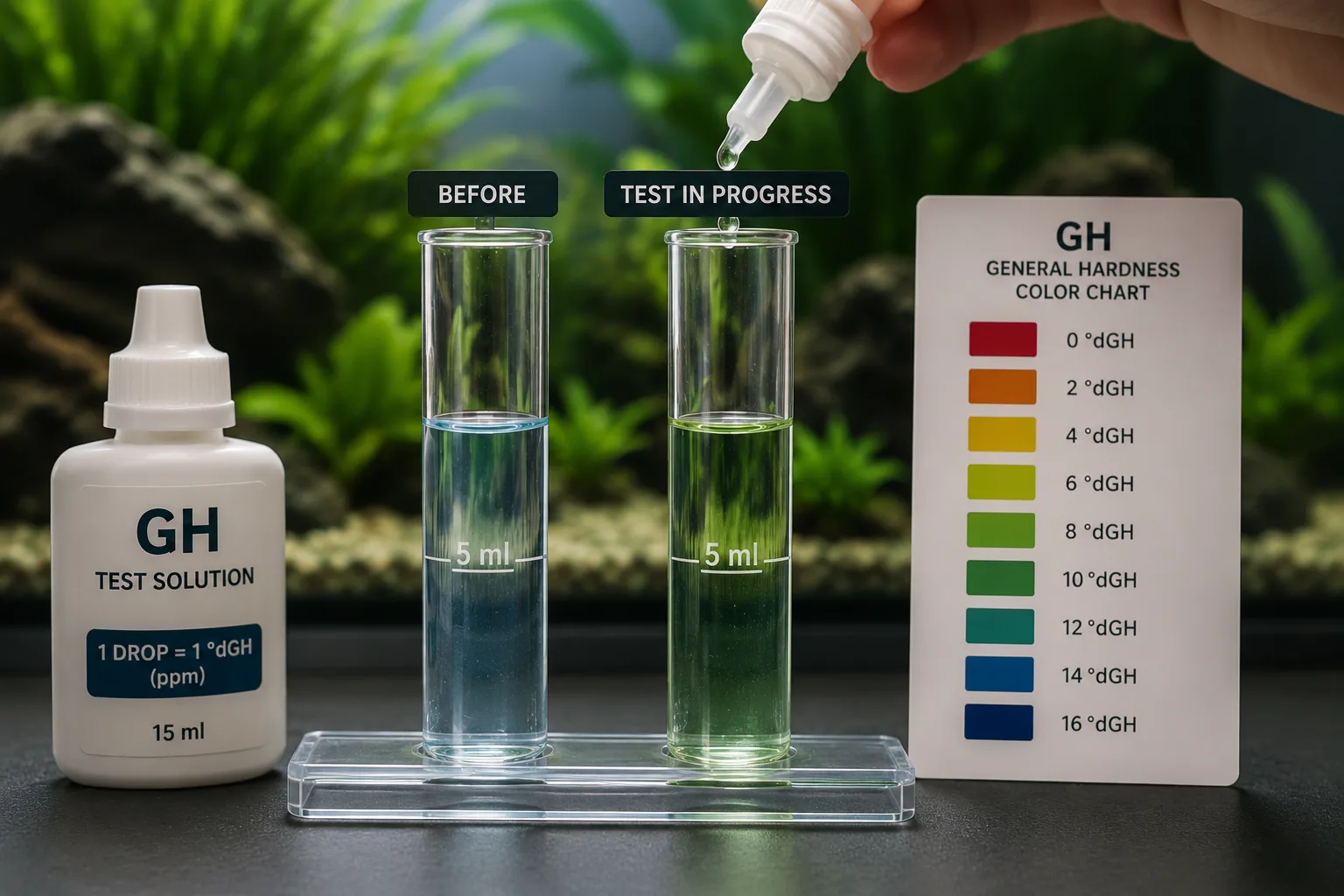
Standard method for GH. API, JBL, Salifert, and others produce GH titration kits. The colour change from red to green (or equivalent) indicates completion of the titration. Count the drops; each drop equals 1 dGH in most kits (check the specific kit’s conversion).
Common errors: Expired or degraded reagent producing gradual rather than sharp colour change; using the wrong sample volume; testing immediately after chemical addition (wait 24 hours).
Test Strips
Less reliable than liquid kits for GH, particularly at low values where precision matters (below 6 dGH). Acceptable for confirming “water is moderately hard” in a stable community tank. Not acceptable for managing softwater species or shrimp tanks where GH precision is important.
TDS Meter as a Proxy
A TDS meter does not measure GH directly but provides a useful cross-check. In RO-water setups with known remineralisation products, the relationship between the added mineral amount and the resulting TDS is predictable. Some hobbyists manage shrimp tanks primarily by TDS with periodic GH confirmation, using TDS as the daily monitoring tool and GH tests for periodic verification.
14. India and Delhi NCR — Specific Considerations
Hard tap water is high GH — know your baseline
Delhi NCR tap water GH is typically 8–15 dGH. Noida and Gurgaon groundwater areas tend toward the higher end; central Delhi municipal supply tends toward the lower end of this range. Before making any GH adjustments, test your specific tap water — Delhi NCR variation is significant enough that a single “typical Delhi water” value is not reliable for management decisions.
Calcium dominance and the Ca:Mg problem
Delhi NCR water is predominantly calcium-dominant, with Ca:Mg ratios typically 4:1 to 8:1. For planted tank hobbyists, this means magnesium supplementation with Epsom salt is routinely needed to correct the ratio, even when overall GH appears adequate. Begin with a baseline dose of 1 teaspoon Epsom salt per 100 litres of actual tank volume and watch for older leaf interveinal yellowing as a continuing deficiency signal.
Delhi NCR hard water also affects phosphate availability through calcium phosphate precipitation — the complete phosphate management framework for hard water conditions is in Aquarium Phosphate — Complete Guide.
RO purifiers and aquarium use
Domestic RO purifiers produce water at approximately 10–20% of input TDS — a Delhi NCR input of 400 ppm TDS produces RO output of 40–80 ppm TDS rather than true near-zero. This is higher than the near-zero of commercial aquarium RO units. The actual GH of domestic RO output in Delhi NCR ranges from 0.5–3 dGH rather than zero. Test before assuming true softness, especially for Caridina shrimp where very low GH is required.
Seasonal variation
Delhi NCR tap water GH varies seasonally — typically lower in monsoon (more surface water dilution) and higher in summer (more groundwater contribution). For softwater species tanks relying on specific RO blending ratios, recheck tap water GH at the start of each major season (pre-monsoon and post-monsoon) and adjust blending ratios accordingly.
The complete Delhi NCR water chemistry profile with area-specific ranges and seasonal management is in Hard Water Aquariums in Delhi NCR.
Frequently Asked Questions
What is GH in aquarium water?
GH (General Hardness) measures the concentration of calcium and magnesium ions dissolved in the water, expressed in degrees (dGH). These minerals determine the osmotic pressure fish cells experience, provide calcium for fish bone development and plant cell walls, and supply magnesium for chlorophyll synthesis. GH is what makes water “hard” or “soft” — hard water has high calcium and magnesium, soft water has low concentrations of these minerals.
What is the difference between GH and KH?
GH measures calcium and magnesium concentration — the minerals affecting fish physiology and plant nutrition. KH measures bicarbonate and carbonate concentration — the chemical buffer system that resists pH change. They are different parameters with different biological effects. GH determines whether fish can regulate their body fluids. KH determines whether pH is stable. You can have high GH with low KH (calcium sulphate water — hard but poorly buffered), or low GH with moderate KH (sodium bicarbonate added to soft water — buffered but osmotically soft). See Aquarium KH — Carbonate Hardness Complete Guide for the full KH coverage.
Is it safe to use pure RO water in an aquarium?
No. Pure RO water with near-zero GH, KH, and TDS causes acute osmotic shock in fish. With no external mineral concentration to provide osmotic balance, internal cell fluid imbalances cause rapid physiological crisis. Always remineralise RO water before adding to a tank — raise GH to the appropriate range for your species (minimum 3–4 dGH for most fish, with KH also added for most setups) before introducing any livestock.
How do I raise GH in my aquarium?
Magnesium sulphate (Epsom salt) raises magnesium and GH without affecting KH — 1 teaspoon per 100 litres raises GH by approximately 1.5 dGH. Calcium chloride raises calcium and GH without affecting KH. Crushed coral raises both GH and KH simultaneously. Commercial GH+ products provide pre-balanced mineral mixes. For softwater species tanks on RO water, use species-specific remineralisation products (SaltyShrimp GH+ for Caridina, Seachem Equilibrium for general softwater fish) rather than improvised mineral additions.
How do I lower GH in my aquarium?
Dilution with RO water is the only reliable method. Blending 50% RO water with 50% hard tap water approximately halves the GH. For species requiring very low GH (discus, Caridina shrimp), blend 70–90% RO with a small proportion of remineralised soft water. Chemical GH reducers are not effective in hard water areas — calcium and magnesium cannot be reliably removed by chemical addition. Change the water source, not the chemistry of the existing water.
My plants have yellowing between the leaf veins — is this a GH problem?
Interveinal yellowing (green veins, yellow tissue between them) on older leaves is a magnesium deficiency symptom — magnesium is the core atom of chlorophyll and is mobile in plants, so older leaves are stripped first when supply is limited. In Delhi NCR and other calcium-dominant hard water areas, the cause is typically not overall low GH but an imbalanced Ca:Mg ratio where excess calcium competes with magnesium at root uptake sites. Test GH, then supplement with magnesium sulphate (Epsom salt) at 1 teaspoon per 100 litres of actual tank water volume to correct the ratio.
What GH do cherry shrimp need?
Neocaridina (cherry) shrimp thrive at GH 6–12 dGH with moderate KH tolerance (4–8 dKH). They are significantly more water-chemistry-tolerant than Caridina shrimp. Delhi NCR tap water is often within or slightly above the upper tolerance range for cherry shrimp — test your specific tap water GH and blend with RO water if above 12–14 dGH. Stability is more important than hitting a precise number; avoid sudden GH changes during water changes by adding water slowly or blending in advance.
Why do my fish seem healthy but keep getting sick?
Chronic low-level osmotic stress from mismatched GH is one of the most common and most overlooked causes of recurring disease in aquariums. Fish in water significantly outside their optimal GH range have chronically elevated cortisol, which suppresses immune function. This produces fish that appear to eat and swim normally but are consistently vulnerable to opportunistic pathogens and slow to recover from any disturbance. If fish in your aquarium repeatedly develop infections that respond to treatment but keep recurring, test GH against the species’ requirements and compare. The physiology of stress-induced disease vulnerability is in The Science of Fish Stress.