
by ProHobby™ | Ecological Systems Authority
Knowing how to do a water change correctly is the foundation of every aquarium maintenance routine — and the task most hobbyists do at least partly wrong — not because the process is complicated, but because most guides explain the steps without explaining the biology. When you understand what a water change actually does inside the tank, every decision — how much, how often, how fast, which dechlorinator, whether to vacuum the substrate — becomes logical rather than arbitrary.
This guide covers the complete process, the science behind it, the India-specific risks that most international guides miss entirely, protocols for different tank types, emergency water change procedures, and an honest account of what water changes cannot do — which matters as much as knowing what they can.
Table of Contents
- What a Water Change Actually Does — The Biology
- What a Water Change Cannot Do
- The Five Variables That Determine Your Protocol
- Equipment You Need
- How to Do a Water Change — Step by Step
- How Much and How Often — The Real Science
- India-Specific Risks Every Hobbyist Must Know
- Water Changes Across Different Tank Types
- Common Mistakes That Turn a Good Water Change Bad
- Emergency Water Change Protocols
- Seasonal Adjustments for Indian Aquariums
- Frequently Asked Questions
1. What a Water Change Actually Does — The Biology
Understanding what happens biologically during a water change explains every protocol decision that follows.
It dilutes dissolved waste compounds. Fish produce ammonia continuously as a metabolic byproduct. In a cycled tank, bacteria convert ammonia to nitrite and then to nitrate. Nitrate is far less toxic than ammonia or nitrite, but it accumulates between water changes. At high concentrations — above 40–80 ppm depending on species — nitrate causes chronic stress, suppresses immune function, and reduces reproductive success. A water change physically removes a proportion of the water containing dissolved nitrate, replacing it with fresh water containing none. A 25% water change reduces nitrate by 25%. A 50% change reduces it by 50%. The dilution principle is this simple and this linear.
The same dilution effect applies to dissolved organic carbon (the complex mixture of organic compounds from fish waste, uneaten food, decomposing plant matter, and biological activity), phosphate, medications, and any other dissolved compound accumulating in the water column. The Complete Water Chemistry Guide covers the full parameter set that water changes affect and what safe levels look like for each.
It replenishes minerals that fish and plants consume. Aquarium water is not a static medium. Fish consume calcium and other minerals through respiration and metabolism. Plants consume calcium, magnesium, potassium, iron, and trace elements through root and foliar uptake. Over time, even well-balanced aquarium water becomes depleted of minerals that are not being replenished between changes. Regular water changes restore the mineral profile toward the starting point of the source water.
It introduces fresh dissolved oxygen. Tap water at room temperature is typically close to oxygen saturation. Adding it to an aquarium provides a brief oxygen boost — though this effect is modest compared to the oxygen supplied continuously by surface agitation. The more significant oxygen benefit of a water change is indirect: by reducing the organic load and biological oxygen demand, it reduces the rate at which existing dissolved oxygen is consumed.
It removes algae spores and free-floating microorganisms. A proportion of free-swimming algae cells, pathogens, and organic particles are physically removed with the outgoing water. This is one reason water changes help manage algae pressure — not by changing the conditions that allow algae to grow, but by mechanically reducing the population with each change.
It does not reset the biological system. This is the most important thing a water change does not do. The beneficial bacteria that process ammonia live in biofilms on filter media, substrate surfaces, and hardscape — not in the water column. Removing and replacing the water does not significantly affect the nitrifying bacterial population. It does not reset the nitrogen cycle, remove the biofilm community, or undo biological maturity. The biology of these communities is examined in Biofilms — The Invisible Engine of Every Aquarium.
2. What a Water Change Cannot Do
This section matters because most aquarium problems are brought to water changes as the first response — and water changes cannot fix most of them.
Cannot fix a cycling tank. During cycling, ammonia and nitrite are elevated because the bacterial community is not yet established, not because the water is dirty. Water changes during cycling reduce ammonia and nitrite temporarily but also remove the ammonia that bacteria need to grow. This slows the cycle. Frequent large water changes during cycling can prevent the cycle from completing at all. The correct cycling approach — including when and how to change water during the process — is in How to Cycle a Fish Tank.
Cannot substitute for filtration. A filter provides continuous biological processing 24 hours a day, converting ammonia to nitrate as it is produced. A water change provides a single dilution event once a week or once a fortnight. In a tank without adequate filtration, water changes become a life-support system rather than a maintenance routine — necessary every day or two to prevent ammonia accumulation. This is not a sustainable substitute for correct filtration capacity.
Cannot cure disease. Water changes improve the environmental conditions that either contributed to disease or are preventing recovery — but they do not kill pathogens, parasites, or resolve infections. They are supportive care, not treatment. The diagnostic framework for distinguishing environmental causes from genuine disease is in Quarantine vs Medication.
Cannot compensate indefinitely for overstocking. In an overstocked tank, nitrate and organic compounds accumulate faster than weekly water changes can export them. The water change frequency and volume required to maintain safe parameters in a heavily overstocked tank escalates progressively. This is load-exceeding-capacity — covered in My Aquarium Keeps Failing — not a water change frequency problem.
Cannot correct a fundamental design imbalance. If light, CO₂, and nutrients are mismatched in a planted tank, water changes do not change that balance. If the biological load exceeds processing capacity, water changes reduce the symptom temporarily but do not address the cause. Understanding the design issues that water changes cannot fix prevents the frustration of doing everything right technically while the tank still fails.
3. The Five Variables That Determine Your Protocol
There is no single correct water change protocol. The right approach depends on five variables specific to your tank. Establishing these before deciding on a routine produces a protocol that actually fits the system.
Tank age. A new tank in the cycling phase needs a different approach from an established tank. During cycling, small water changes (10–15%) are appropriate when ammonia or nitrite reaches dangerous levels, but frequent large changes slow the cycle. An established tank tolerates and benefits from larger regular changes.
Stocking level. A lightly stocked tank produces less waste per litre and tolerates less frequent changes. A heavily stocked tank produces more waste and requires more frequent or larger changes to maintain safe nitrate levels. The stocking-to-filtration ratio is the primary driver of required water change frequency. How Many Fish Can an Aquarium Support covers the four-constraint calculation for sustainable stocking.
Plant density. A densely planted tank with high plant uptake capacity converts nitrate to plant biomass continuously, reducing its accumulation between changes. A heavily planted tank in good condition may maintain safe nitrate levels with less frequent changes than an equivalent fish-only tank. A sparsely planted or fish-only tank accumulates nitrate purely from the nitrogen cycle and requires water changes as the primary export mechanism.
Water source. Tap water, RO water, and mixed water require different approaches to dechlorination, temperature matching, and remineralisation. In Delhi NCR particularly, tap water chemistry varies by area and season in ways that affect water change safety — covered in Section 7 below.
Season. In India, tap water temperature varies by 15–20°C between January and June. The water change approach that is safe in March can be dangerous in January or July without adjustment. Seasonal protocols are covered in Section 11.
4. Equipment You Need
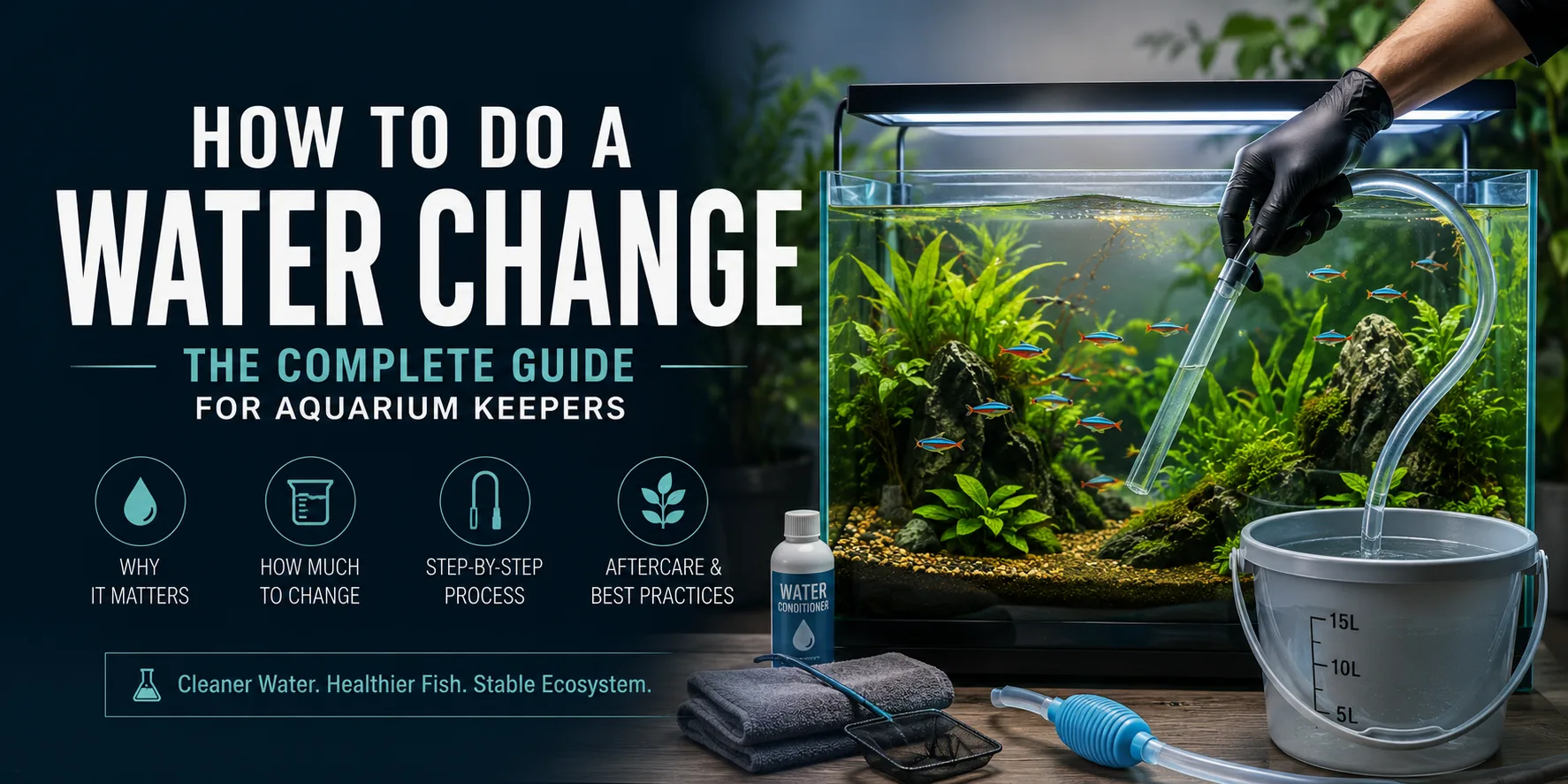
Siphon / gravel vacuum. The primary tool for removing tank water and vacuuming substrate simultaneously. A gravel vacuum with a wide tube head allows debris to be siphoned from the substrate surface while the heavier gravel remains. For aquariums under 100 litres, a standard hand-started siphon with a 25mm tube is adequate. For larger tanks, a self-starting siphon or a Python-style continuous flow vacuum connected to a tap significantly reduces physical effort.
Buckets — dedicated, never shared. Two buckets minimum: one for outgoing water, one for incoming. These must never be used for cleaning with detergents or chemicals. Soap residue in a bucket used for aquarium water can kill fish. Mark them permanently as aquarium-only.
Water conditioner / dechlorinator. Mandatory for any tap water addition. In Delhi NCR and most Indian cities using chloramine rather than free chlorine, the conditioner must specifically state it neutralises chloramines — not just chlorine. Products containing sodium thiosulfate alone handle free chlorine but not chloramine. The ammonia component of chloramine requires a conditioner containing additional binding agents. Seachem Prime, Aqua Safe Plus, and certain other full-spectrum conditioners explicitly address chloramine. Check the label before purchasing and verify it explicitly states chloramine removal.
Thermometer. A digital thermometer for checking temperature match between incoming water and tank water. Do not use touch — the human hand cannot reliably detect a 2°C difference, which is enough to stress sensitive fish.
Test kits. Liquid test kits for ammonia, nitrite, nitrate, and pH. Test before large changes to establish baseline, and 24–48 hours after any significant change to detect delayed effects from substrate disturbance.
Optional but useful: A water change timer or measuring container to track volume. A dedicated water storage container if pre-treating water overnight (for those using RO or wanting to off-gas tap water). For planted tank hobbyists, a TDS meter to verify RO/tap water mix ratios.
5. How to Do a Water Change — Step by Step
Before You Start
Check water temperature. Measure both tap water and tank water. The difference should be less than 1–2°C. If tap water is significantly cooler or warmer, adjust it before adding to the tank.
Check what the tap water will deliver today. In Delhi NCR, tap water chemistry varies seasonally and sometimes day to day. If you have not tested recently, test pH and TDS of incoming tap water — particularly if the season has changed since your last check.
Dose dechlorinator into the bucket before adding water. Add the conditioner to the empty bucket first, then fill it with tap water. This ensures the conditioner mixes with the water before it touches the tank rather than needing to diffuse through the tank to reach the incoming water.
Do not clean the filter on the same day. Filter maintenance and water changes both affect the biological system. Done on the same day, the combined disruption exceeds what the system can absorb. Space them at least a week apart.
The Process
Step 1: Turn off electrical equipment. Switch off the heater before the water level drops significantly — a heater element exposed to air while hot can crack or fail. Turn off the filter if it will be exposed by the lowering water level, and turn off UV sterilisers and CO₂ injection for the duration.
Step 2: Remove the outgoing water. Insert the siphon tube into the tank and start flow — either by creating suction with a hand pump or by briefly submerging the entire tube and then pinching the outlet end before lowering it into the bucket. As water flows, move the vacuum head slowly across the substrate surface. The suction will lift debris, uneaten food, and organic material from the top layer of the substrate while the gravel weight prevents it from being siphoned. Work across a section of the substrate — never the entire bottom at once, and never the same section in consecutive water changes. The biofilm community in the substrate contributes to biological processing; aggressive vacuum of the entire substrate in one session removes more biological capacity than the system can quickly replace.
Remove your target volume. Measure how much water you’re removing by tracking how many buckets you fill, or by marking the water level on the glass before you start.
Step 3: Refill with prepared water. Pour the conditioned, temperature-matched water back into the tank slowly — against the glass wall or over a plate placed on the substrate to diffuse the flow and prevent disturbing the substrate or uprooting plants. Add it gradually if the incoming chemistry is different from the tank (high pH tap water into a CO₂-injected planted tank, for instance) to allow fish to adjust progressively rather than experiencing an instant chemistry shift.
Step 4: Restart equipment. Once the water level is back to normal, restart the heater, filter, and CO₂ injection. Check the thermometer 30 minutes later to confirm the temperature stabilised correctly.
After the Change
Monitor fish for 2–4 hours. A normally behaving fish after a water change indicates no acute chemistry shock. Fish that clamp fins, lose colour, breathe rapidly at the surface, or become lethargic within an hour of a water change indicate something in the incoming water caused stress — most commonly temperature difference, chloramine, or a significant pH shift. If this happens, perform another partial change (20%) with more carefully matched water.
Test 24–48 hours later. If the substrate was vacuumed, test ammonia 24 and 48 hours after the change. Substrate vacuuming can dislodge and remove biofilm communities, producing a delayed ammonia spike as the system adjusts to reduced processing capacity. A reading above zero in a tank that previously tested zero is the diagnostic signal.
6. How Much and How Often — The Real Science
The near-universal advice of “25% weekly” is a reasonable default for a moderately stocked, established freshwater tank. It is not a universal prescription. Understanding the logic behind it allows you to adjust it correctly for your specific situation.
The dilution mathematics. A 25% weekly water change, continued indefinitely, produces an equilibrium nitrate level approximately four times the nitrate concentration of the incoming tap water. If your tap water contains 5 ppm nitrate (common in Delhi NCR municipal supply), the equilibrium nitrate in a 25%-per-week tank is approximately 20 ppm — well within safe range for most species. If tap water contains 20 ppm nitrate (common in some areas), the equilibrium is 80 ppm — at the upper limit of tolerance for sensitive species. Test your tap water for nitrate; it determines the floor of what water changes can achieve.
New tank (cycling phase): 10–15% when ammonia or nitrite exceeds 0.5 ppm. No routine large changes — they slow the cycle. The complete cycling water change protocol is in How to Cycle a Fish Tank.
Lightly stocked fish-only tank (1 fish per 15+ litres, low feeding): 15–20% every 1–2 weeks. Test nitrate monthly to confirm the schedule is maintaining safe levels.
Moderately stocked fish-only tank (standard community, regular feeding): 25% weekly. This is the baseline that the standard advice is calibrated for.
Heavily stocked tank or messy fish (cichlids, goldfish, large carnivores): 30–40% weekly or 20–25% twice weekly. High-bioload species produce substantially more waste per fish than standard community species.
Densely planted, CO₂-injected tank: 30–50% weekly supports the high nutrient turnover that a fast-growing planted tank demands. Plants consume nutrients rapidly; frequent large changes replenish the mineral profile more reliably than smaller infrequent ones. Some high-performance planted tank hobbyists change 50% twice weekly.
Shrimp tanks: 10–15% every 7–14 days, with particular attention to temperature and chemistry matching. Shrimp are significantly more sensitive to parameter shifts than most fish. Osmotic shock from even moderate chemistry differences can kill shrimp that appear healthy immediately after the change. TDS should be matched within 20–30 ppm of the tank.
Never skip more than two consecutive scheduled changes in a moderately or heavily stocked tank. Nitrate, organic carbon, and phosphate accumulate continuously. The longer the gap, the larger the chemistry shift required to correct it — and the larger the correction, the higher the risk of shock.
7. India-Specific Risks Every Hobbyist Must Know
This section addresses risks that are common in Indian aquarium keeping but almost entirely absent from international guides. All four represent genuine fish mortality risks that standard advice does not cover.
Chloramine — Not the Same as Chlorine
Most Indian cities, including Delhi NCR, Mumbai, Bengaluru, and Chennai, treat municipal water with chloramines rather than free chlorine for final disinfection. Chloramine (a compound of chlorine and ammonia) is chemically stable, does not dissipate by aeration or standing water overnight, and is not neutralised by sodium thiosulfate — the active ingredient in most basic dechlorinators.
When chloramine-treated water is added to an aquarium using only a chlorine-specific dechlorinator, the chloramine breaks down into free chlorine (which immediately attacks gill tissue and kills nitrifying bacteria) and free ammonia (which is toxic to fish and feeds the nitrogen cycle in the wrong direction). A hobbyist using the wrong dechlorinator adds a small ammonia dose and a small bacterial-killing event with every water change. This explains chronic biological instability that persists despite correct maintenance in many Indian tanks.
The fix: Use a water conditioner that explicitly states it neutralises chloramines on the label. Confirm the product lists chloramine specifically — not just “chlorine and heavy metals.” Dose at the full recommended amount; underdosing for chloramine is more dangerous than underdosing for free chlorine because the chemistry is less forgiving. The complete Delhi NCR water treatment framework is in Hard Water Aquariums in Delhi NCR.
Overhead Storage Tank Water Temperature
Most Indian homes store water in rooftop overhead tanks before it reaches the taps. In summer — particularly from April through June in North India — the water in these overhead tanks can reach 35–42°C by afternoon as the tank is heated by direct sun exposure.
Adding 40°C water to a 27°C aquarium raises tank temperature by several degrees within minutes if any significant volume is added. At 35°C and above, most tropical fish experience metabolic stress, enzyme disruption, and immune suppression. Repeated exposure through summer water changes causes cumulative damage that eventually manifests as unexplained losses in an otherwise well-maintained tank.
The fix: Always run the tap for 30–60 seconds before collecting water for a water change, allowing the water that has been sitting in hot overhead pipes to clear. Test the temperature of collected tap water before adding it. Perform water changes in the morning when overnight cooling has reduced the overhead tank temperature, rather than in the afternoon when solar heating has peaked. In peak summer, fill a bucket from the tap and allow it to cool to tank temperature before adding.
Hard Water pH Shift
Delhi NCR tap water has high KH — typically 8–14 dKH — and pH of 7.2–8.2 depending on source and season. Planted tank hobbyists running CO₂ injection operate their tanks at pH 6.6–7.0. A standard water change of 25–30% using unmodified Delhi tap water into a CO₂-injected planted tank can shift pH by 0.5–1.0 units within minutes as the high-KH tap water buffers against the CO₂-maintained acidity.
A pH shift of this magnitude causes physiological stress in fish, disrupts enzyme function in nitrifying bacteria, and (in severe cases) can cause osmotic shock in sensitive species. It also causes CO₂ off-gassing as the pH rises, reducing photosynthesis efficiency for the hours following the change.
The fix: Add incoming water gradually — over 5–10 minutes rather than all at once — giving the tank’s CO₂ system time to partially compensate. For sensitive species or high-tech planted tanks, partial RO blending reduces the incoming KH and softens the pH impact. The complete water change strategy for Delhi NCR water chemistry is in Hard Water Aquariums in Delhi NCR.
Power Cuts During Water Changes
A water change with the filter stopped — whether by choice or by a power cut — leaves the tank with reduced surface agitation and no biological processing during the fill period. In summer, a power cut that coincides with a water change (filter stopped, tank partially filled with warm tap water, reduced water volume) can cause oxygen to fall to critical levels within 30–45 minutes in a moderately stocked tank.
The fix: Keep a battery-powered air pump and airstone available, deployable within seconds during a power cut at any stage of the water change process. Do not perform large water changes during known peak load-shedding periods. If a power cut begins mid-water change, prioritise completing the fill and restoring surface agitation before attending to anything else.
8. Water Changes Across Different Tank Types
New Tank — Cycling Phase
During the nitrogen cycle establishment period, water changes serve a specific and limited purpose: reducing ammonia or nitrite when concentrations reach levels acutely harmful to fish (typically above 0.5–1.0 ppm for ammonia, above 1.0 ppm for nitrite).
Outside of crisis intervention, avoid routine large water changes during cycling. The bacteria completing the cycle require ammonia as a food source. Removing it slows their population growth and extends the cycling period. A 10–15% change that brings dangerous levels down without removing all substrate for bacterial growth is the correct calibration. The complete cycling protocol, including exactly when and how much to change during each stage, is in How to Cycle a Fish Tank.
Established Fish-Only Tank
Routine maintenance protocol. The 25% weekly baseline applies here. Substrate vacuuming is appropriate — in sections, not the entire bottom at once. Test nitrate monthly to confirm the schedule is working; if nitrate regularly exceeds 40 ppm before the weekly change, increase volume or frequency.
Lightly Planted Tank Without CO₂
Plants consume some nitrate and nutrients, reducing the accumulation rate between changes. A 20–25% weekly change is typically sufficient. The limiting factor shifts from nitrate accumulation to mineral depletion — plants consume calcium, magnesium, potassium, and trace elements that need replenishing. Fertilisation after water changes (rather than before) ensures the freshest mineral baseline for the following week.
CO₂-Injected High-Tech Planted Tank
Higher change volume (30–50%) supports the high nutrient turnover of fast-growing plants and exports the elevated dissolved organic carbon that a densely planted high-tech tank produces. Add incoming water slowly to manage the pH shift from high-KH Delhi tap water. Perform water changes at a consistent time relative to the CO₂ injection cycle — either 1–2 hours after CO₂ has been running (so plants are in peak photosynthesis during the recovery period) or close to the lights-off period when CO₂ has been off for an hour.
Shrimp Tank
The most sensitive water change scenario. Shrimp are significantly more vulnerable to parameter shifts than fish — a temperature difference of 2°C or a TDS shift of 50 ppm can cause a shrimp death event that appears overnight and is misdiagnosed as disease.
Protocol: 10–15% maximum volume per change. Use a drip method for adding water rather than pouring — a slow drip of new water into the tank over 20–30 minutes allows shrimp to acclimatise to the incoming chemistry continuously rather than experiencing a step change. Match TDS of incoming water to within 20–30 ppm of the tank using a TDS meter. Temperature match to within 0.5°C.
Never perform a shrimp tank water change with water directly from a hot overhead tank in summer.
Marine / Reef Tank
Marine water changes involve additional steps not covered in this guide: mixing saltwater to the correct salinity and allowing it to temperature-stabilise and oxygenate before adding. The mixing chemistry of RO water, sea salt, calcium and alkalinity supplementation, and their interaction during water changes in reef systems is a topic that deserves its own guide. This guide addresses freshwater systems.
9. Common Mistakes That Turn a Good Water Change Bad
Temperature mismatch. The most common cause of fish deaths attributed to water changes. Always measure; never estimate by touch. A 3°C difference is enough to suppress immunity and cause respiratory stress in sensitive species. A 6°C+ difference causes acute shock.
Using the wrong dechlorinator for chloramine. In any Indian city using chloramine treatment, a sodium thiosulfate-only conditioner is inadequate. Fish can die within 24–48 hours of a water change where chloramine was incompletely treated, through gill damage and secondary ammonia toxicity.
Changing too much at once. A single 60–70% change in an established tank causes osmotic stress as fish adjust to a dramatically different water chemistry in minutes. Limit any single change to 50% maximum, with 25–30% being the routine baseline. If nitrate has accumulated to dangerous levels due to a missed maintenance period, correct it with two or three 30% changes spaced 24 hours apart rather than a single massive change.
Cleaning the filter on the same day. Each of these actions removes a portion of the biological community. Together, they remove enough to trigger a measurable ammonia spike in the following 24–48 hours. Space filter maintenance and substrate vacuuming by at least one week. The detailed biology of why this matters is in Biofilms — The Invisible Engine of Every Aquarium.
Vacuuming the entire substrate in one session. The substrate surface is colonised by biological communities that contribute to waste processing. Vacuuming the entire bottom at once removes a significant proportion of this community simultaneously. Divide the substrate into four quadrants and vacuum one quadrant per water change, rotating weekly. Every part of the substrate is cleaned every four weeks, but no more than 25% of the community is disrupted at once.
Ignoring the pH difference between tap water and tank. In a CO₂-injected planted tank particularly, adding high-pH, high-KH tap water rapidly raises pH by 0.5–1.0 units. Add incoming water gradually and test pH before and after until you know how your specific tap water affects your specific tank.
Changing water during a fish health crisis without diagnosing first. A water change as the first response to sick fish is appropriate when ammonia or nitrite is elevated. It is potentially harmful when the cause is a disease that has compromised gill function — adding 25% of cooler, different-chemistry water to fish already in stress adds osmotic and temperature burden on top of the existing physiological challenge. Diagnose before changing. If uncertain, a small 15% change with careful temperature and chemistry matching is safer than a large emergency change. See Fish Dying After Water Change for the complete diagnosis of what goes wrong.
10. Emergency Water Change Protocols
Emergency water changes have different objectives, different volumes, and different timing from routine maintenance.
Ammonia Spike
Objective: Reduce ammonia concentration rapidly to below 0.5 ppm to prevent further gill damage. Volume: 30–40% immediately. Test 2 hours later. If ammonia is still above 0.5 ppm, repeat. Continue 20–25% changes every 12–24 hours until ammonia reads zero across two consecutive tests. Additional: Add an ammonia detoxifier (Prime or equivalent) to bind ammonia to its less toxic ammonium form while the biological system recovers. Do not clean the filter — it contains the bacterial population needed to process the spike. What caused it: Find the cause before the next spike. Ammonia in a cycled tank means either a dead fish (check behind equipment and under substrate), a medication that killed filter bacteria, a power cut that exceeded the filter bacteria’s survival time, or a feeding event that exceeded the system’s processing capacity. The complete guide is in Ammonia in Aquariums — Spikes, Poisoning and How to Lower It.
After a Fish Death
Objective: Remove the ammonia load from a decomposing fish before it spikes the nitrogen cycle. Volume: 20–25% within 24 hours of finding the body. Process: Remove the body immediately upon discovery, as early decomposition produces the highest ammonia release rate. Test ammonia 12 and 24 hours after removal. If elevated, perform a second change.
Medication Overdose or Chemical Contamination
Objective: Dilute the toxic compound as rapidly as possible. Volume: 50% immediately, followed by 30% 12 hours later. Note: Activated carbon added to the filter after the large change will adsorb dissolved chemical compounds and accelerate removal. Remove it after 48 hours — activated carbon saturates and can begin releasing adsorbed compounds if left too long.
After Equipment Failure (Heater Malfunction, Filter Stall, Power Cut)
For heater overheating producing acute temperature elevation: cool the tank gradually with a sealed bag of ice floated in the tank rather than a cold water change — a rapid cold water change adds thermal shock to heat stress. Reduce temperature by no more than 2°C per hour.
For filter failure producing ammonia accumulation: perform a 25–30% water change, add an ammonia detoxifier, and restore biological filtration before the bacteria in the filter media die from oxygen deprivation. A battery-powered air pump connected to a sponge filter provides emergency biological filtration during power outages. The emergency protocol for power cut situations specifically is in Fish Gasping at the Surface of an Aquarium.
11. Seasonal Adjustments for Indian Aquariums
Indian seasons impose specific water change adjustments that a fixed year-round routine does not accommodate. The complete seasonal management calendar is in Seasonal Water Changes in Delhi NCR Aquariums.
January–February (Winter): Tap water is at its coldest — 12–15°C in Delhi NCR. This is the most dangerous temperature mismatch season. A 25% water change with unmodified tap water into a 26°C tropical tank adds 4–5 litres of 13°C water per 60-litre tank — enough to drop tank temperature 2–3°C instantly. Temperature-match winter tap water carefully: add warm water (from a kettle or hot tap) to the bucket to bring the mixture to tank temperature before adding. Test with a thermometer, not touch.
March–April (Pre-summer): Ideal conditions. Tap water temperature is typically 18–22°C — close to tank temperature in most heated aquariums. Standard protocols apply without adjustment.
May–June (Peak summer): The highest-risk water change season. Overhead tank water reaches 35–42°C by afternoon. Morning water changes from overnight-cooled overhead storage are significantly safer than afternoon changes from sun-heated tanks. Test incoming water temperature every time; do not assume it matches previous changes. Simultaneously, fish are under metabolic stress from elevated ambient temperatures — the window for safe water chemistry variation narrows when fish are already heat-stressed. For the complete framework, see Aquarium Water Temperature in Indian Summer.
July–September (Monsoon): Municipal water chemistry may change as water sources shift between groundwater and surface water during monsoon. Treat TDS, pH, and KH as variable during this period — test tap water more frequently than other seasons before relying on a fixed water change protocol. Humidity increases significantly, primarily affecting open-top systems and evaporation rates rather than water change chemistry.
October–December (Post-monsoon / early winter): Tap water stabilises back toward pre-monsoon chemistry. Begin temperature monitoring as ambient temperatures fall, adjusting the water change thermal matching routine before the coldest months.
12. Frequently Asked Questions
How do I know if I’m changing enough water? Test nitrate immediately before your next scheduled water change. If it reads above 20–40 ppm (depending on species — more sensitive fish require lower targets), your current routine is not exporting enough. Increase volume or frequency. If it reads under 10 ppm consistently, you can reduce frequency. Nitrate before the next change is the primary performance indicator for your water change routine.
Can I change too much water at once? Yes. Changes above 50% in a single session risk osmotic shock as fish adjust to a significantly different water chemistry in a short time. Changes above 30% in a tank with a fragile or immature biological system risk disrupting the pH and chemistry stability that nitrifying bacteria require. For nitrate emergencies, perform multiple 30% changes spaced 12–24 hours apart rather than a single 70% change.
Do I need to vacuum the gravel every water change? No. Gravel vacuuming is appropriate every 1–4 weeks depending on stocking level and substrate depth. In a heavily stocked tank, vacuuming a section of substrate every water change (rotating through quadrants) maintains cleanliness without disrupting biological communities excessively. In a planted tank with a deep substrate layer, aggressive gravel vacuuming disturbs the anaerobic zone and root systems — gentle surface passes are sufficient.
Do I need to turn the filter off during the water change? Only if the water level drops low enough to expose the filter intake or impeller. Most hang-on-back and internal filters should be switched off if the water will drop below the intake level during the change — running dry even briefly can damage the impeller. Canister filters sit outside the tank and can generally run throughout a normal water change.
How soon after setting up a new tank should I do the first water change? In a new tank being cycled with fish present: when ammonia exceeds 0.5 ppm or nitrite exceeds 1.0 ppm — as a crisis-management change, not routine maintenance. In a new tank being fishless-cycled: only to correct severe ammonia excess above 5–6 ppm. Routine water changes begin after the cycle is complete and confirmed. See How to Cycle a Fish Tank for the complete new tank water change protocol.
My fish always seem stressed after water changes — what’s wrong? The four most common causes in India: temperature mismatch (tap water too cold in winter, too hot in summer from overhead tanks), chloramine in tap water not being neutralised by the dechlorinator being used, pH shift from high-KH tap water added rapidly to a CO₂-injected tank, or too large a volume changed at once. The complete diagnostic framework for each of these causes, including how to identify which is responsible, is in Fish Dying After Water Change.
Is RO water better for water changes? RO water (reverse osmosis) removes almost all dissolved minerals, producing water with near-zero TDS. This is beneficial for soft-water species (discus, cardinal tetras, blackwater fish), shrimp, and CO₂-injected planted tanks in hard water areas where reducing KH improves CO₂ efficiency and iron availability. Pure RO water must be remineralised before use — it has no buffering capacity and will cause severe pH instability and osmotic stress if added directly to a tank. Most hobbyists use a blend of RO and tap water, adjusting the ratio to reach target TDS and KH. The full RO strategy for Delhi NCR hard water is in Hard Water Aquariums in Delhi NCR.
Do planted tanks need water changes if they have no nitrate? Yes, for two reasons. First, nitrate is not the only compound that accumulates — dissolved organic carbon, phosphate, and various metabolic byproducts build up regardless of plant nitrate uptake. Second, mineral depletion: plants consume calcium, magnesium, potassium, and trace elements continuously. Without water changes replenishing these minerals, deficiency symptoms develop in otherwise well-managed planted tanks over weeks to months. Regular water changes in planted tanks serve as mineral replenishment as much as waste export. The nutrient cycling science behind this is in the Nutrient Cycles in Nature and Captivity cornerstone.
What is the best time of day to do a water change? For routine changes: morning, when overnight cooling has reduced overhead tank water temperature in summer, and when fish are typically less active and less stressed by the disturbance. For CO₂-injected planted tanks: 1–2 hours after CO₂ has been running for the day, so plants are in active photosynthesis during the recovery period and can use the fresh mineral inputs immediately.