
By ProHobby™ | Ecological Systems Authority
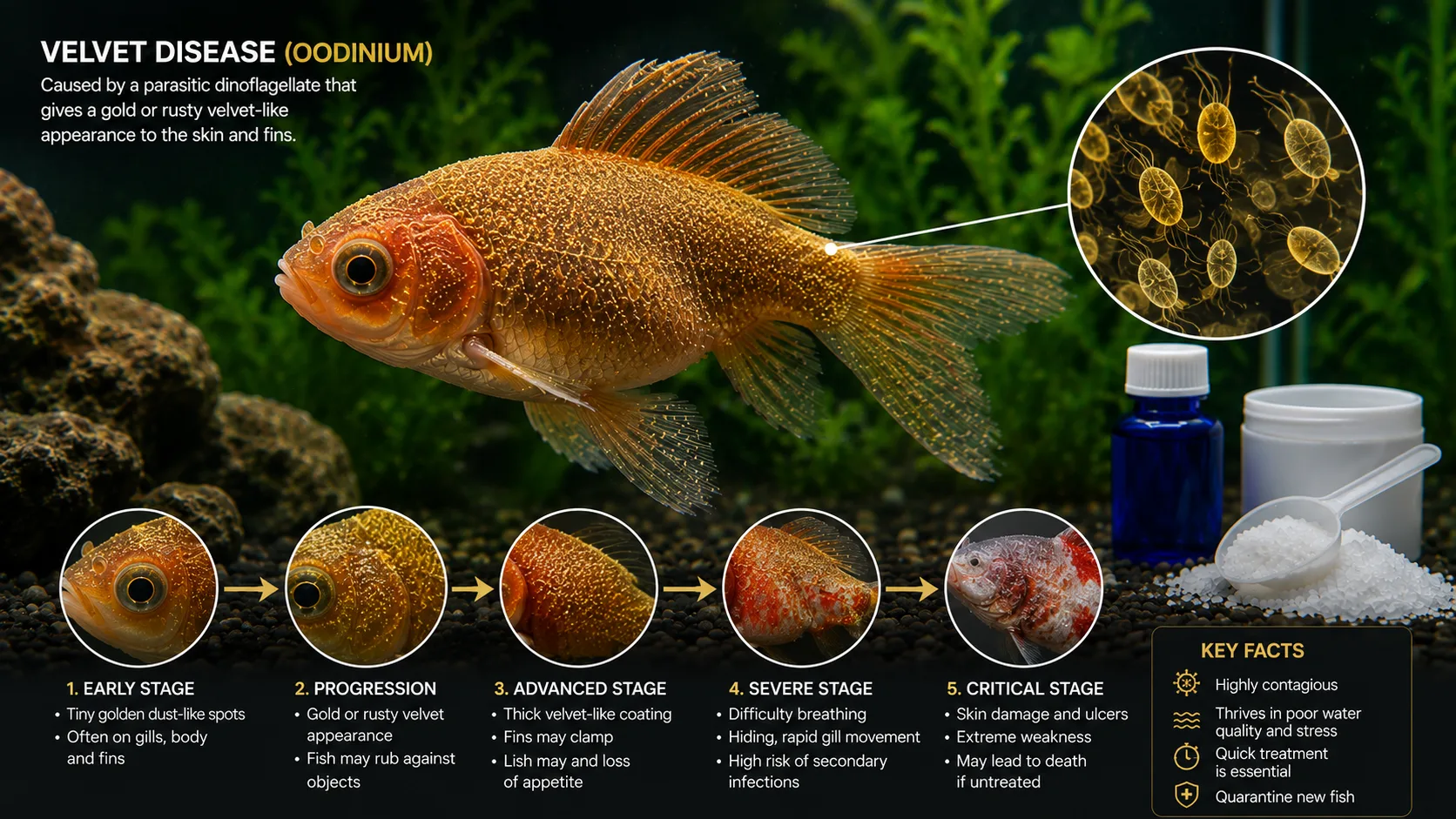
Velvet is the most dangerous common disease in the aquarium hobby. Not the most common — ich is far more frequently encountered. But velvet kills faster than any other disease hobbyists are likely to face, often within 3–5 days of the first visible symptoms, and it is consistently underestimated because it is frequently confused with ich until the progression speed makes the misdiagnosis apparent. By then, fish are already dying.
This guide covers everything needed to identify velvet accurately, treat it immediately, and understand why the treatment protocol — particularly the darkness requirement that distinguishes velvet treatment from ich treatment — works mechanistically rather than being an arbitrary instruction.
Table of Contents
- What Velvet Is — Two Different Organisms
- Why Velvet Kills Faster Than Ich
- The Lifecycle — Similarities and Differences from Ich
- The Flashlight Test — Definitive Diagnosis
- Symptoms and Differential Diagnosis
- Treatment — The Complete Protocol
- Why Darkness Is Part of Treatment
- Freshwater vs Marine Treatment
- After Treatment — Preventing Recurrence
- Frequently Asked Questions
1. What Velvet Is — Two Different Organisms
Freshwater velvet: Caused by Oodinium pilularis (and sometimes Oodinium limneticum). A dinoflagellate — unlike ich, which is a ciliate, Oodinium contains functional chloroplasts and is photosynthetically active. This single biological fact determines a critical treatment requirement covered in Section 7.
Marine velvet: Caused by Amyloodinium ocellatum. A related dinoflagellate but a distinct organism. Marine velvet is one of the most destructive diseases in saltwater aquarium keeping — it progresses faster than freshwater velvet and has lower survival rates without immediate copper treatment.
Both organisms share the same general lifecycle, the same photosynthetic nature, and the same critical vulnerability to copper and darkness. Treatment protocols differ in execution but share the same biological rationale.
2. Why Velvet Kills Faster Than Ich
Ich trophonts burrow under the fish’s epithelium individually, creating discrete spots. Heavy ich infection causes significant immune stress and gill damage but typically takes 1–2 weeks to become acute enough to cause mortality without treatment.
Velvet trophonts attach to the gill lamellae and skin surface in massive numbers simultaneously. A single heavily infected fish may have tens of thousands of individual parasites attached. The damage is not discrete spot-by-spot — it is a wholesale assault on the gill surface that rapidly reduces gas exchange capacity. Fish die from respiratory failure because their gills cannot function, not from the slower immune suppression mechanism of ich.
The speed also reflects the infection biology: velvet theronts (the free-swimming infective stage) can reinfect a host within 24 hours of leaving the previous host. Ich theronts must find a host within 48 hours. The faster reinfection cycle means velvet parasite populations can expand on a fish much faster than ich populations.
This is why velvet cannot wait. A fish showing early velvet symptoms today may be dead in 3–5 days without treatment. The same fish with early ich symptoms has 1–2 weeks of treatment window. Act on suspected velvet immediately — the differential diagnosis between velvet and ich is the most important diagnostic skill in fish disease management.
3. The Lifecycle — Similarities and Differences from Ich
Like ich, velvet has a multi-stage lifecycle with only one stage vulnerable to treatment.
Trophont (attached to fish): Feeds on fish epithelium and gill tissue. Protected from medication by position on the fish surface. Lasts 2–6 days at typical tropical temperatures — faster than ich trophonts.
Tomont (substrate cyst): The mature trophont detaches from the fish and encysts, dividing to produce daughter cells. Highly resistant to medication. Unlike ich, velvet tomonts are photosynthetic — they can sustain themselves in the cyst stage using light energy. Removing light starves the tomont of this energy source, accelerating its lifecycle completion and making the theronts hatch faster into the vulnerable stage.
Dinospore / Theront (free-swimming): The infective stage. Vulnerable to copper, medication, and — uniquely among fish parasites — darkness. Dinospores carry chloroplasts from the parent and can survive longer in light than in darkness. In complete darkness they survive approximately 15–24 hours. In light they can survive up to 24–48 hours. Complete tank blackout accelerates dinospore die-off and simultaneously starves tomonts in the cyst stage.
Temperature and lifecycle speed: At 26°C, the complete velvet lifecycle takes approximately 6–12 days. At 28–30°C, approximately 4–7 days. Heat treatment (raising temperature) accelerates the lifecycle toward the vulnerable stage, the same mechanism as with ich.
4. The Flashlight Test — Definitive Diagnosis
Velvet is frequently invisible under standard aquarium lighting until infection is already advanced. The fine dust of attached trophonts reflects light differently from the ambient aquarium light and is easily missed.
The test: In a dim or dark room, shine a torch or flashlight at a 45-degree angle to the fish’s body, pointing along the body surface rather than directly at it. Hold the light close to the glass.
Positive for velvet: A characteristic gold, rust, or copper-coloured shimmer across the body surface, like fine metallic dust catching the light. The shimmer may be visible only on specific body areas — often the flanks and behind the head initially.
Negative: The body surface appears matte and unremarkable under the raking light.
This test reliably detects velvet at much earlier stages than visual inspection under normal lighting. Any fish showing respiratory distress, increased flashing, or clamped fins should be tested before assuming ich or another diagnosis. Given velvet’s speed of progression, early detection through this test can be the difference between effective treatment and fish loss.
5. Symptoms and Differential Diagnosis
Early velvet: Slightly increased gill movement. Fish may flash against substrate or décor. Rubbing the head or body against surfaces. Under flashlight: the gold dust shimmer. Velvet at this stage is most treatable; many hobbyists miss it entirely because it mimics normal fish behaviour.
Progressive velvet: Clamped fins held tight against the body. Laboured breathing. Fish hovering near the surface or near a high-oxygenation point. Under normal lighting: visible gold, rust, or yellowish coating on fins and body. Skin may appear velvety or dusty. Fish stops eating.
Advanced velvet: Severe respiratory distress, lethargy, lying on the substrate. The gold coating is clearly visible. Scales may appear ruffled. Skin lesions may develop. Death follows rapidly without treatment.
Distinguishing velvet from ich:
| Feature | Ich | Velvet |
|---|---|---|
| Spot size | 1mm uniform white spots | Microscopic gold/rust dust — no discrete spots |
| Colour | White | Gold, rust, yellow-brown |
| Visibility | Clear in normal light | Requires flashlight in dim room |
| Progression speed | 1–3 weeks to acute stage | 3–7 days to acute stage |
| Fin involvement | Spots on fins | Overall dusty coating on fins |
| Treatment urgency | Prompt | Immediate |
Both diseases cause flashing and surface gasping. The flashlight test and visual characteristics resolve most ambiguous cases. When genuinely unsure: treat for velvet, as it is the more urgent disease and velvet treatment is effective against ich as well (copper kills ich theronts; heat affects both).
6. Treatment — The Complete Protocol
Velvet requires immediate treatment. Do not wait to confirm with multiple observations if velvet symptoms are present.
Step 1: Move to hospital tank if possible Move affected fish to a hospital tank for treatment. This protects the main tank’s biological filtration from copper or medication damage. If all fish are affected or a hospital tank is not available, treat the main tank.
Step 2: Complete tank blackout Cover all sides and the top of the tank completely with black bin bags, cardboard, or blankets. No light should enter. This is not optional — it is a core part of velvet treatment. Section 7 explains the biological mechanism. Maintain complete darkness throughout treatment except for brief observation periods.
Step 3: Raise temperature Increase temperature to 28–30°C gradually over 24 hours. This accelerates the velvet lifecycle and increases treatment efficacy. Increase surface agitation significantly — warm water holds less dissolved oxygen and treated fish need maximum oxygenation. See Aquarium Dissolved Oxygen — Complete Guide.
Step 4: Treatment
Freshwater: Copper sulphate solution or commercial Oodinium medication containing copper or acriflavine. Remove activated carbon before treatment. Follow manufacturer dosing instructions precisely — copper is effective at therapeutic doses and toxic above them.
Marine: Copper at therapeutic concentration (0.15–0.20 ppm free copper for most products, or as directed) in the quarantine tank only. Marine velvet requires copper and cannot be reliably treated with copper alternatives at equivalent efficacy. The display tank runs fallow (fish-free) for a minimum of 6–8 weeks, as Amyloodinium cannot complete its lifecycle without a fish host.
Step 5: Maintain treatment Water changes replace a proportion of the treatment chemical — recalculate and re-dose after each water change. Test copper concentration if using a copper-based treatment, as copper can bind to substrate and organic material, reducing free copper concentration. Use the Aquarium Volume Calculator for accurate dosing calculations.
Step 6: Treatment duration Minimum 10–14 days of continuous treatment at elevated temperature with complete blackout. The tank must remain dark throughout. After treatment, gradually return to normal temperature and lighting over 48 hours.
Step 7: Monitor biological filtration Copper and commercial medications damage biological filtration. Monitor ammonia and nitrite daily during and after treatment. See Ammonia in Aquariums and Aquarium Nitrite for the monitoring protocol. How to Clean an Aquarium Filter Without Killing Bacteria provides the biofilm protection context.
7. Why Darkness Is Part of Treatment
This is the mechanistically unique aspect of velvet treatment that has no equivalent in ich management.
Oodinium and Amyloodinium contain functional chloroplasts — the same photosynthetic organelles found in plant cells. The organisms use photosynthesis as a supplementary energy source during the free-swimming dinospore stage and within the tomont cyst.
The effect of light removal:
- Free-swimming dinospores in complete darkness survive approximately 15–24 hours — compared to up to 48 hours in light
- Tomont cysts deprived of light exhaust energy reserves faster, accelerating their maturation and hatching theronts sooner — moving the lifecycle toward the vulnerable free-swimming stage faster
- The combination of darkness and copper/medication creates a dramatically shorter effective treatment window than either alone
This is not a folk remedy or unsubstantiated hobbyist practice. It is a biological consequence of the organism’s photosynthetic nature. Treating velvet in a normally lit tank with full light cycles is treating with one hand tied.
The practical implementation: complete blackout during treatment. Brief, infrequent observation checks (30–60 seconds of light) do not significantly compromise treatment. Extended photoperiods — normal light schedules during velvet treatment — significantly reduce treatment efficacy.
8. Freshwater vs Marine Treatment
Freshwater: Copper sulphate or commercial medications containing copper, acriflavine, or formalin. Salt (2–3g/L) provides supportive benefit as an additional osmotic stressor on the parasite. Treat in quarantine where possible. Temperature to 28–30°C. Complete blackout. 10–14 days minimum.
Marine — the critical difference: Copper is essential for marine velvet treatment. No alternative achieves equivalent efficacy in marine systems. The copper must be maintained at a precise therapeutic range — typically 0.15–0.20 ppm free copper — for the duration of treatment. Below this range, treatment is ineffective; above it, copper toxicity harms fish.
Copper must never be used in a reef display tank. It binds irreversibly to live rock and calcareous substrate at levels toxic to invertebrates for years after use. The only correct marine velvet protocol is:
- Remove all fish to a separate quarantine system for copper treatment
- Run the display tank fallow (fish-free) for a minimum of 6–8 weeks — Amyloodinium cannot complete its lifecycle without a fish host and the population dies out
- Return treated, disease-free fish to the fallow display after the quarantine treatment is complete
9. After Treatment — Preventing Recurrence
Velvet outbreaks in established tanks that have not recently received new fish indicate a stress event suppressed immunity enough for subclinical velvet to establish clinically. The immunity mechanism — how cortisol elevation from any stressor creates the window for parasitic disease — is in The Science of Fish Stress. The prevention is identical to ich prevention — stress management, stable water chemistry, and quarantine for all new additions. Whether a situation calls for treatment or environmental correction first is the framework in Quarantine vs Medication.
All new fish should spend 4 weeks in quarantine before main tank introduction. Velvet is among the most likely diseases to be introduced by new fish from the supply chain, particularly fish that have experienced long-transit stress. The Quarantine and Biosecurity in Aquariums protocol prevents introduction events entirely.
Water chemistry stability is the immune support framework. The Complete Water Chemistry Guide and Aquarium pH — Complete Diagnosis and Fix Guide provide the stability framework. Unstable pH, elevated ammonia, and temperature fluctuations are the most common velvet triggers in established tanks.
Frequently Asked Questions
How do I tell the difference between ich and velvet? Use the flashlight test: in a dim room, shine a torch at a 45-degree angle along the fish’s body surface. Ich appears as discrete 1mm white spots clearly visible in normal light. Velvet appears as a fine gold, rust, or copper shimmer only visible under raking light. Velvet progresses in days; ich progresses over weeks. When in doubt, treat for velvet immediately — the consequences of underestimating velvet are far worse than the consequences of overtreating what might be ich.
Why do I need to black out the tank during velvet treatment? Velvet organisms (Oodinium/Amyloodinium) contain chloroplasts and can photosynthesise. Free-swimming dinospores survive significantly longer in light than in darkness. Complete blackout shortens free-swimming survival time and accelerates the encystment-to-theront transition, moving more of the population into the treatment-vulnerable stage faster. It is a biological requirement, not optional.
Can velvet kill all my fish? Yes. Heavy velvet infestation in a tank of immune-compromised fish can cause complete losses within a week. It is the most acutely lethal common disease hobbyists encounter. Early detection through the flashlight test and immediate treatment on suspicion is the only reliable protection.
Is velvet treatment safe for invertebrates? No. Copper treatment is lethal to invertebrates at therapeutic concentrations. All invertebrates must be removed before copper treatment. Heat and blackout treatment alone (without copper) provides some control in freshwater systems but is less reliable than copper. Always move invertebrates to a separate system for the treatment period.
My fish recovered but now ich has appeared — why? Velvet treatment — particularly copper — is also effective against ich theronts. If ich appears after velvet treatment, it either was present before treatment at subclinical levels and the immune stress of velvet enabled it, or the velvet treatment course was not long enough to cover the full ich lifecycle. Return to treatment conditions (heat, copper or salt) and maintain for the complete ich lifecycle period. conditions (heat, copper or salt) and maintain for the complete ich lifecycle period.