
By ProHobby™ | Ecological Systems Authority
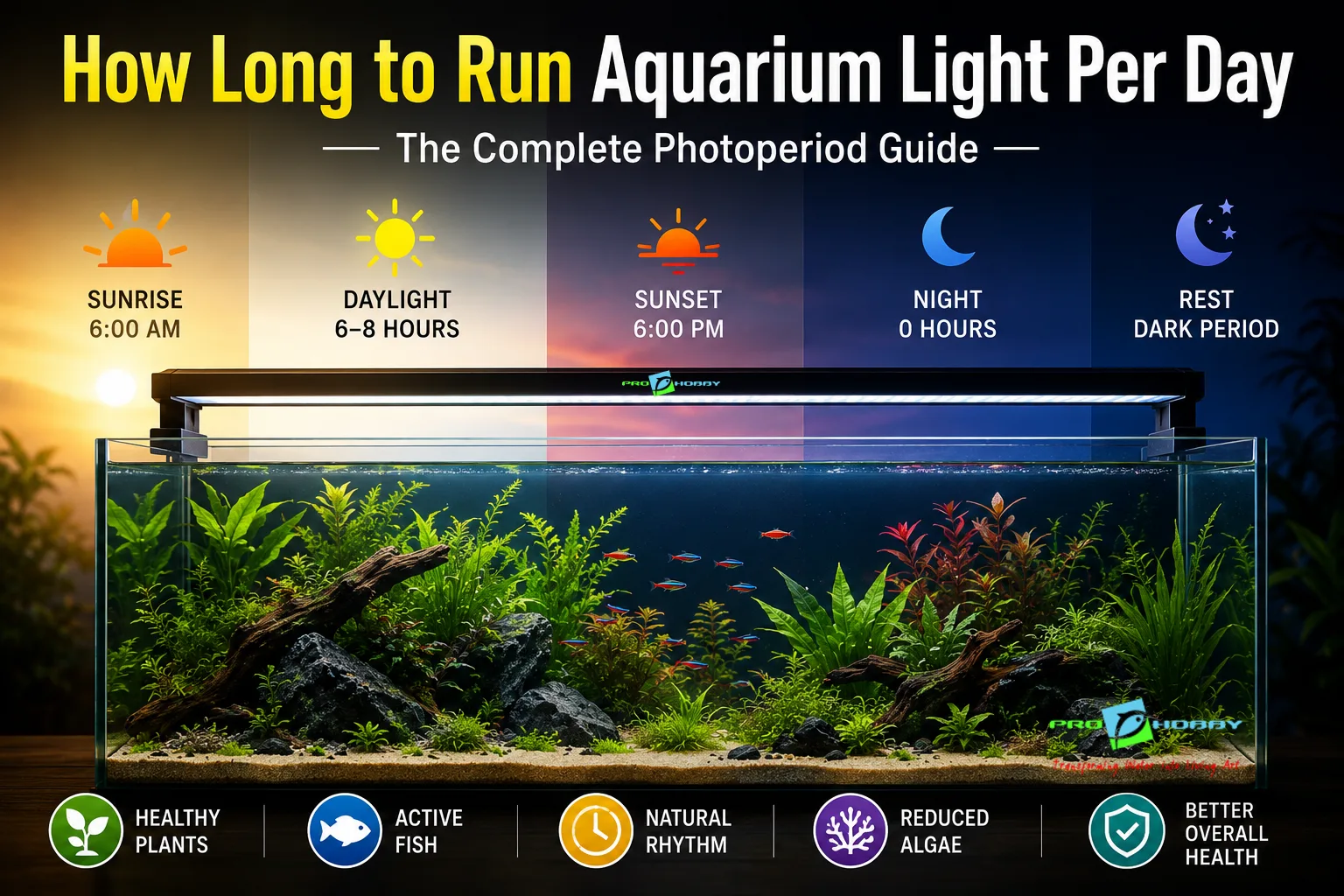
The most common aquarium lighting mistake is running lights too long on the assumption that more light means better plant growth. It does not. Light duration is only one of three variables in the plant growth equation — along with CO₂ and nutrients. If light hours increase without matching increases in CO₂ and nutrients, the result is not faster plant growth. It is algae.
Understanding photoperiod — the daily light cycle — means understanding how plants, fish, and algae all respond to light duration, and why consistency matters as much as duration.
Why Photoperiod Matters
For plants: Aquatic plants photosynthesize during the light period and respire (consuming oxygen, releasing CO₂) during the dark period. The length of the light period determines the total photosynthetic energy input available per day. However, plant photosynthesis saturates — there is a point beyond which additional light hours produce no additional growth because the limiting factor has shifted to CO₂ or nutrients, not light.
For fish: Fish have circadian rhythms regulated by light-dark cycles. Consistent photoperiod produces physiological predictability — hormone regulation, behaviour patterns, immune function. Inconsistent photoperiod (random light-on times, no clear night period) produces chronic low-level stress. Bettas, cichlids, and most community fish show noticeably calmer, more normal behaviour in tanks with consistent 8–10 hour light periods versus tanks with erratic lighting.
For algae: Most nuisance algae species are highly competitive under excess light. Extended light periods — particularly in tanks where CO₂ and nutrients are not matched to the light level — give algae a competitive advantage over plants. The practical implication: reducing light duration is often more effective at controlling algae than any chemical intervention.
Recommended Photoperiod by Tank Type
Fish-Only Aquarium
8–10 hours per day. Light is provided for the benefit of observation and fish circadian rhythm, not for plant growth. The exact duration within this range matters less than consistency — pick a duration and use a timer to maintain it.
Ambient room light provides sufficient night orientation for fish; a completely dark period during the nighttime hours supports normal behaviour patterns.
Low-Tech Planted Tank (No CO₂ Injection)
7–8 hours per day. The logic: in a low-tech tank, CO₂ is the limiting factor for plant growth, not light. Running lights for 10+ hours does not produce faster growth from CO₂-limited plants — it produces algae on the excess light that plants cannot use.
Start lower: For a newly set up planted tank, begin at 6 hours and increase by 30 minutes per week as the plant mass establishes and the biological system matures. A new planted tank during the algae-prone cycling phase benefits from reduced lighting.
High-Tech Planted Tank (CO₂ Injection)
8–10 hours per day. With CO₂ supplemented, plants can utilise longer light periods — the limiting factor has shifted from CO₂ to light. Synchronise CO₂ injection to begin 1 hour before lights-on and end 1 hour before lights-off, maintaining effective CO₂ concentration throughout the light period.
The light-CO₂-nutrient balance: Increasing light hours in a high-tech tank without increasing CO₂ and nutrient dosing shifts the balance toward algae. All three variables must scale together.
Reef / Marine Aquarium
10–12 hours per day with gradual ramp-up and ramp-down. Modern reef LED controllers provide the ability to simulate sunrise (gradual intensity increase over 1–2 hours), peak intensity for 6–8 hours, and sunset (gradual decrease). Corals respond positively to this gradual transition — it more closely replicates natural reef lighting conditions than an abrupt on/off switch.
Actinic vs white light: Actinic (blue/violet spectrum, 420–470nm) can run for longer periods including during ramp phases. White-spectrum light at full intensity is typically limited to the peak 6–8 hours.
The Siesta Method — Splitting the Photoperiod
The siesta method splits the photoperiod into two periods separated by a midday dark break:
Example siesta schedule:
- Lights on: 7:00 AM
- Lights off: 12:00 PM (noon)
- Lights on: 3:00 PM
- Lights off: 8:00 PM
Total light hours: 10 hours, but the continuous unbroken period is only 5 hours.
Why it works for algae control: Many nuisance algae species require a continuous, uninterrupted light period to build the photosynthetic momentum needed to outcompete plants. The midday break disrupts this momentum without reducing total light available to plants, which resume photosynthesis readily after the break.
The siesta method is particularly effective against green spot algae and green dust algae that are associated with continuous long photoperiods. It is less effective against algae driven primarily by nutrient imbalances (black beard algae, staghorn algae).
In Indian conditions where summer daylight runs from approximately 5:30 AM to 7:30 PM, the siesta method also helps compensate for the longer ambient light period affecting tanks near windows.
More Hours ≠ More Plant Growth
This is the central point of the whole photoperiod discussion, worth stating explicitly:
Plant growth is determined by the most limiting factor among: light, CO₂, and nutrients (following Liebig’s Law of the Minimum). If any one of these is limiting, increasing the others produces no additional growth.
In a low-tech tank without CO₂ injection, CO₂ from fish respiration and atmospheric diffusion is the limiting factor. Running lights for 12 hours does not increase plant growth — the plants saturate their CO₂ supply within the first few hours of the light period and cannot photosynthesise faster regardless of additional light. The extra hours feed algae.
In a high-tech tank with CO₂ injection, nutrients may be limiting. Running lights for 14 hours does not increase plant growth if nitrate, phosphate, iron, or other nutrients are already depleted.
The correct approach: identify and address the limiting factor rather than increasing light hours.
PAR vs Duration — Two Different Variables
These are commonly confused.
PAR (Photosynthetically Active Radiation): Measures light intensity — how much light energy is reaching a specific point, typically the substrate. Measured in µmol/m²/s. This determines how much photosynthesis is possible per unit time when the light is on.
Photoperiod / Duration: How many hours the light is on per day. This determines the total daily light dose when multiplied by PAR.
Both matter, independently:
- High PAR for short duration: good for demanding plants; may stress fish if sustained long-term without gradual acclimation
- Low PAR for long duration: may support plants but runs the excess-light-hours algae risk
- Low PAR and short duration: low-tech, low-maintenance approach; suitable for hardy plants
The Aquarium Lighting Calculator helps balance these variables for specific tank setups.
The Timer — Non-Optional Equipment
Manual light switching produces inconsistent photoperiod. Lights forgotten for 14 hours, or left off because of absence, or switched on at different times daily — all produce the circadian disruption that stresses fish and the algae-favouring inconsistency that planted tank stability depends on.
An aquarium timer costs ₹200–500 and solves this completely. Set it once. It runs consistently every day regardless of routine variation.
Programmable LED controllers (standard on quality LED fixtures) provide additional benefits: gradual sunrise/sunset transitions, weather simulation, and seasonal photoperiod adjustment. For most tanks, a simple mechanical or digital timer on any light is fully adequate.
New Tank Protocol — Start Low and Build Up
A newly set up planted aquarium should begin with a reduced photoperiod (5–6 hours) for the first 2–4 weeks.
Why: New tanks lack the mature plant biomass and biological systems to use light effectively. During the cycling phase, nutrient and CO₂ supply is establishing. Reduced photoperiod limits algae competitive advantage during this vulnerable period. As plants establish roots and begin active growth, increase photoperiod by 30 minutes every 2 weeks until reaching the target duration.
This protocol prevents the ubiquitous “new tank algae bloom” that discourages many beginners — the green hair algae, diatoms, and green water that appear in over-lit new tanks.
India-Specific Considerations
Window light and ambient room light: Tanks positioned near windows receive uncontrolled additional light that does not switch off with the aquarium timer. A west-facing window in Delhi NCR in summer can provide significant additional illumination from 2 PM to 7 PM — potentially giving a “planted tank” effectively 12+ hours of combined aquarium and ambient light daily. Position tanks away from direct window light where possible. If window light is unavoidable, reduce the aquarium light timer duration to compensate.
Seasonal daylight variation: Delhi NCR has approximately 10.5 hours of daylight in December and 14 hours in June — a 3.5-hour variation. Fish evolved in environments where this seasonal photoperiod shift occurs naturally. Some hobbyists adjust aquarium light timers seasonally (8 hours in winter, 10 hours in summer) to replicate natural variation; others maintain a fixed year-round photoperiod. Either approach is valid; consistency within the chosen approach is what matters.
Summer algae pressure: Indian summer brings both increased ambient light (longer days) and higher temperatures that accelerate algae metabolism. Reducing photoperiod by 30–60 minutes during the hottest months (April–June) is a simple and effective algae management tool.
Practical Photoperiod Settings — Quick Reference
| Tank Type | Recommended Duration | Notes |
|---|---|---|
| Fish only | 8–10 hours | Consistency most important |
| Low-tech planted | 7–8 hours | Start at 6, increase gradually |
| High-tech planted (CO₂) | 8–10 hours | Synchronise CO₂ with light cycle |
| Reef / coral | 10–12 hours | Gradual ramp up and down |
| New tank (any type) | 5–6 hours | Increase as plants establish |
| Algae problem tank | 6–7 hours | Reduce first; investigate limiting factor |
Frequently Asked Questions
How many hours should I run my aquarium light per day? 8–10 hours for fish-only tanks. 7–8 hours for low-tech planted tanks. 8–10 hours for CO₂-injected planted tanks. Always use a timer — consistency matters as much as duration.
Will more light hours make my plants grow faster? Not if CO₂ or nutrients are limiting growth. In low-tech tanks without CO₂ injection, plant growth is CO₂-limited — additional light hours feed algae, not plants. Address the limiting factor before increasing light duration.
What is the siesta method? Splitting the photoperiod into two sessions with a midday dark break — for example, 7 AM–12 PM and 3 PM–8 PM. Total light is 10 hours but the unbroken period is only 5 hours. Effective at controlling algae that require a continuous light period to outcompete plants.
Why do I need a timer for aquarium lighting? Manual switching produces inconsistent photoperiod that stresses fish (disrupting circadian rhythms) and gives algae irregular competitive advantages. A ₹200–500 timer runs the light consistently every day regardless of routine variation.
My plants are growing slowly — should I increase light hours? Probably not. Test water for nitrate (macronutrient deficiency) and phosphate. Check CO₂ availability if you have a planted tank. Assess whether the light intensity (PAR) at the substrate is adequate. Slow plant growth is almost never a photoperiod problem — it is usually a nutrient, CO₂, or light intensity problem.