
By ProHobby™ | Ecological Systems Authority
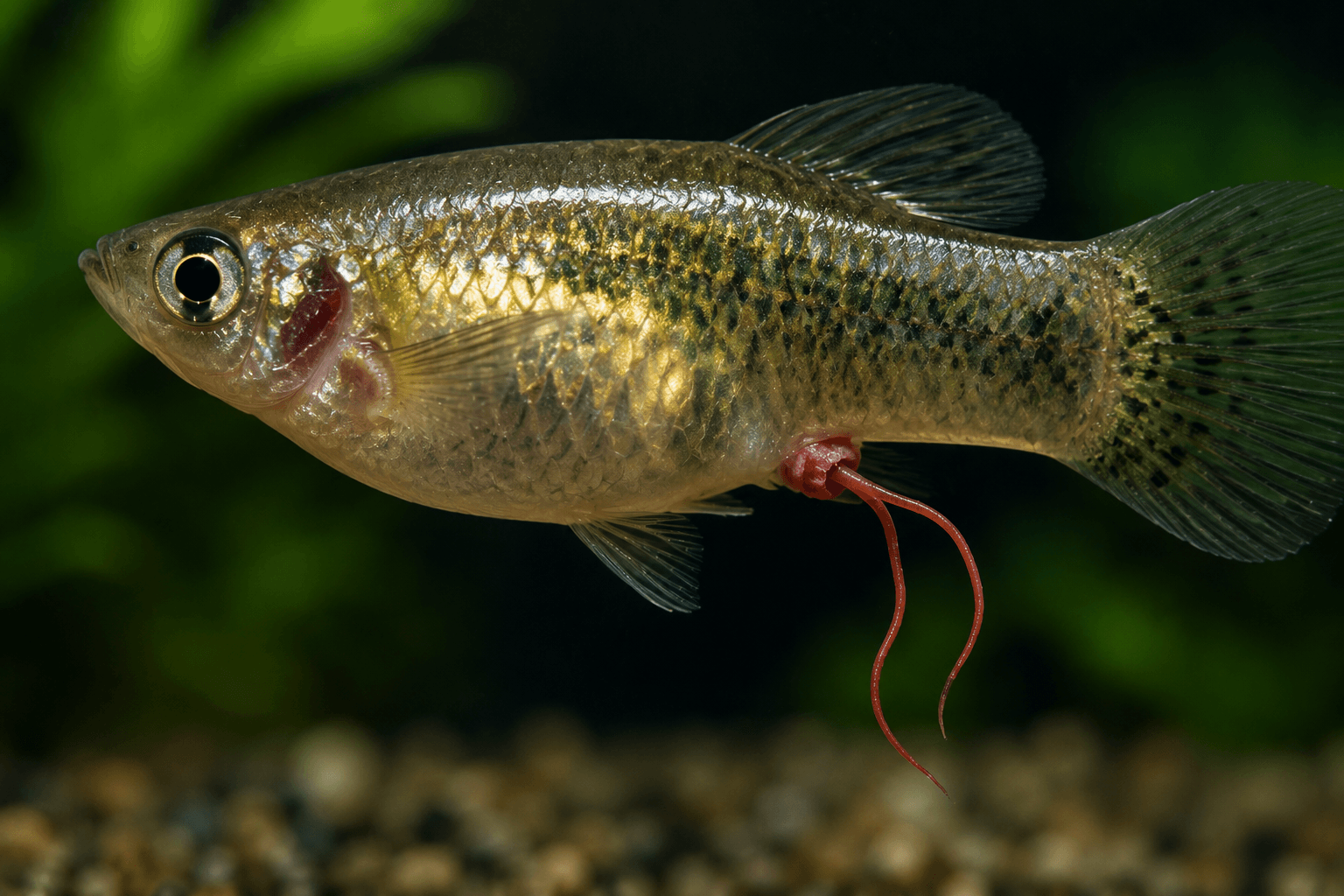
Few aquarium problems produce as much immediate distress as the sight of thin, red-orange worms protruding from a fish’s vent. Camallanus worms — Camallanus cotti and related species — are internal roundworms (nematodes) that complete part of their lifecycle in fish intestinal tissue, emerging at the vent when the population becomes large enough to protrude externally. By the time worms are visible at the vent, the infestation is established and advanced. The fish’s intestines already contain adult worms producing offspring, and other fish in the tank have almost certainly been exposed.
Camallanus is not a disease that can be managed by treating the visibly affected fish and monitoring the rest. Every fish in the tank has been exposed through shared water containing larval worms in feces, and must be treated simultaneously. This is the single most important management principle for Camallanus, and the most commonly violated one. Partial treatment — treating the fish with visible worms while leaving the rest — produces a temporary reduction in visible symptoms followed by full population recovery as the untreated reservoir reinfects the treated fish.
The Camallanus Lifecycle
Camallanus species require an intermediate host in their natural lifecycle — typically small copepods. In aquariums, fish-to-fish transmission occurs through ingestion of larvae shed in feces, which can infect fish directly without the copepod intermediate at some life stages. This simplified transmission pathway is why Camallanus spreads rapidly through closed aquarium populations.
Adult worms live in the intestinal tract, anchored to the intestinal wall with their distinctive head apparatus. They feed on intestinal contents and blood, causing tissue damage that becomes increasingly severe at high worm loads. The red or orange colouration of the worms is due to ingested blood.
Juvenile worms are shed in feces and survive in the water column for several days. They are ingested by other fish and begin development in the new host’s intestinal tract. The lifecycle from ingestion to visible adult worms protruding at the vent is approximately 3–6 weeks.
The practical implication: a fish can harbour a significant worm burden for weeks before visible worms appear at the vent. By the time one fish in a tank is visibly affected, every fish in the tank has been exposed for weeks and most carry an established infestation.
Symptoms
Protruding worms: The most definitive symptom — thin, red-orange worms (1–2cm when fully extended) visible at the vent, sometimes partially protruding and sometimes retracted. Under good lighting they may be seen moving.
Weight loss and wasting: A fish with significant Camallanus burden loses weight despite eating. The worms compete for intestinal nutrition and cause direct tissue damage that impairs absorption. This is often the first symptom before worms become visible — a fish that is eating well but visibly losing condition should prompt a careful vent examination.
Darkened colouration: Many fish with advanced Camallanus infestations show darkening of normal colouration. This is a general stress response rather than a specific Camallanus sign but often accompanies established infestation.
Behavioural changes: Listlessness, reduced feeding, hiding more than usual — the general signs of chronic parasitic burden and the immune suppression it produces.
Treatment
No treatment for Camallanus is licensed specifically for ornamental fish in India or most markets. Two medications are used off-label with documented effectiveness: fenbendazole and levamisole. Both require whole-tank treatment of all fish simultaneously.
Fenbendazole
Fenbendazole (Panacur, a veterinary anthelmintic) is effective against Camallanus at 50mg per kilogram of fish body weight in food. This requires estimating fish body weight and dosing food accordingly — a reasonable approximation for a tank with known stocking. Soak food in a fenbendazole solution, allow to dry, and feed as the daily ration for 3 consecutive days. Repeat after 2 weeks to catch any surviving larvae or adults that were missed in the first course.
Fenbendazole is generally well-tolerated by fish. It does not significantly disrupt biological filtration. Invertebrates should be removed as a precaution — fenbendazole is an invertebrate anthelmintic and may affect shrimp.
Levamisole
Levamisole at 2mg/L as a water treatment is also effective — it causes paralysis in nematodes, after which worms are expelled from the intestinal tract into the water column. A water change after 24–48 hours removes the expelled worms and the medication.
After levamisole treatment, increase surface agitation and perform a thorough siphon of the substrate to remove expelled worms and worm fragments — these decompose and cause ammonia spikes. Test ammonia closely in the days following treatment and manage with water changes as covered in Ammonia in Aquariums. The Hospital Tank setup guide is relevant if treatment must be conducted in isolation, though for Camallanus the whole-tank approach is usually correct.
Repeat after 2–3 weeks to catch the next generation of worms that have developed from larvae present during the first treatment.
What Does Not Work
Salt, melafix, pimafix, general antibacterials, and most commercial “general tonic” products have no activity against nematodes. Camallanus requires an antiparasitic drug specifically effective against nematodes.
Introduction and Prevention
Camallanus is introduced almost exclusively through new fish. Live foods — particularly live Tubifex worms from unknown sources — have also been implicated as introduction vectors, as wild-caught Tubifex may carry infective larval stages. Fish stressed from transport have suppressed immune function that facilitates faster worm establishment — the cortisol-immunity mechanism is in The Science of Fish Stress.
Quarantine for 4 weeks allows any Camallanus burden to develop to the point where worms become visible at the vent and the infestation can be treated before the main tank is exposed. This is one of the most important reasons quarantine prevents disease introduction — Camallanus infestations visible in quarantine are caught before they reach the main tank population. The complete quarantine framework is in Quarantine and Biosecurity in Aquariums. The framework for deciding when medication is genuinely necessary versus when environmental correction addresses the root cause is in Quarantine vs Medication.
Source live foods from known, reliable suppliers. Frozen live foods (frozen bloodworm, frozen brine shrimp) are safer than live foods of unknown provenance.
Frequently Asked Questions
Can Camallanus kill fish? Yes. Heavily infested fish develop progressive weight loss, intestinal damage from worm penetration of the intestinal wall, and eventual mortality if untreated. The timeline from first infestation to death depends on the worm load and the fish’s condition — weeks to months. Early treatment is significantly more effective than treating fish that have already lost substantial condition.
I treated the fish with visible worms but they came back — why? Other fish in the tank were untreated and acted as a reservoir, reinfecting the treated fish through the water column. Partial treatment of only visibly affected fish is the most common management error with Camallanus. All fish in the tank must be treated simultaneously, and treatment must be repeated after 2–3 weeks to catch the next generation.
Are Camallanus worms dangerous to humans? Camallanus cotti is a fish parasite and is not known to infect humans. Normal aquarium hygiene — washing hands after contact with tank water — is the appropriate precaution, as it is for any aquarium pathogen.