
By ProHobby™ | Ecological Systems Authority
Mollies are the most physiologically flexible of the common aquarium livebearers. Poecilia sphenops and its relatives evolved in coastal estuarine environments where freshwater streams meet the ocean — producing a fish capable of osmoregulating across an extraordinary salinity range. Wild mollies live in freshwater rivers, brackish mangroves, and even reef-associated marine environments. This flexibility translates directly to resilience in captivity: mollies tolerate water chemistry variation that would stress most freshwater fish, and they are ideally suited to Indian hard alkaline municipal water without any modification.
Natural Habitat and Biology
Mollies (Poecilia sphenops, P. latipinna, P. velifera) originate from coastal lowlands of the Americas — from Mexico through Central America to Colombia. Their habitat is the estuarine interface: tidal creeks, coastal rivers with variable salinity, and in some cases open marine environments. Delhi NCR’s hard tap water matches their natural ionic environment well.
Tank Requirements
Minimum size: 60–80 litres for a small group. Mollies are active swimmers and their livebearer breeding increases population rapidly without management.
Male to female ratio: Minimum 1:3 (one male per three females) to distribute reproductive harassment. A single male with one female stresses the female to death.
Filtration: Sponge filter works well; power filters with covered intakes for fry protection.
Water Parameters
| Parameter | Target Range |
|---|---|
| Temperature | 24–28°C |
| pH | 7.5–8.5 |
| KH | 6–12 dKH |
| GH | 10–20 dGH |
| Ammonia | 0 ppm |
| Nitrite | 0 ppm |
| Nitrate | Below 30 ppm |
Delhi NCR tap water (pH 7.8–8.2, KH 8–12, GH 10–16 dGH) is excellent for mollies without modification. One of the few fish that genuinely benefits from Indian hard municipal water chemistry.
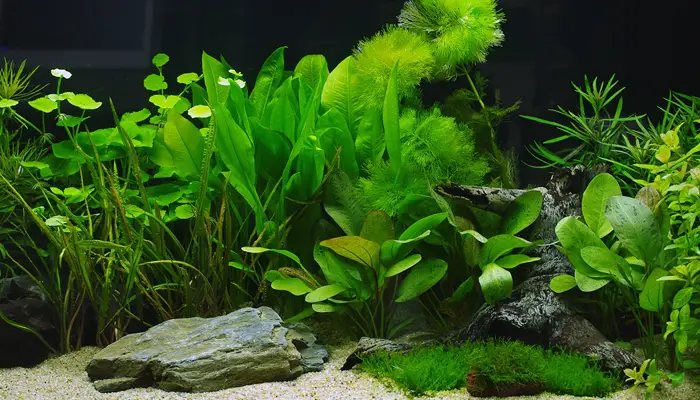
Plants for a Molly Tank
Plants serve both decorative and functional purposes in molly tanks — female refuge and fry survival cover are the primary functions.
Best plants for molly tanks:
- Java moss: Dense growth that fry navigate through but adults cannot easily search. The most important fry-survival plant.
- Hornwort: Fast-growing, excellent nitrate absorption, fine texture provides fry cover. Can be floated or loosely weighted.
- Floating plants (water lettuce, frogbit): Female refuge from male harassment. Surface cover also benefits the tank’s gas exchange.
- Vallisneria: Tall, fast-growing, tolerates the high GH and pH of Indian tap water. Mollies also graze the algae that grows on Vallisneria leaves — consistent with their plant-grazing natural behaviour.
- Java fern and Anubias: Hardy, tolerant of the alkaline conditions mollies prefer. Provide mid-level structure.
A note on algae: Mollies are natural algae grazers — they graze algae from plants, glass, and substrate constantly. A tank with some algae growth (controlled, not excessive) is actually well-suited to mollies. They help manage algae pressure while benefiting nutritionally.
Plants mollies graze: Soft, fine-leafed plants (duckweed, softer stem plants) are grazed by mollies. Fast-growing varieties that tolerate this grazing are preferred.
Male vs Female Molly — How to Tell Them Apart
| Feature | Male | Female |
|---|---|---|
| Anal fin | Gonopodium — thin, pointed, used for mating | Fan-shaped, broader |
| Body | Slimmer | Rounder, broader abdomen |
| Dorsal fin (sailfin males) | Dramatically large, sail-like | Normal sized |
| Size | Smaller | Larger |
The gonopodium is the definitive male identifier and is visible from approximately 4–6 weeks of age. Sailfin molly (P. latipinna/velifera) males are particularly easy to sex — the enormous dorsal fin is unmistakable.
Molly Fish Breeding and Birth
Gestation: 28–35 days at 26–28°C.
Litter size: 20–100 fry per birth depending on female size and age.
Identifying imminent birth: Gravid spot darkens significantly; abdomen becomes squared off and boxy rather than smoothly rounded; the female becomes less active and seeks hiding.
Molly fish giving birth: Normal birth occurs over 2–6 hours. Each fry is born in a translucent membrane it immediately breaks free from and begins swimming. Fry are immediately mobile. The female may eat fry she can catch post-birth — move her to a separate tank or breeder box before birth if fry survival is the goal.
Fry care: Finely crushed flake, commercial livebearer fry food, or baby brine shrimp from day one. Ammonia management critical — frequent small water changes using the Water Change Calculator.
Population control: Mollies overpopulate rapidly. Options: keep all males (beautiful display, no breeding), separate males and females, sell or give away excess fish, or allow natural predation in a community tank with compatible larger fish. An unmanaged molly population quickly overwhelms tank capacity.
Molly Fish Lifespan
3–5 years. Females typically live longer than males. Balloon mollies (compressed body form) tend toward shorter lifespans due to physiological stress from their body conformation.
Mollies in a Brackish Setup
Mollies’ natural salinity tolerance makes them ideal candidates for brackish aquarium setups — one of the few freshwater fish genuinely suited to this transition.
Low-level brackish (SG 1.003–1.005): Mollies thrive in this range. Most common freshwater fish do not tolerate it, making mollies the natural choice for low-level brackish community tanks.
Benefits of low-level brackish for mollies:
- Significantly reduces common molly diseases (ich, bacterial infections are less common in brackish conditions)
- The shimmies (stress shaking behaviour) is virtually absent in brackish conditions
- Mollies are notably more active and colourful in low brackish
Mixing with other species in brackish: Knight gobies, archer fish, figure-8 puffers (at higher salinity), and some killifish tolerate low-level brackish. Standard freshwater community fish do not.
For a dedicated brackish tank: Brackish Aquarium Ecology and Stability.
Molly with Betta — Compatibility
Generally not recommended. Bettas attack molly males with large fins, particularly sailfin mollies. Female mollies have fewer fin triggers but bettas may still be aggressive. The different temperature optima (bettas prefer 26–28°C; mollies prefer slightly cooler at 24–27°C) create a marginal overlap. If attempted: ensure the tank is large (60+ litres), densely planted, and introduce the molly first. Remove either fish at the first sign of fin damage or persistent aggression. Betta Fish Care covers betta compatibility in detail.
Molly Fish Varieties
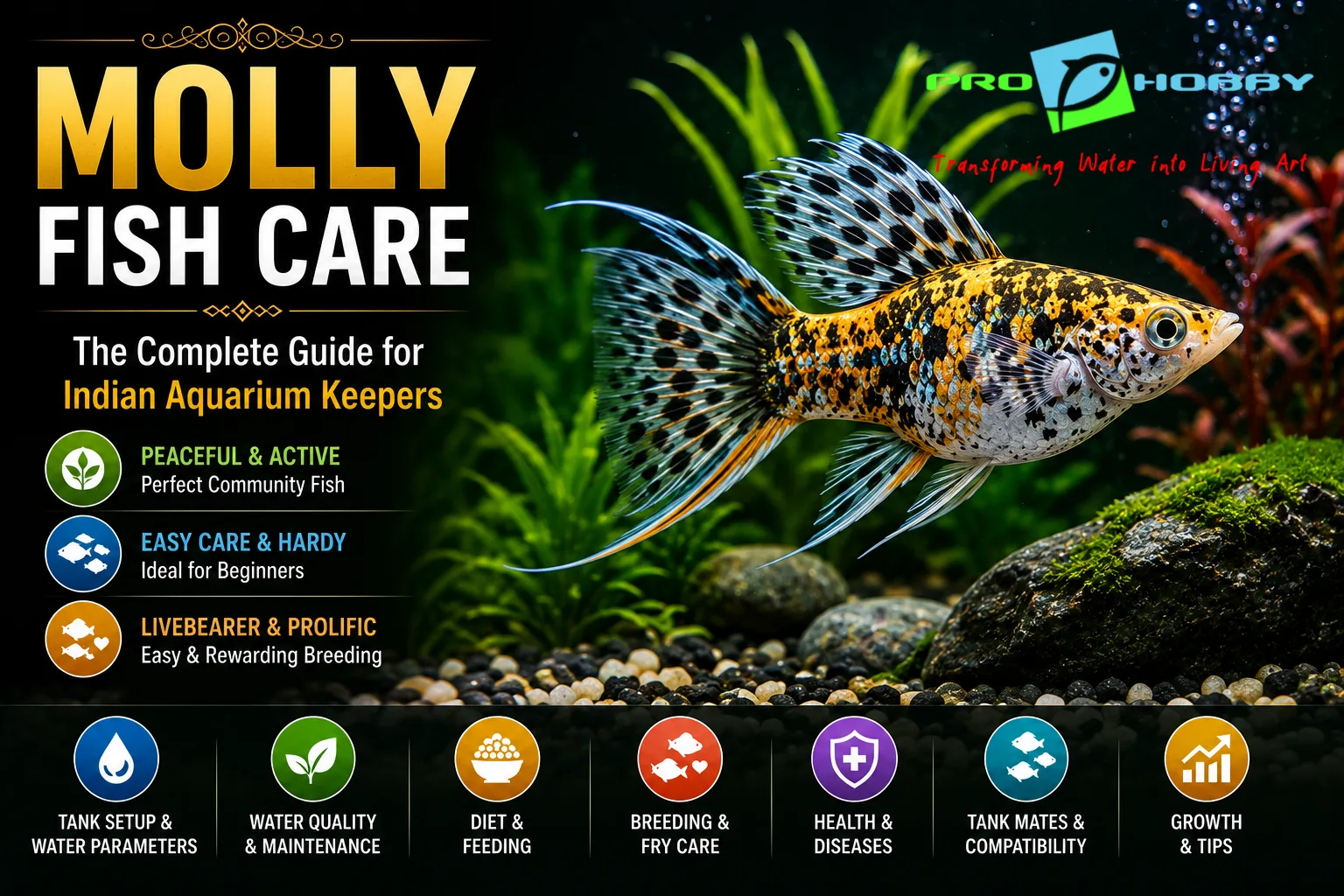
Black molly (P. sphenops): Near-solid black. Most robust of common varieties. Dalmatian molly: White with black spots. Popular, widely available. Gold dust molly: Yellow-gold with dark speckling. Balloon molly: Rounded compressed body. Visually distinctive but prone to swim bladder issues. Less robust. Sailfin molly (P. velifera/latipinna): Dramatic dorsal fin on males. More temperature-sensitive; prefers 26–28°C minimum. Lyretail molly: Extended tail fin. Beautiful but increased fin susceptibility.
Price in India: Common varieties (black, dalmatian) ₹30–80. Specialty varieties ₹80–200.
Colour Change — What It Means
Fading colour: Stress, poor water quality, temperature too low, illness. Test parameters. Male darkening during display: Normal — healthy males intensify colouration during courtship. The shimmies: Shaking/shimmying while stationary — stress response to low hardness (unlikely in Indian tap water), low temperature, or ammonia/nitrite exposure. Test parameters immediately. White patches: Ich or Columnaris — examine closely.
Molly Not Eating
Most common causes: temperature below 22°C, ammonia or nitrite in the water, illness, or stress from male harassment (females under constant pursuit sometimes stop eating). Test water parameters first. Separate a bullied female if male-to-female ratio is low.
Common Health Issues
The shimmies: Water quality stress response. Test and correct parameters. Ich: Ich — Treatment Guide. Fin rot: Water quality lapses. Fin Rot — Treatment Guide. Internal wasting in balloon mollies: Compressed body form predisposes to internal issues.
All treatment through a hospital tank.
Frequently Asked Questions
Why is my molly shimmying and shaking? The shimmies — side-to-side shaking while stationary — is a stress response. In Indian conditions, most commonly caused by ammonia or nitrite in an uncycled or disrupted tank, low temperature, or sudden water chemistry change. Test parameters immediately.
How do I know when my molly is about to give birth? The gravid spot becomes very dark; the abdomen becomes squared off and boxy; the female becomes less active and seeks hiding. Birth typically follows within 24–48 hours.
Do molly fish need salt in their tank? Not in hard Indian tap water. The ionic content of hard alkaline water provides the osmoregulatory support mollies’ estuarine origins require. Salt is beneficial in very soft water conditions but unnecessary — and potentially harmful to plants — in standard Indian municipal water.
Can molly fish live with bettas? Generally not recommended. Bettas attack molly males with large fins. Different temperature optima create marginal overlap. If attempted in a large planted tank with the molly introduced first, monitor closely and separate at any sign of aggression.
How do I control molly population? Keep an all-male tank, separate males from females, sell or give away excess fish, or allow natural predation in a community tank. Unmanaged molly populations quickly overwhelm tank capacity.
What is molly fish lifespan? 3–5 years. Females typically live longer than males. Balloon mollies tend toward shorter lifespans due to physiological stress from their body conformation.