
By ProHobby™ | Ecological Systems Authority
Discus (Symphysodon spp.) are called the King of the Aquarium for a reason — their disc-shaped form, extraordinary colour diversity, and stately presence make them the most visually impressive freshwater fish in the hobby. They are also the most demanding freshwater fish from a water chemistry perspective in India. The mismatch between discus requirements and Indian municipal water chemistry is so severe that RO water treatment is not optional — it is the foundational requirement for keeping discus alive past their first year in most Indian cities.
Are Discus for Beginners?
No. Discus are not a beginner fish and the question is worth addressing directly because the fish’s dramatic appearance attracts beginners who then struggle with its demands. Before keeping discus successfully, a hobbyist needs:
- Experience maintaining stable water chemistry in a cycled tank
- Understanding of RO water management and remineralisation
- Ability to run water tests regularly and interpret results
- Commitment to frequent large water changes
- Access to appropriate food variety
Hobbyists who have successfully kept other tropical fish for 1–2 years and understand the nitrogen cycle and water chemistry fundamentals are ready for discus. Complete beginners are not — and a failed discus attempt typically costs significantly more than learning with hardier species first.
Natural Habitat — Why Water Chemistry Is Everything
Wild discus inhabit the blackwater tributaries of the Amazon — extremely soft (GH 0–3 dGH), very acidic (pH 4.5–6.5), warm (28–32°C) water. Captive-bred discus (the vast majority available in India) tolerate a wider range but “tolerate” is the operative word. Delhi NCR tap water at pH 8.0 and GH 14 dGH is in osmotic distress territory from day one.
Water Parameters — The Non-Negotiables
| Parameter | Target Range |
|---|---|
| Temperature | 28–32°C |
| pH | 6.0–7.0 |
| KH | 0–4 dKH |
| GH | 1–8 dGH |
| TDS | 80–200 ppm |
| Ammonia | 0 ppm |
| Nitrite | 0 ppm |
| Nitrate | Below 10 ppm |
Temperature at 28°C minimum — below 26°C, immune function falls and disease establishes rapidly.
RO water in Indian conditions: Delhi NCR tap water (GH 10–16, KH 8–12, TDS 300–600 ppm) requires 80–100% RO blending with a small amount of tap water or remineraliser to achieve target parameters. Should You Use RO Water in Delhi NCR Aquariums? and Hard Water Aquariums in Delhi NCR.
Nitrate below 10 ppm — much lower than standard recommendations — requires frequent large water changes with correctly conditioned soft water.
Tank Requirements
Minimum tank size: 200 litres for 4–6 discus. Discus are schooling fish — solitary keeping produces chronic stress.
Height: Tank height of 50–60 cm minimum — discus are tall fish.
Filtration: Sponge filters or gentle canister with spray bar diffuser. Discus do not tolerate strong flow. Multiple sponge filters are the standard approach.
Discus Planted Tank — The Cardinal Tetra Setup
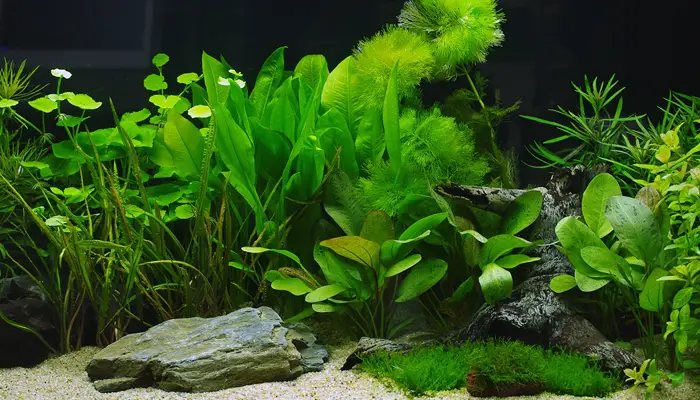
The planted discus tank with cardinal tetras is one of the most spectacular freshwater aquarium setups, and it is achievable — but the water chemistry requirements of discus and plants must be harmonised carefully.
Plants that work with discus water parameters (soft, acidic, warm):
- Amazon sword (Echinodorus spp.): The natural discus companion — co-evolved in the Amazon. Large specimens handle discus-level grazing and provide the vertical structure discus use for cover.
- Vallisneria: Grows readily in soft water with moderate CO₂ and light.
- Java fern and Anubias: Low-light, slow-growing, tolerate soft acidic water without CO₂.
- Cryptocoryne: Many species thrive in soft acidic conditions. C. wendtii and C. becketii suit discus tanks particularly well.
- Floating plants: Water sprite and hornwort provide surface cover and remove nitrate — both critical functions in a discus tank.
CO₂ in discus tanks: Low-level CO₂ injection (15–20 ppm) improves plant growth significantly at discus water parameters. The low KH of discus water (0–4 dKH) makes pH-drop calibration practical at lower CO₂ concentrations than hard water tanks. Advanced Nutrient Dynamics.
Tank mates in a planted discus tank: Cardinal tetras (natural Amazonian range overlap), rummy nose tetras, pencilfish, and Corydoras sterbai (tolerates 30°C). All must tolerate soft acidic warm water.
Discus Varieties Available in India
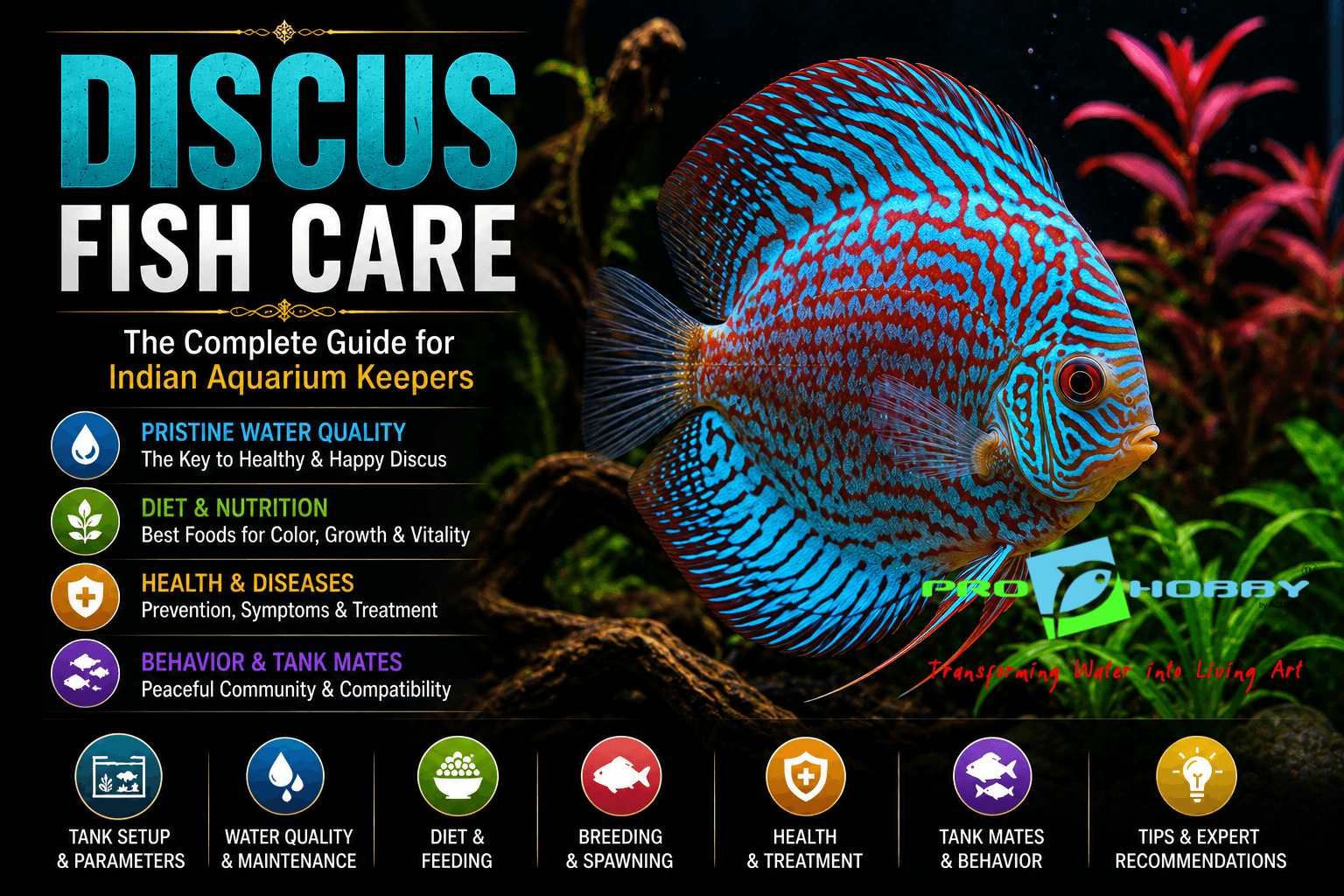
Blue diamond: Solid metallic blue. Clean, striking appearance. One of the most popular in India. Red melon: Orange-red body. Vivid, popular in the Indian market. Pigeon blood: White base with red/orange patterning, often with black pepper spots. Very popular. Turquoise: Blue-green striped pattern. Classic variety. Cobalt blue: Solid cobalt colouration. Selectively bred. Albino: Red-eyed pale varieties. Sensitive, for experienced keepers. Wild-caught: Brown discus, heckel discus — more demanding than captive-bred; require very specific soft acidic conditions.
Feeding
Discus require 3–5 small feedings daily — significantly more frequently than most freshwater fish.
Primary food options:
- High-quality discus-specific pellets or granules
- Beef heart-based paste (traditional discus diet; high acceptance but degrades water quality — feed sparingly and change water afterwards)
- Frozen bloodworm, blackworm, brine shrimp — essential variety
Discus not eating: Loss of appetite is the first visible symptom of water quality deterioration, temperature drop, HITH onset, or disease in discus — often before any visible external symptom. Test water parameters immediately. Also check: food type (discus sometimes refuse specific foods but accept others), temperature (below 28°C suppresses appetite significantly).
Discus breathing fast/panting: Rapid gill movement with normal swimming indicates either gill flukes or oxygen depletion. Test dissolved oxygen; examine gills under torch for pale colouration or visible parasites. Gill flukes are common in discus and require praziquantel treatment.
Male vs Female Discus
Discus are very difficult to sex visually outside of breeding behaviour. The most reliable indicators in mature fish: males tend to have a slightly more pointed dorsal fin tip and slightly thicker lips (used in mouth-to-mouth spawning). Females are sometimes slightly rounder in the belly. These differences are subtle and unreliable for casual observation. The most reliable method is observing spawning preparation behaviour between fish.
Discus Colour Change — What It Means
Darkening overall (the “black disease”): The most common discus stress response — fish darken significantly when stressed, temperature-shocked, or ill. This is the first visible sign of water quality failure in discus. Test parameters immediately.
Pale, washed out: Severe stress or disease. Test water and observe for other symptoms.
Stripes intensifying: Stress or display. Normal stripes becoming very prominent is a stress indicator, particularly if combined with darkening.
Colour fading gradually over weeks: Nutritional deficiency (inadequate variety in diet), water quality below optimal, or early chronic disease.
Breeding Discus
Discus are substrate spawners that pair bond. Breeding in captivity is achievable but requires significant dedication.
Breeding tank: 120–150 litre dedicated breeding tank with soft acidic water (pH 6.0–6.5, TDS 80–120 ppm), bare bottom for easy cleaning, spawning cone or flat surface.
Pair formation: Raise 6–8 discus together and allow natural pairing — bonded pairs become apparent through consistent proximity, mutual cleaning, and displaying.
Spawning: The pair cleans a vertical surface and deposits eggs. Both parents fan and guard the eggs. Hatchlings feed on parental body mucus for the first week — a unique discus characteristic requiring the parents to remain with the fry.
Fry: Feed baby brine shrimp from day 5–7 as parental mucus feeding diminishes. Frequent water changes maintaining excellent quality throughout the fry stage.
First-time discus breeders often experience unfertilised eggs or egg eating — patience across multiple spawns is required.
Discus Lifespan
10–15 years in correct conditions. Most discus in India die within 1–3 years from osmotic stress in hard water, inadequate temperature maintenance, or HITH from poor water management.
Common Health Issues
Hole in the Head disease (HITH): The dominant disease concern. Even moderately elevated nitrate (above 20 ppm) causes HITH in discus. Hole in the Head Disease — Complete Guide.
Gill flukes: Very common in discus — cause panting/rapid breathing. Praziquantel treatment. Gill Flukes — Treatment Guide.
Hexamita/wasting: Internal parasites causing weight loss. Metronidazole treatment.
All treatment through a hospital tank with matching water chemistry.
Discus Price in India
Locally bred captive-bred discus: ₹1,500–4,000 per fish. Imported high-grade fish: ₹5,000–20,000+. Avoid very cheap discus from non-specialist sources — fish kept in inappropriate water are frequently diseased and do not acclimate successfully.
Frequently Asked Questions
Can discus fish survive in Indian tap water? No in most Indian cities. Delhi NCR tap water (pH 8.0+, GH 14, TDS 400+ ppm) is incompatible with discus requirements. 80–100% RO blending is required. Discus in uncorrected hard water decline progressively regardless of other care quality.
Are discus fish suitable for beginners? No. Discus require stable soft water chemistry, frequent water changes, high feeding frequency, and rapid response to health changes. Successful discus keeping requires prior experience maintaining other tropical fish and understanding water chemistry.
What temperature do discus fish need? 28–32°C minimum. Below 26°C, discus become sluggish and develop disease rapidly. Accurate heating is essential equipment.
Why are my discus not eating? Test water parameters immediately — loss of appetite is the first symptom of water quality deterioration in discus. Also check temperature (below 28°C suppresses appetite), food variety (discus sometimes refuse specific foods), and early HITH signs.
Can discus live in a planted tank? Yes — the planted discus tank with cardinal tetras is a classic combination. Amazon swords, Cryptocoryne, Java fern, and Vallisneria all thrive in discus water parameters. Low-level CO₂ injection improves plant growth significantly.