
By ProHobby™ | Ecological Systems Authority
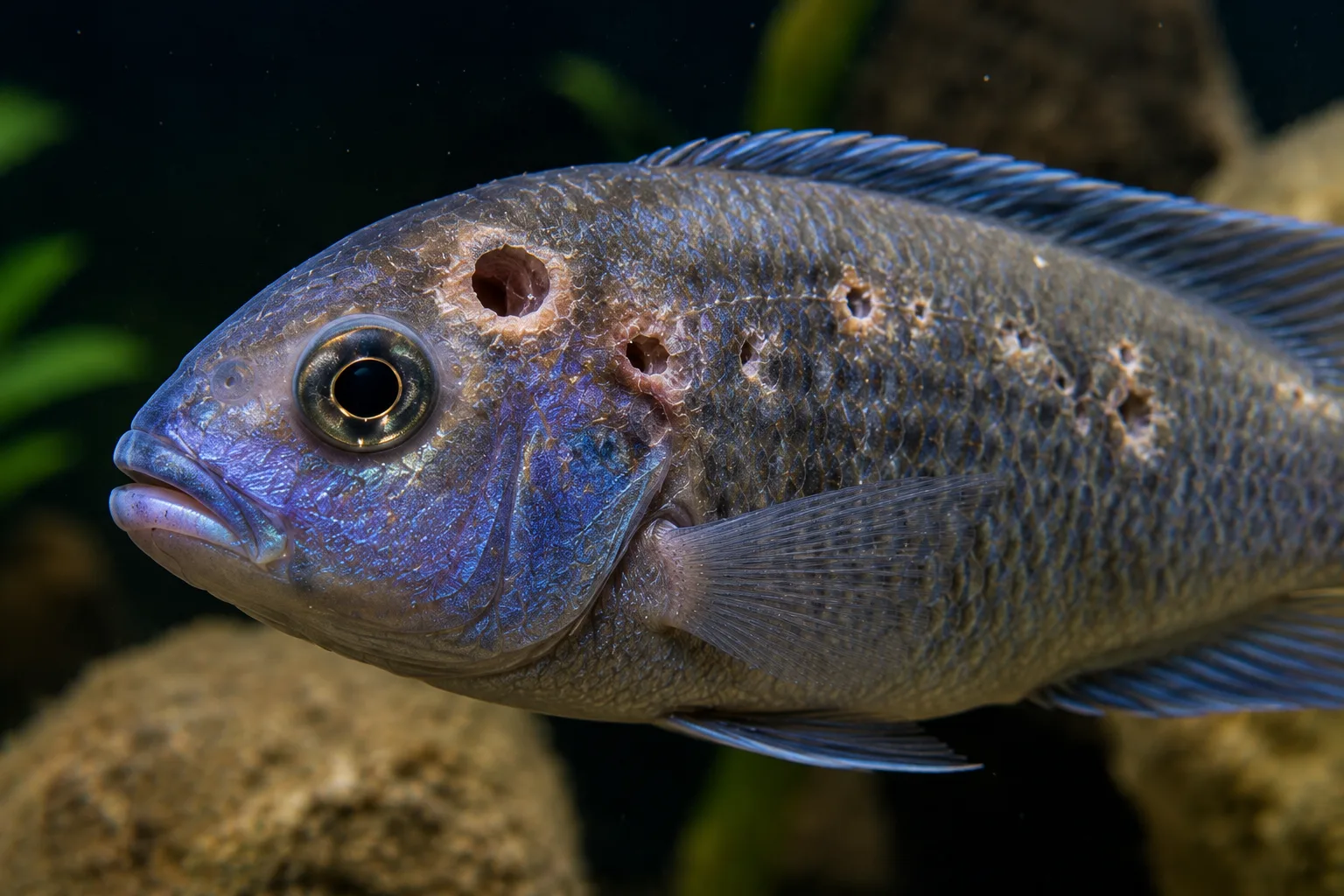
Hole in the Head disease (HITH) — also called Head and Lateral Line Erosion (HLLE) — produces one of the most distinctive visible symptoms in aquarium fish: shallow pits and erosions appearing on the head, around the eyes, and along the lateral line. In mild cases these appear as small white-filled pores; in advanced cases, significant tissue is lost, producing visible craters across the face and flanks of affected fish.
HITH affects primarily large cichlids — discus, oscars, green terrors, geophagus, and African cichlid species — though other large fish (freshwater stingrays, large catfish) can be affected. The disease is chronic rather than acute; it develops over weeks to months, allowing time for intervention before severe tissue loss occurs. What makes HITH distinct from most other fish diseases is that it has multiple concurrent causes, and treatment that addresses only one factor rarely produces lasting resolution.
What Causes Hole in the Head Disease
HITH has been studied for decades and the causation is still not fully resolved. The current consensus is that it is a multifactorial condition: internal flagellate parasites (primarily Hexamita spp. and Spironucleus spp.) create a vulnerability, while nutritional deficiency, water quality failure, and specific chemical stressors (particularly activated carbon) determine whether clinical disease develops and how severely.
Hexamita and Spironucleus: These internal flagellate parasites inhabit the digestive tract of many cichlids at subclinical levels. They are also the causative organism in Malawi Bloat in African cichlids. Hexamita alone does not cause HITH in well-nourished fish with good water quality — the parasites require a predisposing vulnerability. This explains why HITH appears in some tanks and not others with the same species, and why metronidazole treatment (which targets Hexamita) alone often produces incomplete resolution. The immunity mechanism — how chronic stress, poor water quality, and nutritional deficiency create the window for opportunistic disease — is in The Science of Fish Stress. Whether a case of HITH calls for medication or environmental correction first is the framework in Quarantine vs Medication.
Nutritional deficiency: Vitamin C deficiency is the most consistently associated nutritional factor. Vitamin C is essential for collagen synthesis and wound healing — without adequate vitamin C, the sensory pores of the lateral line system cannot maintain normal tissue integrity. Calcium and phosphorus deficiency have also been associated. Fish fed exclusively on processed foods without vitamin C supplementation or live/frozen foods are at elevated risk.
Elevated nitrate: The association between high nitrate and HITH is well-documented. Nitrate above 20–30 ppm is consistently associated with HITH in cichlid tanks, and reduction in nitrate through water changes and tank management reliably improves HITH outcomes even when other factors are unchanged. Nitrate at elevated concentrations produces the chronic immune suppression covered in Aquarium Nitrate — Complete Guide and directly impairs the skin tissue maintenance that would otherwise contain the lateral line pores.
Activated carbon: This association is the most controversial but has the strongest circumstantial evidence: the removal of activated carbon consistently correlates with HITH improvement in many documented cases. The proposed mechanism is that activated carbon depletes fat-soluble vitamins (A, D, E, K) from the water column, which are present in trace amounts from food and contribute to fish nutrition. Whether this mechanism is correct or whether some other interaction with chemical filtration is responsible, the empirical evidence for removing activated carbon as part of HITH management is sufficient to make it a standard recommendation.
Symptoms and Progression
Early HITH: Small white-filled pores on the head, slightly more prominent than the surrounding skin. The sensory pores of the lateral line system are visible. Fish continues to eat and behave normally. This stage is readily reversible with correct management.
Progressive HITH: Pores become irregular, with raised edges and white or mucous-filled centres. Multiple sites affected across the head and beginning along the lateral line. Fish may show some reduction in appetite.
Advanced HITH: Deep pitting and tissue erosion. The craters are clearly visible without magnification and may accumulate detritus. Fish may show weight loss and reduced activity. Bacterial secondary infection of the eroded tissue is common at this stage — the opportunistic gram-negative bacteria causing fin rot and Columnaris readily colonise the open lateral line wounds, and may require concurrent antibiotic treatment alongside the metronidazole protocol.
HLLE (Head and Lateral Line Erosion): HLLE is used specifically for the presentation affecting the lateral line — pale, eroded tissue along the lateral line stripe, sometimes extending substantially. In marine fish (tangs particularly), HLLE is often associated with inadequate diet and electrical stray voltage rather than Hexamita, and the treatment differs accordingly.
Treatment
HITH requires simultaneous correction of multiple factors. Single-factor treatment (metronidazole alone, or water changes alone) produces partial and temporary improvement at best.
Step 1: Remove activated carbon immediately. This is the first action regardless of other management changes. All activated carbon in the filter system should be removed and not replaced for the duration of treatment.
Step 2: Improve water quality. Test ammonia, nitrite, and nitrate. Target nitrate below 10 ppm for affected cichlids — lower than the standard 20 ppm recommendation for unaffected tanks. This requires more frequent and/or larger water changes — the complete protocol is in How to Do a Water Change. Use the Water Change Calculator to calculate the water change volume needed to achieve target nitrate given current levels. Stable pH is also essential — the pH and water chemistry framework is in the Complete Aquarium Water Chemistry Guide.
Step 3: Improve nutrition. Switch to high-quality foods with vitamin C supplementation. Fresh or frozen foods (bloodworm, brine shrimp, mussel, various invertebrates) provide vitamins that processing destroys in pellet foods. Vitamin C supplements can be added to food by soaking pellets. For discus specifically, a varied live/frozen diet is not optional — it is the correct baseline diet.
Step 4: Metronidazole treatment. Metronidazole (400mg per 100L as a water treatment, or at approximately 25mg/kg in food) treats the Hexamita/Spironucleus component. Treat for 10 days. Isolate the affected fish in a hospital tank for treatment — metronidazole in the main tank is not harmful to other fish but controlling the dose and monitoring the patient is easier in isolation.
Step 5: Monitor and maintain. HITH resolution is slow — improvement is measured in weeks, not days. The pits begin to fill in and margins become less raised as healing progresses. Maintaining all corrective factors simultaneously throughout the recovery period is more important than any single intervention.
HITH in Discus
Discus are the species most commonly affected by HITH in the hobby, and their water quality requirements make the management more demanding. Discus require water parameters at the softer, more acidic end of the freshwater spectrum (pH 5.5–6.8, TDS 50–150 ppm, nitrate below 10 ppm), and the standard hobby guidance of “hard Indian tap water is fine for most fish” does not apply. The nitrate floor problem from Indian tap water — discussed in the Complete Aquarium Water Chemistry Guide India-specific section — makes achieving below 10 ppm nitrate particularly challenging without RO water treatment.
Frequently Asked Questions
My cichlid has small white pores on its head — is this HITH? Possibly, but healthy fish also have visible sensory pores on the lateral line that are not disease. Compare current appearance to photographs of the fish when first acquired, or compare to tankmates of the same species. Progressive enlargement of pores, white or mucous filling, and erosion of the surrounding skin are the diagnostic features, not the pores themselves. Early HITH is fully reversible.
Does activated carbon cause HITH? The evidence is associative rather than mechanistically proven. What is established: removing activated carbon consistently helps HITH recovery. Using activated carbon continuously in tanks with HITH-susceptible species is a management risk not worth taking. Use activated carbon specifically when needed (clearing medication after a treatment course, resolving specific water clarity issues) rather than as permanent filtration.
What is the difference between HITH and Malawi Bloat? Both involve Hexamita/Spironucleus and respond to metronidazole, but they present completely differently. HITH produces pitting erosions of the lateral line and head. Malawi Bloat produces acute abdominal distension and resembles dropsy. Both benefit from the same dietary and water quality improvements, and both respond to metronidazole, but they require different urgency levels — Malawi Bloat is an emergency requiring immediate treatment.