
By ProHobby™ | Ecological Systems Authority
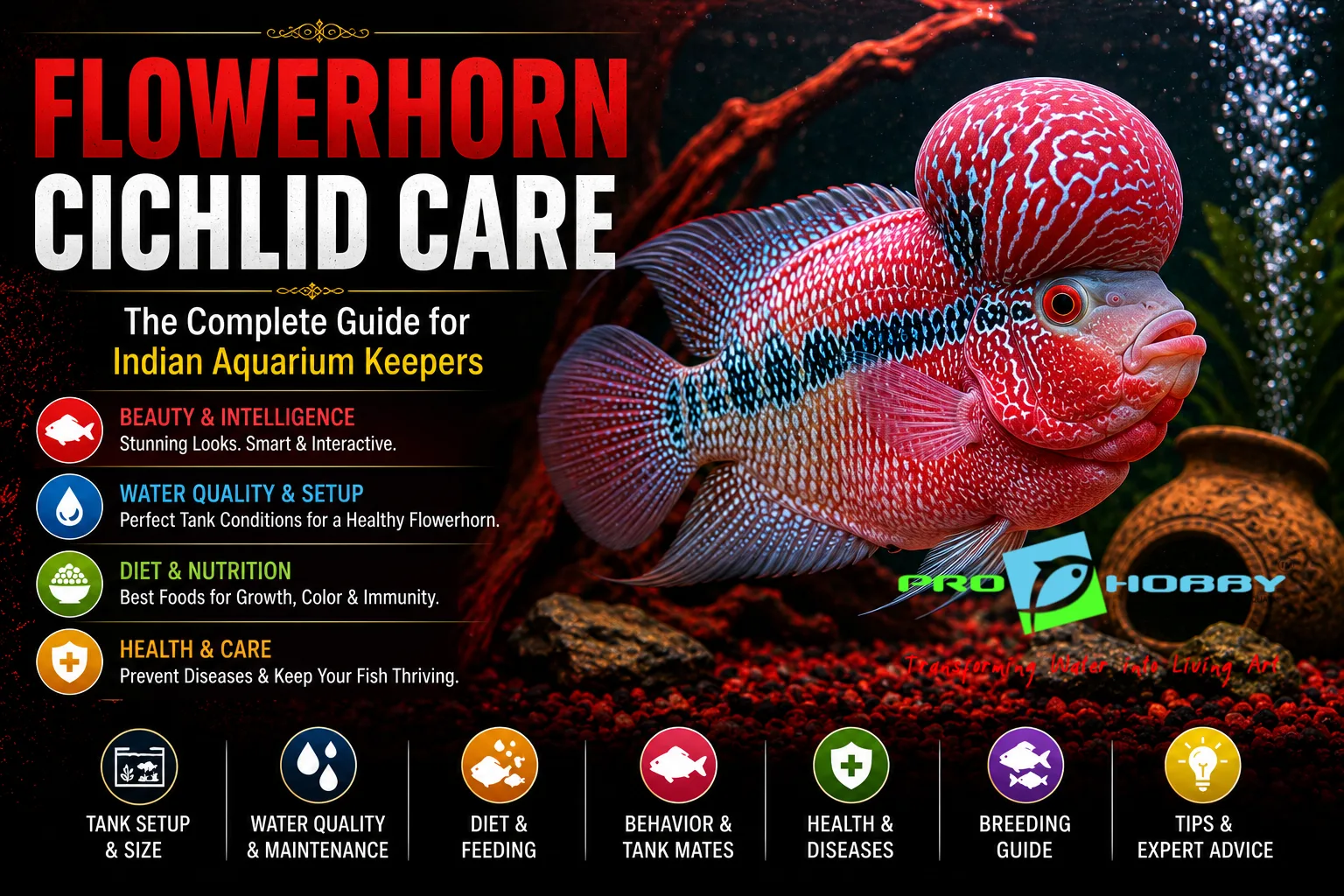
The flowerhorn cichlid is unique in the aquarium hobby: a hybrid fish bred specifically for the Indian and Southeast Asian market, carrying deep Vastu Shastra and Feng Shui significance, and completely unsuitable for community keeping. Flowerhorns cannot coexist with any other fish — not in large tanks, not with dividers in the same water, not with any species at any size. The flowerhorn tank is a one-fish ecosystem, and this is not a limitation to work around but a fundamental fact of the species’ biology.
What Is a Flowerhorn?
Flowerhorns are hybrid cichlids produced from Central American cichlid species (primarily trimac, red devil, and midas cichlids). They are not found in nature. The selective breeding programme began in Malaysia in the 1990s driven by demand in Chinese and Indian markets for auspicious fish with prominent nuchal humps (kok).
Vastu and Feng Shui Significance
In Indian Vastu Shastra and Chinese Feng Shui, flowerhorn is among the most auspicious fish for attracting wealth and positive energy. The red colouration, the prominent kok, and the assertive personality are all associated with positive chi. Placement, direction, tank design, and species selection for Vastu purposes: Vastu Shastra & Feng Shui.
Tank Requirements — Solo Setup Only
Tank size: Minimum 200 litres for a single adult. Smaller tanks produce chronic stress, stunted kok development, and higher disease susceptibility.
Single species only — absolutely non-negotiable. Flowerhorns kill any tank mate regardless of size, species, or tank volume. This is species-level biology, not individual temperament variation.
Filtration: External canister at 8–10× tank volume turnover. Weekly 30–40% water changes. How to Clean an Aquarium Filter Without Killing Bacteria.
Substrate: Smooth gravel or bare bottom. Flowerhorns dig — any substrate arrangement will be excavated.
Water Parameters
| Parameter | Target Range |
|---|---|
| Temperature | 26–30°C |
| pH | 7.0–8.0 |
| KH | 4–8 dKH |
| GH | 8–15 dGH |
| Ammonia | 0 ppm |
| Nitrite | 0 ppm |
| Nitrate | Below 20 ppm |
Delhi NCR tap water suits flowerhorns well without modification. Primary water quality concern is nitrate accumulation from high bioload — Aquarium Nitrate — Complete Guide.
Plants for a Flowerhorn Tank
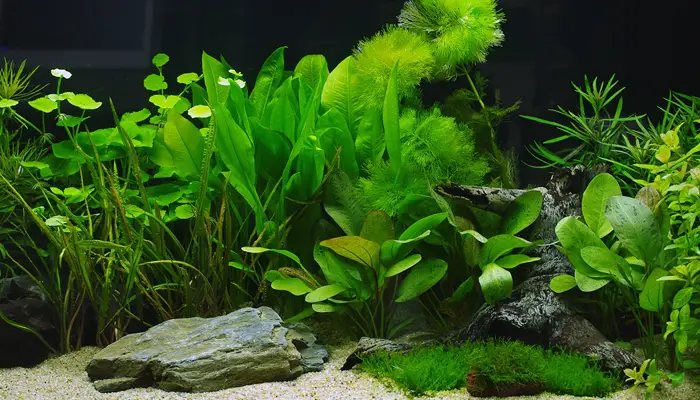
Flowerhorn tanks are largely incompatible with planted aquascapes:
- Flowerhorns dig constantly — all rooted plants are uprooted within hours
- High bioload requires strong filtration with flow that stresses many plants
- The fish physically destroys any planted arrangement it encounters
What can work: Large, mature Anubias (barteri, coffeefolia) attached to very heavy rocks or driftwood — leathery leaves that flowerhorns tend to leave alone, and hardscape that cannot be moved. Large Java fern attached to hardscape similarly survives.
What doesn’t work: Any substrate-planted plant, any delicate stem plant, any floating plant that the fish can reach and destroy.
The reality for most flowerhorn keepers: a bare or near-bare hardscape tank is the most practical approach, matching the flowerhorn’s preference for open territory with defined boundaries.
Feeding and Kok Development
Kok development — the size and prominence of the nuchal hump — is influenced by genetics (primary determinant), diet, temperature, and stress level.
Kok-promoting diet:
- Dedicated flowerhorn pellets with hormone supplementation (widely available in India)
- High-quality cichlid pellets with carotenoid content (astaxanthin, spirulina)
- Frozen prawns, earthworms
Remove activated carbon permanently. Continuous use depletes fat-soluble vitamins and is associated with HITH. Use only temporarily post-medication.
Feeding frequency: Once or twice daily, only what is consumed in 3–5 minutes.
Flowerhorn not eating: Common causes in order of frequency: temperature below 26°C (check first), water quality deterioration (test ammonia and nitrate), stress from external stimuli (cats, children, reflections), illness. A flowerhorn refusing food for more than 3 days in an established tank requires water parameter testing and close observation.
Male vs Female Flowerhorn — How to Tell Them Apart
| Feature | Male | Female |
|---|---|---|
| Kok | Larger, more prominent | Smaller or absent |
| Body | Larger overall | Smaller, slightly slimmer |
| Dorsal/anal fin | Extended, pointed tips | Rounded tips |
| Ovipositor | Absent | Small white tube visible near vent |
| Colour | Usually more vivid | Sometimes less saturated |
Sexing young flowerhorns (under 6–8 months) is unreliable. Mature males develop substantially larger koks and more pointed fin extensions. The ovipositor (egg-laying tube) in females is the most definitive identifier in adults.
Flowerhorn Growth Rate
Flowerhorns grow rapidly in correct conditions — approximately 1–2 cm per month from juvenile to adult. A fish purchased at 5–8 cm reaches adult size (20–30 cm) within 12–24 months. Kok development begins around 4–6 months and continues developing until approximately 2–3 years of age.
Flowerhorn Breeding
Flowerhorn breeding requires a compatible male-female pair — which is genuinely difficult to establish given the species’ extreme aggression. The procedure:
- Raise multiple fish separately and select one confirmed male and one confirmed female
- Use a divider to allow visual contact before physical introduction
- Introduce only when the female shows no stress bars and the male’s aggression appears directed at display rather than attack
- Supervise all initial interaction — separate immediately if the male attacks
Breeding success in home aquariums is uncommon. When it occurs, the pair typically spawns on a flat surface (rocks, slate, tank bottom), with both parents guarding the eggs. Fry management follows similar principles to other cichlid species.
Colour Change — Reading Your Flowerhorn
Darkening overall: Normal stress response. Check for external stimuli (people or animals near tank), water quality issues, or illness.
Fading colour: Stress, poor water quality, illness, or inadequate diet (insufficient carotenoids). Evaluate each factor in sequence.
Black patches or lines: Stress bars — dark markings that appear during stress or territorial display. Normal in context; persistent stress bars indicate an ongoing environmental problem.
Pale, anaemic appearance: Test water immediately — this indicates physiological distress.
Red enhancement: Flowerhorns naturally intensify red colouration during display and good health — this is desirable and indicates a comfortable, well-fed fish.
Common Health Issues
Hole in the Head disease (HITH): The primary disease concern — same causative mechanism as oscars. Remove activated carbon, reduce nitrate below 10 ppm, improve diet, treat with metronidazole. Hole in the Head Disease — Complete Guide.
Bloat: Rapid abdominal distension requiring same-day metronidazole treatment. Malawi Bloat — Treatment Guide.
Ich and fin rot from water quality lapses. Ich and Fin Rot.
All treatment through a hospital tank.
Flowerhorn Lifespan
8–12 years in correct conditions. Fish kept in optimal water quality, fed appropriately, in a solo environment regularly reach 10+ years.
Flowerhorn Varieties and Prices
King Kamfa: Large kok, red body with white flowerline markings. Most popular variety in India. Zhen Zhu (Pearl Flowerhorn): Pearl-like iridescent scaling, vivid colour. Golden Monkey: Yellow-orange colouration, moderate kok. Thai Silk / Titanium: Near-metallic blue-white colouration.
Price in India: Locally bred fish ₹500–3,000. Show-grade imported fish ₹3,000–50,000+.
Frequently Asked Questions
Can flowerhorn fish live with other fish? No. Flowerhorns kill any tank mate regardless of size. This is species-level biology, not individual temperament variation. A flowerhorn tank is a one-fish ecosystem.
How do I tell male from female flowerhorn? In adults: males have larger koks and more pointed dorsal/anal fin extensions. Females have a visible ovipositor (white tube near vent) and smaller koks. Sexing before 6–8 months of age is unreliable.
What food increases flowerhorn kok size? Dedicated flowerhorn pellets with hormone supplementation, high-quality cichlid pellets with carotenoid content, and whole protein sources. Genetics determines the ceiling; diet, temperature, and stress level determine how close the fish comes to its potential.
Is flowerhorn lucky according to Vastu? Yes — among the most auspicious fish in Indian Vastu Shastra for wealth and positive energy. Full placement guidance: Vastu Shastra & Feng Shui.
Why is my flowerhorn not eating? Check temperature first (below 26°C suppresses appetite). Then test water parameters. Evaluate for external stress triggers. A flowerhorn refusing food for more than 3 days requires water testing and observation.