
By ProHobby™ | Ecological Systems Authority
Angelfish (Pterophyllum scalare) are the quintessential intermediate community fish — peaceful enough for a mixed tank, demanding enough that their specific needs are frequently misunderstood. The most consistently overlooked requirement is vertical space. Angelfish are tall, disc-shaped fish that navigate dense, tall vegetation in their natural habitat. A tank with adequate floor area but insufficient height makes normal swimming impossible and causes chronic fin damage.
The most common tankmate mistake with angelfish — putting them with neon tetras — produces the other consistent failure. This needs its own section.
Natural Habitat
Pterophyllum scalare originates from slow-moving tributaries and flooded forests of the Amazon and Orinoco basins. Natural water is warm (25–30°C), soft (GH 3–8 dGH), and slightly acidic (pH 6.0–7.0). Wild angelfish navigate between stands of tall aquatic vegetation using their laterally compressed body and elongated fins.
Three Pterophyllum species exist: P. scalare (most common, this guide), P. altum (larger, very specific soft acid requirements, rarely available in India), and P. leopoldi (smallest). Virtually all fish available in India are captive-bred P. scalare.
Tank Requirements — Height Is Critical
Minimum dimensions: 60 cm height is the critical measurement. A tank less than 45 cm tall is inadequate for adult angelfish, whose body height including fins reaches 20–25 cm. Standard aquarium trade advice focuses on volume — for angelfish, prioritise height first, then volume.
A tall 90-litre tank (60 cm height) is preferable to a standard 120-litre tank (38 cm height) for angelfish.
Minimum volume for a small group: 150 litres, tall format.
Social structure: Angelfish form pair bonds with a dominance hierarchy in groups. 4–6 fish in a sufficiently large tank allow natural social structure to develop.
Plants and décor: Tall plants create the vertical structure angelfish navigate naturally. This is both aesthetic and functional.
Water Parameters
| Parameter | Target Range |
|---|---|
| Temperature | 25–30°C |
| pH | 6.5–7.5 |
| KH | 2–6 dKH |
| GH | 3–10 dGH |
| Ammonia | 0 ppm |
| Nitrite | 0 ppm |
| Nitrate | Below 20 ppm |
Captive-bred angelfish tolerate pH up to 7.8. In Delhi NCR hard water (GH 14+), established fish survive but breeding success drops significantly. 30–50% RO blending improves long-term outcomes and breeding results.
Angelfish Planted Tank
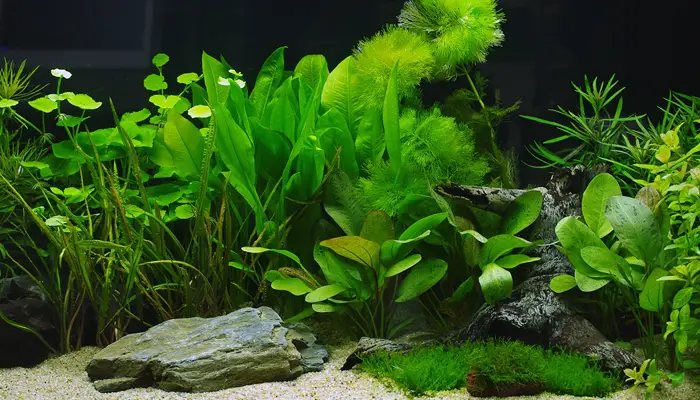
The planted angelfish tank is one of the most achievable and visually rewarding freshwater setups. Angelfish are compatible with planted tanks and benefit from the structure.
Best plants for angelfish tanks:
- Vallisneria: Tall, ribbon-like leaves that angelfish swim between and use for cover. Fast-growing, ideal for the vertical dimension angelfish need.
- Amazon sword (Echinodorus bleheri): The classic angelfish companion — co-evolved in the Amazon. Large, broad leaves that angelfish use for resting and as spawning sites.
- Java fern: Attaches to driftwood, provides mid-level structure. Angelfish rest on broad leaves.
- Anubias: Attached to hardscape, provides lower-level cover. Breeding pairs often spawn on large Anubias leaves.
- Hornwort and water sprite: Fast-growing, excellent nitrate removal, provide surface structure.
- Cryptocoryne: Various Cryptocoryne species thrive at angelfish water parameters without high light or CO₂.
Spawning plants: Breeding angelfish preferentially spawn on flat vertical surfaces — large Amazon sword leaves and smooth Anubias leaves are the most commonly used natural spawning sites. Providing these plants actively encourages breeding.
CO₂: Low to moderate CO₂ injection (15–25 ppm) supports plant growth at angelfish parameters without the hard water complications of high-KH tanks.
Feeding
Angelfish are omnivores with a significant carnivore component.
Primary: High-quality tropical flake or medium granules. Supplements: Frozen bloodworm, brine shrimp, daphnia — improve colour and condition breeding fish. Feeding frequency: 2–3 times daily, only what is consumed in 2–3 minutes.
Angelfish not eating: Test water parameters first. Temperature below 24°C suppresses appetite significantly. Stress from tank mates or territorial conflict also causes food refusal — observe carefully for fin damage or chasing. A bonded pair that suddenly stops eating may be preparing to spawn — watch for surface cleaning behaviour.
Male vs Female Angelfish
Angelfish are notoriously difficult to sex reliably outside of breeding behaviour. Attempted indicators:
| Feature | Male | Female |
|---|---|---|
| Forehead profile | Steeper, more convex | Flatter |
| Nuchal hump | Small hump present in some males | Absent |
| Ovipositor | Absent/pointed | Blunt, rounded, visible before spawning |
| Body shape | Slightly slimmer | Slightly rounder belly |
None of these are reliable for casual observation. The ovipositor is the most definitive identifier — it becomes visible (as a small blunt tube near the vent) in the days before spawning. Attempting to sex juvenile angelfish is essentially guesswork.
Angelfish with Neon Tetras — The Classic Mistake
This combination is one of the most frequently attempted and most frequently regretted in the hobby.
Juvenile angelfish and neon tetras coexist peacefully. As the angelfish grow — typically between 6–12 months — neon tetras enter the size range that triggers predatory behaviour. The angelfish begin eating neons, typically one at a time until the school is gone.
The hobbyist usually blames “sudden aggression” when in fact the angelfish have simply grown to the size where neons become food. This is not aggression — it is predation, and it is predictable.
Safe alternatives to neons with angelfish:
- Larger tetras: Bleeding heart tetras, black skirt tetras, emperor tetras — all too large to be eaten once angelfish are adult
- Rummy nose tetras: Slightly larger than neons and faster; can coexist in sufficiently large planted tanks though not guaranteed
- Cardinal tetras: Same size problem as neons — not reliable with adult angelfish
Breeding Angelfish
Bonded pairs in a 150+ litre tall tank with flat vertical spawning surfaces will breed regularly in correct conditions.
Breeding trigger: Clean warm water (28–30°C), good varied nutrition, and a spawning surface. The pair cleans the surface, the female deposits rows of eggs, and the male fertilises.
Egg care: Angelfish are attentive parents that fan and guard. First-time parents often eat the eggs. Subsequent spawns typically produce better parental care.
Artificial hatching: Transfer eggs to a separate container with gentle aeration and a drop of methylene blue to prevent fungal infection. Eggs hatch in 48–60 hours; fry free-swim in 4–5 days.
Fry care: Infusoria or commercial liquid fry food initially, progressing to baby brine shrimp within the first week. Frequent small water changes maintaining excellent water quality throughout.
Angelfish Fighting
Angelfish establish dominance hierarchies in groups. Some chasing and minor conflict is normal. Serious fighting — torn fins, persistent bullying of one individual — indicates:
- Insufficient tank size for the group
- Established pair excluding others during spawning
- Too few fish for stable hierarchy formation (groups under 4 are more prone to bullying than groups of 6+)
Solutions: increase tank size, increase group size above the bullying threshold, remove injured fish to a hospital tank temporarily.
Colour Change — What It Means
Darkening/black markings intensifying: Normal during aggression, display, and spawning preparation. If combined with lethargy and food refusal — stress or illness.
Pale, washed out: Stress or poor water quality. Test parameters.
White patches on body: Ich or Columnaris — examine closely.
Reddening of fin edges: Bacterial infection. Fin Rot — Treatment Guide.
Angelfish Varieties
Silver/wild type: Three vertical black bars. Closest to wild type, generally robust. ₹80–250 per fish. Marble: Black and gold/white pattern. Popular in India. ₹150–500. Koi angelfish: Red, white, and black pattern. Very popular. ₹200–600. Black: Near-solid black. Selectively bred. Veil tail: Extended fins. More susceptible to fin damage and bacterial infections.
Angelfish Lifespan
8–10 years in correct conditions, sometimes longer. Most captive angelfish die well before this from water quality issues, inappropriate tank mates, or inadequate tank height causing chronic physical damage.
Common Health Issues
Ich: Most common disease in angelfish. Ich — Treatment Guide. Fin rot: Water quality lapses. Fin Rot — Treatment Guide. Columnaris: Fast-progressing, misdiagnosed as fungal infection. Gram-negative antibiotic treatment. Columnaris Disease — Treatment Guide.
All treatment through a hospital tank.
Frequently Asked Questions
Can angelfish live with neon tetras? Not reliably once angelfish reach adult size. Juvenile angelfish coexist peacefully with neons. As angelfish grow to 10+ cm, neons enter the size range that triggers predatory behaviour and are systematically eaten. Use larger tetras — bleeding hearts, black skirts — instead.
What tank size do angelfish need? A minimum of 150 litres with 60 cm height for a small group. Tank height is the most important dimension — angelfish are tall fish. Tanks under 45 cm tall are inadequate for adult angelfish.
How do I sex angelfish? Reliably, only by observing the ovipositor (blunt tube near the female’s vent) visible before spawning. All other physical indicators are inconsistent and unreliable. The practical approach: raise a group of 6 and allow pairs to form naturally.
How do I breed angelfish? Bonded pair in a 150+ litre tall tank, clean warm water (28–30°C), varied nutrition, and a flat vertical spawning surface (large Amazon sword leaf, smooth Anubias leaf, or slate). The pair will spawn without further intervention once conditions are met.
What is angelfish lifespan? 8–10 years in correct conditions. Most angelfish die significantly earlier from water quality issues, inappropriate tank mates, or physical damage from insufficient tank height.