
By ProHobby™ | Ecological Systems Authority
Fish lice are among the most visible aquarium parasites and among the most consistently mismanaged — because their lifecycle, like anchor worm, has distinct stages requiring different treatment approaches, and treating only the adult parasites visible on the fish produces rapid reinfection from the next generation hatching in the substrate. Argulus foliaceus and related species are flat, disc-shaped branchiuran crustaceans — not insects despite the common name — that move freely across the fish body surface feeding on blood and tissue fluids through a piercing stylet. They are visible to the naked eye at 3–12mm, and unlike anchor worm which embeds permanently in muscle tissue, Argulus detaches, moves between fish, and leaves the host to lay eggs on hard substrate. This free-moving behaviour and substrate egg-laying makes them both easier to identify than most parasites and more complex to eradicate than treatments targeting only the fish suggest.
Table of Contents
- What Argulus Is — Biology and Why It Differs From Anchor Worm
- The Argulus Lifecycle — Why Tank Treatment Is Non-Negotiable
- Symptoms — Identifying Fish Lice Correctly
- Differential Diagnosis — Fish Lice vs Anchor Worm vs Other Parasites
- Treatment — Step by Step
- Physical Removal of Adults
- After Treatment — Preventing Reinfection
- Species Most Affected — Koi, Goldfish and Pond Fish
- India and Delhi NCR — Specific Considerations
- Frequently Asked Questions
1. What Argulus Is — Biology and Why It Differs From Anchor Worm
Argulus belongs to the class Branchiura — a group of parasitic crustaceans distinct from the copepods that include anchor worm (Lernaea). The most important practical distinction between the two:
- Anchor worm (Lernaea) embeds its anchor-shaped head permanently into the fish’s muscle tissue and remains fixed at one site. It is physically attached and immobile once mature.
- Argulus (fish lice) uses suction discs to attach temporarily and moves freely across the fish surface. It detaches to swim, to feed at different sites, and to lay eggs on substrate. An individual Argulus parasite may spend time on multiple fish in the same tank during its lifespan.
Argulus attaches using a pre-oral sucker and pierces the skin with a pointed stylet to feed on blood and tissue fluids. The stylet injection includes anticoagulants and potentially cytotoxic compounds that irritate tissue beyond the feeding site. Repeated feeding at multiple sites produces significant cumulative skin damage — creating entry points for secondary bacterial infections including fin rot, scale rot, and in severe infestations, septicaemia.
Argulus is not host-specific — it infests a wide range of freshwater fish species and can move between species in the same tank. It survives brief periods off the host in aquarium water and swims actively to find new hosts.
2. The Argulus Lifecycle — Why Tank Treatment Is Non-Negotiable
Understanding this lifecycle determines why treating only the fish with visible adults always fails.
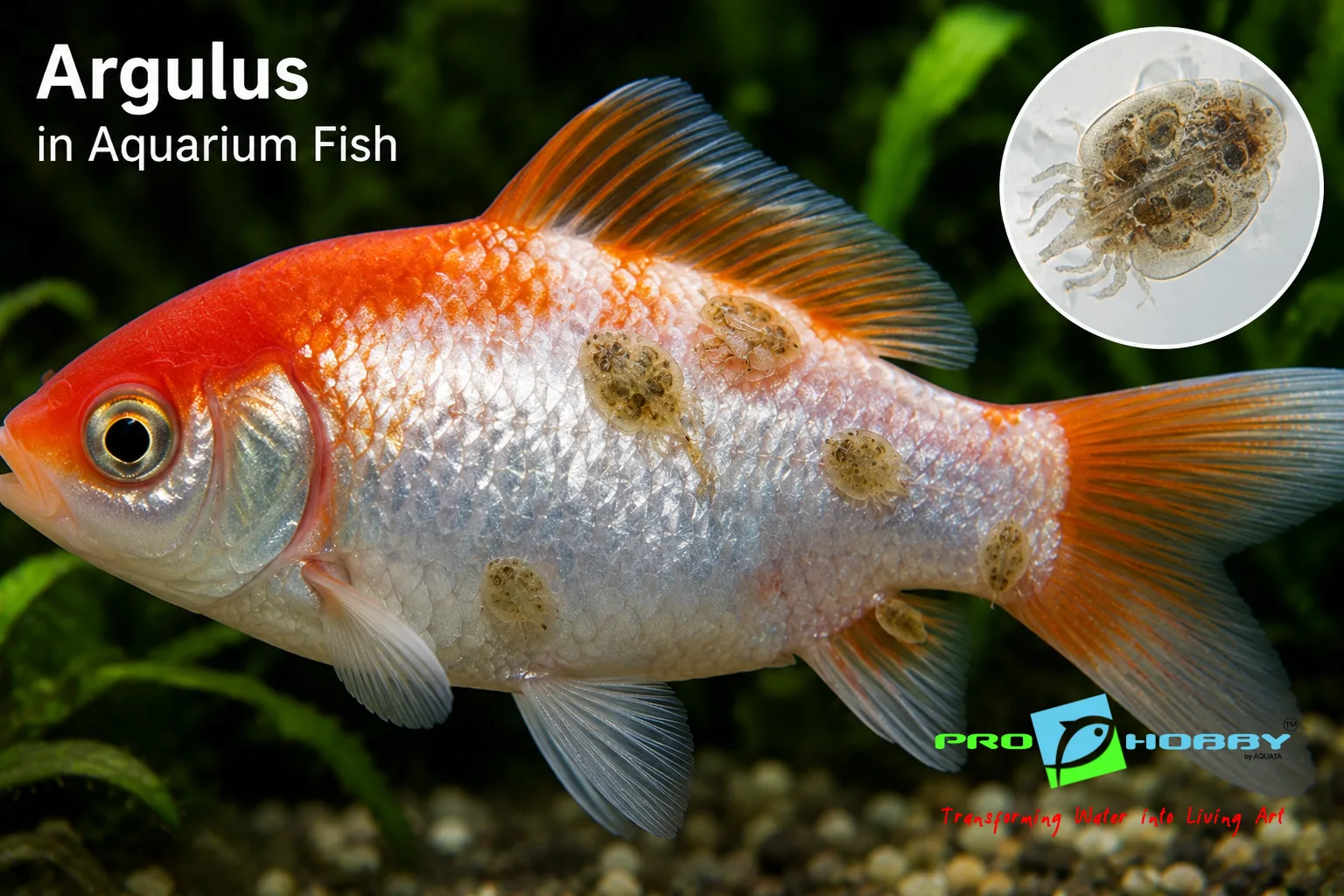
Adult on host: The mature adult parasitises fish, feeds, and periodically detaches to swim freely in the water column. Adult Argulus are visible — flat, oval, greyish-green, 3–12mm in diameter.
Egg laying: Females leave the host to lay eggs in rows on hard substrate — rocks, tank walls, equipment surfaces, and the substrate itself. Egg masses are small and not easily visible without close inspection. A single female lays hundreds of eggs over her lifespan.
Free-swimming larvae: Eggs hatch after 2–8 weeks depending on temperature (faster at warmer temperatures). The larvae are free-swimming and immediately seek a fish host. Without a host within days, larvae die. With a host, they undergo several moult stages over 4–8 weeks before reaching reproductive adult stage.
The treatment implication: Any treatment that kills only the adult parasites on fish leaves the substrate egg masses completely unaffected. When those eggs hatch, the larvae immediately re-infest the fish. This is why hobbyists report “successful” removal of all visible lice followed by reinfection within weeks — the substrate was never treated.
3. Symptoms — Identifying Fish Lice Correctly
Visible parasites on the body surface: The primary diagnostic sign. Argulus appear as flat, oval, semi-transparent to grey-green discs, 3–12mm in diameter, visible with the naked eye on the fish body, fins, and gill covers. They may be seen moving across the body surface — this movement is distinctive and immediately diagnostic.
Flashing and rubbing: Fish rub intensely against substrate, rocks, and décor — reacting to the irritation of Argulus feeding sites. This is identical to the flashing of gill flukes and external protozoan parasites — the distinction is the visible parasite.
Multiple red or haemorrhagic feeding sites: Small red spots or lesions at sites where Argulus has fed. In heavy infestations, the fish surface shows multiple wound sites from repeated feeding at different locations.
Localised scale loss and inflammation: Around feeding sites and under the suction disc attachment points.
Restlessness and loss of appetite: Chronic parasite burden and feeding site irritation produces behavioural changes — reduced feeding, erratic swimming, increased surface time in severe cases from the secondary stress on gill function.
Severe infestation: In extreme cases (particularly small fish or fry with multiple adult Argulus), visible anaemia, rapid gill movement, and significant physical weakness. Argulus feeding on small fish removes proportionally significant blood volume.
4. Differential Diagnosis — Fish Lice vs Anchor Worm vs Other Parasites
| Feature | Argulus (fish lice) | Anchor Worm (Lernaea) | Gill Flukes |
|---|---|---|---|
| Visible on fish | Yes — flat disc, 3–12mm | Yes — protruding “worm”, trailing egg sacs | No |
| Movement on fish | Moves freely across surface | Fixed at one embedded site | Microscopic |
| Location | Body surface, fins, gills | Embedded in muscle at fixed site | Gills primarily |
| Attachment | Suction discs — removable | Anchor structure — embedded | Clamps |
| Substrate eggs | Yes — laid on hard surfaces | No | Dactylogyrus lays eggs |
| Treatment | Organophosphates, diflubenzuron | Physical removal + diflubenzuron | Praziquantel |
The flat disc shape and visible movement across the fish surface is the definitive Argulus identifier. No other common aquarium parasite looks or moves like this.
5. Treatment — Step by Step
Because Argulus has adults on fish AND eggs in the substrate simultaneously, effective treatment must address both.
Step 1: Isolate in a hospital tank where possible for individual fish treatment. For pond fish or when all fish are affected, treat the full system.
Step 2: Physical removal of visible adults (see Section 6).
Step 3: Chemical treatment for larvae and remaining adults
Diflubenzuron (Dimilin or aquarium-specific products): Inhibits chitin synthesis, preventing larvae from completing moulting. Highly effective against larval stages and juveniles — less immediately lethal to adults but prevents population reproduction. Safe for fish at therapeutic doses. Remove all invertebrates — diflubenzuron kills crustaceans including shrimp, snails, and any other invertebrates in the tank.
Dose: Follow manufacturer instructions. Typically applied twice with a 2-week interval to catch hatching larvae from substrate eggs laid before first treatment.
Potassium permanganate dips (10mg/L for 30–45 minutes): Kills adults and larvae on the fish surface. Used in a separate treatment container with active aeration. Same handling care as with other KMnO₄ treatments — have clean water ready to transfer the fish immediately if distress is shown.
Step 4: Treat the main tank substrate
Diflubenzuron added to the main tank (even while fish are in the hospital tank) kills larvae as they hatch from substrate eggs. Maintain treatment concentration according to product instructions for a minimum of 3–4 weeks — the full hatch period for substrate eggs.
Step 5: Physical removal and discard of visible egg masses from rocks, glass, and equipment if identifiable.
Step 6: Raise temperature to 26–28°C to accelerate egg hatching and compress the treatment timeline — larvae hatch faster and encounter lethal treatment concentration sooner.
Step 7: Repeat the main tank treatment after 2 weeks to catch any newly hatched larvae from eggs laid just before the first treatment.
Monitor ammonia and nitrite throughout — Ammonia in Aquariums. How to Clean an Aquarium Filter Without Killing Bacteria.
6. Physical Removal of Adults
Adult Argulus on a fish should be physically removed before or alongside chemical treatment — the adults are robust enough that diflubenzuron alone is slow to kill them.
Procedure: Briefly sedate the fish with 1–2 drops of clove oil per 10 litres in a small container until swimming slows. Using fine-tipped forceps, press down gently on the flat parasite disc and slide it across the fish surface to break the suction attachment — do not simply grab and pull vertically, which can leave the stylet embedded in the wound. The released parasite should be placed directly into a container of water for disposal rather than allowed to fall back into the tank.
Wound treatment: After removal, dab each feeding site and suction attachment wound with diluted povidone-iodine on a cotton bud. Return the fish to the hospital tank. Monitor feeding sites for secondary bacterial infection development over the following days — reddening or expanding lesions indicate scale rot or bacterial infection establishing at wound sites.
7. After Treatment — Preventing Reinfection
Quarantine all new fish for a minimum of 4 weeks before main tank introduction. Argulus are visible enough that a careful inspection during quarantine will reveal any adults. Quarantine water change protocols remove larvae before they can develop to adults. Quarantine and Biosecurity in Aquariums.
Quarantine all plants and hardscape from outdoor or unknown sources. Argulus egg masses on rocks or décor introduced from a pond or unknown aquarium are a primary introduction vector.
Outdoor pond fish — koi and goldfish kept in outdoor ponds and then moved to indoor aquariums carry the highest risk. Full quarantine with targeted Argulus inspection is essential before any pond-to-tank transfer.
8. Species Most Affected — Koi, Goldfish and Pond Fish
Argulus infestations are most commonly associated with pond fish — koi and goldfish — because outdoor pond environments are natural Argulus habitats. Wild waterfowl and other animals carry Argulus between ponds, establishing endemic populations in outdoor water bodies. Fish sourced from outdoor ponds, fish markets that hold pond fish, or fish transported in containers with pond water carry significant Argulus risk.
Koi: The most commonly affected species in India. Any koi purchased from an outdoor pond or market source should be quarantined with specific Argulus inspection before joining an established system. Koi Fish Care in India. Koi Pond Setup in India.
Goldfish: Particularly outdoor-kept goldfish or those sourced from pond environments. Goldfish Care Guide.
Tropical aquarium fish: Less commonly affected, but tropical fish introduced from pond-reared stock or held in outdoor systems during warm months carry Argulus risk. Silver arowanas, which are sometimes held in large outdoor systems, are a specific tropical species where Argulus is occasionally encountered in India.
9. India and Delhi NCR — Specific Considerations
Koi and pond fish sourcing in Delhi NCR: The koi and goldfish trade in Delhi NCR involves significant movement of fish from outdoor holding ponds to retail environments. Argulus is endemic in many of these pond systems. Any koi or goldfish acquired from a market or shop with outdoor pond holding should be quarantined with specific Argulus inspection — examining the fish surface under good lighting for the characteristic flat disc parasites.
Temperature and lifecycle acceleration: Delhi NCR summer temperatures (water temperatures 28–32°C in outdoor ponds) accelerate the Argulus lifecycle significantly — egg hatching, larval development, and time to reproductive adulthood are all compressed at higher temperatures. This means infestations build faster in Indian summer conditions than in temperate climates. Treatment intervals must be correspondingly shorter. Aquarium Water Temperature in Indian Summer.
Monsoon and new introductions: The monsoon season and post-monsoon period in Delhi NCR correlates with increased ornamental fish movement — fish dealers receive new stock from farms and ponds. This is a peak period for introduction of Argulus with new fish. Quarantine discipline is particularly important in the July–October period.
Frequently Asked Questions
What do fish lice look like? Flat, oval, semi-transparent to grey-green discs, 3–12mm in diameter, visible on the fish body, fins, or gill covers with the naked eye. They move freely across the fish surface — this movement is characteristic and immediately distinguishes them from other parasites. Under a hand lens the suction disc structure and segmented body are clearly visible.
What is the difference between fish lice and anchor worm? Both are crustacean parasites but with completely different biology. Anchor worm (Lernaea) embeds permanently in muscle tissue with an anchor-shaped head structure and remains fixed. Fish lice (Argulus) attach temporarily with suction discs and move freely across the fish surface. Both require lifecycle-based treatment addressing substrate stages. Anchor Worm Treatment Guide.
Can I just remove the fish lice I can see and be done? No. The female Argulus lays eggs on hard substrate surfaces — rocks, tank walls, equipment. These eggs are not killed by removing adults from the fish. When they hatch, larvae immediately re-infest the fish. Diflubenzuron treatment of the full tank is required over a minimum 3–4 week period to kill larvae as they hatch. Treating only the fish produces rapid reinfection.
Are fish lice dangerous to fish? Yes, particularly in heavy infestations or on small fish. Argulus feeding removes blood and tissue fluids, injects irritating compounds, and creates multiple wound sites that enable secondary bacterial infections including scale rot and septicaemia. Severe infestations on small fish cause significant anaemia and physical weakness. Treat promptly.
Can fish lice infect humans? No. Argulus are host-specific to fish and cannot establish infection in humans. They may briefly attach to human skin during aquarium maintenance, producing a transient itching sensation, but cannot feed successfully or reproduce on human tissue.