
By ProHobby™ | Ecological Systems Authority
Fish TB — Mycobacteriosis — is the most prevalent serious disease in aquarium fish that almost no hobbyist diagnoses correctly. Estimates from research on ornamental fish populations suggest Mycobacterium infection rates of 30–80% in some species groups. Most of these fish are never identified as infected. They decline gradually over months, are attributed to “old age,” “stress,” or “unknown causes,” and die without the infection being named. Meanwhile, the bacteria persist in the tank, infect other fish, potentially transmit vertically to the next generation of fry, and in some cases find their way into the keeper’s skin through an unnoticed cut.
This guide covers everything about fish TB that other guides omit — species susceptibility, vertical transmission, what open versus closed granulomas mean for transmission risk, what to do with the other fish in the tank, how long an infected fish realistically has, the Nocardia distinction, and the full human health picture including what treatment looks like in India.
Table of Contents
- What Causes Fish TB — The Mycobacterium Species
- The Underreporting Problem — Why Fish TB Is Everywhere and Nowhere
- Symptoms — The Chronic Timeline That Distinguishes Fish TB
- The Curved Spine — The Late Diagnostic Sign
- Open vs Closed Granulomas — What This Means for Transmission Risk
- Species Most Susceptible
- Vertical Transmission — Parent to Fry
- Is Fish TB Treatable?
- Realistic Prognosis — How Long Does an Infected Fish Have?
- What to Do With Other Fish in the Same Tank
- Fish TB vs Nocardia — The Distinction That Matters
- Diagnosis — Why It Is Almost Always Clinical
- The Zoonotic Risk — Fish Handler’s Granuloma — Full Clinical Picture
- Tank Disinfection and Environmental Persistence
- India and Delhi NCR — Specific Considerations
- Frequently Asked Questions
1. What Causes Fish TB — The Mycobacterium Species
Mycobacteriosis is caused by slow-growing, acid-fast bacteria of the genus Mycobacterium. Three species are primarily responsible in ornamental fish:
- Mycobacterium marinum — the most common species in aquarium fish, and the one responsible for human fish handler’s granuloma
- Mycobacterium fortuitum — associated with acute disease rather than the typical slow chronic presentation
- Mycobacterium chelonae — particularly associated with coldwater species
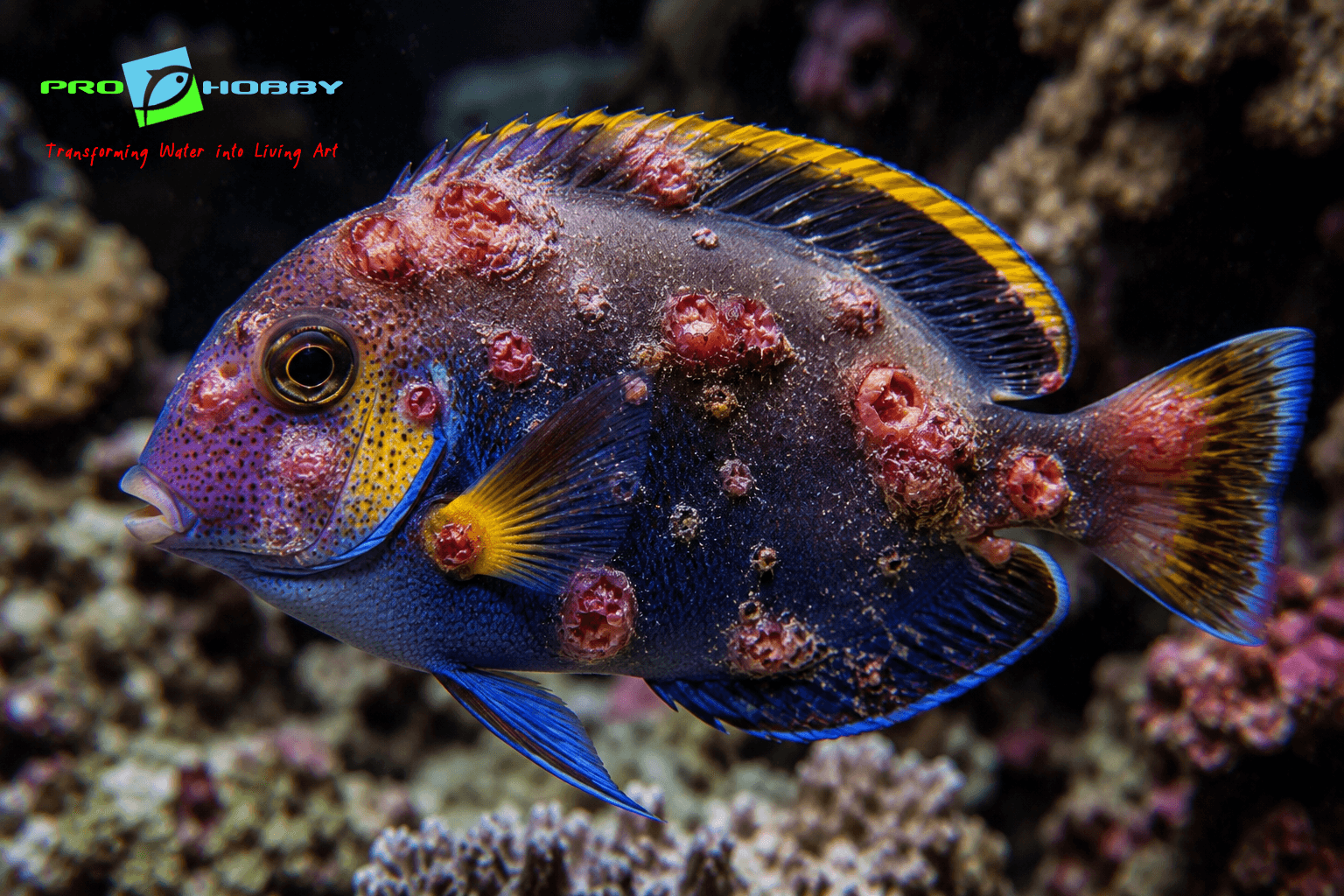
These bacteria are widely distributed in aquatic environments. Once established in a fish, they form granulomas — clusters of bacteria surrounded by immune cells attempting to contain them — in internal organs including the liver, spleen, kidney, intestine, and muscle tissue. Progressive organ failure and wasting result as granulomas enlarge and multiply. The slow growth rate of Mycobacterium (doubling time of hours to days rather than the minutes of Aeromonas) is why the clinical course unfolds over months, not days.
The stress-immunity framework that allows Mycobacterium to establish pathogenic infection: The Science of Fish Stress.
2. The Underreporting Problem — Why Fish TB Is Everywhere and Nowhere
The slow, non-specific clinical presentation of fish TB means that the vast majority of infected fish are never diagnosed. A fish declining over six months is “getting old.” A fish that wastes away in a maintained tank is “stressed” or “not eating well.” A fish with a curved spine is “deformed.” The diagnosis of Mycobacteriosis is almost never made in the living fish — and post-mortem examination of aquarium fish is exceptionally rare.
Research studies examining ornamental fish populations for Mycobacterium have found infection rates that consistently surprise aquarium hobbyists: 30–80% in labyrinthfish (bettas, gouramis) in some studies; significant prevalence in cichlid populations; high rates in livebearers. Most of these fish are subclinically infected — carrying the bacteria but controlled by immune function — and most will never develop clinical disease. A proportion will, and the conditions that tip subclinical infection into clinical disease are the same conditions that cause every other opportunistic aquarium disease: water quality failure, chronic stress, poor nutrition, and concurrent disease pressure.
The practical implication: when a fish in your tank declines with the described symptom pattern over months, the base rate of fish TB in aquarium fish populations makes it a serious and common diagnostic consideration — not a rare exotic disease.
3. Symptoms — The Chronic Timeline That Distinguishes Fish TB
No single symptom is pathognomonic for fish TB. The combination of symptoms and — critically — the chronic multi-month timeline together form the clinical picture.
Progressive weight loss and emaciation despite apparently normal appetite. The fish continues feeding but loses body condition — ribs and vertebral outline become visible, the abdomen becomes sunken. This combination of eating and losing weight indicates internal pathology consuming resources faster than feeding replaces them.
Faded, desaturated colouration developing progressively over months. This distinguishes fish TB from acute disease where colour change is rapid.
Increasing lethargy — reduced activity, resting on substrate, disinterest in feeding as disease advances.
Exophthalmia (bulging eyes) from granulomas behind the eye socket. Fish TB popeye is chronic, progressive, and completely non-responsive to antibiotic treatment — distinguishing it from bacterial popeye which responds within 7–10 days of gram-negative antibiotics.
Ulcers on the body surface — chronic, non-healing lesions that do not respond to standard bacterial treatments. Unlike scale rot which responds to gram-negative antibiotics, fish TB ulcers continue developing regardless of antibiotic treatment.
Abdominal swelling from granulomatous involvement of internal organs and associated fluid accumulation.
The diagnostic principle: All of these symptoms develop slowly over months. A fish with fin rot deteriorates over days. A fish with septicaemia deteriorates over hours. A fish declining over months — with any of the above symptoms — has fish TB until proven otherwise.
4. The Curved Spine — The Late Diagnostic Sign
Spinal deformity — scoliosis (lateral curvature) or lordosis (dorsal-ventral curvature) — is the most specific external sign of fish TB. Mycobacterial granulomas in the vertebral muscle tissue physically distort the spine as they grow. A curved spine that develops in an adult fish that previously had a normal spine is essentially diagnostic in the context of the full symptom picture.
Important distinction: spinal deformity present from a young age or from birth is developmental — not fish TB. Fish TB produces acquired spinal deformity in previously straight adult fish.
Once spinal deformity is present, the infection is advanced. The deformity is permanent — the structural alteration to muscle tissue by granuloma formation is not reversible. Assess quality of life honestly: if the fish can still reach food, avoid aggression, and navigate the tank, supportive care is appropriate. If normal function is significantly impaired, humane euthanasia with clove oil (10+ drops per litre) is the most ethical decision.
5. Open vs Closed Granulomas — What This Means for Transmission Risk
This is the dimension of fish TB biology that no hobbyist guide addresses, yet it directly determines how urgently the other fish in the tank need to be managed.
Closed granulomas are walled-off bacterial clusters where the immune response has successfully contained the bacteria — a fibrous capsule surrounds the granuloma and prevents bacterial shedding. Fish with only closed granulomas may live for extended periods with subclinical infection and pose lower transmission risk to other fish.
Open granulomas are actively shedding bacteria into the fish’s intestinal tract, body cavity, or ulcerated tissue — from where they enter the water. Fish with open granulomas (visible body ulcers, chronic diarrhoea, or advanced internal disease with intestinal granulomas) are actively contaminating the tank water with viable Mycobacterium.
The practical implication: A fish with weight loss and faded colour but no ulcers poses lower immediate transmission risk than a fish with active body ulcers. Both should be isolated — but the urgency differs. A fish with open ulcers shedding Mycobacterium into shared water has potentially already exposed every other fish in the tank to bacterial doses that may or may not establish infection depending on each fish’s immune status.
6. Species Most Susceptible
Fish TB prevalence is not uniform across species groups. Understanding which species carry the highest risk informs both husbandry decisions and the weight to place on a suspected diagnosis.
Labyrinthfish (bettas, gouramis, paradise fish): The highest-risk group in the ornamental fish trade. Research studies consistently find the highest Mycobacterium infection rates in this family. Bettas in the Indian market — arriving through import chains with minimal quarantine — represent a significant source of introduction.
Cichlids (oscars, discus, angelfish, African cichlids): High susceptibility, particularly in species with demanding water chemistry requirements where chronic suboptimal conditions are common. Oscar Fish Care, Discus Fish Care.
Livebearers (guppies, mollies, platies): Moderate susceptibility, but the livebearer community’s vertical transmission pathway (see Section 7) makes fish TB particularly significant in breeding populations.
Wild-caught fish: Substantially higher risk than captive-bred fish from established farms. Wild-caught fish carry Mycobacterium from natural environments where the bacteria are ubiquitous. Any wild-caught fish should be quarantined for longer than standard — a minimum of 6–8 weeks — before main tank introduction.
7. Vertical Transmission — Parent to Fry
This is the fish TB pathway that receives almost no attention in hobbyist literature and is critically important for anyone breeding fish.
Mycobacterium can transmit vertically — from infected parent fish to offspring — through two mechanisms:
Transovarial transmission: Bacteria present in the female reproductive tract infect the eggs before or during fertilisation. The fry are born infected — carrying a bacterial load from the moment they are free-swimming.
Transmission during spawning and early fry life: Open granulomas in parent fish contaminate the spawning environment with bacteria that fry are exposed to at extremely early developmental stages, before their immune systems have matured.
The consequences for breeders: Fry from infected parents may appear normal for months before showing clinical signs — or may remain subclinically infected carriers throughout their lives, transmitting to the next generation. A breeding colony with fish TB can produce infected offspring for years without the source being identified.
If fish in a breeding group show the fish TB symptom pattern, the fry from those fish should be considered potentially infected. Selling or distributing these fry spreads Mycobacterium through the ornamental fish community — which is likely a significant mechanism by which fish TB is so widespread in captive populations.
8. Is Fish TB Treatable?
No available aquarium treatment effectively clears Mycobacterium infections.
The antibiotics used in human TB treatment (rifampicin, isoniazid, ethambutol, clarithromycin) have been used experimentally in fish. Results have been inconsistent and largely discouraging: Mycobacterium in fish often shows resistance to the concentrations achievable through aquarium dosing, the treatment courses required are many months long, and even in the most favourable reported cases complete clearance was not confirmed. In India, these medications are not available as aquarium products and require veterinary prescription with specific justification.
What this means practically:
- Do not spend money or subject the fish to stress attempting standard aquarium antibiotic treatment for a confirmed or strongly suspected fish TB case
- Gram-negative antibiotics (kanamycin, nitrofurazone) have no useful activity against Mycobacterium whatsoever — they treat the secondary bacterial infections that often complicate fish TB, not the disease itself
- Supportive care (optimal water quality, nutrition, stress reduction) is the appropriate primary response for fish in earlier stages with good quality of life
9. Realistic Prognosis — How Long Does an Infected Fish Have?
This is the question hobbyists ask most and guides answer least. The honest answer has a wide range — because fish TB progression depends on the granuloma type (open vs closed), the fish’s immune status, water quality maintenance, and the specific Mycobacterium species.
Subclinical infection: Fish carrying only closed granulomas with adequate immune function may live essentially normal lifespans — years — without clinical disease ever manifesting. Many fish die of other causes before fish TB produces visible symptoms.
Early clinical disease (wasting, colour loss, no ulcers): Typically 6–18 months from first visible symptoms to death or euthanasia. Quality of life is often reasonable for much of this period.
Intermediate disease (visible exophthalmia, significant weight loss): Typically 3–9 months from this stage. Quality of life declining.
Advanced disease (spinal deformity, open ulcers, loss of equilibrium): Weeks to months. Euthanasia should be actively considered.
These are ranges, not schedules. The most useful guidance: assess quality of life at each observation rather than counting time. A fish that is still feeding, maintaining position, and engaging with the environment is living a reasonable life regardless of the timeline. A fish that cannot feed, cannot swim normally, or is being actively outcompeted by tank mates for food is suffering.
10. What to Do With Other Fish in the Same Tank
This is the decision point most guides skip. The answer is nuanced.
The immediate step: Do not add new fish to the tank while fish TB is suspected or confirmed. Any fish added is exposed to a contaminated environment.
For fish already in the tank: The options range from watchful observation to prophylactic treatment to full tank clearance.
If the affected fish has no visible ulcers (likely closed granulomas): Observe remaining fish closely for the symptom pattern over the following months. Improve water quality across the board — Complete Water Chemistry Guide. Reduce stocking density to reduce immune pressure. A healthy immune system is the best available protection against Mycobacterium establishing in exposed fish.
If the affected fish has active body ulcers (open granulomas, active shedding): The tank water is contaminated. Isolate the infected fish immediately. Consider whether the remaining fish — given their exposure level and individual immune status — warrant a prophylactic metronidazole course (metronidazole has limited but some activity against mycobacterial species and is broadly used as a supportive measure in exposed populations). Full tank clearance and disinfection is the most conservative appropriate response.
For breeding populations: See Section 7. If the infected fish were part of a breeding group, fry from recent spawns are potentially infected. These should not be distributed.
11. Fish TB vs Nocardia — The Distinction That Matters
Nocardiosis — infection by Nocardia species bacteria — produces clinical signs in fish that are almost identical to fish TB: chronic wasting, weight loss, body ulcers, internal granulomas, and organ failure. It is sometimes called “pseudo-tuberculosis” in fish disease literature.
Why the distinction matters:
- Nocardia is a gram-positive aerobic bacterium (unlike Mycobacterium which is acid-fast)
- Nocardia responds to sulphonamide antibiotics and trimethoprim-sulfa combinations that have no activity against Mycobacterium
- The zoonotic risk from Nocardia species differs from that of M. marinum — both can cause human infections but through different mechanisms and with different treatment responses
The practical diagnostic challenge: Neither can be reliably distinguished from the other clinically in a living aquarium fish. Both require laboratory examination. For the hobbyist, the management approach is the same (isolation, supportive care, honest quality-of-life assessment, disinfection protocol) regardless of which organism is responsible. The distinction matters most if a human health concern arises — at which point the physician needs accurate organism identification for appropriate antibiotic selection.
12. Diagnosis — Why It Is Almost Always Clinical
Definitive diagnosis requires:
- Microscopic examination of tissue samples with Ziehl-Neelsen staining to identify acid-fast bacilli
- Culture for species identification — typically taking weeks due to the slow growth rate
- PCR testing in well-equipped facilities
All of these are post-mortem in the vast majority of aquarium cases. For the hobbyist, clinical diagnosis is the practical reality:
- Chronic timeline of months
- Progressive wasting despite eating
- Spinal deformity in a previously straight adult fish (late, near-diagnostic)
- Body ulcers non-responsive to gram-negative antibiotics
- Normal water parameters
- Elimination of internal parasites as an alternative diagnosis (internal parasites respond to metronidazole and fenbendazole; fish TB does not)
If post-mortem examination is pursued, a veterinary practice with fish medicine experience can perform the staining. The results meaningfully inform the disinfection decision and the management of remaining fish.
13. The Zoonotic Risk — Fish Handler’s Granuloma — Full Clinical Picture
Mycobacterium marinum can and does infect humans. This section provides the complete clinical picture — not a brief warning.
Transmission mechanism: M. marinum enters through breaks in the skin — cuts, abrasions, hangnails, eczema patches, any disruption of skin integrity. It cannot penetrate intact skin. It does not transmit through the air or through consuming fish. Every aquarium maintenance task involving hand contact with tank water carries risk when the tank contains actively infected fish.
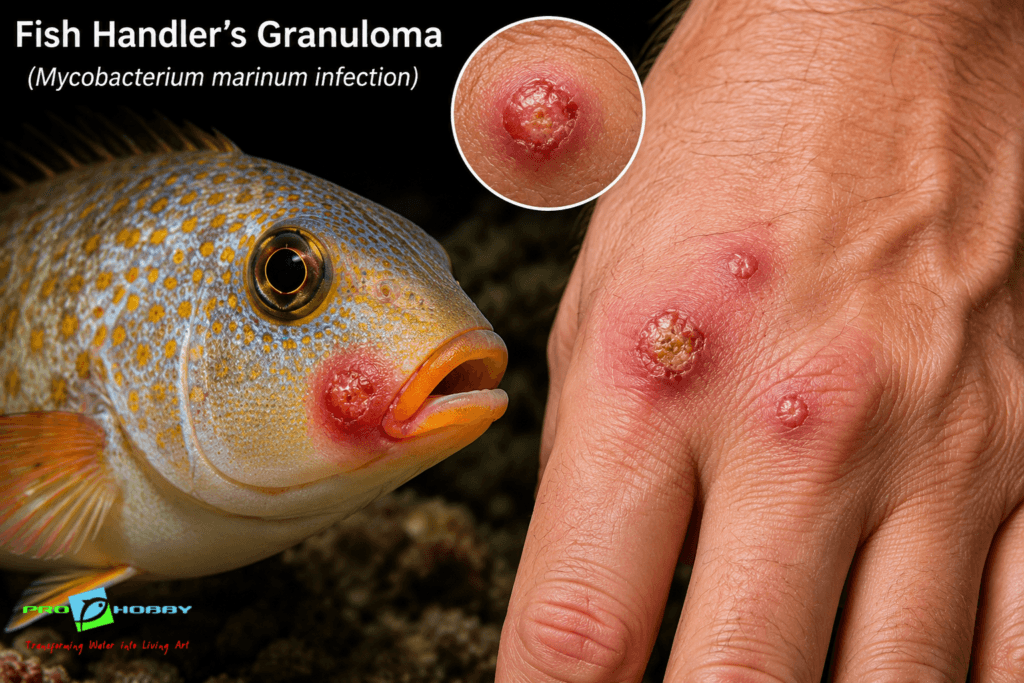
Incubation period: 2–6 weeks from exposure to first visible lesion. The delay means the aquarium exposure is often not connected to the skin lesion when it appears.
Human disease presentation: A slowly enlarging, firm nodule or ulcer at the inoculation site — typically the dorsum of the hand, fingers, or forearm. The lesion does not heal spontaneously. Without treatment it enlarges over weeks to months. In approximately 30–40% of cases, infection spreads along the lymphatic channels of the hand and arm, producing a string of nodules — the sporotrichoid pattern — that is characteristic of M. marinum and specifically distinct from common bacterial skin infections.
Why it is consistently misdiagnosed in India: M. marinum infection is on the differential diagnosis list of infectious disease specialists and dermatologists familiar with aquarium exposure, but is rarely considered by general practitioners. In India, where the differential diagnosis for chronic skin nodules typically focuses on more prevalent local conditions, M. marinum is frequently treated as a common bacterial infection with standard antibiotics for weeks or months before the correct diagnosis is made. The critical information to provide any physician: exact date of aquarium contact, that the tank contained fish suspected of having fish TB, and the description “chronic non-healing skin nodule or ulcer after aquarium exposure.”
Treatment for human infection: Not a short course. Standard treatment is typically 3–6 months of dual antibiotic therapy — most commonly clarithromycin combined with rifampicin or ethambutol, or trimethoprim-sulphamethoxazole for milder cases. Shorter courses produce relapse. The treating physician should be a dermatologist or infectious disease specialist, not a general practitioner. In India, such specialists are available in major cities including Delhi — do not delay referral.
Protective measures — non-negotiable when fish TB is suspected:
- Waterproof gloves for all aquarium maintenance
- Waterproof plasters over any cuts, abrasions, or skin breaks before aquarium contact
- Never suck siphons
- Thorough handwashing with soap after all aquarium maintenance regardless of glove use
- If children maintain the tank, adult supervision and gloves for all water contact
14. Tank Disinfection and Environmental Persistence
Mycobacterium species form granuloma structures and produce resistant spore-like forms that persist in the environment significantly longer than most aquarium pathogens.
Environmental persistence: M. marinum has been shown to survive in aquarium water and substrate for weeks to months at room temperature. In biofilm (which forms on all aquarium surfaces) the persistence is longer. This is why superficial cleaning is insufficient — the entire substrate, porous media, and any organic-retaining surfaces must be discarded.
Disinfection protocol:
- Remove and euthanise all remaining fish — do not transfer them to other tanks
- Discard all porous materials — substrate, sponge filter media, porous rocks, driftwood, organic décor. These cannot be reliably disinfected
- Bleach solution (1 part household bleach : 9 parts water) — apply to all non-porous tank surfaces, glass, heater, filter body, hard plastic. Minimum 30 minutes contact time. Rinse thoroughly with clean water and allow to air-dry completely — residual bleach is toxic to fish
- Thermometer, nets, and equipment — soak in bleach solution 30 minutes, rinse, dry
- Allow the tank and all equipment to air-dry completely — a minimum of 48 hours. Mycobacterium desiccates and dies significantly faster than it survives in water
- Re-cycle the tank fully before adding new fish — a minimum of 4–6 weeks. How to Cycle a Fish Tank
15. India and Delhi NCR — Specific Considerations
Import chain and labyrinthfish: A significant proportion of bettas and gouramis entering the Indian market arrive through import chains with minimal quarantine. Given the high Mycobacterium prevalence in labyrinthfish, proper quarantine of all new bettas is meaningful disease prevention. The quarantine protocol applied to all ProHobby livestock directly addresses this: Quarantine and Biosecurity in Aquariums. Betta Fish Care Guide.
Tubifex worms: Wild-caught Tubifex worms — widely sold in Indian fish markets — are a documented vector for Mycobacterium. Frozen live food from reputable suppliers eliminates this specific transmission route.
Summer immune suppression: Delhi NCR’s summer conditions (ambient 40–45°C, uncontrolled tank temperatures exceeding 30°C) produce the immune suppression that tips subclinical Mycobacterium infection into clinical disease. Temperature management through summer is meaningful prevention — not just for fish comfort but for immune function. Aquarium Water Temperature in Indian Summer.
The human health infrastructure: Infectious disease and dermatology specialists capable of diagnosing and treating M. marinum infection are available in Delhi NCR’s major hospitals. Do not manage a suspected human M. marinum infection at the general practitioner level — the treatment duration (3–6 months) and the antibiotic regimen require specialist management. Specifically mention the aquarium exposure history at the first appointment.
Frequently Asked Questions
Can fish TB spread to humans? Yes. Mycobacterium marinum causes fish handler’s granuloma — a chronic skin infection entering through any break in the skin during aquarium contact. Treatment requires 3–6 months of dual antibiotic therapy under specialist supervision. Wear waterproof gloves for all maintenance when fish TB is suspected. If a chronic non-healing skin nodule appears after aquarium contact, see a dermatologist or infectious disease specialist immediately and specifically mention the aquarium exposure.
Is there any treatment for fish TB? No effective aquarium treatment exists. Standard aquarium gram-negative antibiotics have no useful activity against Mycobacterium. Experimental use of human TB antibiotics produces inconsistent results and requires veterinary prescription. Management focuses on supportive care, isolation, and humane euthanasia when quality of life deteriorates significantly.
How do I know if my fish has fish TB? Chronic decline over months: progressive wasting despite eating, faded colouration, lethargy, and as a late sign — spinal curvature in a previously straight adult fish. Body ulcers non-responsive to gram-negative antibiotics are strongly suggestive. Elimination of internal parasites as an alternative (internal parasites respond to metronidazole and fenbendazole; fish TB does not) strengthens the clinical diagnosis.
My fish has a curved spine — is it fish TB? Spinal deformity in a previously straight adult fish with a history of chronic wasting is strongly suggestive of fish TB. Mycobacterial granulomas in vertebral muscle physically distort the spine. Developmental spinal abnormalities present from early life are a different issue. If spinal deformity has appeared in an adult fish alongside the described symptom pattern, fish TB is the primary working diagnosis.
Can fish TB transmit from parent fish to fry? Yes — through transovarial transmission (bacteria in the reproductive tract infect eggs before fertilisation) and through environmental contamination of the spawning environment. Fry from infected parents may be born infected or exposed at a stage where immune defence is minimal. A breeding population with fish TB may produce infected offspring for years without the source being identified.
How long does an infected fish live? Subclinical fish with only closed granulomas may live essentially normal lifespans. Early clinical disease (wasting, colour loss) typically progresses over 6–18 months. Advanced disease (spinal deformity, open ulcers) — weeks to months. Assess quality of life at each observation rather than counting time. A fish still feeding and maintaining position is living reasonably; a fish unable to feed or swim normally warrants euthanasia consideration.
What should I do with the other fish in the same tank? Do not add new fish. If the infected fish had no visible ulcers (lower transmission risk): observe remaining fish closely, improve water quality throughout. If the infected fish had active body ulcers (active bacteria shedding into shared water): isolate infected fish immediately, consider prophylactic metronidazole for the tank, consider full disinfection as the most conservative response.