
By ProHobby™ | Ecological Systems Authority
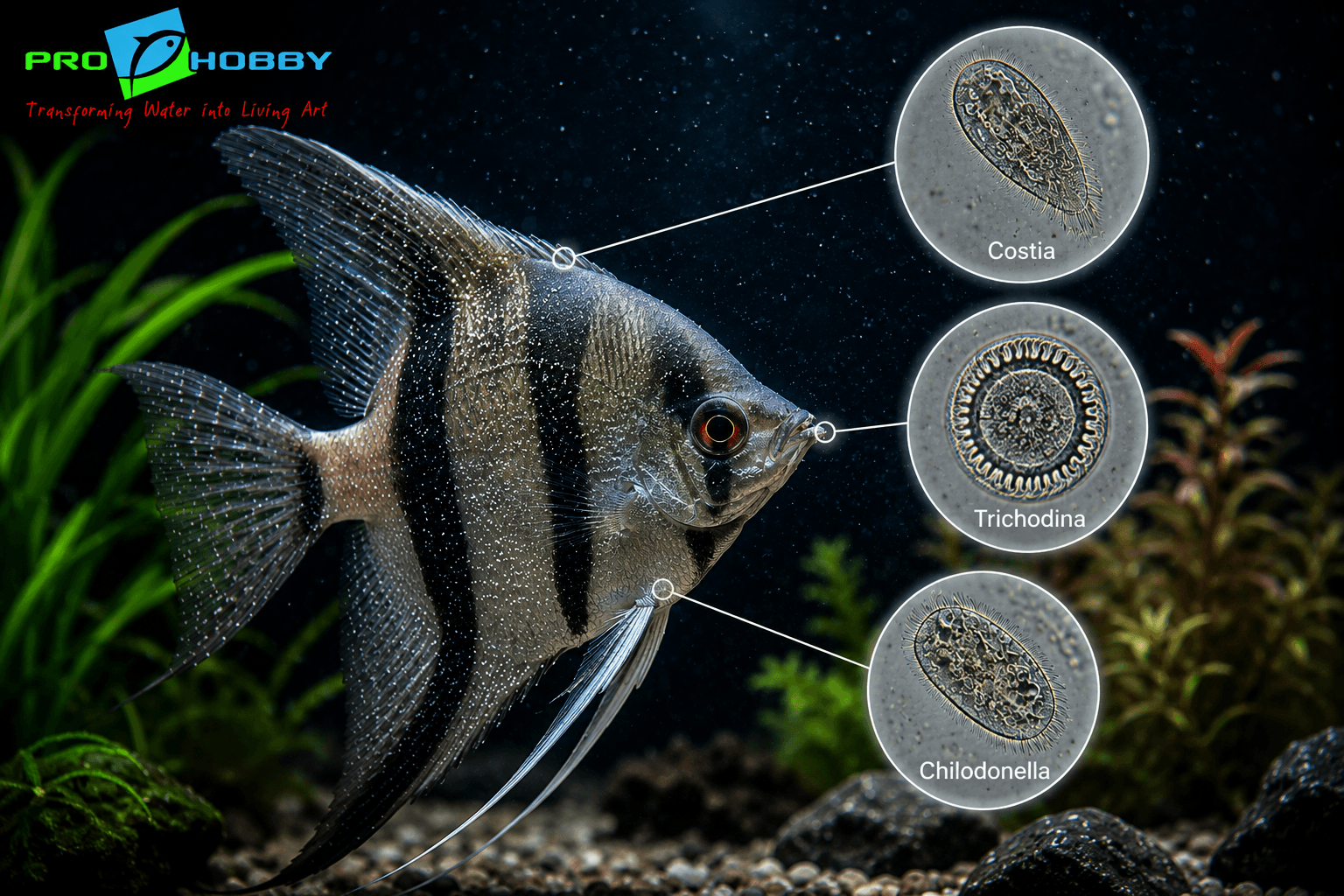
Three of the most common aquarium parasites are consistently misidentified as ich or velvet — and treated incorrectly as a result. Costia (Ichthyobodo necatrix), Trichodina, and Chilodonella produce flashing, cloudy skin, and respiratory distress without the discrete white spots of ich or the gold dust of velvet. They are distinct organisms requiring different treatments. Treating them with ich protocol produces no improvement. Recognising this group correctly and treating with formalin or potassium permanganate resolves what repeated ich treatment cannot.
Table of Contents
- What These Parasites Are — Three Distinct Organisms
- Costia (Ichthyobodo necatrix) — The Smallest and Fastest
- Trichodina — The Ring Parasite
- Chilodonella — The Leaf-Shaped Ciliate
- Differential Diagnosis — Distinguishing From Ich, Velvet and Water Quality
- Treatment — Step by Step
- After Treatment — Preventing Recurrence
- India and Delhi NCR — Specific Considerations
- Frequently Asked Questions
1. What These Parasites Are — Three Distinct Organisms
Costia, Trichodina, and Chilodonella are external protozoan parasites that infest the skin and gills of aquarium fish. They share the same clinical presentation — cloudy or hazy skin, excess mucus, flashing, and respiratory distress — but are biologically distinct organisms with different lifecycle characteristics and slightly different treatment sensitivities. All three are present in most aquatic environments at subclinical levels and establish pathogenic infections primarily in stressed, immunocompromised fish. The stress-immunity mechanism that enables them to establish is in The Science of Fish Stress.
2. Costia (Ichthyobodo necatrix) — The Smallest and Fastest
Costia is among the smallest fish parasites — a biflagellate protozoan invisible without magnification. It attaches to skin and gill epithelium, feeding directly on host cells. It thrives at cooler temperatures (4–12°C is optimal) but infects tropical fish at normal aquarium temperatures when immune function is suppressed.
Clinical signs: A grey-blue sheen or cloudiness over the body surface and fins, excess mucus, flashing and scratching against substrate, rapid or laboured breathing when gills are heavily infested, hanging near the surface or in areas of high water flow. The body surface looks hazy — uniformly clouded, not spotty and not dusty.
Speed: Costia can kill within days in cold water and within 1–2 weeks in tropical conditions. Heavily infested fry batches can be lost without any recognisable spots or dust appearing.
3. Trichodina — The Ring Parasite
Trichodina is a saucer-shaped ciliate with a distinctive ring-like denticulate disc that functions as its attachment mechanism. Under microscopy this ring structure rotates as the parasite moves across the host surface — the characteristic wheel-like appearance that gives rise to the “ringworm” terminology sometimes applied to this parasite group in regional aquarium literature. It is a completely different organism from ich, velvet, or the fungal ringworm of mammals.
Clinical signs: Identical to Costia — grey-blue skin cloudiness, excess mucus, flashing, respiratory distress. Trichodina feeds on bacteria and organic debris rather than host cells directly, making it more of an opportunist complication than a primary pathogen. At high densities, however, it damages gill epithelium and skin significantly.
Association with poor water quality: Trichodina specifically thrives in overcrowded tanks with high organic load — conditions that provide the bacteria it feeds on while simultaneously suppressing fish immunity. A Trichodina outbreak is almost always co-occurring with water quality problems that must be addressed as part of treatment.
4. Chilodonella — The Leaf-Shaped Ciliate
Chilodonella is a leaf-shaped ciliate that attaches to skin and gills and feeds directly on epithelial cells. It is hardier than Costia at lower temperatures and produces more significant tissue damage per individual organism. At high infestation densities it produces severe gill damage that reduces oxygen extraction — fish can die from hypoxia in well-oxygenated water, the same mechanism as gill flukes and nitrite toxicity.
Clinical signs: Same presentation as Costia and Trichodina. Chilodonella tends to progress slightly slower but can produce mass mortalities in heavily stocked or stressed populations.
5. Differential Diagnosis — Distinguishing From Ich, Velvet and Water Quality
Always test water before treating for parasites. Ammonia and nitrite cause identical flashing and respiratory distress symptoms from direct gill irritation. Correcting water quality first and observing whether symptoms resolve is always the correct first step.
| Feature | Costia / Trichodina / Chilodonella | Ich | Velvet |
|---|---|---|---|
| Appearance | Uniform grey-blue haze, no discrete marks | Discrete 1mm white spots | Fine gold/rust dust — torch in dim light |
| Visible to naked eye | No | Yes — spots | With torch only |
| Progression | Fast (days) | Moderate | Fast, can kill quickly |
| Gills affected | Yes — often primary site | Secondary | Yes |
| Treatment | Formalin, salt, potassium permanganate | Heat + salt/medication | Copper, formalin, darkness |
A definitive diagnosis requires a skin scrape under a microscope — Trichodina’s ring disc and Chilodonella’s leaf shape are immediately identifiable. Costia requires higher magnification but its flagellate motion is distinctive. In practice, empirical treatment is appropriate when symptoms fit and water quality has been ruled out.
6. Treatment — Step by Step
Step 1: Test water parameters. Ammonia, nitrite, temperature. If any are abnormal, correct these first. Water quality improvement alone resolves many cases of Trichodina specifically.
Step 2: Isolate in a hospital tank. All three parasites spread through shared water. Isolation protects healthy fish and allows targeted treatment.
Step 3: Salt treatment. Aquarium salt at 2–3g/L provides osmotic stress on all three parasites and supports gill tissue recovery. Effective for mild cases as standalone; used as adjunct in moderate to severe cases.
Step 4: Formalin treatment (moderate to severe cases). Formalin dips at 1–2 ml/L for 30–60 minutes in a separate aerated treatment container, or prolonged bath at 0.15–0.25 ml/L for 60 minutes. Formalin is an oxidiser — maintain strong aeration throughout. Remove fish immediately at any sign of distress.
Step 5: Potassium permanganate (alternative to formalin). 10 mg/L for 30–45 minutes in a separate treatment container. Particularly effective against Costia and Chilodonella. Same strong aeration requirement.
Step 6: Raise temperature to 28–30°C. Accelerates parasite lifecycle, speeds treatment response in tropical aquariums.
Step 7: Repeat treatment after 5–7 days to catch any parasites that survived the initial course. Monitor ammonia daily — formalin damages biological filtration. How to Clean an Aquarium Filter Without Killing Bacteria covers biofilm recovery during treatment.
7. After Treatment — Preventing Recurrence
These parasites almost always arrive on new fish. Quarantine for 4 weeks before main tank introduction is the primary prevention — salt at 2g/L during quarantine provides prophylactic protection. The complete quarantine protocol: Quarantine and Biosecurity in Aquariums. The treatment vs environment decision framework: Quarantine vs Medication.
Trichodina recurrence specifically signals ongoing water quality problems — high organic load, overcrowding, or parameter instability that must be addressed to prevent recolonisation.
8. India and Delhi NCR — Specific Considerations
Indian summer and Costia: Costia thrives at cooler temperatures — it is less of a threat in Indian tropical tank conditions than in temperate regions. However, the immune suppression produced by summer heat stress (tanks exceeding 30°C) creates the vulnerability that enables all three parasites to establish, regardless of temperature preference. Aquarium Water Temperature in Indian Summer.
New imports and quarantine: Fish imported through the Indian ornamental trade are a significant introduction vector for all three parasites. The quarantine protocols that ProHobby applies to all incoming livestock directly address this risk. Aquarium Shop Delhi NCR — What a Specialist Looks Like.
Frequently Asked Questions
My fish is cloudy and flashing but has no white spots — what is this? Most likely Costia, Trichodina, or Chilodonella. Test ammonia and nitrite first — both cause identical symptoms from gill irritation. If parameters are normal, treat with aquarium salt at 2–3g/L. If no improvement within 48 hours, progress to formalin treatment.
How are these different from ich? Ich produces discrete 1mm white spots visible to the naked eye across body and fins. These parasites produce uniform grey-blue cloudiness with no discrete spots. Both cause flashing and distress but require different treatments — ich responds to heat and salt; this group requires formalin or potassium permanganate.
What is the “ring parasite” or “ringworm” in fish? Trichodina — a saucer-shaped ciliate with a distinctive ring-like denticulate disc structure visible under microscopy. It is unrelated to the fungal ringworm of mammals. The ring structure is its attachment mechanism and the source of the regional “ringworm” terminology sometimes applied to it.
Can these parasites kill fish quickly? Yes. Costia can kill within days in stressed populations, particularly cold-water fish. Chilodonella causes significant gill damage that produces hypoxia — fish die from oxygen deprivation despite adequate dissolved oxygen in the water. Treat promptly; these are not slow-moving conditions.
Are these parasites visible without a microscope? No. Their effects are visible — the cloudy skin, excess mucus, respiratory distress — but the organisms themselves require microscopic examination for identification. Diagnosis is clinical, based on symptom pattern and elimination of other causes.