
By ProHobby™ | Ecological Systems Authority
Brooklynella hostilis has acquired the nickname “clownfish disease” in the marine hobby, and that nickname does real damage — it teaches hobbyists to associate a genuinely universal pathogen with a single species group, producing dangerous underdiagnosis whenever it appears in anything other than a clownfish. It also obscures the thing that makes Brooklynella mechanistically unlike almost every other disease covered in this library: it is not a parasite that forms discrete feeding lesions and moves through a staged lifecycle of attachment, encystment, and release the way Cryptocaryon and Amyloodinium do. Brooklynella destroys epithelial cells directly across the entire body surface and triggers the fish’s own mucus-producing cells into a hypersecretion response so severe that the excess mucus itself becomes a mechanical barrier to gas exchange — the fish’s own defence mechanism becomes a direct contributor to its death. Combined with a reproductive strategy that does not require the same off-host encystment cycle as Cryptocaryon or Amyloodinium, Brooklynella can move from first symptom to death within 24 hours, placing it among the fastest-killing diseases in the marine hobby regardless of species.
Table of Contents
- What Brooklynella hostilis Actually Is
- Why “Clownfish Disease” Is a Dangerous Oversimplification
- The Pathology — Direct Cell Destruction, Not a Feeding Parasite
- The Mucus Mechanism — When the Fish’s Own Defence Becomes the Killer
- Reproduction Without an Off-Host Cycle — Why This Changes Everything
- Symptoms — What Brooklynella Actually Looks Like
- Brooklynella vs Velvet vs Ich — The Full Differential
- Why Formalin Is First-Line, Not Copper
- Freshwater Dips — The Rapid Diagnostic and Supportive Tool
- Treatment Protocol — Step by Step
- The Import Holding Tank Connection
- Emergency Response — The First Hour
- Prevention and Quarantine
- India — Sourcing Realities
- Frequently Asked Questions
1. What Brooklynella hostilis Actually Is
Brooklynella hostilis is a ciliated protozoan — placing it in the same broad organism class as Cryptocaryon irritans, but functioning in a fundamentally different way. Where Cryptocaryon behaves as a classic feeding parasite that attaches, burrows beneath the epidermis to feed as a discrete trophont, then departs to encyst and reproduce off the host, Brooklynella lives and reproduces directly on the host’s skin and gill surface, feeding on and destroying epithelial cells in a diffuse, spreading pattern across the body rather than as a population of individually countable feeding lesions.
This distinction is not academic. It is the reason Brooklynella infestations frequently do not present as anything a hobbyist would immediately recognise as “spots” — there is no equivalent to the discrete white dot of ich or even the fine dusting of velvet. What develops instead is a generalised deterioration of the skin surface across the whole fish simultaneously.
2. Why “Clownfish Disease” Is a Dangerous Oversimplification
Clownfish are genuinely and disproportionately affected by Brooklynella, and there are real biological and epidemiological reasons for this — but the resulting nickname has created a hobby-wide assumption that actively harms fish of other species.
Why clownfish are disproportionately affected: Clownfish are, by a wide margin, the single most heavily traded marine ornamental fish species group globally, meaning far more individual clownfish pass through the high-density holding and shipping conditions described in Section 11 than any other marine species — conditions that are themselves a major driver of Brooklynella outbreaks. There is also some evidence that clownfish and related damselfish may have a degree of particular physiological susceptibility, though the sheer trade volume alone would be sufficient to explain much of the disproportionate case reporting even without any species-specific vulnerability.
The consequence of the nickname: A hobbyist who has internalised “Brooklynella is the clownfish disease” is measurably less likely to consider it as a diagnosis when a tang, an angelfish, a wrasse, or any other marine species presents with the symptom pattern described in Section 6 — despite Brooklynella having a genuinely broad host range across marine fish species. This diagnostic blind spot costs time in a disease where, as established throughout this guide, time is the single scarcest resource a hobbyist has.
The correct framing: Brooklynella is a generalist marine fish pathogen that happens to disproportionately affect the most heavily traded species group in the hobby. Any marine fish — not just clownfish — showing the symptom pattern in Section 6 should be assessed for Brooklynella as a genuine possibility.
3. The Pathology — Direct Cell Destruction, Not a Feeding Parasite
Understanding what Brooklynella actually does to fish tissue explains why its clinical presentation and its treatment logic diverge so sharply from Cryptocaryon and Amyloodinium.
Rather than attaching at discrete sites and feeding through specialised structures the way Cryptocaryon’s trophonts or Amyloodinium’s rhizoid-anchored trophonts do, Brooklynella spreads across the epithelial surface, directly damaging and destroying the outer layer of skin and gill cells it contacts. This produces a diffuse pattern of epithelial injury across large areas of the body simultaneously, rather than the accumulation of individually identifiable lesions that characterises the other two organisms covered in this library.
This diffuse, surface-wide injury pattern is the direct cause of the two dominant clinical features of Brooklynella disease: the excessive mucus response described in Section 4, and gill damage that, as with Amyloodinium, can produce fatal respiratory compromise — though through a distinctly different tissue-level mechanism than Amyloodinium’s rhizoid feeding damage.
4. The Mucus Mechanism — When the Fish’s Own Defence Becomes the Killer
This is the single most important and most underexplained aspect of Brooklynella pathology, and it deserves to be understood in full rather than mentioned in passing.
Fish skin and gill tissue produce mucus as a baseline protective barrier — a normal, continuous, low-level physiological process that protects the epithelium from pathogens, physical abrasion, and osmotic stress. When epithelial cells are damaged or destroyed at scale, as occurs across the body surface in Brooklynella infestation, the fish’s mucus-producing cells respond to this widespread tissue injury with a dramatically upregulated secretion response — producing far more mucus, far faster, than the normal protective baseline.
In a localised injury, this hypersecretion response would be appropriately protective. In a diffuse, whole-body Brooklynella infestation, the response becomes pathological: mucus production across the entire skin and gill surface simultaneously produces a thick, excessive coating that itself becomes a mechanical barrier to oxygen diffusion across the gills and, to a lesser extent, the skin. The fish, in the process of mounting what is in isolation a biologically sensible defensive response to cell damage, effectively smothers itself. This is a genuinely distinct killing mechanism from the direct tissue destruction of Amyloodinium’s gill damage or the simple physical parasite burden of heavy Cryptocaryon infestation — it is the fish’s own physiology, deployed at pathological scale, that becomes the proximate cause of respiratory failure.
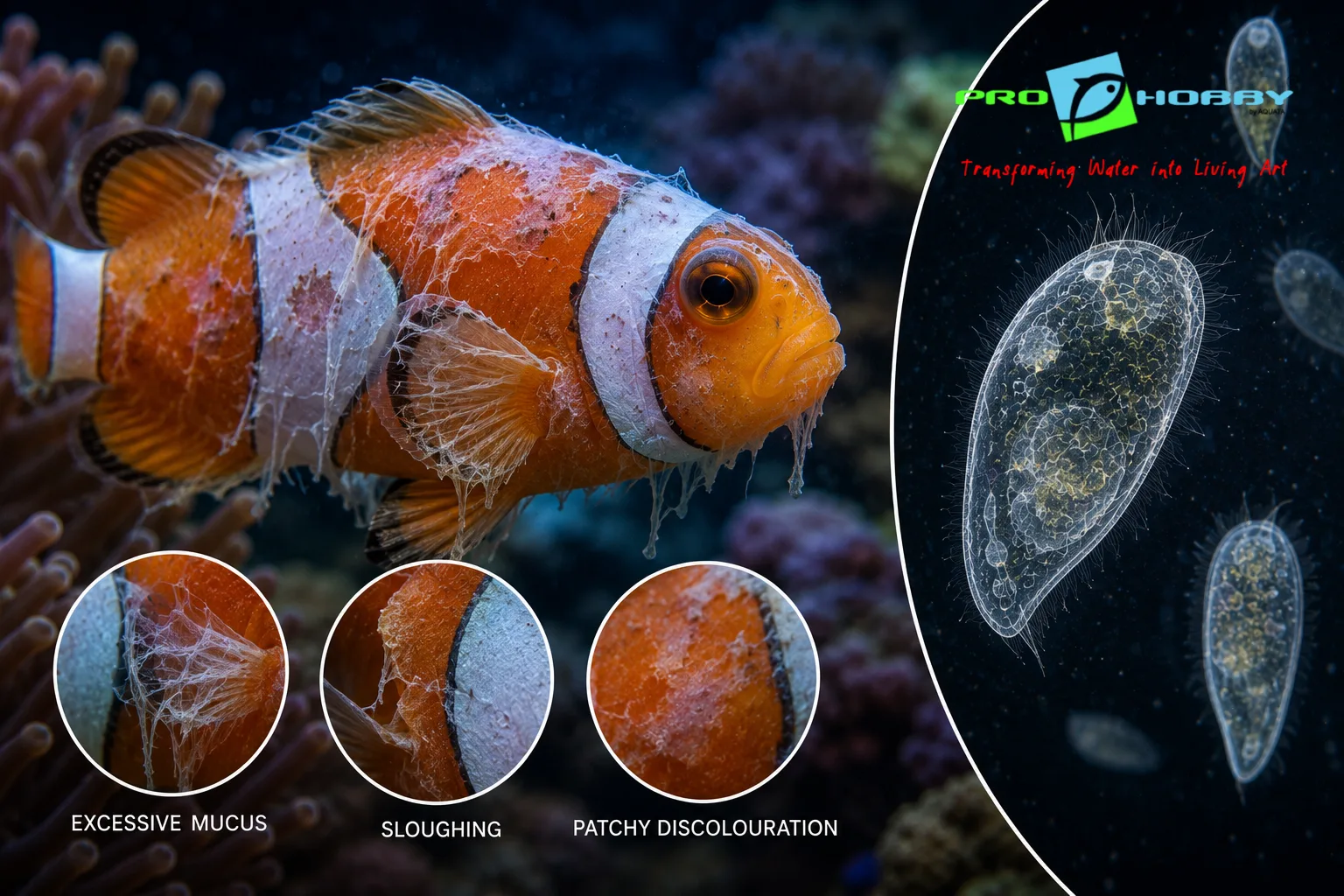
This mechanism is also why excess visible mucus — sometimes described by hobbyists as the fish appearing to be shedding a cloudy or slimy film, or skin that looks like it is sloughing away — is one of the most reliable and distinctive clinical signs of Brooklynella, and why it differs meaningfully from the drier, dust-like or spot-like presentations of velvet and ich respectively.
5. Reproduction Without an Off-Host Cycle — Why This Changes Everything
Cryptocaryon and Amyloodinium both depend on a structured lifecycle that includes a mandatory off-host reproductive stage — the tomont, encysted on tank substrate, is where the population multiplication that drives an outbreak actually occurs, and this off-host stage is precisely what the Tank Transfer Method exploits by physically separating the fish from the substrate before that reproduction can complete.
Brooklynella reproduces through binary fission directly on the host fish’s surface, without the same obligate off-host encystment stage that defines Cryptocaryon and Amyloodinium’s lifecycles. This has two major practical consequences. First, Brooklynella can spread through direct fish-to-fish contact and through free organisms shed into the water column without requiring the population to first pass through a substrate-bound reproductive stage — meaning transmission between fish sharing water can be extremely rapid, unmediated by the multi-day tomont cycle that partially paces Cryptocaryon and Amyloodinium outbreaks. Second, and directly following from this, the Tank Transfer Method’s core logic — physically separating the fish from a substrate where reproducing parasites are encysted before they can complete their cycle and reinfect — is considerably less applicable to Brooklynella, since there is no equivalent obligate substrate-bound stage to outrun in the same way.
This is the central reason formalin-based treatment protocols, rather than TTM, are the standard first-line approach for Brooklynella, covered in full in Section 8.
6. Symptoms — What Brooklynella Actually Looks Like
Excessive mucus production — the dominant and most distinctive sign, described variously as a cloudy or slimy film over the body, skin that appears to be sloughing or peeling, or a fish that looks like it is coated in an abnormal amount of clear-to-white mucus. This is frequently the first thing a hobbyist notices, well before any discrete lesion pattern.
Rapid, laboured respiration — reflecting the gill involvement and mucus-mediated gas exchange impairment described in Section 4, and frequently as prominent or more prominent than any visible skin change.
Loss of appetite and rapid lethargy — onset within hours to a day or two of infestation, notably fast even by the standards of the other rapid marine diseases covered in this library.
Flashing and scratching — the same generalised irritation response seen with other external parasites and pathogens.
Skin discolouration and patchy, blotchy appearance — reflecting the diffuse epithelial damage pattern described in Section 3, distinct from the discrete spots of Cryptocaryon or the fine uniform dusting of Amyloodinium.
Rapid overall deterioration — Brooklynella is consistently described in marine fish health literature as one of the fastest-progressing common marine diseases, with death occurring within 24 hours of first visible symptoms in severe cases, and sometimes faster still in heavily stressed or newly imported fish.
7. Brooklynella vs Velvet vs Ich — The Full Differential
| Feature | Brooklynella | Marine Velvet (Amyloodinium) | Marine Ich (Cryptocaryon) |
|---|---|---|---|
| Organism type | Ciliate (diffuse surface pathogen) | Dinoflagellate | Ciliate (discrete trophont parasite) |
| Visible presentation | Excessive mucus, sloughing, patchy discolouration | Fine gold/rust dust | Discrete 0.5-1mm white spots |
| Primary mechanism of death | Mucus-mediated gas exchange failure + direct epithelial destruction | Gill tissue destruction by rhizoid feeding | Physical parasite burden, gill involvement |
| Off-host reproductive stage | Minimal/not obligate in the same sense | Obligate tomont stage | Obligate tomont stage |
| Typical time to death | Can be under 24 hours | 24-48 hours in severe cases | Days to over a week typically |
| Species reputation | Wrongly associated with clownfish only | Broad host range, high in damselfish | Broad host range |
| First-line treatment | Formalin | Copper | Copper |
| Tank Transfer Method applicability | Limited | Effective | Effective |
Full biology and treatment detail for the other two conditions in this table: Amyloodinium ocellatum (Marine Velvet) — Complete Guide and Cryptocaryon irritans (Marine Ich) — Complete Guide.
The practical rule that follows from this table: any marine fish presenting with excessive mucus, apparent skin sloughing, and rapid respiratory distress — regardless of species — should be assessed for Brooklynella specifically, not defaulted to a general “marine parasite” treatment assumption built around copper and Cryptocaryon-style thinking.
Two further conditions sit close enough to Brooklynella’s presentation to warrant specific mention. Uronema marinum produces ulcerative lesions that can be mistaken for Brooklynella-related tissue damage, particularly once secondary bacterial colonisation is also present, though Uronema’s lesions are typically more localised to a site of pre-existing damage rather than the diffuse, whole-body mucus pattern that characterises Brooklynella — full differential and the external-versus-systemic distinction that determines prognosis: Uronema marinum — Complete Guide. Bacterial gill disease, covered in full in Bacterial Gill Disease in Marine Fish — Complete Guide, can produce the same rapid respiratory distress as Brooklynella’s gill involvement with no mucus or skin change at all, and responds to water quality correction and antibiotics rather than formalin — a genuinely different treatment pathway that only close observation of whether excess mucus is actually present can help distinguish.
8. Why Formalin Is First-Line, Not Copper
Copper’s mechanism of action — cellular toxicity to the free-swimming infective stage of a parasite, as established in the Cryptocaryon and Amyloodinium guides — is most effective against organisms with a defined free-swimming infective stage that spends meaningful time in open water where copper concentration can act on it. Given Brooklynella’s reproduction directly on the host surface without the same obligate off-host cycle described in Section 5, copper’s standard mechanism of primarily targeting a free-swimming stage is less directly applicable, and copper is generally not regarded as the most reliable first-line treatment for Brooklynella in the way it is for the other two organisms.
Formalin — a diluted formaldehyde solution — is the standard first-line treatment. Formalin works through a broader-acting mechanism, causing direct chemical damage to the ciliate organism’s cell structure on contact, making it effective against organisms present directly on the fish’s body surface rather than relying primarily on intercepting a free-swimming stage. This makes it considerably better suited to an organism like Brooklynella that spends the overwhelming majority of its life cycle directly on host tissue rather than cycling through a distinct off-host reproductive stage.
Formalin treatment protocol: Formalin baths, typically in the range of 15-25 ppm formaldehyde (product-dependent — always follow the specific commercial product’s labelled concentration rather than approximating), administered as a bath treatment of limited duration (commonly around 30-60 minutes, product and severity dependent) rather than as a continuous, weeks-long water additive in the way copper is dosed for Cryptocaryon. Formalin is a significant respiratory irritant and oxidiser, and strong aeration throughout the bath is essential — the fish should be observed continuously throughout treatment and removed immediately at any sign of severe distress.
Repeat treatment: Given that reinfection can occur rapidly through direct contact and the abbreviated or absent off-host cycle described in Section 5, formalin bath treatment is typically repeated over consecutive days rather than following the multi-week continuous exposure model used for copper against Cryptocaryon or Amyloodinium.
Handling formalin safely: Formalin is toxic and an irritant to humans as well as fish — use in a well-ventilated area, avoid skin and eye contact, and follow commercial product handling instructions precisely.
9. Freshwater Dips — The Rapid Diagnostic and Supportive Tool
A brief freshwater dip — transferring the marine fish to a separate container of temperature- and pH-matched freshwater for a short duration, typically several minutes — is a widely used supportive and diagnostic tool specifically relevant to Brooklynella and other external marine parasites, working through osmotic shock to organisms adapted to marine salinity.
Diagnostic value: A freshwater dip can cause a heavily Brooklynella-affected fish to visibly shed excess mucus and dying organisms into the dip water, sometimes providing clearer visual or even microscopic confirmation of the disease than examining the fish in its normal tank environment.
Supportive value: Beyond diagnosis, a freshwater dip provides genuine short-term relief by physically removing some parasite burden and excess mucus from the gill surface, though it is a supportive adjunct to formalin treatment rather than a standalone cure — the osmotic shock affects organisms on the fish’s surface at the time of the dip but does nothing to address the underlying infestation or prevent rapid reestablishment once the fish returns to marine water.
Procedure: Freshwater must be dechlorinated, and both temperature and pH should be matched as closely as possible to the fish’s normal tank water to minimise additional stress from the dip itself — the goal is osmotic shock to the parasite, not additional physiological shock to the fish. Duration is typically short (commonly cited in the several-minutes range) and the fish should be observed continuously and returned to appropriate water immediately at any sign of severe distress.
10. Treatment Protocol — Step by Step
Step 1: Isolate immediately in a bare hospital tank. Given the direct contact transmission route established in Section 5, isolation of an affected fish from any tank mates is both urgent and directly protective of the remaining population in a way that is somewhat less immediately critical (though still important) for organisms with a slower, substrate-mediated reproductive cycle.
Step 2: Consider a diagnostic freshwater dip as described in Section 9, both for symptom relief and potential diagnostic confirmation.
Step 3: Begin formalin bath treatment per the product-specific protocol described in Section 8, with strong aeration and continuous observation.
Step 4: Repeat formalin treatment over consecutive days rather than a single treatment, given the rapid reproduction and reinfection potential established throughout this guide.
Step 5: Reduce stress and optimise supportive water quality in the hospital tank throughout treatment — test ammonia and maintain excellent water quality per the Complete Water Chemistry Guide, since formalin treatment itself is a physiological stressor on top of the disease burden the fish is already managing.
Step 6: Monitor respiratory rate closely throughout treatment as the primary indicator of clinical trajectory, given the centrality of the mucus-mediated respiratory mechanism established in Section 4.
Step 7: Treat the display tank environment as contaminated if the affected fish came from a shared system — given the direct transmission route, other fish that shared water with an affected individual should be considered exposed and monitored closely, or in high-value systems, proactively treated.
Step 8: Watch for secondary bacterial infection at damaged tissue sites throughout treatment and recovery. Brooklynella’s diffuse epithelial destruction leaves extensive tissue vulnerable to opportunistic bacterial colonisation, and a lesion or area of skin damage that continues to worsen despite successful formalin treatment of the primary infection should be assessed for Vibriosis or other secondary bacterial complication requiring antibiotic treatment. Vibriosis and Marine Bacterial Infections — Complete Guide.
11. The Import Holding Tank Connection
Brooklynella outbreaks show a consistent and well-documented epidemiological association with high-density wholesale and import holding conditions — the crowded transit and holding tanks that marine ornamental fish, and clownfish specifically given their trade volume, pass through between collection and final retail sale.
Why holding conditions specifically drive Brooklynella: High stocking density in holding systems means direct fish-to-fish contact — the primary transmission route established in Section 5 — occurs far more frequently than in a typical retail or home display tank. Combined with the substantial physiological stress of extended holding, handling, and transport (see The Science of Fish Stress for the underlying cortisol-immunity mechanism), holding tank conditions represent close to a worst-case combination of transmission opportunity and host immune vulnerability.
The practical implication: A newly acquired marine fish — and clownfish in particular, given both their trade volume and any species-level susceptibility — should be assumed to have passed through exactly these high-risk holding conditions, reinforcing why the quarantine discipline established throughout this disease library, and particularly in the Cryptocaryon guide’s quarantine section, is not a generic best practice but a direct, targeted response to a well-understood transmission pathway.
12. Emergency Response — The First Hour
Given Brooklynella’s capacity to kill within 24 hours, the emergency response principles established for marine velvet apply with equal or greater urgency here.
Immediate steps for a fish showing excessive mucus, sloughing skin, or unexplained rapid respiration:
- Isolate the fish in a bare hospital tank immediately — do not wait for symptoms to develop further or for definitive diagnostic confirmation
- Consider an immediate diagnostic freshwater dip per Section 9 for both symptom relief and confirmation
- Begin formalin bath treatment the same day rather than researching options after the fact — have formalin-based product on hand as standard marine hospital-kit stock before it is needed, given how little time a genuine outbreak allows for sourcing treatment
- Test water parameters in the display tank to rule out or identify concurrent water quality contribution to respiratory distress
- Treat any fish that shared water with the affected individual as exposed and monitor closely
13. Prevention and Quarantine
The quarantine principles established throughout the Cryptocaryon and marine velvet guides apply directly to Brooklynella, with the additional emphasis that new clownfish specifically — given both trade-volume exposure and reported susceptibility — warrant particular attention during the standard 4-6 week quarantine period.
Given the abbreviated or absent off-host reproductive cycle established in Section 5, some of the substrate-focused quarantine and treatment logic that applies to Cryptocaryon and Amyloodinium (bare tanks specifically to deny tomont encystment sites, for instance) is less centrally relevant to Brooklynella prevention — the more critical prevention factor is minimising the stress and high-density direct-contact conditions described in Section 11 during the quarantine period itself, alongside standard biosecurity practice covered in Quarantine and Biosecurity in Aquariums.
14. India — Sourcing Realities
The general marine sourcing considerations detailed in the Cryptocaryon and marine velvet India sections apply directly here, with particular relevance given Brooklynella’s association with high-density holding conditions and extended transit — precisely the supply chain characteristics of marine ornamental fish, and clownfish specifically, reaching the Indian market through multi-point import chains.
Indian marine hobbyists should stock formalin-based treatment product as standard hospital-kit inventory alongside copper treatment supplies, rather than assuming copper alone covers the full range of likely marine disease emergencies — the pharmacological distinction established in Section 8 is a genuinely practical stocking decision, not just a clinical detail. Aquarium Shop Delhi NCR — What a Specialist Looks Like covers the quarantine and sourcing questions worth asking any marine livestock supplier, directly relevant given Brooklynella’s holding-tank epidemiology.
The same hospital tank, formalin stock, and post-treatment monitoring discipline established here directly supports management of the rest of this marine disease cluster — Uronema as a secondary complication, Vibriosis at damaged tissue sites, bacterial gill disease as a non-parasitic respiratory differential, the tang- and angelfish-specific HLLE, and coral-focused marine flatworm quarantine for any reef-keeping hobbyist building out a full marine system.
Frequently Asked Questions
Is Brooklynella really just a clownfish disease? No — this is a misleading oversimplification. Clownfish are disproportionately reported with Brooklynella primarily because they are the highest-volume marine fish in the ornamental trade and pass through the high-density holding conditions that drive outbreaks, not because other species are immune. Any marine fish showing excessive mucus, apparent skin sloughing, and rapid respiratory distress should be assessed for Brooklynella regardless of species.
What does Brooklynella actually look like on a fish? Excessive, cloudy-to-white mucus production giving the fish a slimy or sloughing appearance, often with patchy skin discolouration, rather than discrete spots (marine ich) or fine dust (marine velvet). Rapid, laboured breathing is frequently as prominent as, or more prominent than, any visible skin change.
Why does Brooklynella treatment use formalin instead of copper? Copper primarily targets the free-swimming infective stage of parasites with an obligate off-host reproductive cycle, as in marine ich and marine velvet. Brooklynella reproduces largely on the host directly without the same off-host stage, making copper less reliably effective. Formalin works through direct chemical damage to the organism on contact, making it more suited to a pathogen present mainly on the fish’s body surface.
How fast can Brooklynella kill a fish? Death can occur within 24 hours of first visible symptoms in severe cases — among the fastest-progressing common marine diseases, driven largely by the mucus-mediated gas exchange failure described in this guide rather than direct parasite burden alone.
What is a freshwater dip and does it cure Brooklynella? A brief transfer to temperature- and pH-matched dechlorinated freshwater, typically for several minutes, causing osmotic shock to marine-adapted organisms on the fish’s surface. It provides diagnostic and short-term supportive relief by shedding some parasite burden and excess mucus, but is not a standalone cure — formalin bath treatment remains the primary therapy.
Can Brooklynella spread through shared water without direct fish contact? Yes, more readily than Cryptocaryon or Amyloodinium, because Brooklynella does not depend on the same obligate off-host substrate-encystment stage — organisms shed into the water column can transmit between fish sharing the same system without requiring a multi-day reproductive cycle first, making rapid isolation of any affected fish especially important.