
By ProHobby™ | Ecological Systems Authority
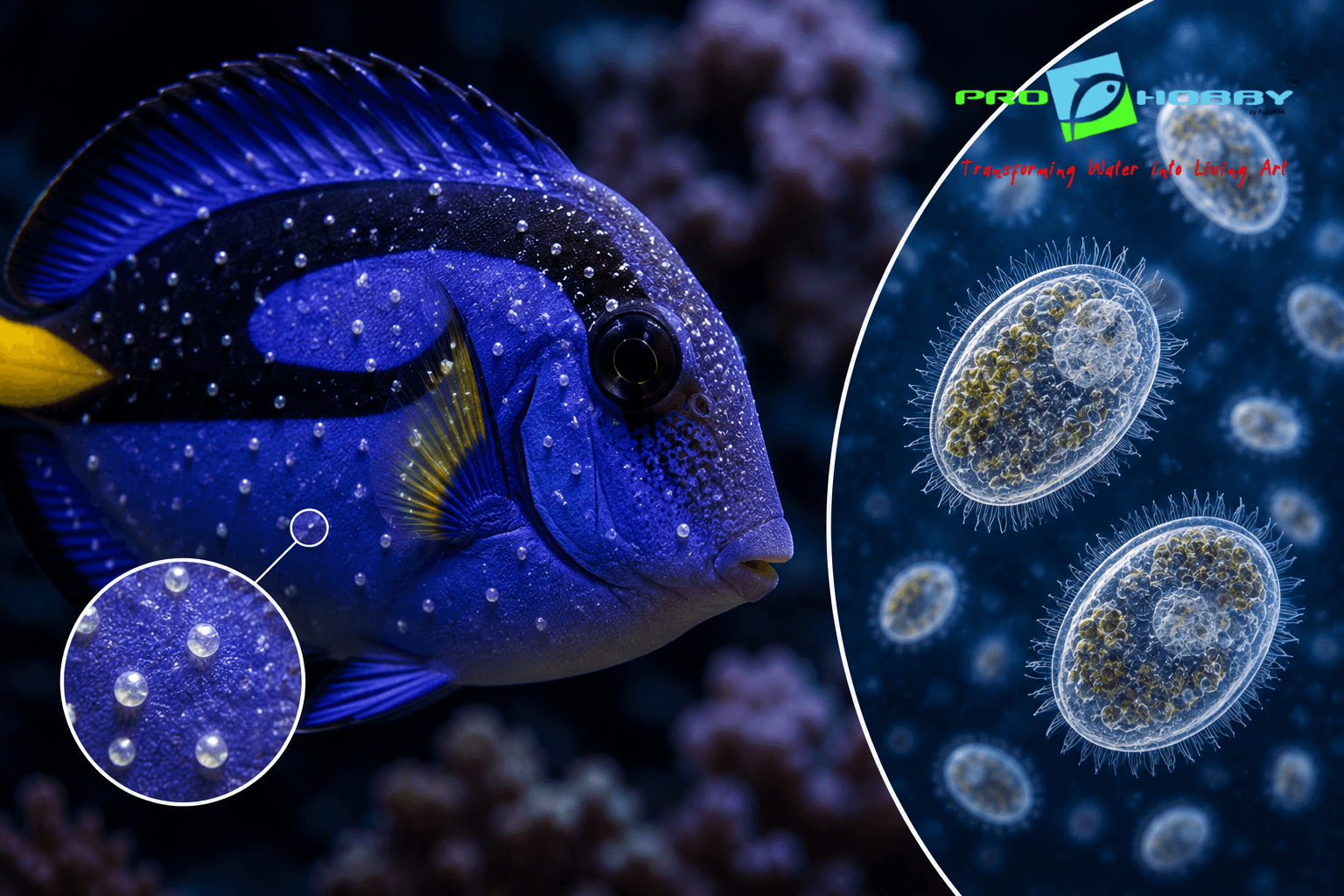
Cryptocaryon irritans — marine ich, sometimes called saltwater ich or crypto — is the single most consequential disease decision point in marine aquarium keeping, and the one where hobbyist intuition consistently produces the wrong response. New marine fish arrive stressed. Stress suppresses immunity. Cryptocaryon, present at low levels in many marine systems and introduced readily through new livestock, establishes and multiplies rapidly in immunocompromised fish. Within days, a display tank of expensive fish and corals can be facing a parasite outbreak where the only fully effective treatments — copper and significant salinity reduction — are lethal to every coral, most invertebrates, and the biological filtration the tank depends on. This single fact, more than any other, is why marine fish quarantine is not a recommendation in serious marine keeping. It is the only thing standing between a new fish purchase and the potential loss of an entire established reef system.
This guide covers the actual biology of Cryptocaryon — not simply as “marine ich” but as the genuinely distinct organism it is — because the lifecycle is what dictates every treatment decision that follows.
Table of Contents
- Cryptocaryon irritans — Not the Same Organism as Freshwater Ich
- The Four-Stage Lifecycle — Why Treatment Duration Is Fixed by Biology
- Symptoms — Identifying Cryptocaryon Correctly
- Why Display Tank Treatment Is Usually Impossible
- Copper Therapy — The Full Science
- Hyposalinity Treatment — The Osmotic Mechanism
- Tank Transfer Method — Lifecycle Disruption Without Chemicals
- Combination and Comparison of Methods
- Why Quarantine Is Non-Negotiable for Marine Fish
- The Stress-Reinfection Cycle in Newly Imported Fish
- Differential Diagnosis — What Else Looks Like Cryptocaryon
- Species Susceptibility and Resistance
- India — Sourcing, Quarantine Infrastructure and Practical Realities
- Frequently Asked Questions
1. Cryptocaryon Irritans — Not the Same Organism as Freshwater Ich
The common practice of calling Cryptocaryon irritans “marine ich” or “saltwater ich” creates a persistent and consequential misunderstanding: it is not the marine version of the same organism that causes freshwater ich. Freshwater ich is caused by Ichthyophthirius multifiliis, a ciliate in the family Ophryoglenidae. Cryptocaryon irritans is a ciliate in the family Cryptocaryonidae — related at a high taxonomic level (both are ciliated protozoans) but genuinely distinct organisms that evolved independently to exploit marine versus freshwater fish hosts.
This distinction matters practically because it means the fish immunity, environmental tolerances, and treatment sensitivities of the two organisms are not interchangeable. A hobbyist with freshwater ich experience bringing that knowledge into marine fishkeeping without understanding the differences will make treatment errors — most critically, believing that freshwater ich’s heat-sensitivity applies to Cryptocaryon (it does not to the same degree, and raising marine tank temperature carries its own significant risks to biological filtration and other livestock) or that similar medication classes will work at similar doses.
Both organisms share the general biological strategy of an obligate parasitic lifecycle with a feeding stage on the fish and a reproductive stage off the fish — and this shared general strategy, rather than close relatedness, is why both produce visually similar white-spot symptoms and why both require lifecycle-timed treatment approaches.
2. The Four-Stage Lifecycle — Why Treatment Duration Is Fixed by Biology
Understanding this lifecycle in detail is not optional background information — it is the entire logical basis for every treatment protocol used against Cryptocaryon, including why treatment duration cannot be shortened regardless of how the fish appears to be responding.
Trophont stage (on the fish, feeding): The visible white spot. The trophont burrows beneath the fish’s epidermis, feeding on host cells and fluids for approximately 3–7 days depending on temperature (faster at higher temperatures within the tolerable range). During this entire feeding period, the trophont is physically embedded within host epithelial tissue, protected from direct contact with anything in the water column — medication in the water cannot reach or kill a feeding trophont. This single fact is the reason no marine ich treatment claims to work “instantly” and the reason short treatment courses fail.
Protomont stage (departure and transition): Once feeding is complete, the trophont ruptures out of the fish’s skin and becomes a protomont — a free-swimming but non-feeding transitional stage that seeks a suitable substrate surface (rock, sand, glass, equipment) to settle on. This stage lasts hours to about a day.
Tomont stage (encysted on substrate, reproducing): The protomont settles and forms a protective cyst wall on the substrate surface, becoming a tomont. Within this cyst, the organism undergoes repeated binary fission — a single tomont can produce hundreds to well over a thousand daughter cells (tomites) through this reproductive division. This stage is the population explosion point of the entire lifecycle, and it takes place entirely off the fish, on tank surfaces, protected within a cyst wall that is highly resistant to most treatments. Duration: typically 3–28 days depending heavily on temperature, with lower temperatures dramatically extending tomont duration — this is the single most important lifecycle fact for treatment planning, because it means a tank held at a lower stable temperature can have Cryptocaryon tomonts lying dormant and viable for weeks longer than hobbyists commonly assume.
Theront stage (free-swimming, infective): When conditions are right, the tomont cyst ruptures and releases theronts — small, free-swimming, infective ciliates that must find and penetrate a fish host within roughly 24 hours or die. This is the only stage vulnerable to water-column medication and hyposalinity treatment. Theronts are actively swimming in open water, unprotected by host tissue or a cyst wall, exposed directly to whatever is in the water.
The treatment logic that follows directly from this lifecycle: Because only the theront stage is vulnerable, and because tomonts can remain dormant and continue releasing new theront waves for many days to weeks depending on temperature, any effective treatment must maintain therapeutic conditions continuously for long enough to catch every theront release wave from every tomont in the system — not just until visible spots disappear from the fish. This is why every legitimate Cryptocaryon protocol specifies a minimum treatment duration of no less than 3–4 weeks even when visible symptoms clear within days, and why “the fish looks better so I stopped treatment” is the single most common cause of Cryptocaryon treatment failure.
3. Symptoms — Identifying Cryptocaryon Correctly
Visible white spots: Small (approximately 0.5–1mm), discrete, salt-grain-like white spots across the body, fins, and gills. Individually smaller and often more numerous than the spots typical of freshwater ich, though this varies by infestation severity and fish species.
Rapid onset in stressed fish: Cryptocaryon can go from first visible spot to substantial infestation within 3–7 days in a newly stressed or immunocompromised fish, reflecting the trophont feeding duration described above.
Flashing and scratching: Fish rub against rock, sand, and glass in response to the irritation of trophonts embedded in the skin.
Rapid, laboured respiration: When trophonts infest gill tissue — which occurs frequently and is sometimes the dominant site of infestation with fewer visible body spots — fish show increased respiratory rate and effort. Heavy gill infestation is a leading cause of death in severe Cryptocaryon cases, sometimes before extensive body spotting is visible, making respiratory distress in a recently introduced marine fish a signal to consider Cryptocaryon even without dramatic visible spotting.
Clamped fins, reduced appetite, hiding: General stress and illness behaviour accompanying the parasite burden.
Cloudy eyes or skin in advanced cases: Secondary complications from extensive epithelial damage.
4. Why Display Tank Treatment Is Usually Impossible
This is the section that distinguishes marine ich management fundamentally from freshwater ich management, and it is the single most important practical fact for any marine hobbyist to understand before ever purchasing a fish.
Copper is lethal to invertebrates — every coral, every clam, every shrimp, every snail, every starfish, essentially all marine invertebrates — at concentrations far below what is required to kill Cryptocaryon in fish. There is no copper dose that treats fish without devastating invertebrate life. A reef display tank cannot be treated with copper without losing the reef.
Hyposalinity is similarly incompatible with a reef system — most corals and invertebrates cannot tolerate the salinity reduction required for therapeutic effect, and the biological filtration bacteria population is also stressed by significant, rapid salinity change.
The consequence: In any marine system containing corals or invertebrates — which describes the majority of serious marine aquariums — Cryptocaryon cannot be effectively treated in the display tank at all. The only options are: remove all fish to a separate treatment system for proper medicated treatment while the display tank runs fallow (fish-free) for a period long enough to starve out the parasite lifecycle, or manage supportively and hope immune function controls the infestation (a genuine gamble with a real chance of fish loss and reinfection cycling).
This is precisely why the entire structure of responsible marine fishkeeping is oriented around preventing Cryptocaryon from ever reaching the display tank rather than treating it once there — see Section 9.
5. Copper Therapy — The Full Science
Copper is the most reliable pharmacological treatment for Cryptocaryon when used correctly, and understanding the science prevents the two most common copper treatment failures: underdosing (ineffective) and overdosing (kills the fish).
Mechanism: Copper ions are toxic to the free-swimming theront stage through disruption of cellular ion transport and enzyme function. Crucially, copper has essentially no effect on trophonts embedded in host tissue or tomonts encysted on substrate — reinforcing why sustained treatment duration across multiple theront release cycles is required regardless of which copper product is used.
Ionic copper vs chelated copper: Ionic copper (free Cu²⁺ ions, as in copper sulphate-based products) is more readily bioavailable and more precisely measurable but also has a narrower safety margin — the therapeutic concentration and the toxic concentration are closer together. Chelated copper products (copper bound to an organic chelating agent) release copper more gradually, offering a somewhat wider safety margin but requiring different test kits calibrated specifically for the chelated form, since standard ionic copper test kits will not accurately read chelated copper products.
Therapeutic index and the necessity of daily testing: The gap between an effective copper concentration (typically 0.15–0.2 ppm ionic copper for Cryptocaryon, product-dependent) and a toxic concentration is narrow enough that copper level must be tested daily throughout treatment using a copper test kit matched to the specific product type in use. Copper depletes over time through absorption by substrate, filter media, and organic matter, meaning concentration drifts downward without re-dosing — testing without adjustment is as useless as not testing at all.
Fish species sensitivity: Not all marine fish tolerate copper equally. Some species — notably certain wrasses, some invertebrate-associated fish, and a number of other specific groups — show heightened copper sensitivity and may require reduced dosing or alternative treatment approaches. Research the specific species’ copper tolerance before beginning treatment rather than assuming standard dosing is universally safe.
Duration: Minimum 3–4 weeks of continuous, tested, maintained therapeutic copper concentration — reflecting the lifecycle logic in Section 2. Ending treatment when visible spots clear is the most common cause of treatment failure and reinfection.
Copper and biological filtration: Copper is toxic to nitrifying bacteria at treatment concentrations, meaning a copper-treated system requires either dedicated bare-bottom hospital tank setup with alternative ammonia management (frequent water changes, ammonia-binding products) rather than reliance on an established biofilter, or acceptance that biological filtration in the treatment tank will be compromised throughout the treatment period. Ammonia in Aquariums covers the monitoring and management framework directly applicable here.
6. Hyposalinity Treatment — The Osmotic Mechanism
Hyposalinity — maintaining tank salinity at a significantly reduced specific gravity for an extended period — treats Cryptocaryon through an osmotic mechanism distinct from copper’s cellular toxicity.
Mechanism: Cryptocaryon theronts and other free-swimming stages are adapted to full marine salinity. At significantly reduced salinity, the parasite’s cells cannot maintain osmotic balance — water moves into the cell faster than it can be expelled, and the theront stage in particular is vulnerable to this osmotic stress in a way that damages or kills it before it can successfully infect a host.
Target specific gravity: Typically 1.009–1.010 SG (compared to normal marine SG of approximately 1.020–1.025), maintained consistently for the full treatment duration.
Precision requirement: This is not a treatment that tolerates approximation. The target SG range is precise enough that a standard hydrometer — which has meaningful measurement error — is not accurate enough for reliable hyposalinity treatment. A calibrated refractometer is required to hit and confirmally maintain the correct target range; SG that is too high fails to treat effectively, and SG dropped too low or too quickly risks osmotic stress to the fish itself.
Fish tolerance: Not all marine fish tolerate hyposalinity equally well, and the transition into and out of hyposalinity must be gradual (over 24–48 hours in each direction) to avoid osmotic shock to the fish. Invertebrates and most corals do not tolerate hyposalinity at all, which is the same fundamental limitation that makes copper unusable in a reef display — hyposalinity treatment also requires a dedicated fish-only treatment system.
Duration: As with copper, a minimum of several weeks of continuously maintained hyposalinity is required to span multiple theront release cycles from tomonts already present in the system.
7. Tank Transfer Method — Lifecycle Disruption Without Chemicals
The Tank Transfer Method (TTM) is a copper-free, hyposalinity-free eradication protocol that works by directly exploiting the lifecycle stages described in Section 2, rather than by chemically or osmotically killing the parasite.
The core principle: Trophonts on the fish will eventually detach and become tomonts on whatever substrate is present — including the walls and any surfaces of the tank the fish is currently in. If the fish is physically moved to a completely clean, separate tank with no substrate before those detached parasites can complete the tomont-to-theront cycle and reinfect it, the parasites left behind in the original tank die without a host to reinfect, and the fish arrives in the new tank effectively starting fresh.
Protocol: The fish is transferred to a new, bare, sterile quarantine tank containing only pre-mixed, aged saltwater and a bare bottom (no substrate, no rock, no décor for parasites to encyst on) every 3 days, without exception, for the duration of the protocol. Each transfer interval of 3 days is chosen specifically because it is shorter than the minimum time typically required for a tomont to complete reproduction and release theronts back onto a fish, meaning the fish is moved away before any newly forming tomont population in that tank can complete its cycle and reinfect it.
Duration: The full protocol typically runs a minimum of 12–16 days of transfers (roughly 4–5 transfer cycles), reflecting the same lifecycle-duration logic underlying copper and hyposalinity minimum treatment periods.
Advantages: No medication, no copper toxicity risk, no invertebrate incompatibility to manage, and no risk of copper or salinity dosing error. Effective specifically because it is based directly on the parasite’s biology rather than trying to poison or osmotically stress it.
Disadvantages: Labour-intensive (strict adherence to the transfer schedule is non-negotiable — a missed or delayed transfer defeats the entire method), requires multiple bare tanks or thorough sterilisation between reuses, and is more stressful to the fish from repeated handling and transfer than a stable single-tank medicated treatment, which is a real consideration for already-stressed or fragile fish.
8. Combination and Comparison of Methods
| Method | Mechanism | Reef-safe | Invertebrate-safe | Duration | Key requirement |
|---|---|---|---|---|---|
| Copper | Cellular toxicity to theronts | No | No | 3–4+ weeks | Daily copper testing, dedicated tank |
| Hyposalinity | Osmotic stress to theronts | No | No | 3–4+ weeks | Calibrated refractometer, dedicated tank |
| Tank Transfer Method | Physical lifecycle disruption | Yes (fish only, isolated) | Yes (fish only, isolated) | 12–16+ days | Strict 3-day transfer schedule |
All three require a dedicated system separate from any display tank containing corals or invertebrates — none can be performed safely in a mixed reef display. Selection between copper, hyposalinity, and TTM depends on available equipment (refractometer vs copper test kit vs multiple bare tanks), the specific fish species’ tolerance for each method, and the hobbyist’s capacity to maintain the strict discipline each method requires — inconsistent execution of any of the three produces treatment failure.
9. Why Quarantine Is Non-Negotiable for Marine Fish
Given that Section 4 establishes Cryptocaryon typically cannot be treated once established in a reef display, the entire disease management strategy for marine fishkeeping is necessarily preventive rather than reactive — and quarantine is the mechanism that makes this possible.
The standard protocol: Every new marine fish, without exception, spends a minimum of 4 weeks — many experienced marine keepers recommend 6 weeks or longer — in a dedicated quarantine system before ever entering the display tank, regardless of how healthy the fish appears at purchase. Because Cryptocaryon’s full lifecycle from trophont through tomont to theront can span several weeks depending on temperature (Section 2), a quarantine period shorter than this risks releasing a fish into the display before a full lifecycle cycle has had the opportunity to manifest visibly.
Prophylactic treatment during quarantine: Many marine keepers run a full copper or Tank Transfer Method course as standard practice during the quarantine period for every new fish, regardless of whether visible symptoms are present — reflecting the reality that Cryptocaryon can be present at subclinical levels, and that the cost of unnecessary prophylactic treatment is far lower than the cost of introducing an active infestation to an established reef.
The economic and ecological logic: A quarantine tank, copper test kit, and refractometer represent a modest fraction of the investment in an established reef system with corals and fish accumulated over years. Skipping quarantine to save this modest cost and time risks the entire system. Quarantine and Biosecurity in Aquariums covers the general biosecurity framework; for marine fish specifically, the stakes of skipping this step are categorically higher than in freshwater keeping given the treatment limitations described above.
10. The Stress-Reinfection Cycle in Newly Imported Fish
Marine ornamental fish overwhelmingly enter the trade as wild-caught specimens collected from reef environments, and the collection, holding, and international shipping process is genuinely and significantly stressful — extended confinement, water quality fluctuation, temperature change, and handling across multiple points in the supply chain before reaching a final retail buyer.
This sustained stress produces exactly the immune suppression that allows subclinical or latent Cryptocaryon — which many wild marine fish populations carry at some baseline level — to establish active, visible infestation. This is why Cryptocaryon outbreaks in the marine hobby are disproportionately associated with recently acquired fish, and why the 4–6 week quarantine window described above serves a dual function: both allowing sufficient time for the parasite lifecycle to become visible if present, and allowing the fish’s stress-suppressed immune system time to recover under stable, well-managed quarantine conditions before facing the additional stress and disease exposure of a mixed display tank population.
The Science of Fish Stress covers the cortisol-immunity mechanism underlying this pattern, which applies as directly to marine fish and Cryptocaryon as it does to freshwater fish and the opportunistic bacterial and parasitic diseases covered throughout this disease library.
11. Differential Diagnosis — What Else Looks Like Cryptocaryon
Marine velvet (Amyloodinium ocellatum): Produces a finer, dust-like coating rather than discrete spots, progresses faster than Cryptocaryon, and is generally more immediately lethal — marine velvet is frequently a more acute emergency than Cryptocaryon, capable of killing within 24-48 hours and often presenting with gill-only symptoms and no visible body dusting at all. The two are sometimes confused at early stages but marine velvet’s finer, golden-dust texture and more rapid respiratory distress onset are distinguishing. Full biology, the photosynthetic mechanism behind why darkness helps, and complete treatment protocol: Amyloodinium ocellatum (Marine Velvet) — Complete Guide.
Brooklynella hostilis: Frequently labelled “clownfish disease,” though this is a misleading oversimplification — it affects a broad range of marine species and is disproportionately reported in clownfish mainly due to their trade volume and holding conditions, not species-specific immunity in other fish. Brooklynella produces excessive mucus production, apparent skin sloughing, and rapid respiratory distress rather than discrete white spots or dust — a diffuse, whole-body pathology mechanistically distinct from Cryptocaryon’s discrete feeding lesions, and one of the fastest-killing common marine diseases, sometimes fatal within 24 hours. It is sometimes confused with heavy gill-stage Cryptocaryon in early misdiagnosis, but responds to formalin rather than copper as first-line treatment. Full biology and treatment protocol: Brooklynella hostilis — Complete Guide.
Uronema marinum: A free-living marine ciliate that can become opportunistically pathogenic, producing skin lesions and ulceration rather than the discrete spot pattern of Cryptocaryon, generally distinguishable but requiring microscopic confirmation in ambiguous cases. Uronema is particularly relevant during the recovery period following a Cryptocaryon outbreak, where it can establish as a secondary “second wave” infection at sites of tissue damage left behind by resolving trophonts — full biology and the external-versus-systemic distinction that determines prognosis: Uronema marinum — Complete Guide.
Bacterial gill disease: Given how frequently Cryptocaryon presents as gill-dominant infestation with minimal or no visible body spots, a fish showing sustained respiratory distress with no organism visible on a gill scrape may in fact have a primary bacterial gill condition rather than Cryptocaryon at all — a genuinely different diagnosis requiring water quality correction rather than copper, since copper has no effect on non-parasitic bacterial gill pathology. Full differential and the gill biopsy approach that reliably distinguishes the two: Bacterial Gill Disease in Marine Fish — Complete Guide.
Marine bacterial infection (Vibriosis): Any Cryptocaryon trophont attachment and departure site is a potential entry point for opportunistic Vibrio bacteria, and a lesion that continues to worsen after the parasitic infestation itself has been successfully treated should be assessed for secondary bacterial infection rather than assumed to be residual Cryptocaryon damage. Vibriosis and Marine Bacterial Infections — Complete Guide.
Ammonia or water quality irritation: Newly introduced marine fish showing respiratory distress and flashing without confirmed visible spots should always have water parameters tested before assuming Cryptocaryon — the symptom overlap with ammonia and general water quality stress is significant, and the Complete Water Chemistry Guide marine section covers the relevant parameter targets.
12. Species Susceptibility and Resistance
Susceptibility to Cryptocaryon varies meaningfully across marine fish species and is a relevant consideration both for treatment approach (some species tolerate copper or hyposalinity better than others) and for stocking decisions in systems with a documented history of Cryptocaryon pressure.
Higher susceptibility: Many tang species, several wrasse species, and a number of other commonly kept reef fish show notable Cryptocaryon susceptibility, often related to their natural history as species that experience significant collection and shipping stress or that have thinner protective mucus coats.
Some documented resistance or tolerance: Certain species show comparatively better resilience, generally attributed to more robust natural immune function or protective mucus characteristics, though “resistant” should not be read as “immune” — any species can develop clinical Cryptocaryon under sufficient stress and exposure.
The practical implication is that species-specific research before purchase, particularly around known copper sensitivity and general disease resilience, is a meaningful part of responsible marine fish selection rather than a detail that applies uniformly across all species.
13. India — Sourcing, Quarantine Infrastructure and Practical Realities
The Indian marine ornamental supply chain: Marine fish reaching the Indian market travel through international collection, export, and import chains involving multiple transit and holding points before reaching a retail buyer — a supply chain length that compounds the stress-immunosuppression-Cryptocaryon pathway described in Section 10. Fish arriving in India have frequently experienced longer total transit time than in some other major markets, making robust quarantine at the retail and hobbyist level correspondingly more important rather than less.
Quarantine infrastructure investment: A dedicated marine quarantine system — bare tank, protein skimmer or adequate filtration independent of display tank biofiltration, heater, and either a copper test kit and copper-safe product or the equipment for Tank Transfer Method — represents a meaningful but proportionate investment relative to the value of an established reef display, and should be treated as a required cost of marine fishkeeping in the Indian market context rather than an optional extra.
Sourcing from quarantine-practicing suppliers: A supplier who quarantines marine livestock before sale — rather than moving fish directly from import holding to retail tanks to buyer — measurably reduces the Cryptocaryon risk a buyer inherits, though this does not eliminate the need for the buyer’s own quarantine period given the lifecycle timing discussed throughout this guide. Aquarium Shop Delhi NCR — What a Specialist Looks Like covers the questions worth asking any marine livestock supplier regarding their own quarantine and holding practices.
Water quality and marine keeping in Indian conditions: Marine and reef system stability depends on parameter precision that is generally more demanding than freshwater keeping — Marine Aquarium Ecology and Stability and Reef Aquarium Ecology and Collapse cover this in depth, and maintaining the stable, low-stress environment that supports fish immune function against Cryptocaryon is one part of the broader stability discipline those guides address.
Beyond Cryptocaryon specifically: the same quarantine and stress-management discipline established throughout this guide underpins management of every other marine health risk covered in this cluster — marine velvet, Brooklynella, Uronema, Vibriosis and other marine bacterial infections, bacterial gill disease, the tang- and angelfish-specific condition Head and Lateral Line Erosion, and coral-specific pest risk from marine flatworms. Building a proper quarantine and hospital tank system once, and applying it consistently to every new marine acquisition — fish and coral alike — is the single highest-leverage investment a serious Indian marine hobbyist can make.
Frequently Asked Questions
Is marine ich the same as freshwater ich? No. Marine ich (Cryptocaryon irritans) and freshwater ich (Ichthyophthirius multifiliis) are different ciliate species in different families. They share a broadly similar parasitic strategy — a feeding stage on the fish and a reproductive stage off the fish — which is why both cause white spots, but their specific biology, environmental tolerances, and treatment requirements are not interchangeable.
Can I treat Cryptocaryon in my reef tank? No, not with any of the fully effective treatments. Copper and hyposalinity are both lethal to corals and most invertebrates at the concentrations required to treat Cryptocaryon in fish. The Tank Transfer Method requires removing fish to a separate bare system. Cryptocaryon in a reef display generally requires removing all fish to a dedicated treatment system while the display runs fish-free long enough to starve out the parasite lifecycle.
Why does my fish still have spots after several days of copper treatment? Copper only kills the free-swimming theront stage — it has no effect on trophonts already feeding under the skin or tomonts encysted on substrate. Visible spots on the fish are trophonts that will run their feeding course (3–7 days) before detaching regardless of copper presence in the water. This is expected and does not indicate treatment failure provided copper concentration is being tested daily and maintained at therapeutic level throughout the full 3–4 week minimum course.
How long do I need to quarantine a new marine fish? Minimum 4 weeks, with 6 weeks or longer recommended by many experienced marine keepers, reflecting the temperature-dependent tomont stage duration which can extend the full lifecycle considerably. Many marine keepers run prophylactic copper or Tank Transfer Method treatment during this quarantine period for every new fish regardless of visible symptoms.
What is the Tank Transfer Method and how does it work without medication? A protocol that moves the fish to a new, bare, sterile tank every 3 days for 12–16+ days. This interval is shorter than the time tomonts need to complete reproduction and release theronts, so parasites shed by the fish into one tank die there without a host before they can complete their cycle and reinfect the fish in the next tank. It exploits the parasite’s lifecycle timing rather than using any chemical or osmotic treatment.
Can Cryptocaryon go away on its own without treatment? In some cases, a fish with strong immune function and low initial parasite burden may control an infestation without formal treatment, particularly if stress is eliminated and water quality is optimised. However, this is not reliable, particularly in a system where reinfection can continue from tomonts on tank surfaces — for any fish showing clear symptoms, active treatment via copper, hyposalinity, or Tank Transfer Method in a dedicated system is the responsible approach rather than waiting for spontaneous resolution.