
By ProHobby™ | Ecological Systems Authority
Marine snails occupy a strange dual position in reef and marine fishkeeping that this guide exists to properly untangle: they are simultaneously among the most deliberately purchased livestock in the entire hobby — sold in bulk as “clean-up crew” to virtually every new marine tank — and among the most commonly misidentified pests, with at least one genuinely problematic species so effectively disguised in plain sight that the overwhelming majority of reef keepers who encounter it do not even recognise it as a snail at all. Understanding which functional role a given species is actually filling in a system — deliberate algae grazer, deliberate sand-bed scavenger, unintentional hitchhiker, or in a small number of cases, a genuine threat to the coral it is living alongside — is the entire foundation of managing marine snail populations correctly, and it is a foundation almost no general “clean-up crew” guide actually builds properly before recommending a shopping list of species.
Table of Contents
- The Clean-Up Crew Framing — Why It Undersells What These Animals Actually Do
- Nassarius Snails — The Sand-Bed Sanitation Specialists
- Cerith Snails — The Unglamorous Workhorse
- Astrea Snails — Why They Have a Reputation for Randomly Dying
- Turbo Snails — The Most Powerful Grazers and Their Bulldozer Problem
- Vermetid Snails — The “Tube Worm” That Isn’t a Worm at All
- Why Vermetids Are a Genuine Coral Health Risk, Not Just an Eyesore
- Coral-Predating Snails — The Species That Are Not Clean-Up Crew at All
- Copper Sensitivity Across Every Marine Snail Species
- Do Marine Snails Actually Breed in Captivity?
- Brackish and Estuarine Snails — Where Freshwater Tolerance Actually Ends
- Sand Bed Health and the Sanitation Ecology Connection
- Identification — Telling Beneficial Species From Pests at a Glance
- Removal — Managing Vermetids and Other Problem Species Without Harming Coral
- Stocking Density and the Overstocking Mistake
- India — Reef Livestock Sourcing Realities
- Frequently Asked Questions
1. The Clean-Up Crew Framing — Why It Undersells What These Animals Actually Do
The retail phrase “clean-up crew” — almost universally applied to the mixed bag of snails, hermit crabs, and sometimes small crustaceans sold as a package to new marine and reef keepers — is not inaccurate, but it collapses a genuinely diverse set of species with meaningfully different feeding ecology, activity patterns, and system roles into a single undifferentiated shopping category. A hobbyist buying “clean-up crew” without understanding what each species inside that bag actually does is in a broadly similar position to a freshwater hobbyist buying “algae eaters” without understanding the very different roles played by, for instance, an Otocinclus versus a large adult Pleco — superficially similar marketing category, genuinely different animals doing genuinely different jobs.
This guide treats each major species group separately and specifically because the functional differences between them — established across Sections 2 through 5 — directly determine which species are actually solving the particular sanitation problem a given system has, and because at least one commonly encountered marine “snail” — the vermetid, covered in Sections 6 and 7 — is not clean-up crew at all, and its presence is frequently mismanaged specifically because hobbyists do not realise it is a snail in the first place.
2. Nassarius Snails — The Sand-Bed Sanitation Specialists
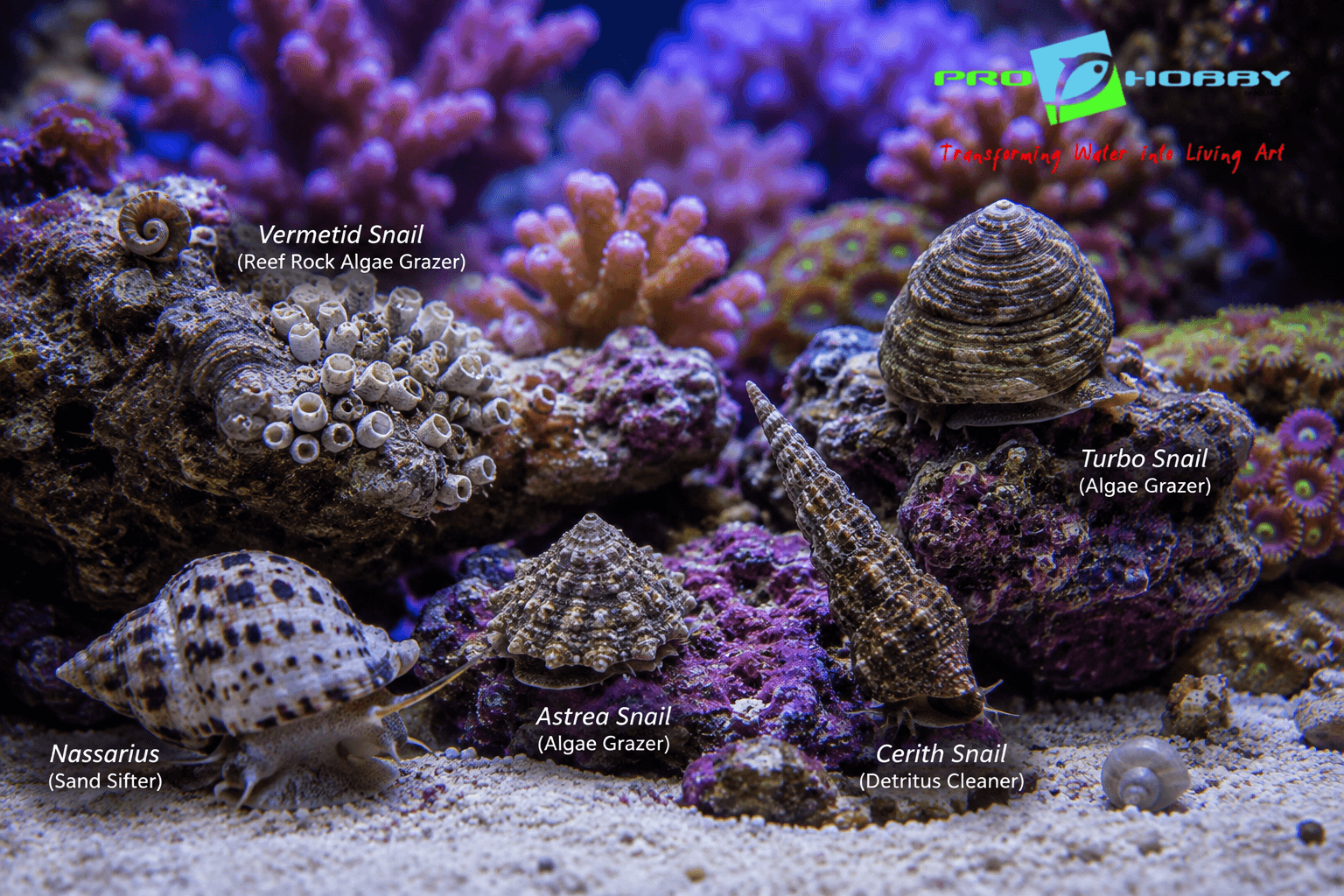
Nassarius snails are predominantly nocturnal, burrowing scavengers whose defining ecological role is patrolling and processing the sand bed itself rather than grazing algae from glass or rock surfaces — a genuinely distinct functional niche from every other species covered in this guide. During daylight hours, a healthy Nassarius population is typically buried within the sand bed, emerging with striking speed and coordination in response to the chemical cues released by decaying food or organic matter — a feeding response so pronounced and rapid that it is frequently used by experienced reef keepers as a direct visual indicator of a fresh feeding event or a decomposing organism somewhere in the system, since a Nassarius population “boiling” up out of the sand in unison is a reliable signal that something has just introduced a meaningful new organic load.
This scavenging behaviour makes Nassarius populations genuinely valuable for processing uneaten food and organic waste before it decomposes in place and degrades water quality, a sand-bed-specific sanitation function that surface-grazing species like Cerith, Astrea, and Turbo snails, covered in the following sections, do not perform in the same way.
3. Cerith Snails — The Unglamorous Workhorse
Cerith snails are smaller, generally less visually striking, and consequently less prominently marketed than Nassarius, Astrea, or Turbo snails, but they are frequently the most consistently reliable and lowest-maintenance member of a typical clean-up crew stocking list. Cerith snails graze algae film and detritus from both sand and hard surfaces, are considerably more tolerant of a wide range of reef parameters than some of the more sensitive species covered later in this guide, and — unlike Nassarius, whose population is primarily sand-bed focused, or Astrea and Turbo, whose primary function is glass and rock algae grazing — occupy something of a generalist middle ground between the sand-bed specialists and the surface-grazing specialists.
Their smaller size and lower individual biomass per snail also means a given Cerith population places comparatively modest bioload demand on system filtration relative to an equivalent population of larger species, a genuine practical consideration when planning total clean-up crew stocking density, covered in full in Section 15.
4. Astrea Snails — Why They Have a Reputation for Randomly Dying
Astrea snails are widely regarded within the reef-keeping community as effective algae grazers with a genuinely poor survival reputation, and this reputation deserves a proper biological explanation rather than being treated as simple bad luck or poor sourcing, because the actual mechanism has direct implications for how this species should be introduced and monitored.
The righting-reflex problem: Astrea snails have a comparatively weak or slow ability to right themselves if flipped onto their back, a vulnerability that many other common snail species do not share to the same degree. A flipped Astrea snail, unable to right itself and consequently unable to feed or, in cases of prolonged displacement, unable to maintain adequate gill function and water flow across its body, can die from this seemingly minor mechanical mishap in a way that would not affect a species with a more robust self-righting capability — and because this death occurs somewhat separately from any water quality or acclimation failure, it is frequently misattributed to general “Astrea are just fragile” folklore rather than understood as a specific, addressable mechanical vulnerability.
Acclimation sensitivity: Astrea snails are also frequently cited as being less tolerant of acclimation stress and rapid parameter change than some other common clean-up crew species, meaning inadequate drip acclimation — the same slow, careful acclimation principle established for shrimp in the Shrimp Tank Setup guide — matters disproportionately for this species relative to some of its hardier clean-up crew counterparts.
The practical implication: a reef keeper stocking Astrea snails should specifically check the substrate and rockwork periodically for any individual that has become flipped and stranded, particularly in a tank with substantial flat, open sand area where a flipped snail may not encounter rockwork or decor that would otherwise assist it in righting itself, and should apply particularly careful, gradual acclimation to this species specifically given its documented lower tolerance for acclimation stress.
5. Turbo Snails — The Most Powerful Grazers and Their Bulldozer Problem
Turbo snails are among the most powerful and effective algae grazers commonly available in the marine trade, capable of processing considerably more algae per individual than the smaller species covered above, and are frequently recommended specifically for systems experiencing significant nuisance algae pressure that smaller grazing species are struggling to keep pace with.
The trade-off: Turbo snails are considerably larger and more physically substantial than Cerith or Astrea snails, and their size and grazing intensity translates into a genuine physical risk within an established reef aquascape — a large Turbo snail moving across rockwork in pursuit of algae film can dislodge loosely placed rock, knock over coral frags that have not yet fully attached to their mounting point, and in some cases physically damage delicate coral structures through simple incidental contact during normal grazing movement, an issue sometimes referred to informally within the hobby as the “bulldozer” problem.
Managing this trade-off: Turbo snails are generally best suited to more mature, securely aquascaped systems where rockwork is well-settled and coral frags have had time to establish firm attachment, rather than newly established systems where aquascape stability and frag attachment are still developing — introducing Turbo snails to a very new system compounds physical instability risk at exactly the point when the aquascape is least equipped to tolerate it.
6. Vermetid Snails — The “Tube Worm” That Isn’t a Worm at All
This is the single most consequential identification error covered in this entire guide, and the section that most directly justifies treating marine snails as a dedicated topic separate from general reef pest control.
Vermetid snails are sessile marine gastropods — genuinely and completely snails, taxonomically, despite bearing essentially no visual resemblance to any of the free-crawling species covered in Sections 2 through 5 — that construct calcified tubes cemented to rock, glass, or coral skeleton, from which they never subsequently emerge or relocate for the remainder of their life. This fixed, tube-dwelling, superficially worm-like growth form is the entire reason they are so consistently and so confidently misidentified by hobbyists as a species of worm, most commonly confused with the various genuinely beneficial bristleworm and spaghetti worm species that are also tube- or burrow-associated detritivores in a reef system.
How vermetids actually feed: rather than grazing or scavenging the way every other species in this guide does, vermetids extend a mucus feeding net into the surrounding water column to capture plankton and organic particulates, periodically retracting and consuming the net along with whatever it has trapped — a filter-feeding strategy entirely unlike anything else covered in this guide, and one with a specific downstream consequence for coral health covered in Section 7.
7. Why Vermetids Are a Genuine Coral Health Risk, Not Just an Eyesore
Because vermetids are permanently fixed in place once established, a vermetid that has settled directly on or immediately adjacent to a coral colony cannot be dislodged or relocated the way a free-crawling snail encroaching on coral territory could simply move on — the vermetid’s mucus feeding net, extended repeatedly in the immediate vicinity of coral tissue, causes genuine, documented physical and chemical irritation to coral polyps through direct contact and through the stinging or irritant properties some vermetid mucus secretions carry, in a manner distinct from and considerably more persistent than incidental contact from a mobile grazing species.
This is the fact most general reef pest guides omit or understate: vermetids are not simply an aesthetic nuisance comparable to a nuisance algae bloom or an unwanted bristleworm population. A vermetid population establishing directly on or immediately around a valuable coral colony represents a genuine, ongoing tissue health threat to that specific coral for as long as the vermetid remains in place, given its complete inability to relocate away from the coral it is irritating.
The population growth pattern: vermetids reproduce readily in established reef systems and, left unaddressed, a small initial population can expand considerably over time, with new individuals settling and cementing themselves in place progressively closer to existing coral colonies as available open substrate is occupied — making early identification and management, covered in Section 14, considerably more effective than addressing an already well-established population.
8. Coral-Predating Snails — The Species That Are Not Clean-Up Crew at All
Beyond vermetids’ indirect irritation risk, a small number of snail species that occasionally arrive as hitchhikers in the reef trade are genuine, direct coral predators, actively consuming coral tissue rather than algae, detritus, or planktonic particulate matter — the most consequential possible outcome of the general clean-up crew versus pest identification problem this entire guide addresses.
Certain wentletrap snail species specifically are documented coral predators, feeding directly on coral polyp tissue in a manner analogous in principle, though mechanistically distinct, to the Acropora-eating flatworm covered elsewhere in this site’s marine disease and pest library — both are examples of an organism that superficially resembles or is casually assumed to be part of a system’s beneficial or neutral background fauna, while in fact actively destroying the coral tissue a reef keeper is trying to cultivate.
The practical implication: any unidentified snail found directly on or in close association with coral tissue, showing any sign of coral tissue recession, necrosis, or unusual localised coral stress in its immediate vicinity, should be treated with the same identification urgency established for Acropora-eating flatworms — close visual inspection, ideally with magnification, and removal to a quarantine or isolation container for closer identification before assuming any unfamiliar snail found near coral is automatically benign clean-up crew.
9. Copper Sensitivity Across Every Marine Snail Species
This deserves explicit, standalone treatment because it is one of the most consequential practical facts in this entire guide and directly parallels the invertebrate copper toxicity principle established throughout this site’s marine disease cluster, from Cryptocaryon through marine velvet treatment: every marine snail species covered in this guide, beneficial and pest alike, is severely copper-sensitive at concentrations that are considered therapeutic and appropriate for treating fish disease. The same underlying principle applies on the freshwater side of the hobby, where copper-based molluscicide products sold to control pest snails carry an identical risk to shrimp and other invertebrates — covered in full in Aquarium Snails — Complete Guide to Pest Control.
The direct practical consequence: any system containing marine snails — which describes essentially every reef and most marine fish-only systems given how universally clean-up crew species are stocked — cannot have copper-based fish disease treatment administered in the display without killing the snail population entirely, exactly the same fundamental reef-incompatibility problem established for coral and other invertebrates throughout the marine disease cluster on this site. A reef keeper treating a fish for Cryptocaryon or marine velvet in a separate hospital tank, rather than the display, is protecting the snail population as much as the coral and other invertebrates.
Residual copper risk: copper introduced to a system even briefly, or copper leaching from old copper-based plumbing or fixtures in an improperly sourced system, can produce chronic, low-level snail mortality that is sometimes misattributed to poor acclimation, poor sourcing, or general species fragility (particularly compounding the already fragile reputation of Astrea snails established in Section 4) rather than correctly identified as ongoing copper exposure — testing for copper is a worthwhile diagnostic step in any system experiencing unexplained, persistent snail die-off with no other identifiable cause.
10. Do Marine Snails Actually Breed in Captivity?
This varies considerably by species and is worth addressing directly given how frequently reef keepers assume a stable or growing snail population indicates successful captive breeding, when in most cases it does not.
The majority of commonly kept marine clean-up crew species — Nassarius, Cerith, Astrea, and Turbo snails specifically — have larval development stages requiring specific planktonic conditions that a typical closed reef aquarium does not reliably provide, meaning most established reef tank snail populations are not self-sustaining through captive reproduction and instead represent an initial stocking population that gradually declines over time through natural mortality, requiring periodic restocking to maintain the same functional population level rather than assuming the original stocking purchase will sustain itself indefinitely.
Vermetid snails are a notable exception to this general pattern, given their documented capacity to establish and expand a population within a closed reef system as established in Section 7 — precisely why early management of vermetid populations, rather than an assumption that “a few tube snails” will remain a stable, minor presence indefinitely, is the more accurate expectation to plan around.
11. Brackish and Estuarine Snails — Where Freshwater Tolerance Actually Ends
A small number of snail species occupy the genuine brackish transition zone between the freshwater species covered in Aquarium Snails — Complete Guide to Pest Control and the fully marine species covered throughout the rest of this guide, and are directly relevant to hobbyists running the kind of brackish systems covered in Brackish Aquarium Ecology and Stability elsewhere on this site.
Nerite snails, discussed briefly in the freshwater snail guide as a non-breeding, deliberately introduced freshwater species, actually illustrate this brackish transition point directly: nerite larvae require brackish or marine salinity to develop successfully, which is precisely why nerite snails do not reproduce and overpopulate freshwater aquariums the way the true freshwater pest species do, despite adult nerites tolerating and being commonly kept in fully freshwater conditions. This makes nerite snails a genuinely useful illustrative bridge between the freshwater and marine sections of this site’s snail coverage — a species whose adult tolerance spans both worlds, while its reproductive biology remains tied specifically to the brackish-to-marine salinity range covered in this guide.
Other snail species more specifically adapted to genuine estuarine and mangrove habitat conditions are less commonly available in the general aquarium trade than nerites, Nassarius, or the other species covered in this guide, and hobbyists specifically building a dedicated brackish or mangrove-style system should research species-specific salinity tolerance carefully rather than assuming general marine clean-up crew species are automatically appropriate at reduced salinity.
12. Sand Bed Health and the Sanitation Ecology Connection
The sand-bed sanitation role played by Nassarius snails specifically, established in Section 2, connects directly to the broader ecological principle of substrate health covered in the freshwater context in Aquarium Substrate Biogeochemistry — an undisturbed sand bed accumulating organic matter without adequate processing is vulnerable to the same anaerobic pocket formation and associated water quality risk in a marine system as in a freshwater one, and a functioning population of sand-bed scavenging species is a genuine, active contributor to preventing this outcome rather than a purely cosmetic addition to the system.
This connects the marine and freshwater sides of this site’s snail coverage through a shared underlying ecological principle: whether it is Malaysian Trumpet Snails aerating freshwater substrate or Nassarius snails processing marine sand-bed organic load, active substrate-dwelling detritivore populations perform a genuine, measurable system-health function that goes well beyond the simple aesthetic “clean-up” framing most retail marketing applies to them.
13. Identification — Telling Beneficial Species From Pests at a Glance
Free-crawling, actively grazing on glass, rock, or sand surfaces: almost certainly one of the beneficial clean-up crew species covered in Sections 2 through 5 — Nassarius (typically buried during the day, emerging rapidly to feeding cues), Cerith (small, generalist, tolerant), Astrea (effective grazer, check for flipped individuals per Section 4), or Turbo (large, powerful grazer, monitor for aquascape disruption per Section 5).
Fixed in place, never moving, with a distinctive calcified tube structure: vermetid snail — treat as a species requiring active monitoring and management per Sections 6, 7, and 14, not as passive background clean-up crew.
Found directly on or immediately adjacent to coral tissue, with any sign of tissue recession or necrosis nearby: treat with the same urgency as a potential coral predator per Section 8 — isolate for closer identification rather than assuming benign clean-up crew status by default.
Unexplained persistent snail mortality with no clear cause: consider copper contamination per Section 9 as a specific, testable possibility before assuming poor sourcing or general species fragility.
14. Removal — Managing Vermetids and Other Problem Species Without Harming Coral
Given vermetids’ fixed, cemented growth form established in Section 6, removal is considerably more involved than the simple hand-picking or trapping approaches available for free-crawling freshwater pest snails covered in the companion freshwater guide.
Manual removal from bare rock or glass — away from any coral tissue — can be achieved through careful mechanical removal of the calcified tube structure, though this requires care not to damage surrounding coralline algae or rock surface unnecessarily, and does not guarantee the organism itself has been fully removed rather than simply having its visible tube structure damaged.
Removal from immediately adjacent to coral tissue is considerably more delicate, given the physical proximity risk to the coral itself during any mechanical intervention, and in cases where a vermetid has established directly against valuable coral tissue, careful assessment of whether intervention risk to the coral outweighs the ongoing irritation risk from leaving the vermetid in place is a genuine judgement call best made with direct visual assessment of the specific situation rather than a generic instruction applied uniformly.
Predatory snail-eating fish and invertebrates used for general pest snail control in reef systems show variable and generally limited effectiveness specifically against vermetids given their fixed, protected tube-dwelling growth form, meaning biological control approaches effective against free-crawling pest species are not a reliable vermetid-specific solution.
Prevention through coral and rock quarantine — the same quarantine discipline established for Acropora-eating flatworms elsewhere in this site’s marine cluster — is the most effective vermetid management approach overall, since catching a small number of vermetids on new coral or rock during a dedicated quarantine period, before introduction to an established display, avoids the far more difficult proposition of removing an established population from directly around already-settled coral colonies.
15. Stocking Density and the Overstocking Mistake
A common clean-up crew stocking error, particularly in newer reef systems, is significantly overstocking snail populations relative to the actual algae and detritus load the system is producing, on the general retail-driven assumption that more clean-up crew produces a cleaner tank in direct proportion. Given the food-availability population dynamics established for freshwater pest snails in the companion guide — where population size ultimately tracks available food rather than expanding indefinitely regardless of resources — an overstocked marine snail population in a system without adequate algae or detritus to sustain that population will experience elevated mortality as available food is exhausted, producing exactly the kind of “snails keep dying for no reason” pattern that is frequently misattributed to poor sourcing, inadequate acclimation, or copper contamination (Section 9) rather than correctly identified as simple overstocking relative to the system’s actual sanitation workload.
Matching clean-up crew stocking density to the system’s genuine algae and detritus production — a judgement that depends on lighting, feeding, nutrient levels, and overall system maturity — rather than defaulting to a generic stocking number, is a meaningfully more effective approach than assuming larger clean-up crew populations are uniformly better.
16. India — Reef Livestock Sourcing Realities
Marine snail availability through the Indian reef-keeping trade generally covers the major clean-up crew species discussed throughout Sections 2 through 5, though the same general marine livestock sourcing and quarantine considerations established throughout this site’s marine disease cluster — see Aquarium Shop Delhi NCR — What a Specialist Looks Like — apply directly to snail sourcing as well as fish and coral, particularly given the extended transit and holding conditions typical of livestock reaching the Indian market discussed throughout that cluster.
Indian reef keepers should apply the same coral and rock quarantine discipline established in Section 14 to any new coral or live rock acquisition specifically to catch vermetid hitchhikers before display introduction, and should specifically verify that any copper-based fish medication used in a hospital or quarantine system — necessary given the marine disease treatment protocols covered throughout this site’s marine cluster — is never permitted to reach a display system containing snails, corals, or other invertebrates, given the universal copper sensitivity established in Section 9.
Frequently Asked Questions
Are the tube worms on my glass actually snails? Very possibly, if they are fixed permanently in place inside a small calcified tube and never move or relocate. These are vermetid snails, not worms, despite the superficial resemblance to bristleworms or spaghetti worms. Unlike genuine worms, vermetids feed through an extended mucus net rather than grazing or scavenging, and can irritate nearby coral tissue if established too close to a colony.
Why do my Astrea snails keep dying for no reason? Astrea snails have a comparatively weak self-righting reflex, meaning an individual flipped onto its back during normal tank activity can become stranded, unable to feed, and eventually die from what looks like an unexplained cause. They are also generally more acclimation-sensitive than some other clean-up crew species. Check rockwork and open sand areas periodically for stranded, flipped individuals, and apply particularly careful drip acclimation when introducing this species.
Can I treat my reef tank for marine ich or velvet without killing my snails? No — copper, the standard treatment for Cryptocaryon and Amyloodinium, is severely toxic to every marine snail species at concentrations required to treat fish disease. Affected fish must be moved to a separate hospital tank for copper treatment; the display system containing snails, corals, and other invertebrates should never be dosed with copper directly.
Do all marine “clean-up crew” snails actually eat algae? No — the clean-up crew label covers genuinely different feeding ecologies. Nassarius snails are primarily sand-bed scavengers feeding on decaying organic matter rather than algae grazers. Cerith, Astrea, and Turbo snails are the actual algae and detritus grazers within a typical clean-up crew package, each with different grazing intensity and system-impact considerations.
Is there a snail that actually eats coral? Yes — certain wentletrap snail species are documented coral predators, feeding directly on coral tissue rather than algae or detritus. Any unfamiliar snail found directly on or near coral showing tissue recession or necrosis should be isolated for identification rather than assumed to be benign clean-up crew.