
By ProHobby™ | Ecological Systems Authority
Throughout the Cryptocaryon, Amyloodinium, and Brooklynella guides in this cluster, one warning recurs: gill-dominant infestations of any of these three organisms can cause severe respiratory distress with minimal or no visible body symptoms, meaning a gasping fish should never be dismissed just because it looks otherwise unremarkable. What none of those guides addresses directly is the fourth possibility hiding behind that same symptom picture — that the gill tissue itself may be the site of a primary bacterial infection with no parasite involved at all. Bacterial gill disease produces respiratory distress that is, to casual observation, indistinguishable from parasitic gill infestation, yet copper, formalin, and every antiparasitic tool covered elsewhere in this cluster will do nothing for it, because there is no parasite present to kill. Recognising when gill pathology is bacterial rather than parasitic — and knowing that the only reliable way to tell the difference is direct examination of gill tissue — closes the final gap in this cluster’s respiratory-distress differential.
Table of Contents
- What Bacterial Gill Disease Actually Is
- Gill Hyperplasia — The Tissue Response That Does the Damage
- Why Water Quality Is the Root Cause, Not the Bacteria
- Symptoms — Distinguishing From Parasitic Gill Disease by Behaviour Alone Is Not Reliable
- The Gill Biopsy — Why This Is the Only Definitive Answer
- Differential Diagnosis Against the Rest of This Cluster
- Treatment — Water Quality Correction First
- When Antibiotics Are Actually Indicated
- Why Copper and Formalin Will Not Help
- The Chronic, Low-Grade Presentation — A Different Clinical Picture Entirely
- Prevention — This Is an Environmental Disease
- India — System Design and Water Quality Realities
- Frequently Asked Questions
1. What Bacterial Gill Disease Actually Is
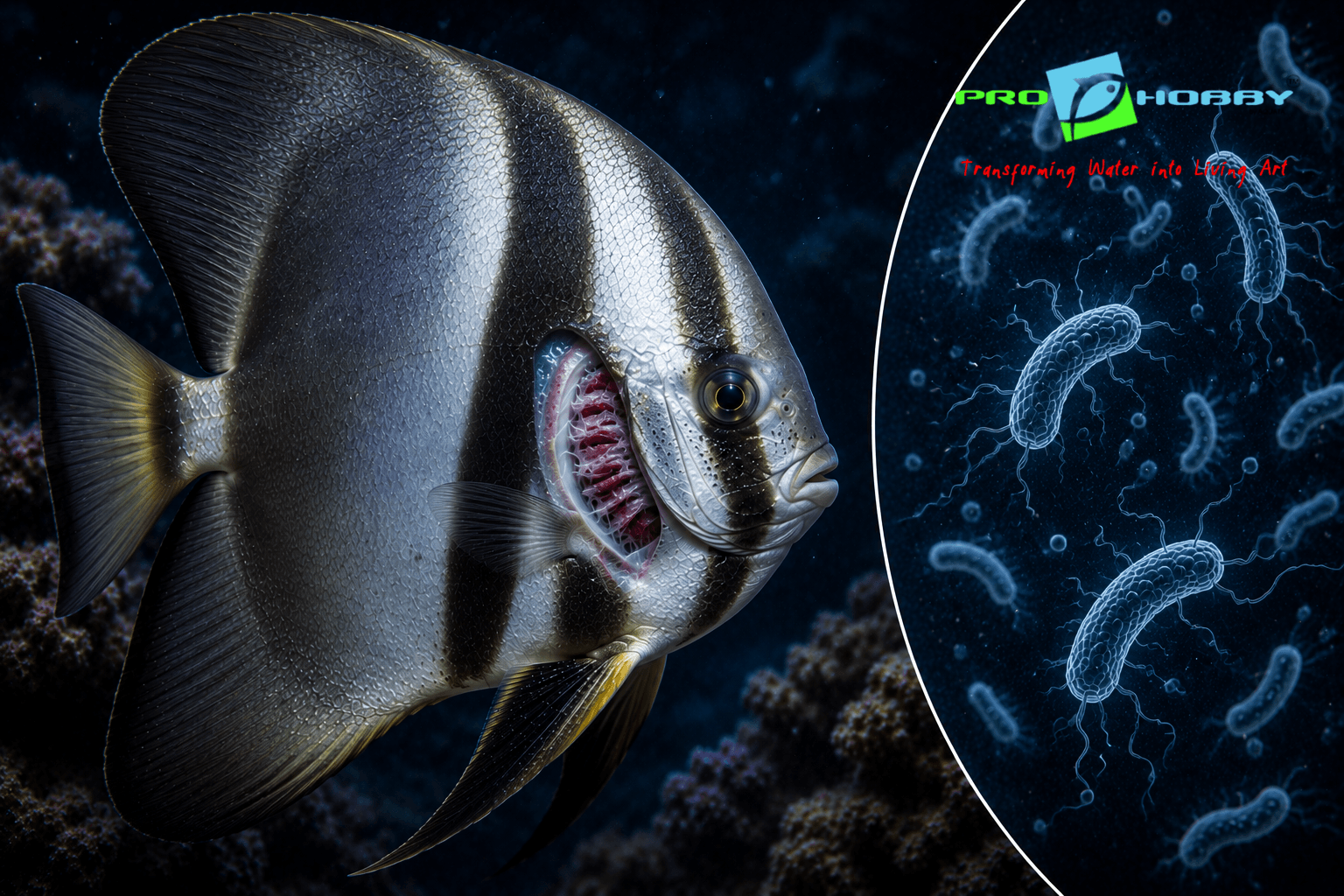
Bacterial gill disease is not caused by a single specific pathogen in the way Cryptocaryon or Amyloodinium are — it is better understood as a category of gill pathology driven by opportunistic bacterial colonisation of gill tissue, frequently involving Vibrio species and other gram-negative marine bacteria covered in the Vibriosis guide, that establishes when gill tissue is chronically irritated or when water quality conditions favour bacterial proliferation directly on the gill surface. Unlike Vibriosis presenting as a skin or body lesion following an entry-point wound, bacterial gill disease is specifically a respiratory tissue condition, and its clinical picture and treatment logic diverge enough from body-surface bacterial infection to warrant separate treatment here.
2. Gill Hyperplasia — The Tissue Response That Does the Damage
Understanding the actual tissue-level pathology explains why bacterial gill disease is genuinely dangerous even though, organism for organism, it may involve less aggressive bacteria than an acute Vibriosis wound infection.
Gill tissue chronically irritated by bacterial colonisation, ammonia exposure, or other environmental stressors responds with hyperplasia — a proliferative thickening of the gill epithelium as the tissue’s own defensive and repair response to ongoing irritation. In isolation, this proliferative response would be a reasonable protective mechanism. At the scale that develops under sustained bacterial and environmental irritation, however, hyperplastic gill tissue becomes progressively thicker, and the increased tissue thickness directly impairs the gas exchange that thin, delicate, richly vascularised healthy gill tissue is specifically structured to maximise. This produces a mechanism of respiratory compromise that is, in a broad functional sense, comparable to the mucus-mediated gas exchange failure described in the Brooklynella guide — the fish’s own tissue response to injury becomes the direct physical barrier to breathing, rather than the pathogen itself causing damage through direct destructive feeding the way Amyloodinium’s rhizoids do.
3. Why Water Quality Is the Root Cause, Not the Bacteria
As with essentially every opportunistic condition covered throughout this cluster, from Uronema to Vibriosis, the bacteria implicated in bacterial gill disease are ordinarily present in the system without causing disease. What converts a background bacterial population into an active gill pathology is chronic environmental irritation of the gill tissue itself, most commonly from:
Elevated ammonia or nitrite — even at sub-lethal concentrations that would not otherwise be flagged as an acute emergency, chronic low-level exposure directly irritates and damages gill epithelium, creating the hyperplastic response described in Section 2 and an environment favourable to bacterial colonisation of the damaged tissue. Ammonia in Aquariums.
Elevated organic load and poor water quality generally — supporting larger bacterial populations in direct contact with gill surfaces, mirroring the organic-load relationship established for Uronema in the preceding guide.
Chronic suboptimal salinity, pH, or temperature stability — general system stress that compromises gill tissue integrity and immune function via the same cortisol-mediated pathway discussed throughout this library.
Physical or chemical gill irritation from other sources — including as a secondary complication following heavy parasitic gill infestation from Cryptocaryon or Amyloodinium, where already-damaged gill tissue from the primary parasite becomes secondarily colonised by bacteria in a pattern directly analogous to the Uronema post-outbreak wave described in that guide.
The central point: bacterial gill disease is fundamentally a water quality and system management disease with a bacterial complication layered on top, not a primary infectious disease requiring quarantine-style exclusion measures. Treating it successfully requires fixing the environment, not simply killing the bacteria present at any given moment.
4. Symptoms — Distinguishing From Parasitic Gill Disease by Behaviour Alone Is Not Reliable
This needs to be stated plainly because it is the central diagnostic problem this guide exists to address: rapid or laboured breathing, gasping, increased gill movement rate, and general respiratory distress look essentially identical whether the cause is bacterial gill disease, gill-dominant Cryptocaryon, gill-dominant Amyloodinium, or heavy Brooklynella gill involvement. There is no behavioural sign reliable enough to distinguish between these possibilities from external observation alone.
Additional signs that may accompany bacterial gill disease specifically:
- Pale or discoloured gill tissue visible on close inspection of the gill cover area, where accessible
- Excessive mucus specifically at the gills rather than distributed across the whole body (distinguishing from the whole-body mucus pattern of Brooklynella)
- Flared or held-open gill covers as the fish attempts to maximise available gill surface exposure to water
- Reduced appetite and lethargy as generalised illness signs
- In chronic cases, a gradual rather than acute onset, discussed further in Section 10
Even with these additional signs present, definitive differentiation from parasitic gill disease requires the direct examination described in Section 5 — behavioural and even most visual external signs are simply not specific enough to serve as a reliable standalone diagnosis given the overlap with every other gill-affecting condition in this cluster.
5. The Gill Biopsy — Why This Is the Only Definitive Answer
A gill biopsy — a small tissue sample taken from the gill filaments, examined as a wet mount under a compound microscope — is the only genuinely reliable method of distinguishing bacterial gill disease from parasitic gill infestation, and is considered standard diagnostic practice in professional marine fish health assessment specifically because behavioural and external signs are so unreliable, as established in Section 4.
Under microscopic examination, a gill biopsy will directly reveal the presence or absence of Cryptocaryon trophonts, Amyloodinium trophonts, or other parasitic organisms attached to the gill filaments, alongside visible evidence of hyperplasia, excessive mucus, or other tissue changes consistent with bacterial gill disease. A biopsy showing hyperplastic, damaged, or bacterially colonised tissue with no parasitic organisms present is the clearest possible confirmation that the respiratory distress has a bacterial or environmental origin rather than a parasitic one, directing treatment toward Section 7 rather than toward copper or formalin.
For hobbyists without access to microscopy, the practical approach is to treat respiratory distress as a genuine diagnostic uncertainty spanning both parasitic and bacterial possibilities simultaneously: test and correct water quality immediately regardless of suspected cause (since this addresses the bacterial gill disease root cause directly and does no harm in a parasitic case), while also considering empirical antiparasitic treatment if water quality is confirmed adequate and respiratory distress persists or worsens.
6. Differential Diagnosis Against the Rest of This Cluster
| Feature | Bacterial Gill Disease | Gill-dominant Cryptocaryon/Amyloodinium | Brooklynella (gill involvement) |
|---|---|---|---|
| Underlying cause | Water quality/environmental, bacterial complication | Parasitic infestation | Diffuse ciliate pathogen |
| Onset | Often gradual (chronic) or following water quality event | Days (Cryptocaryon) to 24-48hrs (Amyloodinium) | Very fast, under 24 hours |
| Definitive diagnosis | Gill biopsy showing hyperplasia, no parasites | Gill biopsy showing trophonts | Whole-body mucus pattern usually visible |
| Response to water quality correction | Directly resolves root cause | No effect on established parasite burden | No effect |
| Response to copper/formalin | No effect | Effective (copper) | Effective (formalin) |
| Body symptoms | Often absent | Often absent in gill-dominant cases | Usually present (mucus, sloughing) |
The presence of Brooklynella is somewhat easier to distinguish given its characteristic whole-body mucus presentation described in that guide, even when gill involvement is prominent. The harder differential is specifically between bacterial gill disease and gill-dominant Cryptocaryon or Amyloodinium, where body symptoms may be equally absent in all three — this is precisely the differential that only a gill biopsy reliably resolves.
7. Treatment — Water Quality Correction First
Given the root cause established in Section 3, the primary and most important treatment step for bacterial gill disease is thorough correction of water quality, independent of any antibiotic decision:
Test and correct ammonia and nitrite immediately to zero, using the framework in Ammonia in Aquariums, even at levels that might not otherwise be flagged as an acute emergency, given the chronic gill-irritation mechanism established in Section 2.
Perform significant water changes to reduce organic load and any accumulated bacterial population, following How to Do a Water Change principles adapted to marine parameters.
Increase surface agitation and overall aeration to support gas exchange while impaired gill tissue recovers, providing the fish maximum available dissolved oxygen during the recovery window.
Review and correct any underlying system management issue — overstocking, overfeeding, inadequate filtration — that allowed water quality to deteriorate to the point of causing gill irritation in the first place, rather than treating this as an isolated event.
In many cases, thorough water quality correction alone, without antibiotic treatment, produces meaningful improvement, since removing the ongoing irritant allows gill tissue to begin resolving hyperplasia and allows the fish’s own immune function to contain the secondary bacterial population without pharmacological intervention.
8. When Antibiotics Are Actually Indicated
Antibiotic treatment for bacterial gill disease is appropriate when water quality correction alone does not produce improvement within a reasonable observation window, or when the presentation is severe enough that waiting to see if environmental correction alone resolves the issue carries unacceptable risk given the respiratory compromise already present.
Gram-negative antibiotic treatment following the general principles established in the Vibriosis guide — including the marine-specific dosing and product-selection considerations covered there — is the appropriate approach when antibiotics are indicated, administered in a dedicated hospital tank given the same reef-incompatibility and biological filtration disruption concerns established throughout this cluster.
9. Why Copper and Formalin Will Not Help
This deserves explicit statement because it is precisely the mistake this guide exists to prevent: copper (effective against the free-swimming stages of Cryptocaryon and Amyloodinium) and formalin (effective against Brooklynella and external Uronema through direct contact action) both work by killing or disrupting parasitic organisms present on or around the fish. Bacterial gill disease, by definition, involves no parasitic organism for either treatment to act on — dosing copper or formalin into a tank with a fish suffering bacterial gill disease will do nothing for the underlying condition while still carrying all of the same risks to biological filtration, and to invertebrates and corals in any reef-containing system, established throughout the rest of this cluster.
This is exactly why the gill biopsy in Section 5, or at minimum the water-quality-first diagnostic approach described there for hobbyists without microscopy access, matters so much: applying the wrong treatment category not only fails to help the fish but actively risks the rest of the system for no benefit.
10. The Chronic, Low-Grade Presentation — A Different Clinical Picture Entirely
Unlike the acute emergencies that dominate much of this marine disease cluster, bacterial gill disease frequently presents as a low-grade, chronic condition rather than a sudden crisis — a fish with mildly elevated respiratory rate, slightly reduced activity, and reduced appetite over an extended period, in a system with chronically marginal rather than acutely dangerous water quality.
This chronic pattern is easy to miss or normalise, particularly in systems where water quality has been marginal for long enough that the affected fish’s reduced activity is mistaken for normal temperament rather than recognised as an ongoing illness. Any fish showing a sustained pattern of mildly elevated respiratory effort, even without the acute distress typical of the other conditions in this cluster, warrants a full water quality review rather than being dismissed as simply “a slow breather.” This chronic, environmentally-driven presentation pattern has a close conceptual relative elsewhere in this cluster: Head and Lateral Line Erosion (HLLE) in tangs and marine angelfish is a similarly slow, non-infectious, husbandry-linked condition, and a system producing chronic bacterial gill disease is frequently the same kind of marginal environment that also predisposes susceptible species to HLLE — the two are worth reviewing together in any system showing either sign.
11. Prevention — This Is an Environmental Disease
Bacterial gill disease prevention is, more directly than almost any other condition in this cluster, simply correct system management:
- Maintaining zero ammonia and nitrite at all times, including during the elevated bioload periods that follow feeding or new stock introduction
- Appropriate stocking density relative to filtration and water volume, per the principles in Marine Aquarium Ecology and Stability
- Regular water changes to control organic load
- Prompt and complete treatment of any primary parasitic gill infestation (Cryptocaryon, Amyloodinium) to prevent secondary bacterial colonisation of already-damaged gill tissue, following the same post-outbreak vigilance principle established for Uronema and Vibriosis elsewhere in this cluster
- Stable salinity, pH, and temperature to minimise chronic system-level stress on gill tissue and immune function generally
12. India — System Design and Water Quality Realities
Given that bacterial gill disease is fundamentally a water quality and system management condition rather than an introduced pathogen, the most relevant India-specific consideration is system design and water quality maintenance discipline rather than sourcing or quarantine practice, though the general marine sourcing and stress considerations established throughout the rest of this cluster remain relevant background context.
Indian marine systems managing the additional environmental variables of summer ambient heat and its effects on water parameter stability — discussed in the freshwater context in Aquarium Water Temperature in Indian Summer but equally relevant to marine system stability — should treat consistent water quality testing as a specific defence against the chronic, low-grade bacterial gill disease pattern described in Section 10, which is exactly the kind of gradual, easy-to-normalise condition that inconsistent testing regimes allow to develop unnoticed. The same consistent, unglamorous system-management discipline is what ultimately protects a reef system on the coral side as well, whether the specific risk is bacterial gill pathology or the coral-focused threat covered in Marine Flatworms — Complete Guide.
Frequently Asked Questions
My marine fish is breathing rapidly but has no visible parasites — what could it be? Bacterial gill disease is a genuine possibility alongside gill-dominant Cryptocaryon or Amyloodinium infestation, both of which can also present with minimal or no visible body symptoms. Test and correct water quality immediately regardless of suspected cause, since this addresses bacterial gill disease directly and causes no harm if a parasite is actually responsible. A gill biopsy examined under a microscope is the only fully definitive way to distinguish between these possibilities.
Will copper or formalin treat bacterial gill disease? No. Both treatments work against parasitic organisms present on the fish. Bacterial gill disease involves no parasite for either treatment to act on, meaning dosing copper or formalin will not help the underlying condition while still carrying the same risks to biological filtration and any corals or invertebrates present.
Do I need antibiotics for bacterial gill disease? Not always. Thorough water quality correction alone frequently resolves bacterial gill disease, since removing the underlying environmental irritant allows gill tissue to recover and the fish’s own immune function to contain the secondary bacterial population. Antibiotics become appropriate when water quality correction alone does not produce improvement within a reasonable observation period, or when the presentation is severe.
How do I know if my fish’s breathing problem is chronic bacterial gill disease rather than an acute parasite? Bacterial gill disease frequently presents gradually — mildly elevated respiratory rate and reduced activity over an extended period in a system with chronically marginal water quality — rather than the acute, rapid-onset distress typical of Amyloodinium or Brooklynella. However, this pattern alone is not fully diagnostic, and a full water quality review alongside consideration of gill biopsy remains the reliable path to a confident answer.