
By ProHobby™ | Ecological Systems Authority
Uronema marinum occupies a category of its own among marine fish pathogens, and understanding that category is the entire key to managing it. Cryptocaryon, Amyloodinium, and Brooklynella are all obligate or facultative parasites — organisms whose biology is built around infecting a fish host. Uronema is fundamentally different: it is a free-living scavenging ciliate, present in essentially every marine system as part of the normal microbial background, that spends the overwhelming majority of its existence feeding on bacteria, detritus, and dead organic matter with no interest in a living fish whatsoever. It becomes a pathogen only when a fish is already compromised — by another disease, by a wound, by severe stress, or by the kind of skin damage left behind after a Cryptocaryon or Brooklynella outbreak has already run its course. This makes Uronema less a primary disease in its own right and more a signal: a fish with a genuine Uronema infection is a fish whose defences have already failed for some other reason, and treating the Uronema alone without identifying what let it in is treating the symptom while ignoring the actual story.
Table of Contents
- What Uronema marinum Actually Is — A Scavenger, Not a Hunter
- The Opportunistic Switch — What Turns a Scavenger Into a Pathogen
- External vs Systemic Uronema — Why the Distinction Is Everything
- Symptoms — What Uronema Looks Like at Each Stage
- Why Uronema Is So Often Misdiagnosed as Something Else
- The Post-Outbreak Connection — Uronema as the Second Wave
- Diagnosis — Why Confirmation Usually Requires a Microscope
- Treatment — External Infections
- Treatment — Systemic Infections and Why the Outlook Changes
- Formalin and Freshwater Dips — Shared Tools, Different Logic
- Prevention — Why This Is Fundamentally a Husbandry Disease
- Species and System Risk Factors
- India — Sourcing and System Realities
- Frequently Asked Questions
1. What Uronema Marinum Actually Is — A Scavenger, Not a Hunter
Uronema marinum is a free-living, bacterivorous ciliate — a single-celled organism whose default ecological role is to consume bacteria and decaying organic matter in the water column and on surfaces, precisely the same general niche occupied by countless other harmless microorganisms that make up the invisible background biology of every established marine aquarium. It is not, in its normal state, adapted to living on or inside a fish, has no specialised feeding structures for host tissue the way Amyloodinium’s rhizoids or Cryptocaryon’s trophont feeding apparatus do, and under ordinary circumstances a healthy fish’s intact skin, protective mucus layer, and functioning immune system are more than sufficient to prevent it from ever becoming a problem.
This is the single most important fact to hold onto throughout everything else in this guide: Uronema is not something a healthy fish needs to be protected from in the way it needs protection from Cryptocaryon or Amyloodinium. It is already present. It is not going anywhere. The entire question is whether the conditions exist for it to stop scavenging and start invading.
2. The Opportunistic Switch — What Turns a Scavenger Into a Pathogen
Uronema’s transition from harmless scavenger to invasive pathogen is triggered by a breach in the fish’s normal defences, most commonly one of the following, individually or in combination:
Existing skin or tissue damage — open wounds from aggression, physical injury, or damaged tissue left behind after the resolution of another disease. This is covered in depth in Section 6, because it is arguably the single most clinically important trigger pattern in the entire Uronema picture.
Severe or prolonged stress — the same cortisol-mediated immune suppression covered throughout this disease library, whether from poor water quality, aggressive tank mates, or the transport and holding stress described in the Brooklynella guide’s discussion of import holding conditions, reduces the fish’s capacity to prevent normally harmless organisms from establishing.
Poor water quality with high organic load — because Uronema’s baseline ecological role is consuming organic matter and bacteria, systems with elevated organic waste, overfeeding, or inadequate filtration support substantially larger background Uronema populations than a clean, well-maintained system does, simply increasing the number of organisms present at the moment a fish becomes vulnerable.
Concurrent illness — a fish already fighting Cryptocaryon, Amyloodinium, or Brooklynella, or recovering from any of them, presents both the direct tissue damage and the diverted or exhausted immune resources that create ideal opportunistic conditions.
None of these triggers is Uronema-specific — they are the same general immune-suppression and tissue-damage pathway that underlies opportunistic disease throughout this entire library, from freshwater scale rot to marine bacterial complications. Uronema is simply one of several organisms waiting to exploit the same opening.
3. External vs Systemic Uronema — Why the Distinction Is Everything
This is the clinical fork in the road that determines prognosis more than any other single factor in Uronema disease.
External (cutaneous) Uronema infection remains confined to the skin and superficial tissue, producing the lesions, ulceration, and localised damage described in Section 4. Caught at this stage, external Uronema infection is genuinely treatable, and outcomes are frequently good provided the underlying predisposing cause is also addressed.
Systemic Uronema infection occurs when the organism penetrates beyond the skin into deeper tissue and internal organs — a progression that is understood to occur more readily with Uronema than with most other marine ciliates, and one that fundamentally changes the treatment picture. Once internalised, Uronema is no longer reliably reachable by any external bath, dip, or water-column treatment, because those treatments act on the fish’s exterior and gill surface, not on organisms already established in internal tissue. Systemic Uronema infection carries a substantially worse prognosis than external infection, and is a significant cause of unexplained mortality in marine fish that appeared to be recovering from an external skin condition before deteriorating and dying with no obvious external cause visible at the time of death.
The practical implication: speed of recognition and treatment of external Uronema lesions is not just about resolving the visible problem faster — it is about preventing the disease from crossing into a category that becomes substantially harder to treat at all.
4. Symptoms — What Uronema Looks Like at Each Stage
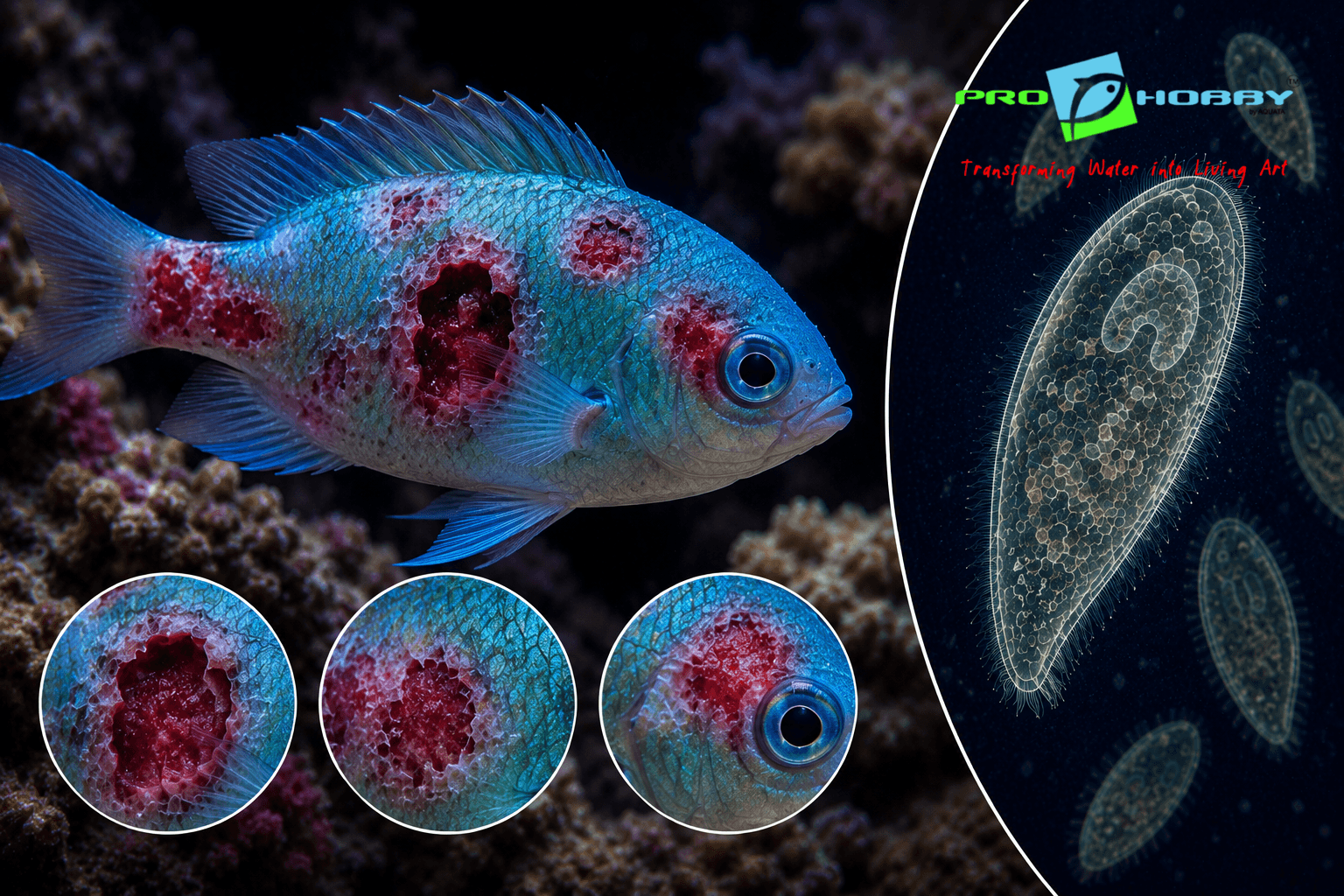
Early external lesions: Small areas of skin erosion, ulceration, or discolouration, frequently beginning at a site of pre-existing damage — a healing wound, a site where a Cryptocaryon trophont has recently detached, or an area affected by fin or scale damage from any cause. Unlike the diffuse whole-body pattern of Brooklynella or the fine uniform dusting of Amyloodinium, Uronema lesions are frequently localised initially, reflecting their origin at a specific point of tissue vulnerability rather than a whole-body parasitic assault.
Progressive external disease: Ulceration expanding in size and depth, sometimes with a ragged or eroded margin, occasionally with visible haemorrhaging at the lesion edge as tissue destruction progresses.
Behavioural signs: Reduced appetite, lethargy, and general illness behaviour, though frequently less dramatically acute in the early external stage than the rapid deterioration seen with Amyloodinium or Brooklynella — Uronema’s early presentation can be deceptively mild, which is part of why it is underestimated until progression accelerates.
Systemic disease signs: Once internalised, symptoms broaden to include the non-specific signs of internal illness generally — worsening lethargy, loss of equilibrium, rapid overall decline, and death, frequently without a proportionate worsening of visible external symptoms, since the disease has moved beyond what is visible on the surface.
5. Why Uronema Is So Often Misdiagnosed as Something Else
Uronema’s lesion-based, ulcerative presentation sits at an uncomfortable overlap point with several other conditions covered elsewhere in this library, and distinguishing between them matters because the treatments diverge significantly.
Uronema vs bacterial ulcer disease: Marine bacterial pathogens — predominantly Vibrio species — produce externally similar ulcerative lesions through an entirely different mechanism, and the two can coexist, with bacterial infection frequently establishing secondarily at a Uronema lesion site exactly as it does at wound sites throughout this library, from fin rot to scale rot. A lesion that is not responding to antiparasitic treatment, or that shows the spreading, discoloured, rapidly progressing character typical of bacterial infection, should prompt consideration of a bacterial component requiring antibiotic treatment alongside or instead of antiparasitic management — full diagnosis and treatment detail: Vibriosis and Marine Bacterial Infections — Complete Guide.
Uronema vs heavy gill-stage Cryptocaryon or Amyloodinium: As noted in both the Cryptocaryon and Amyloodinium guides, gill-dominant presentations of either organism can produce respiratory distress without dramatic external signs, creating diagnostic overlap with early Uronema in fish where skin lesions have not yet become obvious. A fourth possibility worth ruling out in any case of unexplained respiratory distress is non-parasitic bacterial gill disease, which involves neither Uronema nor any of the primary parasites and responds to water quality correction rather than any antiparasitic treatment.
The definitive answer is microscopic examination, covered in Section 7 — Uronema’s distinctive free-swimming, pear-shaped ciliate morphology under magnification, generally from a wet mount of lesion tissue or exudate, is the only fully reliable way to confirm the diagnosis rather than infer it from external appearance alone.
6. The Post-Outbreak Connection — Uronema as the Second Wave
This is arguably the single most clinically important and least appreciated fact about Uronema, and it deserves to be stated plainly: a tank that has just been through a Cryptocaryon, Amyloodinium, or Brooklynella outbreak is at meaningfully elevated risk of a subsequent Uronema wave among the survivors.
The reason follows directly from Sections 1 and 2. Fish recovering from any of the three primary marine parasites covered elsewhere in this cluster carry exactly the combination of factors that predispose to opportunistic Uronema infection: physical tissue damage at former trophont attachment sites or from the diffuse skin injury of Brooklynella, immune systems already taxed by fighting off the primary infection, and — in a tank that has just been through significant stress and possibly copper or formalin treatment — an environment with elevated organic load and biological filtration disruption that supports a larger background Uronema population than usual.
The practical implication: close monitoring of fish for a period after apparent recovery from Cryptocaryon, Amyloodinium, or Brooklynella should specifically include watching for new lesions or ulceration distinct from the resolving primary disease — a fish that appears to be clearing its original infection but then develops a new, separate skin lesion in the following days to weeks should be assessed for secondary Uronema infection rather than assumed to be experiencing a relapse of the original disease.
7. Diagnosis — Why Confirmation Usually Requires a Microscope
Definitive Uronema diagnosis relies on microscopic identification of the organism itself, most commonly from a wet mount preparation of a skin scrape or lesion exudate sample examined under a compound microscope. Uronema’s characteristic pear or oval shape, its uniform ciliation, and its active, free-swimming movement pattern are distinguishing under magnification, differentiating it from the discrete trophont morphology of Cryptocaryon or the very different structure of bacterial organisms that might be present at a mixed-infection lesion site.
For hobbyists without microscopy access, clinical diagnosis rests on the pattern established throughout this guide: a lesion appearing at a site of pre-existing tissue damage, in a fish recently recovered from another marine disease or otherwise significantly stressed, that does not fit the classic discrete-spot or fine-dust presentation of Cryptocaryon or Amyloodinium and does not show the diffuse whole-body mucus pattern of Brooklynella. This clinical picture warrants treatment as presumptive Uronema alongside consideration of a bacterial component, covered in Sections 8 and 9.
8. Treatment — External Infections
Isolate immediately in a bare hospital tank, both to allow targeted treatment and to remove the compromised fish from any ongoing stress or aggression in the display system that may be perpetuating the underlying vulnerability.
Formalin bath treatment — the same general approach and product-specific dosing described in the Brooklynella guide is commonly used against external Uronema, working through direct chemical damage to the ciliate on contact rather than depending on intercepting a free-swimming infective stage the way copper does against Cryptocaryon and Amyloodinium.
Address any secondary bacterial component. Given the frequency of bacterial co-infection at Uronema lesion sites established in Section 5, topical treatment of the lesion with diluted povidone-iodine and, where a bacterial component is suspected or confirmed, a course of appropriate antibiotic treatment following the general principles in the fin rot and scale rot guides (adjusted for marine dosing) is frequently necessary alongside antiparasitic treatment rather than as an alternative to it.
Correct water quality and organic load in both the treatment and display systems, given the direct relationship between organic load and background Uronema population density established in Section 2. Complete Water Chemistry Guide.
Identify and resolve the original predisposing cause. Treating the visible Uronema lesion without identifying what allowed it to establish — an unresolved aggression problem, ongoing suboptimal water quality, or incomplete recovery from a primary parasitic disease — sets up the conditions for recurrence even after apparently successful treatment.
9. Treatment — Systemic Infections and Why the Outlook Changes
Once Uronema has progressed to systemic, internalised infection as described in Section 3, treatment options narrow considerably and prognosis worsens substantially. External bath and dip treatments have limited or no reach into internal tissue, and there are no well-established, reliably effective systemic antiparasitic treatments for internalised Uronema comparable to the oral antibiotic or antiparasitic protocols available for some internal bacterial and helminth conditions covered elsewhere in this library, such as the internal parasite and Capillaria treatments available for freshwater fish.
Management at this stage shifts toward maximally supportive care — optimal water quality, minimal additional stress, and close observation — while accepting a genuinely guarded prognosis. This reality is precisely why Sections 3 and 6 emphasise early recognition and prompt treatment of external lesions so strongly: the entire strategic goal of Uronema management is preventing the external-to-systemic progression before it happens, because managing it after the fact is a substantially harder and less certain proposition.
10. Formalin and Freshwater Dips — Shared Tools, Different Logic
Both formalin bath treatment and the freshwater dip technique described in detail in the Brooklynella guide are used against external Uronema through broadly the same mechanisms discussed there — direct chemical damage on contact for formalin, and osmotic shock to marine-adapted organisms for the freshwater dip. Neither is Uronema-specific; both are general-purpose tools against externally accessible marine ciliates lacking the same reliance on intercepting a free-swimming infective stage that makes copper the tool of choice against Cryptocaryon and Amyloodinium.
The freshwater dip in particular can serve a dual diagnostic and supportive role for Uronema exactly as it does for Brooklynella — visibly disrupting surface organisms and providing some symptomatic relief — though, as with Brooklynella, it is not a standalone cure and does nothing for infection that has already progressed beyond the external surface.
11. Prevention — Why This Is Fundamentally a Husbandry Disease
Every trigger established in Section 2 — tissue damage, stress, poor water quality, concurrent illness — is a husbandry and system-management variable, not a matter of exposure to a rare or exotic pathogen. Because Uronema is already present in essentially every marine system, prevention is not achievable through exclusion the way quarantine prevents Cryptocaryon or Amyloodinium introduction. Prevention instead means minimising the conditions that allow an already-present organism to become dangerous:
- Maintaining excellent water quality and appropriately low organic load through correct stocking, feeding, and filtration
- Preventing and promptly treating physical injury from aggression or décor
- Managing stress proactively rather than reactively
- Treating primary parasitic diseases (Cryptocaryon, Amyloodinium, Brooklynella) promptly and completely, and monitoring closely for the secondary Uronema wave described in Section 6 during the recovery period rather than assuming resolution of the primary disease means the fish is fully out of danger
Marine Aquarium Ecology and Stability covers the broader system stability framework that underlies this prevention approach, and The Science of Fish Stress covers the immune mechanism that connects all of these husbandry variables to actual disease outcomes.
12. Species and System Risk Factors
Uronema opportunistic infection has been documented across a wide range of marine fish species, consistent with its nature as an opportunist exploiting a compromised host rather than a species-specific pathogen with particular host preferences. Risk is better predicted by system and individual fish condition than by species: recently stressed or transported fish, fish recovering from any other disease, fish in systems with elevated organic load or inconsistent water quality, and fish in tanks with unresolved aggression producing repeated physical injury are all at elevated risk regardless of species.
Systems that have recently completed copper or formalin treatment for a primary parasitic outbreak represent a particular risk window, combining recovering, immune-taxed fish with the biological filtration disruption that treatment often causes — reinforcing the close post-outbreak monitoring recommended in Section 6.
13. India — Sourcing and System Realities
The general marine sourcing and stress considerations detailed throughout the Cryptocaryon, Amyloodinium, and Brooklynella India sections apply directly to Uronema risk, given that transport and holding stress is precisely the kind of immune-suppressing event that predisposes to opportunistic infection generally.
Given Uronema’s status as a secondary, husbandry-driven condition rather than a primary introduced pathogen, the most relevant India-specific consideration is less about sourcing and more about post-purchase system management — ensuring adequate quarantine-period water quality, promptly treating any physical injury or primary disease a new fish presents with, and maintaining vigilant monitoring through the recovery period from any primary illness rather than considering the fish “in the clear” once initial symptoms resolve. Aquarium Shop Delhi NCR — What a Specialist Looks Like covers broader supplier evaluation relevant to reducing the initial stress load a new marine fish arrives with.
This same husbandry-first, opportunist-aware mindset applies across the rest of this marine cluster — from the chronic, non-infectious tissue breakdown of HLLE in tangs and angelfish to the coral-specific quarantine discipline needed against marine flatworms — recognising that most serious marine health problems trace back to system management rather than an unavoidable external threat.
Frequently Asked Questions
Is Uronema marinum contagious like Cryptocaryon or velvet? Not in the same sense. Uronema is a free-living organism already present in essentially every marine system rather than something introduced and spread fish-to-fish the way Cryptocaryon or Amyloodinium are. It becomes a problem in individual fish that are already compromised by injury, stress, or another illness, rather than spreading as a primary contagious outbreak through a healthy population.
Why did my fish develop a new lesion after recovering from ich or velvet? This is a well-recognised pattern. Fish recovering from Cryptocaryon, Amyloodinium, or Brooklynella carry tissue damage and taxed immune systems that create ideal conditions for opportunistic Uronema infection to establish as a second wave, separate from the original disease. A new lesion appearing during or shortly after recovery from a primary parasitic infection should be assessed as possible secondary Uronema rather than assumed to be a relapse of the original condition.
What is the difference between external and systemic Uronema infection? External infection remains confined to the skin and superficial tissue and is genuinely treatable, generally with good outcomes when caught early. Systemic infection occurs when the organism penetrates into deeper tissue and internal organs, at which point external bath and dip treatments can no longer reliably reach it, and prognosis becomes substantially worse. Fast recognition and treatment of external lesions is aimed specifically at preventing this progression.
How is Uronema treated? External infections are commonly treated with formalin bath treatment, similar to the protocol used for Brooklynella, alongside topical treatment of the lesion and antibiotic treatment if a secondary bacterial infection is present, which is common. Identifying and resolving the underlying cause — stress, water quality, injury, or incomplete recovery from another disease — is essential alongside direct treatment of the lesion itself. Systemic infection has no reliably effective treatment and is managed supportively.
Can Uronema be prevented through quarantine? Not in the same way Cryptocaryon or Amyloodinium can, since Uronema is already present in virtually every marine system rather than being excluded by quarantine. Prevention instead focuses on maintaining excellent water quality, minimising physical injury and stress, and closely monitoring fish recovering from other diseases for the secondary infection pattern described above.