
By ProHobby™ | Ecological Systems Authority
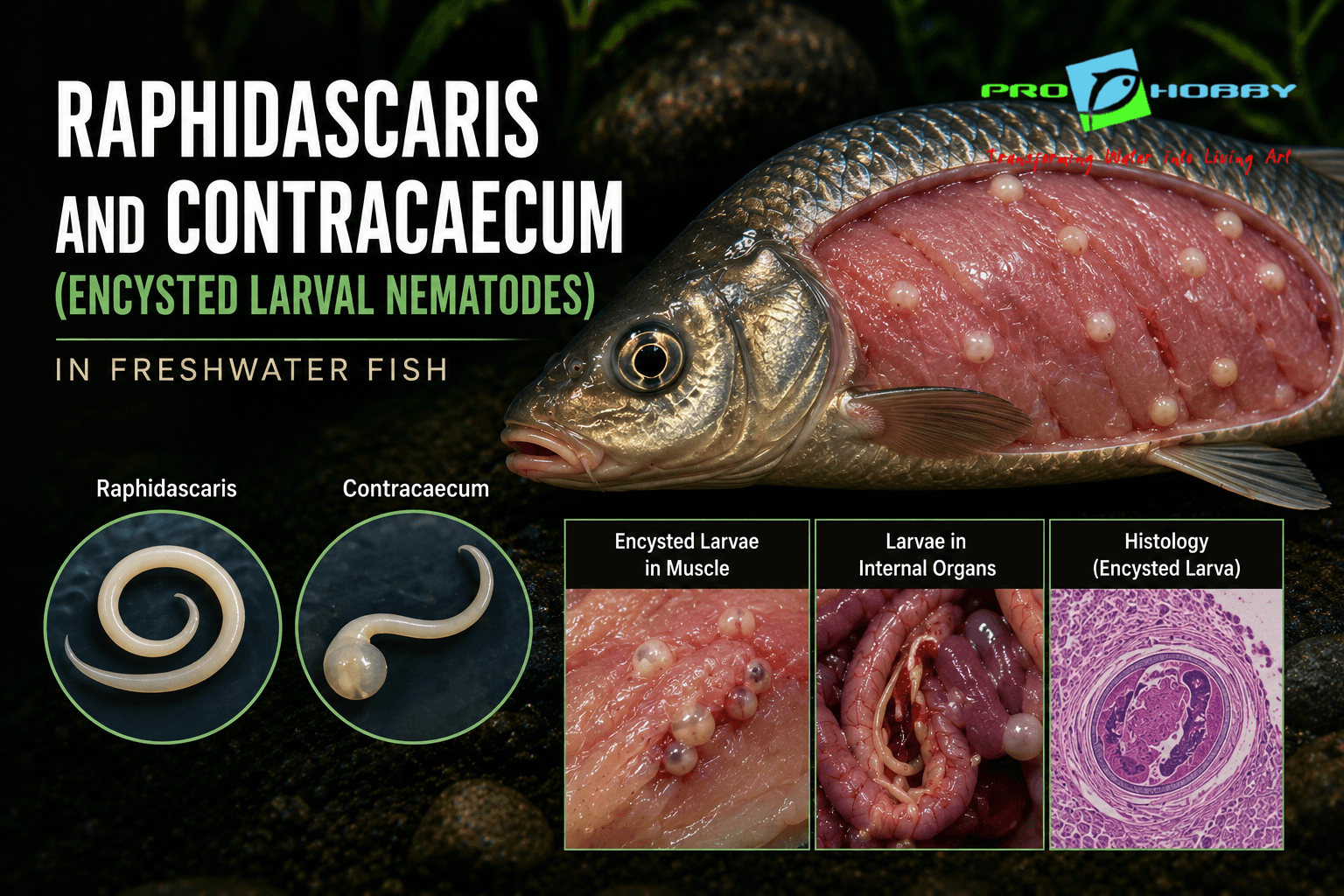
A hobbyist who loses a wild-caught or pond-sourced fish and, out of curiosity or as part of investigating the cause of death, examines the body closely enough to notice small white or yellowish nodules embedded in the muscle tissue, has almost certainly found encysted larval nematodes — most commonly Raphidascaris or Contracaecum species in a freshwater context — and has also almost certainly found something that had nothing whatsoever to do with why the fish died. This guide exists specifically to close the gap between what these organisms actually are, biologically, and the alarm their discovery typically produces, because the honest answer to “what are these and how do I treat my tank” is that these particular parasites are not a treatable aquarium disease at all, in the sense that term is used throughout the rest of this site’s disease library, and understanding exactly why is the entire point of this guide.
Table of Contents
- What Raphidascaris and Contracaecum Actually Are
- The Dead-End Host Concept — Why This Changes Everything
- Why the Full Lifecycle Cannot Complete in an Aquarium or Most Ponds
- How Fish Actually Acquire These Parasites
- Symptoms and Presentation — Usually None at All
- Why There Is No Treatment — And Why None Is Needed
- Distinguishing Encysted Larvae From Genuinely Treatable Conditions
- The Zoonotic Question — Anisakiasis and Why It Does Not Apply Here
- When Heavy Burden Does Matter
- Wild-Caught and Live Food Sourcing — The Actual Risk Factor
- India — Wild-Caught Fish and Live Food Practices
- Frequently Asked Questions
1. What Raphidascaris and Contracaecum Actually Are
Raphidascaris and Contracaecum are genera of anisakid nematodes — a family of parasitic roundworms whose complex, multi-host lifecycle is built around the larval stage encysting within an intermediate host’s tissue while the parasite awaits consumption by its definitive host, at which point it can mature to reproductive adulthood. In freshwater systems, fish — including many commonly kept and commonly wild-caught or pond-sourced ornamental and food fish species — serve specifically as this intermediate host stage, harbouring the larval form encysted within muscle tissue and internal organs without the parasite ever developing further while it remains in the fish.
This intermediate-host role is the central biological fact that distinguishes Raphidascaris and Contracaecum from the treatable intestinal nematodes covered elsewhere in this site’s disease library, Camallanus and Capillaria specifically, both of which complete their full lifecycle directly within fish-to-fish transmission and are consequently genuinely treatable and genuinely capable of spreading through an aquarium population in the way this guide’s subjects are not.
2. The Dead-End Host Concept — Why This Changes Everything
This is the single concept that reframes everything else in this guide, and deserves to be understood clearly before any of the more specific sections that follow.
Raphidascaris and Contracaecum require a piscivorous (fish-eating) bird or mammal as their definitive host — the life stage at which the parasite completes final maturation and reproduces — meaning a fish harbouring encysted larvae in an aquarium or a garden pond, environments with no piscivorous bird or mammal predator present to consume that fish and complete the lifecycle, represents what parasitologists term a dead-end host. The larvae remain encysted, dormant, and developmentally arrested indefinitely, incapable of maturing further, incapable of reproducing, and consequently incapable of producing any new infective stage capable of spreading to other fish within the same system.
The direct practical consequence: unlike essentially every other parasite covered throughout this site’s disease library, an aquarium or garden pond fish carrying encysted Raphidascaris or Contracaecum larvae poses no transmission risk whatsoever to other fish sharing the same water, because the biological pathway required for this parasite to produce a new infective stage simply cannot occur within a closed aquarium or garden pond system lacking the specific bird or mammal definitive host the lifecycle depends on.
3. Why the Full Lifecycle Cannot Complete in an Aquarium or Most Ponds
The complete Raphidascaris or Contracaecum lifecycle, in the wild aquatic environments where it naturally occurs, typically involves an initial intermediate host — often small crustaceans or other invertebrates that first consume free-living larval stages — followed by transmission to a fish intermediate host when that fish consumes the infected invertebrate, with the larvae then encysting in the fish’s tissue exactly as described in Section 1, awaiting the final step: consumption of the infected fish by a piscivorous bird (herons, kingfishers, and similar fish-eating bird species are commonly documented definitive hosts) or, in some regional and species-specific cases, a fish-eating mammal.
An enclosed aquarium provides no realistic pathway for any stage of this multi-host lifecycle to complete — no wild invertebrate intermediate host population, and critically, no piscivorous bird or mammal predator with access to infected fish.
A garden pond occupies a genuinely more variable middle ground worth addressing specifically, since outdoor ponds can and do receive visits from wading or fishing birds depending on location, pond accessibility, and any protective netting or covering in place — meaning a garden pond is not automatically and absolutely guaranteed to be a dead-end environment in the same unambiguous way a fully enclosed indoor aquarium is, though the practical transmission risk even in an accessible outdoor pond remains low relative to the natural wild aquatic environments where this parasite’s full lifecycle is genuinely common, given the additional intermediate invertebrate host requirement and the specific combination of circumstances the complete multi-stage lifecycle depends on.
4. How Fish Actually Acquire These Parasites
Fish acquire Raphidascaris and Contracaecum larvae by consuming infected intermediate hosts — small crustaceans and other invertebrates carrying the parasite’s earlier larval stage — as part of normal feeding behaviour, meaning the parasite arrives in a fish’s tissue as an incidental consequence of that fish’s diet in its original wild or pond environment, rather than through any contact-based or waterborne transmission route comparable to the parasites and pathogens covered throughout most of this site’s disease library.
Wild-caught fish, and fish sourced from outdoor ponds or other semi-natural environments where wild invertebrate populations and their associated parasite loads are present, carry meaningfully higher risk of harbouring these encysted larvae than fish bred and raised entirely within controlled aquaculture or ornamental breeding facility conditions, where the wild invertebrate intermediate hosts required for initial parasite acquisition are generally absent from the controlled feeding regime.
Live food sourced from wild or semi-wild collection — certain live invertebrate foods collected from natural water bodies rather than produced through controlled aquaculture — represents a documented potential introduction pathway, conceptually similar to the live-food transmission risk established for Capillaria elsewhere in this site’s internal parasite coverage, though the specific parasite and specific intermediate host relationship differ between the two.
5. Symptoms and Presentation — Usually None at All
This is worth stating plainly given how much of this site’s disease library is organised around recognising visible symptom patterns: the overwhelming majority of fish carrying encysted Raphidascaris or Contracaecum larvae show no visible external symptoms whatsoever, and the parasite is typically discovered incidentally — most commonly post-mortem, during close physical examination of a fish that died from an entirely unrelated cause, or in a food-fish context, during cleaning and preparation.
In cases of unusually heavy larval burden, covered further in Section 9, some localised effects are possible — visible nodules beneath the skin or in accessible muscle tissue, and in rare cases affecting a functionally significant location, some localised inflammation or reduced tissue function — but this represents a genuine exception rather than the typical presentation, and the presence of a small number of encysted larvae, the far more common finding, produces no reliably observable external sign in the living fish at all.
6. Why There Is No Treatment — And Why None Is Needed
No aquarium medication reliably penetrates and eliminates larvae encysted within muscle and organ tissue, following a similar fundamental accessibility limitation to the one established for systemic Uronema infection elsewhere in this site’s disease library — once a parasite is established within host tissue behind a protective cyst structure, external and even most oral medications simply cannot reach it at a therapeutic concentration without risk to the host fish itself.
Fortunately, given the dead-end host biology established in Section 2, no treatment is actually needed from a tank-management perspective. Because the parasite cannot complete its lifecycle, cannot reproduce, and cannot spread to other fish within an aquarium or typical garden pond, the presence of encysted larvae in an otherwise healthy fish is generally regarded as a biological curiosity and a diagnostic footnote rather than a condition requiring any active aquarium-level intervention — a genuinely different management conclusion from every treatable condition covered elsewhere throughout this site’s disease library, where absence of treatment reflects a genuine unmet medical need rather than, as here, an absence of any genuine ongoing threat to address.
7. Distinguishing Encysted Larvae From Genuinely Treatable Conditions
Given how alarming the discovery of visible nodules or worm-like structures in fish tissue can be, distinguishing this genuinely benign (from a tank-management perspective) finding from conditions that do require active treatment is worth addressing directly.
Visible worms at the vent, moving and clearly external or partially external — this is the presentation of Camallanus, a genuinely treatable intestinal nematode requiring whole-tank fenbendazole or levamisole treatment, and is visually and behaviourally distinct from the fully internal, encysted, immobile presentation of Raphidascaris and Contracaecum larvae.
Progressive wasting despite normal feeding, with no visible external nodules — more consistent with Capillaria or internal flagellate infection, both genuinely treatable conditions covered in the Internal Parasites guide, and requiring the specific fenbendazole or metronidazole-based treatment approaches covered there rather than the “no treatment needed” conclusion appropriate for encysted dead-end larvae.
Firm, discrete, immobile nodules discovered incidentally, most commonly post-mortem or during close physical inspection, with no other symptoms and no progression over time — this pattern is the one most consistent with Raphidascaris or Contracaecum encystment, and the appropriate response, per Section 6, is recognition rather than treatment.
When genuine uncertainty exists between these possibilities in a living, symptomatic fish, the general internal parasite diagnostic framework established in the Internal Parasites guide — testing water quality first, then considering the treatable causes before concluding a finding is a benign encysted larva — remains the appropriate systematic approach.
8. The Zoonotic Question — Anisakiasis and Why It Does Not Apply Here
This deserves specific mention because Raphidascaris and Contracaecum belong to the same broader anisakid nematode family responsible for anisakiasis, a genuine human illness associated with consuming raw or undercooked marine fish carrying related anisakid larvae — a zoonotic concern that occasionally generates alarm when hobbyists encounter the term “anisakid” in reference to parasites found in their fish.
This zoonotic concern is specific to marine fish species typically consumed as food, prepared raw or undercooked, and is not a relevant consideration for ornamental freshwater aquarium or pond fish, which are neither the marine species associated with documented human anisakiasis cases nor, in the overwhelming majority of ornamental fishkeeping contexts, ever intended for human consumption at all. Hobbyists encountering encysted larvae in ornamental freshwater fish should understand this as a fish-specific biological curiosity with the tank-management implications established throughout this guide, entirely separate from the marine food-safety context in which anisakid zoonotic risk is genuinely relevant.
9. When Heavy Burden Does Matter
While the typical finding of a small number of encysted larvae is genuinely benign from a tank management perspective, as established throughout this guide, a small number of specific scenarios warrant more careful consideration.
Unusually heavy larval burden in a single fish — a genuinely uncommon finding relative to the light, incidental encystment typical of most cases — can, in principle, produce localised tissue damage or functional impairment if larvae are concentrated in a functionally significant location, though this remains a considerably less common presentation than the light, asymptomatic encystment covered as the norm throughout this guide.
Wild-caught fish intended for a display or breeding programme where a hobbyist wants confidence in overall parasite burden before introduction, even where the specific larvae present pose no transmission risk to other fish, may reasonably warrant the standard extended quarantine period recommended for all wild-caught stock throughout this site’s biosecurity guidance, primarily to assess and address any other, genuinely transmissible conditions the same fish may also be carrying, rather than specifically because of the encysted larvae themselves.
Any fish showing genuine systemic illness alongside incidentally discovered encysted larvae should have that illness investigated on its own merits following the appropriate diagnostic framework elsewhere in this site’s disease library, rather than the encysted larvae being assumed as the explanation for symptoms they are not typically associated with producing.
10. Wild-Caught and Live Food Sourcing — The Actual Risk Factor
Given the transmission pathway established in Section 4, the practical risk-reduction measure available to hobbyists is not treatment of an already-affected fish, which as established in Section 6 is neither necessary nor available, but rather informed sourcing decisions going forward.
Frozen rather than live food sourced from wild collection eliminates the live intermediate-host transmission pathway entirely, since the freezing process reliably kills parasitic larvae that might otherwise be present in live-collected invertebrate food — the same general principle established for reducing Capillaria transmission risk through frozen rather than live bloodworm sourcing elsewhere in this site’s internal parasite guidance.
Captive-bred stock from controlled aquaculture facilities, where the invertebrate intermediate hosts required for initial parasite acquisition are generally absent from controlled feeding regimes, carries meaningfully lower encysted larval nematode risk than wild-caught fish or fish raised in outdoor pond conditions with wild invertebrate populations present, relevant background for hobbyists specifically prioritising parasite-load considerations in their sourcing decisions.
11. India — Wild-Caught Fish and Live Food Practices
Wild-caught fish and live food collected from natural water bodies remain a meaningful part of the fishkeeping supply chain in parts of the Indian ornamental and pond fish trade, and the general sourcing considerations established in Section 10 apply directly to Indian hobbyists specifically — frozen rather than live wild-collected food, and captive-bred stock where available, both meaningfully reduce encysted larval nematode exposure risk, alongside the broader biosecurity and disease-prevention benefits both practices provide against the genuinely treatable and transmissible conditions covered throughout the rest of this site’s disease library.
Indian koi and pond keepers examining a deceased fish as part of investigating an unexplained loss should specifically not conclude that incidentally discovered encysted nodules explain the fish’s death, given the benign, typically asymptomatic nature of this finding established throughout this guide — the genuine cause of death in such cases warrants separate investigation following the broader diagnostic frameworks established in Why Aquariums Fail — A Systems-Level Diagnosis and the specific pond disease considerations covered in the companion KHV and SVC guides, rather than the encysted larvae being assumed as an adequate explanation.
Frequently Asked Questions
I found white nodules in my fish’s muscle — is this dangerous? Almost certainly not, and not treatable in the sense most aquarium conditions are. These are most likely encysted larval nematodes (Raphidascaris or Contracaecum), which cannot complete their lifecycle, cannot reproduce, and cannot spread to other fish in an aquarium or typical garden pond, since they require a piscivorous bird or mammal to complete development — an animal not present in a closed aquarium system. No treatment is generally needed or available.
Will this spread to my other fish? No. This is the central biological fact that distinguishes these parasites from essentially everything else covered in this site’s disease library. The fish harbouring encysted larvae is a dead-end host, and the parasite cannot produce a new infective stage capable of transmitting to other fish without the specific bird or mammal definitive host the full lifecycle requires.
How do I treat my tank for this parasite? You generally don’t need to. No aquarium medication reliably reaches larvae encysted within muscle tissue, and because the parasite cannot spread between fish in a closed system, there is no ongoing threat to treat. This is a genuinely different situation from treatable internal parasites like Camallanus or Capillaria covered elsewhere on this site.
Is it safe to eat fish with these parasites? This zoonotic concern (anisakiasis) is specific to certain marine fish species consumed raw or undercooked, and is not relevant to ornamental freshwater aquarium or pond fish, which are neither the species involved in documented human cases nor typically intended for human consumption at all.
How did my fish get this parasite if I’ve never fed it live food? Fish acquire these larvae by consuming infected invertebrates carrying the parasite’s earlier larval stage, most commonly in a wild or outdoor pond environment before the fish was acquired, or through live food sourced from wild collection. Fish raised entirely in controlled aquaculture conditions without exposure to wild invertebrate populations carry meaningfully lower risk.