
By ProHobby™ | Ecological Systems Authority
Axolotls occupy a genuinely unusual position in the Indian exotic pet hobby: a cold-water amphibian, native to a single high-altitude Mexican lake system, being kept in one of the hottest climates in the world, by a hobbyist community whose entire existing fishkeeping knowledge base — built around tropical fish requiring 24 to 28°C — is directly counterproductive to what this species actually needs. This is not a fish. It is a neotenic salamander, retaining its larval, fully aquatic gilled form throughout its entire adult life rather than metamorphosing into a terrestrial adult the way most amphibians do, and nearly every aspect of correct axolotl husbandry — its temperature tolerance, its substrate requirements, its filtration needs, its complete inability to coexist safely with most fish — diverges sharply enough from standard aquarium fishkeeping that applying fish-keeping instincts directly to an axolotl produces a genuinely dangerous mismatch. This guide addresses axolotl biology and care in full, with the temperature management challenge specific to Indian conditions treated as the central, not peripheral, concern it actually is for any hobbyist keeping this species outside a climate-controlled environment in India.
Table of Contents
- What an Axolotl Actually Is — Neoteny Explained
- Why Axolotls Are Fundamentally Not Fish-Keeping-Compatible
- Temperature — The Single Most Important Fact for Indian Keepers
- Tank Requirements
- Substrate — Why the Wrong Choice Causes Fatal Impaction
- Filtration — Why Flow Rate Matters More Than Filtration Power
- Water Parameters
- Feeding
- Gills as a Direct Health Indicator
- Regeneration Biology — What It Means for Injury Management
- Morphs and Colour Genetics
- Tank Mates — Why the Honest Answer Is Almost None
- Common Health Issues
- Breeding and Sexing
- India — The Temperature Management Reality
- Frequently Asked Questions
1. What an Axolotl Actually Is — Neoteny Explained
Axolotls (Ambystoma mexicanum) are a species of mole salamander native exclusively to the remaining canal and lake systems in the Xochimilco region near Mexico City, and they are biologically remarkable for a specific reason directly relevant to every subsequent section of this guide: they exhibit neoteny, meaning they retain their fully aquatic, gilled larval body form throughout their entire adult life and reproductive maturity, rather than undergoing the metamorphosis into a terrestrial, lung-breathing adult form that most salamander species complete. An adult axolotl, at full sexual maturity and full adult size, still has external feathery gills, a finned tail, and an entirely aquatic lifestyle — it never leaves the water under normal circumstances, and should never be expected to.
This neotenic biology is the single fact from which nearly every other axolotl care requirement in this guide follows — the permanent external gills establish the water quality sensitivity covered in Section 7, the fully aquatic lifestyle establishes the substrate and filtration considerations covered in Sections 5 and 6, and the cold, high-altitude lake origin establishes the temperature requirement that forms the central concern of this entire guide for Indian keepers specifically, covered in full in Section 3.
2. Why Axolotls Are Fundamentally Not Fish-Keeping-Compatible
This deserves direct statement before any further detail, because it is the single most common source of care failure among hobbyists approaching axolotls with existing fish-keeping experience: an axolotl is not a fish, does not have fish-typical temperature tolerance, does not have skin adapted to fish-typical water flow and filtration turnover, and cannot safely share water with most fish species over any meaningful timeframe, covered fully in Section 12. A hobbyist transferring standard tropical community tank assumptions — moderate-to-warm temperature, standard filter flow rate, generic gravel substrate, compatible tank mates — directly onto an axolotl setup is making decisions that range from suboptimal to genuinely lethal, and this guide is structured specifically to correct each of those transferred assumptions individually.
3. Temperature — The Single Most Important Fact for Indian Keepers
This is the section that most directly justifies treating axolotl care as a genuinely distinct topic for an Indian audience specifically, rather than a generic care guide with an incidental India section appended.
Axolotls require cold water — genuinely cold by tropical fishkeeping standards. Optimal temperature range is generally cited at approximately 16 to 18°C, with an upper tolerance ceiling that becomes genuinely dangerous above roughly 24°C and increasingly life-threatening as temperature climbs further. Sustained exposure above approximately 24°C produces measurable physiological stress, suppressed immune function following the same cortisol-mediated stress pathway established throughout this site’s fish stress guidance but with a considerably narrower safety margin than most tropical fish tolerate, and at sustained higher temperatures still, genuine risk of fatal heat stress.
Why this makes India a genuinely difficult climate for axolotl keeping without active intervention: ambient room temperatures across most of India for a significant portion of the year, and across virtually the entire country during summer months, sit well above the axolotl’s safe upper temperature limit — the same ambient heat that requires active cooling management for goldfish and shrimp elsewhere on this site is, for axolotls specifically, not a seasonal management challenge but a year-round, non-negotiable infrastructure requirement in the vast majority of Indian locations and housing types.
Practical cooling approaches — an aquarium chiller is the only genuinely reliable, consistent solution for maintaining safe axolotl temperature through Indian summer conditions, and should be considered mandatory equipment rather than an optional upgrade for anyone keeping axolotls outside a permanently air-conditioned room maintained reliably below the safe threshold throughout the full year. Fan-based evaporative cooling, frozen water bottles, and other partial-measure approaches covered as supplementary options for goldfish and shrimp elsewhere on this site provide meaningfully less temperature reduction than axolotls require and should not be relied upon as a primary cooling strategy given the considerably narrower and more dangerous temperature tolerance this species has relative to those more heat-tolerant alternatives.
The honest pre-purchase question every prospective Indian axolotl keeper should ask themselves: do I have, or am I prepared to invest in, reliable year-round cooling infrastructure capable of maintaining water temperature below approximately 22°C regardless of ambient room conditions during peak Indian summer — if the answer is no, an axolotl is not currently an appropriate species for you regardless of enthusiasm for the animal itself.
4. Tank Requirements
Minimum tank size for a single adult axolotl is generally recommended at a minimum of 75 to 80 litres, reflecting both the animal’s eventual adult size (commonly 20 to 30 centimetres, occasionally larger) and the water volume stability benefits established throughout this site’s general aquarium guidance — larger water volume buffers both temperature fluctuation, directly relevant given Section 3, and water quality fluctuation more effectively than a smaller volume would.
Tank shape should prioritise floor space over height, given axolotls are bottom-dwelling and do not utilise vertical swimming space the way many fish species do — a wide, relatively shallow footprint serves this species’ actual space usage considerably better than a tall, narrow tank of equivalent volume.
Secure lid is generally recommended, both to prevent any escape attempt and to help maintain more stable water temperature by reducing evaporative heat exchange with ambient room air, a genuinely relevant secondary benefit given the temperature management challenge established in Section 3.
5. Substrate — Why the Wrong Choice Causes Fatal Impaction
This is one of the most consequential and most commonly mismanaged aspects of axolotl care, and deserves emphatic, specific treatment given how directly the wrong choice here can kill an otherwise well-cared-for animal.
Axolotls feed by suction, drawing food and inevitably some surrounding substrate material into their mouths during normal feeding activity. Standard aquarium gravel, and any substrate with particle size small enough to be incidentally ingested during this feeding action but too large to pass safely through the digestive tract, creates genuine, well-documented impaction risk — a blockage in the digestive system that can be fatal without veterinary intervention, and represents one of the most common preventable causes of serious axolotl health crisis in the hobby.
Safe substrate options: bare-bottom tanks (no substrate at all) eliminate the impaction risk entirely and are widely used, particularly in more clinically managed or breeding setups, at some cost to natural aesthetic appearance. Fine sand, with a genuinely small enough particle size to pass through the digestive tract without lodging even if incidentally ingested, is the standard substrate recommendation where a more natural substrate appearance is desired. Large, smooth river stones considerably too large for an axolotl to physically fit in its mouth are sometimes used as an alternative, though require careful size verification relative to the specific animal’s mouth size to genuinely eliminate ingestion risk rather than merely reduce it.
What to avoid absolutely: standard aquarium gravel of the size and type commonly used for tropical fish tanks, and any substrate marketed generically without specific axolotl-safety consideration, given the impaction risk this specific particle size range represents for this specific feeding mechanism.
6. Filtration — Why Flow Rate Matters More Than Filtration Power
Axolotls are adapted to the calm, slow-moving water of their native lake habitat, and strong water flow and current — entirely appropriate and often beneficial for many fish species covered elsewhere on this site — is genuinely stressful and physically difficult for axolotls to navigate against, given their body form and swimming style are not adapted to actively work against significant current the way many fish are.
The practical filtration approach: gentle-flow filtration, commonly achieved through sponge filters (mirroring the same gentle-flow principle established for shrimp tank filtration elsewhere on this site, though for a different underlying reason) or standard filters with flow specifically baffled or diffused to reduce current at the point of output, is the standard and correct approach, prioritising adequate biological filtration capacity for the axolotl’s genuinely substantial bioload — larger and messier than most fish of comparable size — while specifically avoiding the strong directional current output that would otherwise accompany filtration powerful enough to handle that bioload if left undiffused.
7. Water Parameters
| Parameter | Target Range |
|---|---|
| Temperature | 16–18°C (never sustained above 24°C) |
| pH | 6.5–8.0 |
| Ammonia | 0 ppm |
| Nitrite | 0 ppm |
| Nitrate | Below 40 ppm |
Ammonia and nitrite sensitivity is genuinely significant given the permanent external gill structure established in Section 1 — axolotl gills are directly exposed, delicate tissue, and the same ammonia toxicity mechanism covered throughout this site’s fish disease library applies with particular relevance here, making the standard zero-tolerance ammonia and nitrite standard established throughout this site’s general water chemistry guidance a genuinely non-negotiable baseline rather than an aspirational target for axolotl keeping specifically.
A fully cycled tank before introduction is essential, following the complete cycling guide established elsewhere on this site — introducing an axolotl to an uncycled tank risks exactly the ammonia exposure this species’ exposed gill tissue is particularly vulnerable to.
8. Feeding
Axolotls are carnivorous, feeding by direct suction rather than active pursuit-and-bite predation, and accept a range of appropriate foods including earthworms (a commonly recommended staple), specifically formulated axolotl or carnivore sinking pellets, and occasional feeder fish or frozen bloodworm as supplementary variety, with live or appropriately thawed frozen food generally preferred given axolotls’ feeding mechanism relies substantially on movement to trigger the suction feeding response.
Feeding frequency for adults is generally lower than most fish species covered elsewhere on this site, commonly every 2 to 3 days for a healthy adult given their comparatively lower metabolic rate at the cold temperatures this species requires, with juveniles requiring more frequent feeding to support active growth.
Feeding location consideration, given the substrate impaction risk established in Section 5, includes feeding directly from tongs or in a designated feeding area to reduce the amount of substrate incidentally ingested during normal feeding activity, a genuinely useful supplementary practice alongside correct substrate selection rather than a substitute for it.
9. Gills as a Direct Health Indicator
The external, fully exposed gill structure established in Section 1 provides a genuinely useful, directly observable ongoing health indicator that most fish, with their internally protected gill structures, do not offer to the same degree.
Healthy gills appear full, fluffy, and richly coloured (typically a healthy red or pink reflecting good blood oxygenation), actively moving with normal respiratory rhythm.
Receding, clamped, or discoloured gills — appearing shrunken, held close to the body rather than extended, or showing pale or unusual colouration — are a genuine and relatively early warning sign of water quality problems, temperature stress specifically per Section 3, or general systemic illness, and should prompt immediate water parameter testing following the framework established throughout this site’s water chemistry guidance rather than being dismissed as a minor cosmetic variation.
Rapid gill movement can indicate the same general respiratory distress pattern established throughout this site’s fish disease library for ammonia and dissolved oxygen problems, adapted to axolotl-specific interpretation given their permanent external gill structure making this respiratory distress considerably more directly visible than in most fish.
10. Regeneration Biology — What It Means for Injury Management
Axolotls are among the most studied model organisms in regenerative biology specifically because of their remarkable, genuinely unusual capacity to regenerate complex tissue — including entire limbs, portions of the tail, and in some documented cases even portions of organs and spinal cord tissue — to a degree essentially unmatched among vertebrate animals.
The practical implication for injury management: an axolotl that loses a limb or suffers tail damage, whether through handling injury, tank mate aggression (covered as a primary reason to avoid most tank mate combinations in Section 12), or other physical trauma, has a genuinely favourable prognosis for meaningful tissue regeneration over a period of weeks to months, provided water quality is maintained at the standard established in Section 7 throughout the healing and regeneration period — clean water is understood to directly support the regenerative process, making water quality management during any injury recovery period even more critical than the already-high standard this species requires under normal circumstances.
This regenerative capacity should inform, but not eliminate, injury prevention priority — while the prognosis for physical injury is genuinely more favourable in axolotls than in most other commonly kept species, this is not a justification for accepting avoidable injury risk, particularly given that the underlying causes of injury (inappropriate tank mates, rough handling, inadequate tank design) carry their own independent welfare and stress concerns beyond the physical injury itself.
11. Morphs and Colour Genetics
Axolotls have been bred in captivity for a genuinely wide range of colour and pattern morphs, considerably more visually diverse than the species’ natural wild colouration, reflecting decades of both scientific research breeding programmes and hobbyist-driven selective breeding.
Wild type displays the natural mottled dark brown-grey colouration the species shows in its native habitat.
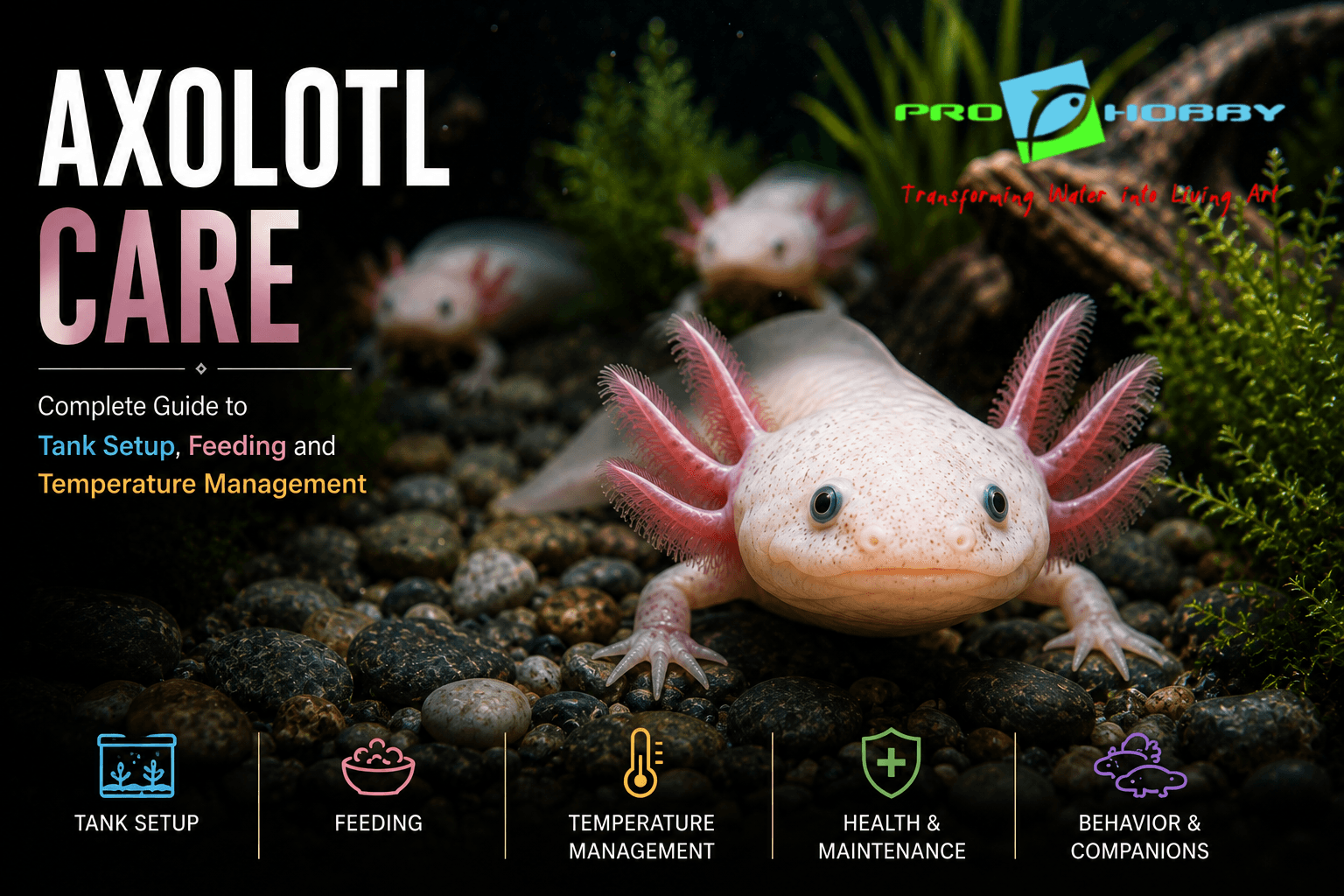
Leucistic axolotls display a pale pink-white body with visible dark eyes, one of the most commonly available and recognisable morphs in the hobby.
Albino axolotls (in both golden and white variants depending on specific genetic lineage) display pale colouration with pink or red eyes, distinguishing them from leucistic animals through the eye colouration difference specifically.
Melanoid axolotls display a solid, deep black-grey colouration lacking the iridescent sheen present in wild-type animals, reflecting a specific genetic variation in pigment cell type present.
Copper, GFP (green fluorescent protein, glowing under specific lighting), and various other specialist morphs are also present in the hobby at varying availability, reflecting the extensive selective breeding history this species has undergone in both scientific and hobbyist contexts.
Morph selection is overwhelmingly an aesthetic preference rather than a care-relevant decision — the water quality, temperature, feeding, and general husbandry requirements established throughout this guide apply essentially identically regardless of which morph a hobbyist selects.
12. Tank Mates — Why the Honest Answer Is Almost None
This deserves direct, unambiguous treatment given how frequently new axolotl keepers, drawing on general community-tank fishkeeping instinct, ask whether a given fish species could be safely added alongside an axolotl.
Most fish are not safe long-term axolotl tank mates, for a combination of compounding reasons: many fish species will nip at the axolotl’s external gills and limbs, mistaking the feathery gill structures for food or simply through incidental fin-nipping-type behaviour, creating exactly the kind of injury risk established in Section 10; conversely, sufficiently large or predatory fish may view a smaller or juvenile axolotl as prey; the temperature range axolotls require, established in Section 3, is considerably colder than the great majority of popular tropical community fish tolerate, meaning few fish species share genuine temperature compatibility with axolotls in the first place; and fish can introduce disease and parasites that, while sometimes well-tolerated by the fish species itself, may affect axolotls differently given their genuinely different amphibian physiology relative to fish.
Cold-water fish species with genuine temperature overlap represent the most plausible tank mate category in principle, though even here, the gill-nipping and general compatibility concerns established above mean any such combination warrants considerably more caution and close monitoring than a typical community fish pairing would, and many experienced axolotl keepers recommend against fish tank mates entirely as the most reliable, lowest-risk approach.
Multiple axolotls together is more commonly practised than fish cohabitation, though even here, axolotls can and do nip at each other’s gills and limbs, particularly around feeding time when competition and misdirected feeding strikes are most likely, meaning adequate space and close monitoring remain relevant even in a same-species grouping, and separating individuals showing repeated injury to tank mates is standard practice.
Invertebrates are broadly unsuitable given predation risk in both directions depending on relative size, and the general principle throughout this section — that axolotls are best kept as a dedicated, single-species (or in some cases, carefully monitored same-species group) setup rather than as part of a mixed community system — represents the most consistently reliable approach across the great majority of hobbyist circumstances.
13. Common Health Issues
Impaction from inappropriate substrate, established in full in Section 5, is among the most common serious health emergencies in captive axolotls and is substantially preventable through correct substrate selection from the outset.
Ammonia and nitrite toxicity affecting the exposed gill tissue established in Section 1, following the same fundamental toxicity mechanism covered throughout this site’s water chemistry guidance, with axolotls’ external gills providing less structural protection than the internally housed gills of most fish species.
Fungal infections, generally presenting as a cottony or fuzzy growth on skin or gill tissue, following broadly similar underlying opportunistic biology to the Saprolegnia fungal infections covered in this site’s fish disease library, though treatment approach and appropriate product selection for amphibian skin, which is considerably more permeable and chemically sensitive than fish scales and mucus coating, requires specific axolotl-appropriate product selection rather than direct application of standard fish antifungal treatment without modification.
Temperature stress, covered in exhaustive detail throughout Section 3 given its particular relevance to Indian keepers, remains the single most consequential and most preventable health risk this species faces in Indian conditions specifically, and should be considered the primary ongoing management concern rather than a one-time setup consideration.
Prolapse (a protrusion of internal tissue, most commonly cloacal) is a documented health issue in captive axolotls, generally associated with digestive or husbandry factors including overfeeding or inappropriate diet, and warrants prompt veterinary consultation where accessible given the potential severity of this specific condition.
14. Breeding and Sexing
Sexing mature axolotls is generally achievable through visual inspection of cloacal region morphology — males typically display a more prominent, swollen cloacal area relative to females — alongside some general body shape differences that become more apparent with maturity, though confident sexing generally requires the animal to have reached genuine sexual maturity rather than being reliably determinable in juveniles.
Breeding axolotls in captivity is genuinely achievable and reasonably well-documented in the hobby, generally triggered by a period of cooler water temperature (itself well within the species’ normal preferred range established in Section 3, rather than requiring any extreme manipulation) followed by introduction of a conditioned male and female, with females subsequently laying substantial numbers of eggs on plants or spawning substrate, requiring separation from adults to achieve meaningful survival given adults will otherwise consume eggs opportunistically — a broadly similar general breeding management principle to the egg-scattering fish species covered elsewhere in this site’s care guides, adapted to axolotl-specific biology.
15. India — The Temperature Management Reality
Given that Section 3 has already established the core temperature challenge in detail, this section focuses specifically on the practical infrastructure and decision-making this creates for Indian hobbyists.
Chiller investment as a genuine prerequisite, not an accessory purchase — for the great majority of Indian locations and housing situations, reliable year-round axolotl keeping requires a dedicated aquarium chiller, and this equipment cost should be factored into the genuine total cost of axolotl keeping in India from the outset, alongside the tank, filtration, and other setup costs established throughout this guide, rather than being treated as an optional later upgrade once initial husbandry challenges become apparent. The full buying, installation and backup guide is Aquarium Chillers in India.
Room selection and passive temperature management as a supplementary rather than primary strategy — positioning a tank in the coolest available room, away from direct sunlight and heat-generating equipment, and in a consistently air-conditioned space where genuinely feasible, meaningfully reduces the cooling burden a chiller must overcome, though should be understood as a supplement to active chilling rather than a substitute for it given the genuinely narrow and dangerous temperature tolerance established in Section 3.
Seasonal vigilance even with cooling infrastructure in place — chiller failure, power outages affecting cooling equipment, and the sheer intensity of peak Indian summer ambient heat mean that even hobbyists with appropriate cooling infrastructure should maintain active temperature monitoring and a contingency plan (backup cooling method, alternative housing arrangement) for equipment failure during the highest-risk summer months, mirroring the general power-outage and equipment-failure contingency planning relevant throughout this site’s dissolved oxygen emergency guidance adapted to axolotl-specific temperature stakes.
The honest sourcing and acquisition recommendation — prospective Indian axolotl keepers should have cooling infrastructure genuinely operational and tested before acquiring the animal, rather than planning to install it afterward, given how rapidly and severely temperature stress can affect this species relative to the somewhat more forgiving timeline available when addressing, for instance, suboptimal but non-immediately-lethal water hardness in a fish species covered elsewhere on this site.
Frequently Asked Questions
Can axolotls survive in Indian room temperature without a chiller? Not reliably across most of India for most of the year. Axolotls require water temperature ideally around 16 to 18°C, with genuine danger developing above roughly 24°C. Indian ambient room temperature exceeds this safe threshold for a significant portion of the year across most locations, making a dedicated aquarium chiller a genuine infrastructure requirement rather than an optional upgrade for reliable year-round keeping outside a permanently and reliably air-conditioned space.
What substrate is safe for axolotls? Bare-bottom tanks or fine sand are the standard safe recommendations. Standard aquarium gravel creates genuine impaction risk, since axolotls feed by suction and can incidentally ingest substrate particles too large to pass safely through the digestive tract, a well-documented and potentially fatal condition.
Can axolotls live with fish? Generally not recommended as a reliable long-term arrangement. Most fish will nip at axolotl gills and limbs, few fish species share the axolotl’s cold-water temperature requirement, and fish can introduce disease that affects axolotls differently given their different physiology. A dedicated single-species or carefully monitored same-species setup is the most reliable approach.
Why do my axolotl’s gills look shrunken or discoloured? This is a genuine, relatively early warning sign, most commonly linked to water quality problems, temperature stress, or general illness. Test water parameters immediately, including temperature specifically, and address any identified issue promptly given how directly gill condition reflects overall health in this species.
Can an axolotl regrow a lost limb? Yes, genuinely and remarkably well. Axolotls are among the most capable regenerators in the vertebrate animal kingdom, able to regrow entire limbs and portions of the tail over a period of weeks to months, provided water quality is well maintained throughout the healing period. This regenerative capacity does not reduce the importance of preventing injury in the first place.