
By ProHobby™ | Ecological Systems Authority
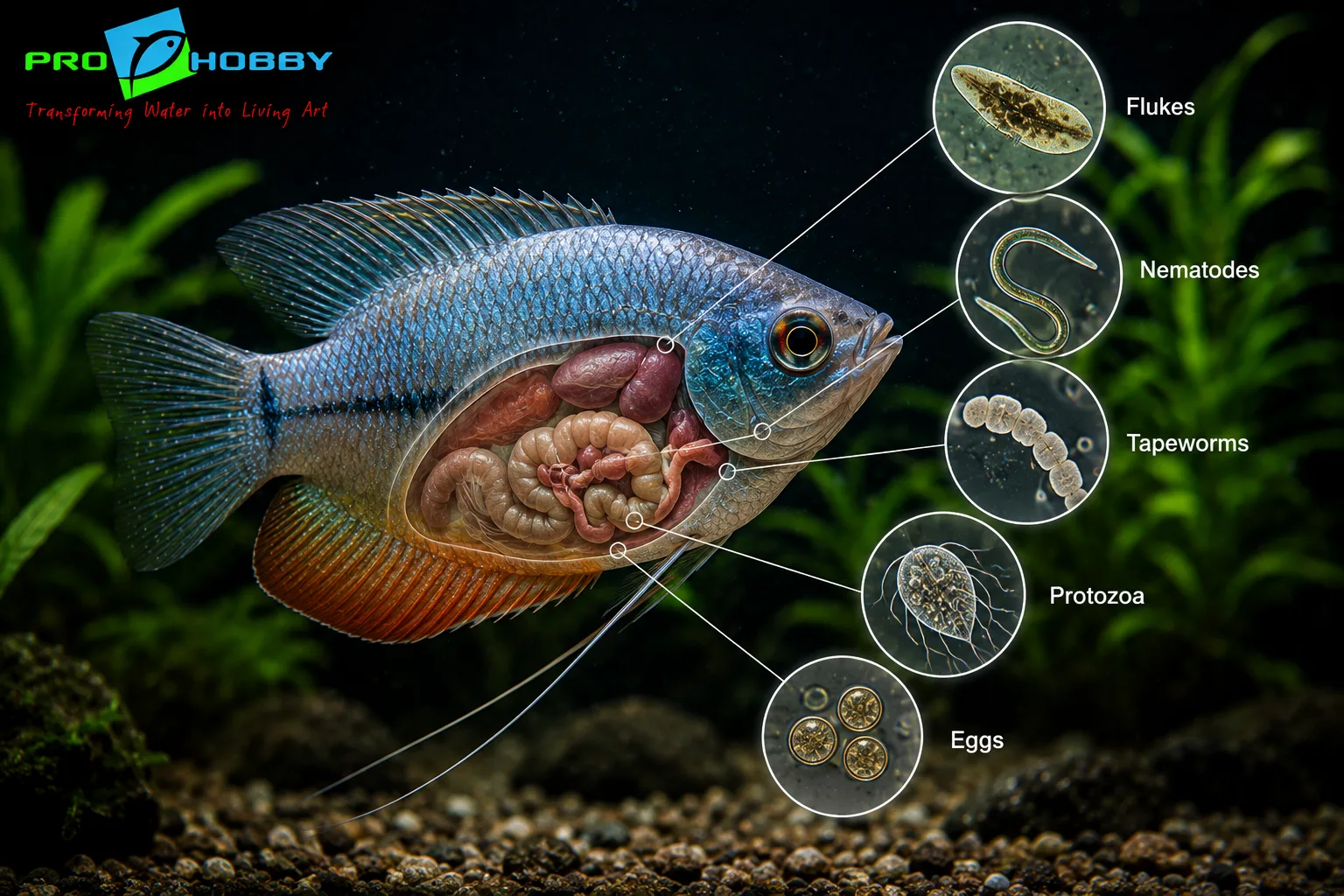
A fish losing weight despite eating normally, producing stringy white faeces, and gradually fading in colour over weeks to months has internal parasites until proven otherwise. Unlike external parasites visible on the body surface, internal parasites are invisible — their presence inferred from symptom patterns, eliminated differential diagnoses, and in some cases post-mortem examination. This guide covers every major internal parasite group affecting aquarium fish: which are treatable, which are not, and which pose a risk beyond the tank.
Table of Contents
- When to Suspect Internal Parasites
- Internal Flagellates — Hexamita and Spironucleus
- Nematodes — Camallanus and Other Roundworms
- Cestodes — Tapeworms
- Microsporidians — Neon Tetra Disease (Incurable)
- Internal Trematodes — Internal Flukes
- Diagnosis and Empirical Treatment Protocol
- Species Most Affected
- India and Delhi NCR — Specific Considerations
- Frequently Asked Questions
1. When to Suspect Internal Parasites
Internal parasites should be considered when:
- A fish loses weight progressively over weeks despite apparently normal appetite
- Stringy, white, or mucoid faeces appear — internal flagellates produce characteristic pale or mucoid faeces distinctly different from normal waste
- Abdominal swelling is present without the full-body scale protrusion of dropsy
- A fish shows chronic lethargy and colour fading with no water quality cause
- There is a history of live food from unknown sources (wild-caught Tubifex, live copepods)
- The fish was recently imported or is wild-caught
Always confirm water quality is not the cause first. Ammonia, nitrite, elevated nitrate, and temperature stress all produce progressive decline indistinguishable from internal parasitism without testing. Only when water parameters are confirmed normal should internal parasites be the primary working diagnosis. The immunity framework: The Science of Fish Stress.
2. Internal Flagellates — Hexamita and Spironucleus
The most commonly encountered internal parasites in ornamental fish, Hexamita spp. and Spironucleus spp. are flagellate protozoa inhabiting the digestive tract and internal organs of a wide range of freshwater fish — particularly cichlids and discus. They exist at subclinical levels in many fish without causing disease; pathogenic infection develops when immune suppression from water quality failure, nutritional deficiency, or chronic stress allows the population to overgrow.
Clinical presentations:
- Hole in the Head disease (HITH): Pitting erosions of the lateral line and head in cichlids, oscars, and discus. Full mechanism and treatment in Hole in the Head Disease
- Malawi Bloat: Acute abdominal distension in African cichlids, combined with Hexamita and dietary triggers. Malawi Bloat Emergency Guide
- General wasting: Weight loss despite eating, sunken abdomen, pale colouration, stringy white faeces, reduced activity
Treatment: Metronidazole at 400–500mg per 100 litres as a water treatment, or 25mg/kg body weight in food. 7–10 day course minimum. Hexamita/Spironucleus responds well to metronidazole when caught before significant tissue damage. Treat in a hospital tank.
3. Nematodes — Camallanus and Other Roundworms
Camallanus cotti is the most visible internal nematode — the thin red-orange worms protruding from the vent are adult females. The complete whole-tank treatment protocol, fenbendazole and levamisole dosing, and why partial treatment fails are in Camallanus Worms — Complete Guide.
Other nematode species infect aquarium fish internally without producing visible vent worms. These present as progressive wasting in fish eating normally. Diagnosis is by microscopic examination of faeces or post-mortem.
Treatment for all nematodes: Fenbendazole at 50mg/kg body weight in food, repeated after 2–3 weeks to catch any larvae present during the first course. All fish in the tank must be treated simultaneously — partial treatment produces reinfection from the untreated reservoir. The same whole-tank principle applies regardless of whether worms are visible at the vent or not.
4. Cestodes — Tapeworms
Tapeworms require intermediate hosts to complete their lifecycle — typically copepods or Tubifex worms. Fish acquire tapeworms from live food of unknown provenance or from wild-caught fish. In closed aquariums without live intermediate hosts, tapeworm populations do not self-propagate.
Symptoms: Progressive weight loss and abdominal swelling as tapeworm segments occupy intestinal space, reduced activity, pale faeces. Tapeworm segments rarely appear in aquarium fish faeces as they do in mammals.
Treatment: Praziquantel at 5mg/L as a water treatment, or 50mg/kg in food. Praziquantel also treats gill flukes and internal trematodes simultaneously — a combined course addresses multiple parasite groups at once. Gill Flukes Treatment Guide.
5. Microsporidians — Neon Tetra Disease (Incurable)
Microsporidian infections are the most challenging internal parasite category — the parasites live inside host cells, making them completely refractory to all currently available aquarium treatments.
Neon Tetra Disease (Pleistophora hyphessobryconis): Initially presents as a pale or white patch appearing on the body — typically below the dorsal fin — that grows progressively. As infection advances, the white area expands, scales may be lost, and the body becomes deformed. The parasite destroys muscle tissue from within the cell.
Why it cannot be treated: Microsporidians are obligate intracellular parasites. No available aquarium medication reaches intracellular parasites at therapeutic concentrations without killing the host fish. This is not a treatment gap that will be closed by trying more medications — it is a fundamental biological barrier.
Critical differential diagnosis: Early Neon Tetra Disease presents as a pale body patch easily confused with Columnaris. The distinction: Columnaris patches are surface lesions with cottony texture that progress rapidly and respond to gram-negative antibiotics. Neon Tetra Disease patches have visible depth within the muscle tissue and produce zero response to any antibiotic treatment.
Management: Quarantine all affected fish immediately — the disease spreads through infected faeces and decomposing bodies. Euthanise fish showing significant tissue damage with clove oil (10+ drops per litre). Thoroughly disinfect any tank that has housed affected fish before introducing new livestock.
6. Internal Trematodes — Internal Flukes
Internal trematodes affect the swim bladder, gut, and liver. They are more common in wild-caught fish and fish from farms using live food. Most require snail intermediate hosts that are not present in standard aquariums — internal fluke infestations typically do not self-propagate in closed systems.
Symptoms: Swim bladder dysfunction, abnormal swimming posture, abdominal swelling, chronic weight loss.
Treatment: Praziquantel at 5mg/L treats most trematode species — the same product used for gill flukes and tapeworms covers all three groups in a single course.
7. Diagnosis and Empirical Treatment Protocol
Definitive diagnosis of most internal parasites requires microscopic examination of faeces or post-mortem tissue — not practical for most hobbyists. Clinical diagnosis is based on symptom pattern with water quality confirmed normal.
Empirical treatment covering treatable internal parasites:
- Metronidazole — targets Hexamita, Spironucleus, and internal flagellates
- Fenbendazole or praziquantel — targets nematodes, cestodes, and trematodes
A combined course of metronidazole and fenbendazole in food, or metronidazole water treatment combined with praziquantel, covers the full treatable range. If treatment produces no improvement after a full course, suspect Neon Tetra Disease or Fish TB — neither responds to any aquarium treatment.
Treat in a hospital tank where possible. The decision framework for when medication is appropriate: Quarantine vs Medication.
8. Species Most Affected
Cichlids and discus: Highly susceptible to Hexamita/Spironucleus — the primary internal parasite concern for these species. HITH and Malawi bloat are the clinical manifestations.
Guppies and livebearers: Camallanus worms are particularly common in livebearer populations. Wasting in guppies eating normally should trigger consideration of Camallanus.
Neon tetras and cardinal tetras: The primary target species for Pleistophora (Neon Tetra Disease). Any pale body patch in a neon tetra population warrants immediate quarantine.
Wild-caught or recently imported fish: All internal parasite categories are more prevalent in fish that have not been through a proper quarantine protocol.
9. India and Delhi NCR — Specific Considerations
Live food sourcing: Wild-caught Tubifex worms — widely sold in Indian fish markets — are a significant vector for Camallanus nematodes and internal flagellate parasites. Frozen live food from reputable suppliers eliminates this risk. The quarantine and sourcing standards that prevent internal parasite introduction: Aquarium Shop Delhi NCR.
Discus and cichlid keeping in India: Both groups are popular in Delhi NCR and both are highly susceptible to Hexamita/Spironucleus. The combination of hard Delhi NCR water creating baseline stress and the Hexamita susceptibility of these species makes internal flagellate infections a consistent management challenge. Correct water chemistry — particularly RO blending for discus — reduces the immune suppression that enables pathogenic infection. Hard Water Aquariums in Delhi NCR.
Frequently Asked Questions
My fish is eating but losing weight — what is wrong? Internal parasites are the primary cause of progressive wasting in feeding fish. The parasites consume nutrition and damage intestinal absorption. Confirm water parameters are normal, then treat empirically with metronidazole and fenbendazole. Ammonia and temperature problems produce similar decline — test first.
What is Neon Tetra Disease and can it be cured? Neon Tetra Disease is caused by Pleistophora hyphessobryconis — a microsporidian intracellular parasite that destroys muscle tissue from within host cells. It cannot be cured — no aquarium treatment reaches intracellular parasites. Quarantine affected fish immediately. Disinfect the tank before adding new livestock.
How do I know if my fish has internal worms? Red-orange worms visible at the vent confirm Camallanus nematodes. Other internal worms are only diagnosable by faecal microscopy or post-mortem. Progressive wasting in a feeding fish with confirmed normal water quality is the clinical indicator — treat empirically with fenbendazole.
Do I need to treat the whole tank for internal parasites? For Camallanus nematodes — yes, always. All fish have been exposed through shared water containing larvae in faeces. For Hexamita/flagellates — treating only the clinically affected fish while leaving others in compromised water conditions produces reinfection. For microsporidians (Neon Tetra Disease) — quarantine the infected fish, treat the rest of the tank for potential exposure with metronidazole as a precaution.
How do internal parasites get into my aquarium? Through new fish (particularly wild-caught or from farms using live food), live food from unknown sources (wild-caught Tubifex), and rarely from infected plants or substrate. Quarantine and sourcing from reputable suppliers who quarantine livestock are the primary preventive measures.