
By ProHobby™ | Ecological Systems Authority
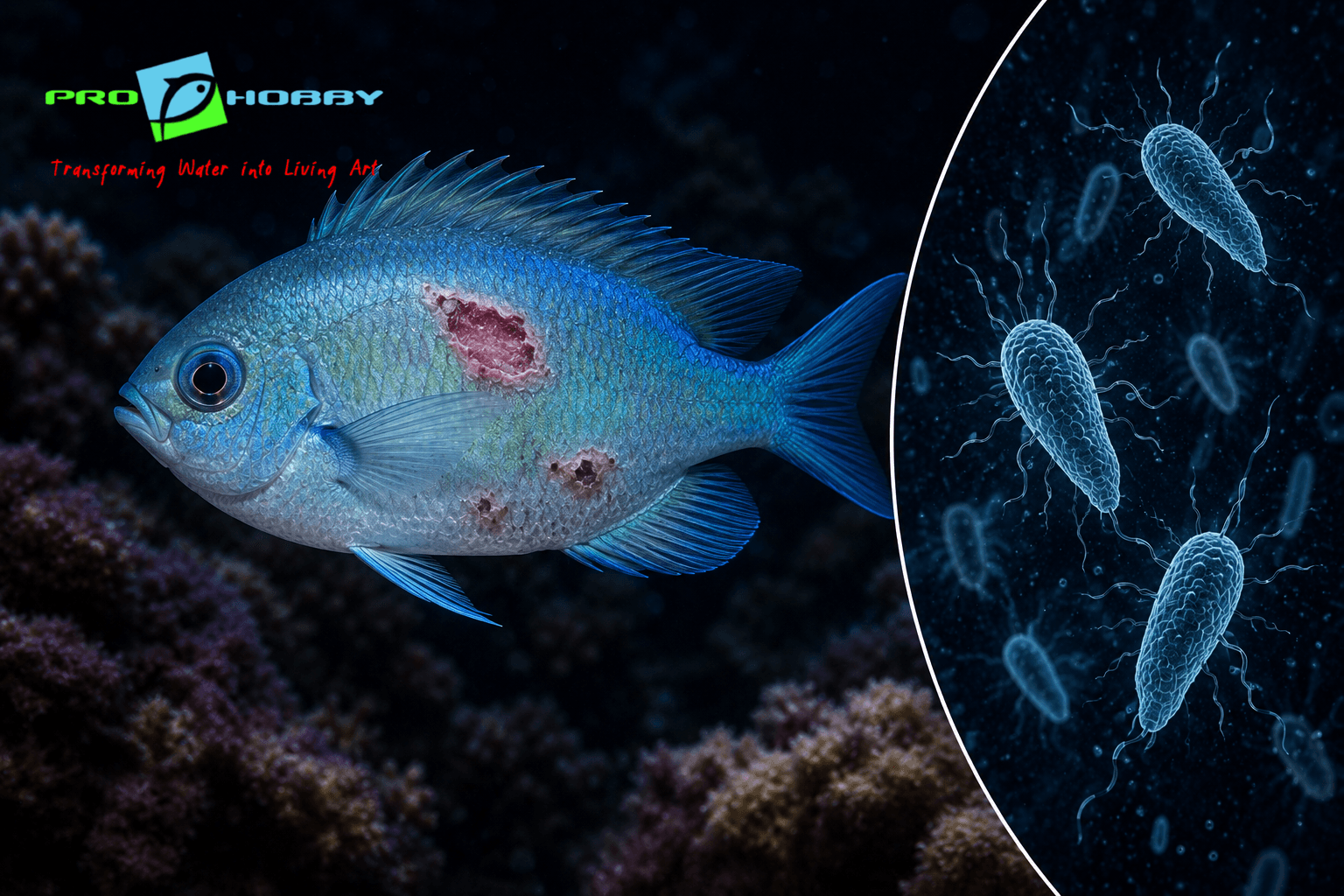
Every disease covered elsewhere in this marine cluster shares a quiet common thread that deserves its own dedicated treatment: Cryptocaryon, Amyloodinium, Brooklynella, and Uronema all damage the skin, gill, or mucosal barrier that would otherwise keep marine bacteria out of a fish’s body — and waiting behind every one of those wounds is the genus Vibrio, the dominant opportunistic bacterial pathogen of the marine environment and one of the fastest-moving killers in the entire hobby once it establishes systemically. A fish that appears to be winning its fight against a parasitic infection can deteriorate and die within hours from a bacterial complication that was never separately diagnosed, because the visible parasite was assumed to be the whole story. Understanding marine bacterial infection as its own distinct clinical entity — not just a footnote to whatever parasitic disease came first — is essential to actually saving fish through the full course of an illness rather than only its opening act.
Table of Contents
- Vibrio — The Marine Environment’s Default Opportunist
- Why Marine Bacterial Infection Is Almost Always Secondary
- The Speed Problem — Why Marine Bacterial Disease Outpaces Freshwater Equivalents
- Symptoms — Localised, Ulcerative and Systemic Presentations
- Marine Septicaemia — Recognising the Emergency
- Differential Diagnosis Against Every Other Marine Disease in This Cluster
- Diagnosis — Culture, Gram Staining and Clinical Judgement
- Antibiotic Selection for Marine Fish — Why Freshwater Dosing Doesn’t Transfer
- Treatment Protocol — Step by Step
- The Reef-Safety Problem — Antibiotics and Biological Filtration
- Prevention — Breaking the Chain at the Primary Wound
- Species and System Risk Factors
- India — Practical Realities
- Frequently Asked Questions
1. Vibrio — The Marine Environment’s Default Opportunist
Vibrio is a genus of gram-negative bacteria that is, without exaggeration, ubiquitous in marine and estuarine environments worldwide, present in essentially every marine aquarium regardless of how well it is maintained, in exactly the same way that Aeromonas and Pseudomonas are permanently present in freshwater systems and covered throughout the freshwater side of this disease library, from fin rot to septicaemia. Several Vibrio species are specifically implicated in ornamental marine fish disease, most notably Vibrio anguillarum, Vibrio alginolyticus, and Vibrio vulnificus, each with somewhat different virulence characteristics but a broadly shared clinical picture and treatment approach for aquarium purposes.
Like their freshwater counterparts, Vibrio species are not something a marine aquarium can be kept free of — they are a permanent resident of the system’s microbial background, held in check under normal circumstances by intact fish skin, functional mucus barriers, and healthy immune function. Vibriosis develops when that containment fails, not when the bacteria are somehow newly introduced.
2. Why Marine Bacterial Infection Is Almost Always Secondary
This is the organising principle of the entire guide, and it mirrors precisely the logic established for freshwater bacterial disease throughout this library: a healthy fish with intact skin does not develop Vibriosis, regardless of how much Vibrio is present in the surrounding water. Bacterial infection requires an entry point, and in marine fish that entry point is created by exactly the conditions covered elsewhere in this cluster:
- Trophont attachment and departure sites from Cryptocaryon or Amyloodinium infestation, where the parasite’s feeding has already compromised the epithelial barrier
- The diffuse epithelial destruction and excessive mucus disruption of Brooklynella
- Ulcerative lesions from Uronema infection, which — as established in that guide — frequently already carry a bacterial component by the time they are noticed
- Physical injury from aggression, handling, transport, or collision with tank décor
- Chronic skin and fin damage from sustained poor water quality or the stress-immunity cascade described throughout this library
The clinical implication that follows directly from this: treating a fish’s primary parasitic diagnosis successfully does not automatically mean the fish is safe. Every wound that parasite left behind is a potential Vibrio entry point, and monitoring for secondary bacterial complication should continue through the full recovery period, not stop once the primary symptoms resolve — precisely the same “second wave” vigilance recommended for Uronema, and for exactly the same underlying reason.
3. The Speed Problem — Why Marine Bacterial Disease Outpaces Freshwater Equivalents
Marine bacterial disease, once established systemically, is capable of progressing with a speed that rivals or exceeds the fastest freshwater bacterial emergencies covered in this library. Freshwater septicaemia — itself already an emergency requiring same-day treatment — provides the closest freshwater analogue, but several factors specific to marine systems and marine Vibrio biology can compress the timeline further: the generally warmer temperatures at which most marine fish are kept relative to some freshwater community setups accelerate bacterial replication rates; certain Vibrio species produce particularly potent toxins and tissue-destructive enzymes; and marine fish, having evolved in an environment where Vibrio exposure is a constant, can nonetheless deteriorate extremely rapidly once their specific defences at a wound site are overwhelmed.
The practical consequence: any fish showing the emergency signs described in Section 5 needs same-day, not same-week, intervention, following exactly the urgency principle established for freshwater septicaemia but applied with, if anything, greater vigilance given the marine-specific acceleration factors above.
4. Symptoms — Localised, Ulcerative and Systemic Presentations
Localised infection at a wound site: Reddening, inflammation, and mild tissue erosion confined to the area of pre-existing damage — a healing parasite attachment site, a physical wound, or a Uronema lesion with secondary bacterial colonisation as described in that guide.
Progressive ulcerative disease: Expanding areas of tissue erosion, sometimes with a ragged, discoloured margin, occasionally accompanied by a cloudy or cottony surface appearance that can create diagnostic overlap with fungal or Uronema presentations, covered in Section 6.
Fin and tail rot: A marine presentation essentially analogous to freshwater fin rot — progressive erosion of fin membrane from the edge inward, caused by the same class of opportunistic gram-negative bacteria exploiting fin damage from aggression, poor water quality, or prior parasitic disease.
Haemorrhagic streaking and red patches: Visible reddening beneath the scales or across body areas from vascular damage — the marine equivalent of the haemorrhagic presentation covered in the freshwater septicaemia guide, and an equally serious warning sign here.
Exophthalmia (popeye): Marine bacterial infection can produce eye protrusion through the same general mechanism covered in the freshwater popeye guide — localised infection behind the eye in unilateral cases with a reasonable prognosis if treated promptly, or as part of broader systemic disease in bilateral cases with a considerably more guarded outlook.
Systemic signs: Loss of equilibrium, rapid overall deterioration, loss of appetite, and darkening or fading of colour as generalised illness indicators once infection has moved beyond a localised site.
5. Marine Septicaemia — Recognising the Emergency
When Vibrio infection moves from a localised wound into the bloodstream, the resulting systemic infection — marine septicaemia — is a genuine emergency requiring immediate recognition and same-day treatment, following the identical urgency logic established in the freshwater septicaemia guide but with the accelerated timeline discussed in Section 3.
Recognise the emergency by: rapid onset of haemorrhagic streaking or diffuse reddening across the body, sudden and severe lethargy or loss of equilibrium in a fish that was showing only localised symptoms hours or a day earlier, and any combination of the localised symptoms in Section 4 that appears to be worsening rapidly rather than progressing at the gradual pace typical of an uncomplicated wound.
Do not wait for confirmation before beginning treatment. As with every other emergency covered in this library, the asymmetric cost of unnecessary early antibiotic treatment versus delayed necessary treatment in a genuinely systemic case strongly favours immediate action once the emergency pattern is recognised.
6. Differential Diagnosis Against Every Other Marine Disease in This Cluster
This is the section that ties the entire marine disease cluster together, because Vibriosis sits in diagnostic overlap with essentially every other condition covered elsewhere in this library.
| Feature | Vibriosis (bacterial) | Uronema (opportunistic ciliate) | Brooklynella | Fungal/Saprolegnia-type |
|---|---|---|---|---|
| Onset speed | Fast — hours to days once systemic | Variable, can be deceptively gradual | Very fast — under 24 hours | Slower — days |
| Lesion character | Reddened, inflamed, ulcerative, may be haemorrhagic | Ulcerative, often at pre-existing damage site | Diffuse mucus, sloughing, whole-body | Fluffy, three-dimensional, extending outward |
| Response to antibiotics | Effective | Ineffective alone (may help secondary bacterial component) | Ineffective (formalin is first-line) | Ineffective |
| Response to antiparasitics | Ineffective | Effective (formalin) | Effective (formalin) | Ineffective |
| Typically follows | Any wound or parasitic damage | Wound or post-outbreak recovery period | Direct contact, high-density holding | Wound sites specifically |
The critical practical point: the two most common misdiagnosis pairs are Vibriosis-as-Uronema and Vibriosis-as-fungal, both of which lead to antiparasitic or antifungal treatment being applied to a condition that requires antibiotics instead. When a lesion is not responding to formalin or antiparasitic treatment within several days, or when reddening and inflammation are prominent features rather than the paler ulceration more typical of Uronema, a bacterial component should be assumed and antibiotic treatment initiated, ideally alongside continued antiparasitic treatment where a primary parasitic disease is also confirmed or suspected, rather than treating the two as mutually exclusive diagnoses. Full biology and treatment for the comparison conditions in this table: Uronema marinum — Complete Guide and Brooklynella hostilis — Complete Guide.
Two further conditions round out the full respiratory and tissue-erosion differential relevant to Vibriosis. Where the dominant symptom is respiratory distress with no lesion at all, bacterial gill disease should be considered — a related but distinct condition affecting gill tissue specifically, also bacterial in nature but managed primarily through water quality correction rather than the wound-focused antibiotic and topical treatment approach covered here. Where erosion is slow, chronic, and confined to the head and lateral line in a tang or marine angelfish rather than the faster, more inflamed presentation typical of Vibriosis, Head and Lateral Line Erosion — a non-infectious condition entirely — is the more likely explanation.
7. Diagnosis — Culture, Gram Staining and Clinical Judgement
Definitive Vibrio identification requires bacterial culture and species identification, generally beyond the reach of home hobbyist diagnostics and typically reserved for veterinary or specialist laboratory settings, particularly relevant for valuable breeding stock or in cases where treatment failure demands a more precise answer.
For practical hobbyist purposes, clinical diagnosis rests on the pattern established in Sections 4 through 6: reddened, inflamed, ulcerative lesions — particularly at a known wound or prior parasitic attachment site — that are progressing over a timescale of hours to a few days, not responding to antiparasitic treatment where that has been tried, and showing the inflammatory rather than the paler, more gradual character typical of Uronema. This clinical picture is sufficient grounds to begin antibiotic treatment without waiting for laboratory confirmation, given the time-sensitivity established throughout this guide.
8. Antibiotic Selection for Marine Fish — Why Freshwater Dosing Doesn’t Transfer
This is a genuinely important and frequently overlooked practical point: the gram-negative antibiotics used throughout the freshwater side of this disease library — kanamycin sulphate and nitrofurazone, covered repeatedly from fin rot through scale rot — remain broadly relevant in marine settings, since Vibrio is gram-negative and shares general susceptibility patterns with the freshwater Aeromonas and Pseudomonas these antibiotics target. However, marine-specific factors mean dosing and product selection deserve careful attention rather than simply assuming a freshwater protocol transfers unchanged: marine salinity affects the stability and bioavailability of some antibiotic formulations, some Vibrio strains show resistance patterns distinct from freshwater gram-negative opportunists, and the reef-safety considerations in Section 10 add a layer of system-level complexity that most freshwater treatment scenarios do not carry.
Marine-formulated antibiotic products, where available, and product labelling specifically validated for marine use are preferable to assuming direct freshwater-to-marine dosing equivalence. Where marine-specific product guidance is unavailable, veterinary consultation for valuable stock is a reasonable additional step given the stakes involved.
9. Treatment Protocol — Step by Step
Step 1: Isolate immediately in a bare hospital tank. As with every bacterial condition covered throughout this library, isolation protects both the affected fish (allowing controlled dosing) and any tank mates from a potentially spreading bacterial population in shared water.
Step 2: Begin gram-negative antibiotic treatment per Section 8, without waiting for laboratory confirmation given the emergency-pattern recognition established in Section 5.
Step 3: Address any concurrent primary condition. If Vibriosis has developed secondary to an active or recently resolved Cryptocaryon, Amyloodinium, Brooklynella, or Uronema infection, continue or complete appropriate treatment for that primary condition alongside the antibiotic course rather than assuming one diagnosis excludes the other.
Step 4: Apply topical treatment to accessible lesions — diluted povidone-iodine directly to the wound site, following the same wound-care principle established in the scale rot guide, under brief sedation if handling is required.
Step 5: Monitor water quality closely throughout treatment, given that antibiotics disrupt biological filtration exactly as covered throughout this library — test ammonia and manage with water changes rather than relying on an established biofilter during the treatment course. Ammonia in Aquariums.
Step 6: Continue treatment for a minimum of 7–10 days, and several days beyond visible resolution of symptoms, following the same duration principle established for every gram-negative bacterial condition throughout this library — stopping treatment as soon as visible improvement appears is a common cause of relapse.
10. The Reef-Safety Problem — Antibiotics and Biological Filtration
Antibiotic treatment for Vibriosis carries the same fundamental reef-incompatibility problem established for copper and hyposalinity treatment of Cryptocaryon and Amyloodinium: most antibiotics are not safe for invertebrates and corals at treatment concentrations, and antibiotics are also broadly disruptive to the beneficial bacterial populations that maintain both fish-only and reef biological filtration. This means, exactly as established throughout this cluster, that antibiotic treatment for Vibriosis in a fish that lives in a display tank containing corals or invertebrates requires removing the affected fish to a dedicated treatment system rather than dosing the display directly — reinforcing, once again, why the dedicated quarantine and hospital tank infrastructure discussed throughout this entire marine disease cluster is not an optional convenience but a structural requirement of responsible marine fishkeeping.
11. Prevention — Breaking the Chain at the Primary Wound
Because Vibriosis is overwhelmingly a secondary condition, as established in Section 2, prevention is largely inherited from correct management of everything else covered in this cluster rather than requiring a separate, Vibrio-specific prevention strategy:
- Prompt and complete treatment of Cryptocaryon, Amyloodinium, Brooklynella, and Uronema, closing the wound-based entry points those conditions leave behind
- Minimising physical injury from aggression and décor
- Maintaining excellent water quality to support the immune function that keeps background Vibrio populations contained
- Close monitoring through the full recovery period from any primary disease, not just its acute phase, following the same “second wave” vigilance established for Uronema
- Prompt topical treatment of any physical wound, regardless of cause, before bacterial colonisation has the opportunity to establish
12. Species and System Risk Factors
As with Uronema, Vibriosis risk is better predicted by individual fish condition and system management than by species susceptibility, since Vibrio is a ubiquitous opportunist rather than a pathogen with particular host preferences. Fish recovering from any primary marine disease, fish with unresolved aggression-related injury, fish in systems with elevated organic load, and fish experiencing significant transport or handling stress are all at elevated risk regardless of species — precisely the same risk profile established for Uronema in the preceding guide, reflecting the shared opportunistic logic underlying both conditions.
13. India — Practical Realities
The general marine sourcing, stress, and post-treatment monitoring considerations established throughout the Cryptocaryon, Amyloodinium, Brooklynella, and Uronema India sections apply equally to Vibriosis risk. Given the emphasis in Section 8 on marine-specific antibiotic product selection, Indian marine hobbyists should specifically verify product marine-suitability rather than assuming freshwater aquarium antibiotics — more widely available and commonly stocked in the Indian retail market — transfer directly, and should maintain marine-validated antibiotic stock as standard hospital-kit inventory alongside the copper and formalin supplies discussed elsewhere in this cluster. Aquarium Shop Delhi NCR — What a Specialist Looks Like covers relevant supplier evaluation questions. For reef keepers, the same reef-incompatibility logic covered in Section 10 applies equally to coral-specific treatment decisions, such as those needed against marine flatworms — every treatment in this cluster carries a system-wide risk that must be actively managed rather than assumed away.
Frequently Asked Questions
Is Vibriosis contagious between fish? Vibrio is present as a background organism in virtually every marine system, similar to Uronema, rather than being a newly introduced contagion. However, a fish actively shedding high bacterial loads from an advanced infection can elevate the ambient bacterial pressure other fish in shared water are exposed to, meaning isolation of an actively infected fish is still protective for tank mates even though the bacteria were already present in the system beforehand.
Why isn’t my marine fish’s wound healing with antiparasitic treatment? If a lesion is not responding to formalin or other antiparasitic treatment within several days, and particularly if it shows reddening, inflammation, or a spreading, discoloured margin rather than the paler ulceration typical of Uronema, a bacterial component is likely and antibiotic treatment should be initiated rather than continuing antiparasitic treatment alone.
Can I treat marine bacterial infection in my reef tank? No, for the same reasons copper and hyposalinity cannot be used in a reef display. Most antibiotics are unsafe for corals and invertebrates and disrupt biological filtration. Affected fish should be moved to a dedicated hospital tank for antibiotic treatment.
How fast can marine bacterial infection kill a fish? Systemic marine bacterial infection (marine septicaemia) can progress from localised symptoms to a life-threatening systemic emergency within hours to a day or two, a timeline that can match or exceed even freshwater septicaemia given marine-specific acceleration factors. Any fish showing rapid worsening, haemorrhagic streaking, or sudden severe lethargy requires same-day antibiotic treatment.
Do freshwater aquarium antibiotics work for marine bacterial infections? The same general antibiotic classes (gram-negative targeted antibiotics like kanamycin and nitrofurazone) are broadly relevant since Vibrio shares general susceptibility patterns with freshwater gram-negative opportunists, but marine-specific dosing, formulation stability in saltwater, and resistance pattern differences mean marine-validated products are preferable to direct freshwater-to-marine substitution where available.