
By ProHobby™ | Ecological Systems Authority
Dissolved oxygen is the aquarium parameter that kills fish most silently. Unlike ammonia, which is tested regularly and produces symptoms within hours, or pH, which is tracked as a routine measurement, dissolved oxygen is almost never measured by hobbyists. It is invisible, it requires specialised equipment to test accurately, and its depletion produces symptoms — fish gasping at the surface, lethargy, reduced appetite — that are consistently misdiagnosed as disease, ammonia toxicity, or “sudden mysterious death.” For dissolved oxygen in the context of all measurable water parameters as an integrated system, see the Complete Water Chemistry Guide.
Yet dissolved oxygen depletion is, after ammonia toxicity in uncycled tanks, the most common acute cause of fish mortality in home aquariums. It peaks in summer when water temperature rises, oxygen saturation capacity falls, fish metabolism accelerates, and power cuts interrupt aeration — all simultaneously.
This article covers dissolved oxygen completely: the chemistry, the fish physiology, the day-night dynamics that make mornings dangerous in planted tanks, the critical temperature relationship, how to assess and improve oxygen levels without specialised equipment, and the specific Indian conditions that make this parameter particularly important.
Table of Contents
- What Dissolved Oxygen Is and Why It Matters
- How Fish Extract Oxygen — The Gill Physiology
- The Four Factors That Control DO Levels
- The Temperature-Oxygen Relationship — The Critical Problem
- Day-Night Oxygen Dynamics — Why Morning Is the Danger Period
- Surface Agitation — The Primary Oxygen Delivery Mechanism
- Tank Design and Oxygen — Why Shape and Depth Matter
- Biological Oxygen Demand — How Stocking and Load Affect DO
- Planted Tanks — Oxygen Producer and Consumer
- Diagnosing Oxygen Problems
- How to Increase Dissolved Oxygen
- Power Cuts and Oxygen Emergencies
- Measuring Dissolved Oxygen
- India and Delhi NCR — The Summer Oxygen Problem
- Frequently Asked Questions
1. What Dissolved Oxygen Is and Why It Matters
Dissolved oxygen (DO) is molecular oxygen (O₂) that has entered the water from the atmosphere and dissolved into solution. Unlike the oxygen bound in water molecules (H₂O), which fish cannot use, dissolved oxygen is the free O₂ that fish extract through their gills for cellular respiration.
Water holds far less oxygen than air. At 25°C, fully oxygen-saturated water contains approximately 8.3 mg/L (ppm) of dissolved oxygen. Air at the same temperature contains approximately 270 mg/L equivalent — over 30 times more oxygen per litre. This means fish are working much harder to extract oxygen from water than air-breathing animals do from air, and any reduction in dissolved oxygen availability rapidly becomes physiologically significant.
The acceptable dissolved oxygen range for most tropical aquarium fish is 6–8 mg/L. Below 5 mg/L, most fish begin showing stress. Below 4 mg/L, many species enter acute respiratory distress. Below 3 mg/L, fish deaths begin. Coldwater species (goldfish, koi) require even higher DO because their physiology is adapted to colder, more oxygen-rich water.
The invisibility of dissolved oxygen is its most dangerous property. Crystal clear water can have critically low DO. Fish can appear normal at midday and be in oxygen crisis at 5 AM. A tank with excellent water chemistry (zero ammonia, correct pH, appropriate parameters) can have lethal oxygen levels and the hobbyist has no visual indication until fish are gasping or dead.
2. How Fish Extract Oxygen — The Gill Physiology
Fish extract dissolved oxygen by pumping water continuously across their gill lamellae — the thin, richly vascularised structures where gas exchange occurs. Blood flows through the lamellae in the opposite direction to water flow (countercurrent exchange), maximising the efficiency of oxygen extraction.
At maximum efficiency under ideal conditions, fish extract approximately 80% of the dissolved oxygen in water passing their gills. In stressed conditions, this efficiency falls. At low DO concentrations, fish compensate by increasing ventilation rate — pumping water over gills faster, which is visible as rapid gill movement.
Ammonia and gill damage significantly impair oxygen extraction. Fish that have experienced ammonia exposure develop gill hyperplasia — thickening of the gill lamellae that reduces the surface area available for gas exchange. These fish gasp at the surface not because oxygen is absent from the water but because their damaged gills cannot extract what is present. This is a critical diagnostic distinction covered in Ammonia in Aquariums — Spikes, Poisoning and How to Lower It. Incorrect filter cleaning kills the biofilm community that consumes oxygen in the filter — the safe protocol is in How to Clean an Aquarium Filter Without Killing Bacteria.
High CO₂ interferes with oxygen uptake. When CO₂ is elevated (from overnight biological respiration, excessive CO₂ injection, or inadequate surface agitation), it reduces blood pH, which shifts the oxygen-haemoglobin binding curve, reducing oxygen delivery to tissues even at adequate dissolved oxygen concentrations. This is rare in typical community tank conditions but relevant in heavily planted tanks with CO₂ injection running overnight.
3. The Four Factors That Control DO Levels
Temperature. The most important factor. Cold water holds more dissolved oxygen than warm water. This relationship is directly relevant to every decision about aquarium management in warm climates. As temperature rises, maximum DO capacity falls — see Section 4.
Surface agitation. Oxygen enters the water primarily through the air-water interface. Surface agitation increases the surface area in contact with air, increases the rate of oxygen exchange, and drives off excess CO₂. A still water surface with no agitation exchanges oxygen slowly. A broken, rippling, or turbulent surface exchanges oxygen rapidly. This is why aeration is the primary tool for increasing dissolved oxygen — not oxygen tablets or pumped air per se, but the surface agitation these methods create.
Biological oxygen demand (BOD). Every living organism in the aquarium consumes oxygen continuously. Fish, plants (during dark periods), bacteria in the filter and substrate, and decomposing organic matter all create oxygen demand. The more organisms and organic matter, the faster oxygen is consumed. If oxygen consumption rate exceeds the replenishment rate through surface exchange, DO falls.
Oxygen production by plants. During the light period, photosynthesising plants and algae produce oxygen as a byproduct of CO₂ fixation. In a heavily planted, well-lit tank, plant oxygen production can significantly exceed biological demand during the day, producing supersaturated conditions. At night, this production stops — see Section 5.
4. The Temperature-Oxygen Relationship — The Critical Problem
The relationship between water temperature and dissolved oxygen saturation capacity is one of the most important concepts in summer aquarium management.
DO saturation capacity by temperature:
| Water Temperature | Maximum DO (mg/L at full saturation) |
|---|---|
| 20°C | 9.1 mg/L |
| 22°C | 8.7 mg/L |
| 24°C | 8.4 mg/L |
| 26°C | 8.1 mg/L |
| 28°C | 7.8 mg/L |
| 30°C | 7.5 mg/L |
| 32°C | 7.2 mg/L |
| 34°C | 7.0 mg/L |
| 36°C | 6.7 mg/L |
At 36°C, even fully saturated water holds only 6.7 mg/L — near the lower acceptable limit for many fish before any biological demand is applied. In a stocked tank at 36°C, actual DO will be below saturation because fish and bacteria are continuously consuming oxygen. Real DO in a heavily stocked tank at 36°C may be 4–5 mg/L — approaching or below acute stress thresholds.
The compound summer problem:
As temperature rises:
- Maximum oxygen saturation capacity falls
- Fish metabolism accelerates — more oxygen consumed per fish per hour
- Bacterial decomposition accelerates — more oxygen consumed by BOD
- Nitrification accelerates — more oxygen consumed by filter bacteria
All four effects occur simultaneously and compound each other. A tank that maintained comfortable 7+ mg/L DO at 26°C in November may fall to 4–5 mg/L DO at 34°C in May without any change in stocking or aeration. This is the mechanism behind the “fish die in summer for no reason” pattern that is one of the most common complaints in Indian aquarium keeping.
The complete summer aquarium management framework is in Aquarium Water Temperature in Indian Summer.
5. Day-Night Oxygen Dynamics — Why Morning Is the Danger Period
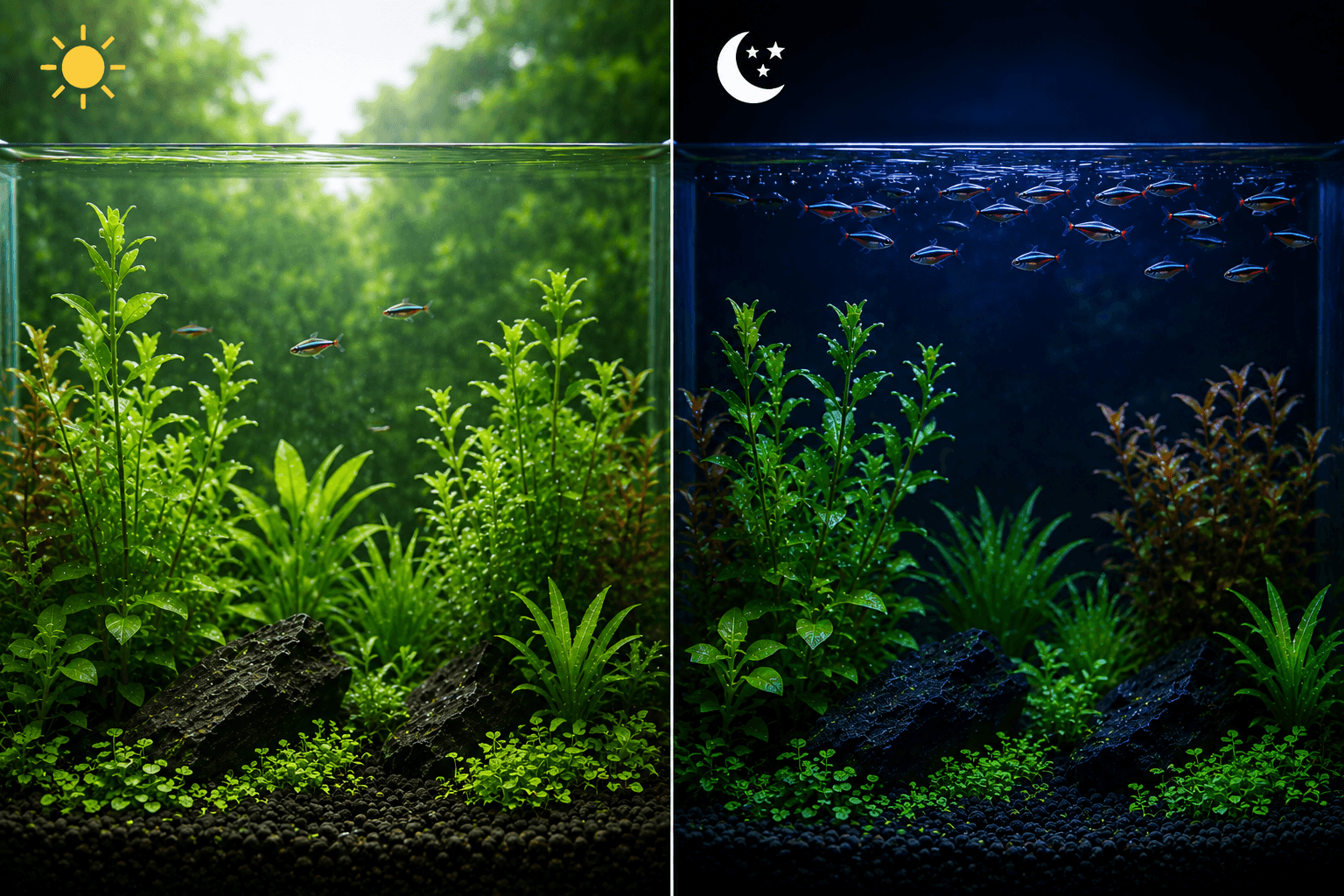
In any aquarium with aquatic plants or algae, dissolved oxygen follows a predictable daily cycle that makes early morning the most dangerous period for oxygen depletion.
During the light period: Photosynthesising plants consume CO₂ and produce O₂. In a heavily planted, well-lit tank, plant oxygen production significantly exceeds biological demand from fish and bacteria during peak photosynthesis. DO may reach supersaturation (above 100% saturation) — visually apparent as oxygen bubbles on plant surfaces (“pearling”). This is the healthy daytime planted tank condition.
At lights-off: Photosynthesis stops immediately. All organisms — fish, plants, bacteria in filter and substrate, decomposing matter — continue consuming oxygen throughout the night. The oxygen production that was counteracting biological demand is gone. DO begins falling.
By dawn (3 AM–6 AM): In a heavily planted, densely stocked tank, overnight oxygen consumption may have reduced DO by 2–4 mg/L from the evening peak. Fish that were in well-oxygenated water at 9 PM may be in stressful or borderline dangerous DO at 5 AM. This is when fish most commonly exhibit morning gasping — hovering at the surface, rapid gill movement, reduced activity — that resolves after lights come on and plants resume photosynthesis.
The diagnostic importance: Morning gasping that resolves within 1–2 hours of lights-on, and recurs every morning, is virtually diagnostic for overnight oxygen depletion. This is not disease, not ammonia, not pH — it is oxygen dynamics in a biologically active planted tank. The relationship between overnight oxygen and the specific symptoms it produces is examined in Fish Gasping at the Surface of an Aquarium.
Management: Ensure surface agitation runs through the night even if CO₂ injection stops. In dense planted tanks, increase night-time aeration — a second airstone or increased filter return angle during dark hours. This reduces overnight CO₂ accumulation and maintains gas exchange during the period when plant oxygen production is absent. The pH consequences of overnight CO₂ accumulation — and why morning pH is always lower than evening pH in planted tanks — are covered in Aquarium pH — Complete Diagnosis and Fix Guide. Overnight CO₂ accumulation also consumes KH buffering capacity, contributing to long-term KH depletion in CO₂-injected planted tanks — the KH-CO₂ relationship is in Aquarium KH — Carbonate Hardness.
6. Surface Agitation — The Primary Oxygen Delivery Mechanism
Surface agitation is the most important and most controllable factor in dissolved oxygen management. Understanding how it works prevents both under-aeration (insufficient DO delivery) and over-aeration (excessive CO₂ loss that harms planted tanks).
The mechanism: Oxygen diffusion from air to water occurs at the air-water interface. The rate of diffusion depends on the concentration gradient (more oxygen in air than water drives diffusion into water), the interface area (larger area = faster diffusion), and the rate of water movement at the interface (agitation constantly presents fresh water to the surface, maintaining the concentration gradient).
A completely still water surface exchanges oxygen slowly. A rippling, moving surface exchanges oxygen much faster. Breaking the water surface — through a filter return, airstone, powerhead, or spray bar — increases both interface area and the rate of water turnover at the surface.
What creates effective surface agitation:
Filter return/outlet: Angling the filter return toward the water surface or at a downward angle that creates surface rippling is the simplest aeration method. Hang-on-back filters naturally agitate the surface through their return flow.
Air pumps and airstones: The bubbles from an airstone carry some oxygen as they rise, but their primary benefit is the surface agitation created when bubbles break the surface. A single airstone in a large tank provides less surface agitation than the same pump connected to a longer air diffuser along the tank bottom, which creates more bubbles across more of the tank floor.
Spray bars: Long, perforated tubes along the water surface create broad, gentle surface agitation without strong current. Useful in tanks with current-sensitive species.
Powerheads aimed at the surface: Create directed water movement and surface agitation.
The CO₂ trade-off in planted tanks: Surface agitation drives off CO₂ as well as replenishing O₂. In CO₂-injected planted tanks, excessive surface agitation wastes injected CO₂ — the CO₂ dissolves in water and then immediately off-gases from the agitated surface before plants can use it. The balance: enough surface agitation for adequate oxygen exchange, without so much that CO₂ cannot accumulate to photosynthetically useful concentrations.
In CO₂-injected planted tanks: moderate surface agitation during the light period (just enough to prevent film formation and maintain oxygen), with increased agitation after CO₂ turns off in the evening and through the night.
7. Tank Design and Oxygen — Why Shape and Depth Matter
Tank geometry has a direct effect on oxygen dynamics that most beginner guides ignore.
Surface area determines oxygen exchange capacity. The air-water interface is where oxygen enters the water. A tank with more surface area relative to its volume exchanges oxygen faster. This makes wider, shallower tanks inherently better oxygenated than narrow, tall tanks of the same volume.
Practical comparison:
- 60-litre standard (60×30×33cm): surface area 1,800 cm²
- 60-litre tall/column (30×30×67cm): surface area 900 cm²
The column tank has half the oxygen exchange surface despite identical volume. With identical stocking and aeration, the column tank operates at meaningfully lower DO, especially at night or in summer.
Depth and oxygen stratification: In tanks with insufficient circulation, dissolved oxygen can stratify — higher concentrations near the surface (close to the air-water interface) and lower concentrations near the substrate where biological oxygen demand is highest. Fish near the bottom in poorly circulated tanks may experience low DO conditions while the surface appears fine.
Good circulation (filter return directed to move water throughout the tank volume) prevents stratification. Check whether filter flow is creating full-tank circulation or a short-circuit loop between intake and return that leaves dead zones.
Overstocking tall, narrow tanks is particularly risky for oxygen management — less surface area, more oxygen demand, and greater stratification risk combine to create marginal DO conditions that become critical during summer or power cuts.
8. Biological Oxygen Demand — How Stocking and Load Affect DO
Biological oxygen demand (BOD) is the total rate at which oxygen is consumed by all biological processes in the tank. Understanding BOD helps manage the oxygen budget — ensuring supply consistently exceeds demand.
Sources of oxygen demand:
Fish respiration: The primary controllable BOD source. More fish, larger fish, and warmer water all increase fish oxygen consumption. Larger fish are disproportionately demanding — a single 10cm fish consumes more oxygen than ten 1cm fish because body mass (and therefore respiration) scales non-linearly with length.
Filter bacteria: Nitrifying bacteria in the filter and substrate are strict aerobes consuming oxygen continuously. A heavily loaded filter with significant nitrifying activity consumes meaningful oxygen — particularly relevant in the immediate post-filter-clean period when bacterial die-back briefly reduces this demand before recovery. The nitrifying biofilm communities in the filter and substrate that consume oxygen continuously — their structure, lifecycle, and management — are examined in Biofilms — The Invisible Engine of Every Aquarium.
Decomposing organic matter: Uneaten food, dead plant matter, faeces, and any decomposing organic material consumes oxygen through heterotrophic bacterial decomposition. A heavily organically loaded tank has significantly higher BOD than a clean tank with identical stocking.
Plant respiration (at night): Plants consume oxygen through cellular respiration at all times. During the day, photosynthetic oxygen production exceeds respiratory consumption. At night, respiratory consumption continues without photosynthetic offset.
Managing BOD:
Use the Aquarium Stocking Calculator to ensure stocking is within sustainable limits that the available oxygen and filtration can support — particularly for the summer months when oxygen capacity is reduced.
Feed conservatively. Every gram of uneaten food that decomposes in the tank adds directly to BOD. Regular substrate vacuuming removes accumulated organic matter that would otherwise continue creating oxygen demand. See How Often to Feed Fish for calibrated feeding guidance.
In summer, reduce stocking through strategic management — if overcrowding is a concern, separate some fish to a secondary tank during peak summer months.
9. Planted Tanks — Oxygen Producer and Consumer
Planted tanks have more complex oxygen dynamics than fish-only tanks because plants both produce and consume oxygen, with the balance shifting dramatically between day and night.
During light hours — net oxygen production: In a well-lit, CO₂-supplemented planted tank with healthy plants, photosynthetic oxygen production typically exceeds total biological consumption by a significant margin. DO can reach 110–130% saturation (“supersaturation”). The visible pearl of oxygen bubbles on plant leaves is the excess oxygen escaping from supersaturated water. This daytime condition is comfortable and beneficial for fish.
The complete framework for how light, CO₂, and nutrients interact to determine whether plants are photosynthesising — and therefore producing oxygen — at their maximum capacity is in Nutrients, CO₂ and Algae — The Balancing Act.
During dark hours — net oxygen consumption: When photosynthesis stops, the full biological oxygen demand continues unmet. In a heavily planted tank with dense substrate bacteria and biofilm communities, nighttime oxygen consumption may be higher per litre than in a comparable fish-only tank because of the additional microbial biomass in the plant root zone.
The intensity trade-off: Higher light intensity drives faster plant growth and more daytime oxygen production — but also creates larger day-night swings because the biological community supporting that growth (filter bacteria, substrate bacteria, root zone microbes) has a larger total nighttime oxygen demand. A high-intensity planted tank may peak at 130% DO saturation by afternoon and drop to 70–80% by dawn — a safe range. But the same tank with insufficient surface agitation overnight may drop to 50% or below.
CO₂ injection and overnight oxygen: CO₂ injection is timed to turn off before lights-off, preventing overnight CO₂ accumulation in the tank. However, the switch from CO₂-on (daytime, plants photosynthesising) to CO₂-off (night, full biological consumption) is the most challenging oxygen period. Increase surface agitation when CO₂ turns off in the evening to promote gas exchange through the night.
Low-light planted tanks have smaller day-night oxygen swings — less production during the day, proportionally less demand at night — making them less vulnerable to overnight depletion than high-growth setups.
10. Diagnosing Oxygen Problems
Classic oxygen depletion presentation: Fish gather at the water surface, particularly near any surface agitation (filter return, airstone). Gill movement is rapid and visible. Fish are less active than normal, particularly in the early morning. Fish near the surface improve when you turn on a light (plants resume photosynthesis) or increase surface agitation (improving gas exchange). These symptoms appear at specific times — most commonly early morning — and improve through the day.
Distinguish from other surface-gasping causes:
Ammonia toxicity: Surface gasping that persists through the day and does not improve with increased aeration. Ammonia damages gills regardless of water oxygen level. Test ammonia — if positive, ammonia is the primary cause.
Nitrite toxicity (brown blood disease): Fish gasp despite adequate surface agitation because nitrite converts haemoglobin to methaemoglobin, which cannot carry oxygen. Fish suffocate in well-oxygenated water. No improvement with increased aeration; gills may appear brownish on close inspection.
Gill disease/parasites: Surface gasping without timing pattern (not specifically morning), may not improve with aeration. Fish may flash or scratch gills. See Quarantine vs Medication in Aquariums for the diagnostic framework.
Film on water surface: A protein or oil film on an otherwise still water surface can impede gas exchange. Visible as a shimmering or dull film. Remove with a paper towel dragged across the surface, then address the source (usually overfeeding or insufficient surface agitation).
The morning test: If symptoms are worst at the first observation of the day (before lights on) and improve after lights have been on for 1–2 hours, overnight oxygen depletion is the most likely diagnosis. Increase surface agitation overnight and reassess. The systems-level framework for understanding how oxygen depletion connects to the broader cascade of aquarium failure is in Why Aquariums Fail — A Systems-Level Diagnosis.
11. How to Increase Dissolved Oxygen
Increase surface agitation — immediate effect:
Add or increase an airstone. The bubbles contribute some direct oxygen but the primary benefit is surface agitation. Place airstones where they create maximum surface movement, not just midwater columns.
Reangle the filter return to break the water surface. The simplest modification in most tank setups.
Add a spray bar that distributes water movement across the surface rather than one point.
Use a powerhead positioned to create surface ripples.
Reduce temperature — significant effect in summer:
Every 1°C of cooling increases maximum DO by approximately 0.1–0.2 mg/L and reduces metabolic demand. In Indian summer, even modest temperature reduction from 34°C to 30°C meaningfully improves the oxygen situation through both higher saturation capacity and lower biological demand.
Methods: aquarium fan creating evaporative cooling (2–3°C reduction), frozen water bottles rotated through the tank (temporary but effective), chiller (most reliable for critical situations). The complete temperature management guide is in Aquarium Water Temperature in Indian Summer.
Reduce biological oxygen demand:
Feed less, particularly in summer. Remove uneaten food immediately. Vacuum substrate to remove accumulated organic matter. Consider temporarily reducing stocking during peak summer months in heavily stocked tanks.
Increase plant photosynthesis:
Ensuring plants are actively photosynthesising during the light period significantly increases daytime DO and reduces overnight deficit. Adequate light, CO₂, and nutrients maximise plant oxygen contribution. Dead or dying plants consume oxygen through decomposition rather than producing it. Decomposing organic matter that consumes oxygen also produces nitrate — the complete guide to nitrate accumulation, its connection to feeding and stocking, and how to reduce it is Aquarium Nitrate.
Emergency oxygen rescue for acute depletion:
Move fish to a container with fresh, cool, well-oxygenated water immediately if DO appears critically low (fish unable to maintain upright posture, gasping continuously with no response to increased aeration). Change 30–50% of tank water with cooler, dechlorinated water to simultaneously reduce temperature and increase oxygen. Run maximum aeration.
12. Power Cuts and Oxygen Emergencies
Power cuts in Delhi NCR peak during the summer months — precisely when tanks are warmest, oxygen saturation is lowest, and biological oxygen demand is highest. A 2-hour power cut at 34°C in a heavily stocked tank can reduce DO from 6 mg/L to below 4 mg/L before power returns.
The timeline: When the filter stops, surface agitation from the filter return stops. The air-water interface becomes increasingly still. Oxygen exchange slows to diffusion only. Simultaneously, all biological oxygen demand continues: fish, bacteria, decomposing matter all continue consuming oxygen at the accelerated summer rate.
At 30°C with standard community stocking: DO may fall 0.5–1 mg/L per hour without surface agitation. A 2-hour outage may reduce DO by 1–2 mg/L — significant but manageable.
At 34°C with heavy stocking: DO may fall 1–2 mg/L per hour. A 2-hour outage can take a tank from 6 mg/L to 2–4 mg/L — acute stress territory.
The battery air pump solution:
A battery-operated air pump connected to an airstone is the single most important emergency equipment for Indian summer aquarium management. It provides surface agitation and some direct oxygen during power cuts without requiring electricity.
Keep it charged and accessible. Test it before summer begins. During any power cut lasting more than 30 minutes in summer, deploy it immediately — do not wait to see if fish begin gasping. Gasping indicates DO is already in the stress zone; prevention is better than emergency response.
Water change during power cut:
If a battery pump is not available and a power cut is extended, a partial water change with cooler, fresh, dechlorinated water simultaneously reduces temperature (increasing oxygen capacity), introduces fresh oxygen-saturated water, and reduces biological load through dilution.
Why oxygen depletion events — power cuts, overnight crashes, summer temperature peaks — represent systemic stability events rather than isolated incidents is covered in the Stability and Collapse in Aquarium Ecosystems cornerstone. For the complete power cut oxygen protocol and the visual indicators of acute oxygen stress, see Fish Gasping at the Surface of an Aquarium.
13. Measuring Dissolved Oxygen
Why hobbyists rarely measure DO: Accurate dissolved oxygen measurement requires either a DO meter (optical or electrochemical sensor) or a chemical titration test. DO meters range from ₹3,000 for basic pen meters to ₹15,000+ for laboratory-grade optical sensors. Chemical titration kits (Winkler method) are accurate but time-consuming. Neither is part of the standard hobbyist water testing kit.
DO pen meters: Entry-level polarographic (electrochemical) DO meters are available and adequate for aquarium use. They require calibration in air (the probe equilibrates with atmospheric oxygen at known partial pressure and temperature) before each use. Accuracy of ±0.5 mg/L is typical — sufficient for determining whether DO is in the comfortable range (6–8 mg/L), stress range (4–6 mg/L), or critical range (below 4 mg/L).
Optical DO sensors: More accurate and requiring less maintenance than polarographic sensors (no membrane replacement). More expensive. The standard for serious monitoring but generally unnecessary for hobbyist use.
Indirect assessment without a meter:
Most hobbyists assess oxygen indirectly through fish behaviour and surface observation. This is less precise but entirely practical for most situations:
Fish behaviour: Fish at the surface, rapid gill movement, reduced activity in morning hours — oxygen depletion indicators. Normal, active, bottom-oriented or midwater fish not gasping — adequate oxygen.
Surface condition: A protein film on the water surface indicates inadequate surface agitation and likely reduced gas exchange. Bubbles from plant leaves (pearling) indicate daytime supersaturation from photosynthesis.
Temperature as proxy: Knowing water temperature and the saturation table (Section 4), combined with knowledge of stocking and aeration, gives a reasonable estimate of whether DO is likely adequate or marginal. In summer at 34°C with heavy stocking and no additional aeration beyond a small filter — assume DO is marginal and add aeration proactively.
Unlike most water parameters, dissolved oxygen cannot be assessed through a TDS meter — the complete guide to what TDS measures and its relationship to other parameters is Aquarium TDS — Complete Guide.
14. India and Delhi NCR — The Summer Oxygen Problem
The compound summer risk
Delhi NCR aquarium water temperatures in peak summer (May–June) routinely reach 30–36°C in tanks without active cooling. This creates the most dangerous oxygen conditions of the year through the compound mechanism described in Section 4:
- Maximum DO saturation at 34°C: approximately 7.0 mg/L
- Reduction from full saturation in a stocked tank: typically 20–30%
- Actual DO in heavily stocked tank at 34°C: approximately 4.9–5.6 mg/L — at the lower boundary of safe range
- Add overnight consumption in a planted tank: potential drop to 3–4 mg/L by dawn
This calculation explains why fish that have been healthy throughout winter and spring begin dying in May without any apparent change in management. The oxygen math has simply shifted beyond what the existing aeration can maintain.
Proactive summer oxygen management:
Start by mid-April before peak temperatures arrive:
- Increase surface agitation — add a second airstone or increase filter flow toward the surface
- Reduce stocking density if possible — move some fish to a secondary tank or rehome fish approaching the stocking ceiling
- Reduce feeding by 20–30% — lower food input reduces both organic BOD and metabolic oxygen demand
- Consider an aquarium fan for evaporative cooling — even 2–3°C reduction meaningfully improves the oxygen budget
- Ensure battery air pump is charged and accessible
The complete month-by-month management calendar for Delhi NCR aquariums — including oxygen management through each seasonal transition — is in Seasonal Water Changes in Delhi NCR Aquariums.
Monsoon relief: Delhi NCR ambient temperatures fall with monsoon onset (late June/July). Tank temperatures often stabilise in the more manageable 28–30°C range. Monitor tank temperature and scale back emergency aeration measures as conditions improve — excessive surface agitation in a CO₂-injected planted tank wastes CO₂ unnecessarily once temperature pressure eases.
Winter oxygen: The opposite situation — cold tap water for water changes is discussed in the seasonal articles, but cold tanks have substantially higher DO capacity. A December tank at 26°C has meaningfully more oxygen headroom than a June tank at 34°C. Oxygen management is substantially less demanding in winter months.
Frequently Asked Questions
How do I know if my aquarium has enough oxygen?
The most reliable behavioural indicator is whether fish are comfortable at their normal positions in the tank (midwater, bottom) and not congregating at the surface with rapid gill movement. If fish gather at the surface, particularly in the morning before lights come on, and improve after lights on or when you increase surface agitation, overnight oxygen depletion is likely. Test with a DO meter for precision if available. Fish active, distributed normally in the tank, and not gasping indicates adequate DO.
Do aquarium plants produce oxygen?
Yes, during the light period. Through photosynthesis, plants produce oxygen as a byproduct of CO₂ fixation. In a well-lit planted tank, daytime oxygen production from plants significantly exceeds biological consumption, creating very comfortable DO conditions. At night, photosynthesis stops but all organisms continue consuming oxygen. In densely planted tanks, overnight oxygen consumption can be significant. This day-night cycle is why morning DO is lower than afternoon DO in planted tanks, and why early morning gasping in planted tanks resolves after lights come on.
Why are my fish gasping at the surface in the morning but fine during the day?
This is the classic pattern of overnight oxygen depletion in a planted tank. During the night, plants stop producing oxygen while all organisms continue consuming it. By early morning, DO is at its daily minimum. After lights come on, plant photosynthesis resumes and DO rises. The gasping resolves as DO improves. Solutions: increase surface agitation overnight (run an additional airstone through the night), time the CO₂ solenoid to turn off 1–2 hours before lights-off (allowing more CO₂ to be consumed before the dark period), and consider reducing plant or stocking density if the problem persists.
How do I increase oxygen in my aquarium quickly?
Increase surface agitation immediately: increase the filter return angle to break the surface, add an airstone connected to an air pump, or use a powerhead aimed at the surface. A water change with cooler water simultaneously introduces oxygen-saturated water and reduces temperature, improving oxygen capacity. For acute emergencies, transfer fish to a bucket or container with fresh, well-oxygenated water while the tank is treated. The fastest oxygen delivery is through surface agitation creating gas exchange — not through chemical additives.
What is the minimum dissolved oxygen level for aquarium fish?
Acute stress begins below 5 mg/L for most tropical fish. Behavioural changes (surface orientation, reduced activity) appear below 5 mg/L. Fish deaths begin at sustained levels below 3–4 mg/L in most tropical species. Some hardy species (goldfish, carp) tolerate lower DO for short periods through physiological adaptations. In practice, aim to maintain DO above 6 mg/L throughout the day-night cycle, achieved through adequate surface agitation and temperature management.
Do I need an air pump if I have a filter?
Not necessarily, but it depends on the filter type and placement. Many filters provide adequate surface agitation through their return flow — particularly hang-on-back filters and canister filters with the outlet positioned to ripple the surface. Internal filters positioned mid-tank with the outlet aimed at the surface also provide adequate agitation in smaller tanks. If the filter return is positioned below the surface without breaking it, a supplementary airstone adds meaningful oxygen exchange. In summer, or in tall tanks with limited surface area, additional aeration through an air pump is recommended regardless of filter type.
Why do fish die during power cuts in summer?
Power cuts in summer combine three dangerous factors: the filter (providing surface agitation and biological processing) stops; tank temperature is already high (reducing DO saturation capacity and increasing metabolic demand); and all biological oxygen consumption continues. In a heavily stocked tank at 34°C, DO can fall from adequate to critical within 2–4 hours without surface agitation. A battery-powered air pump connected to an airstone prevents this — it maintains surface agitation and oxygen exchange during the outage. This is the single most important emergency equipment for Indian aquarium management during summer.