
Aquarium systems in Delhi NCR are not static. Across Delhi, Gurgaon, Noida, Faridabad, and Ghaziabad, seasonal shifts change water chemistry throughout the year. Temperature, evaporation, and supply variation alter TDS, GH, and KH, introducing instability into otherwise stable systems. These changes are gradual and often unnoticed until they affect plant growth, algae patterns, or fish behavior.
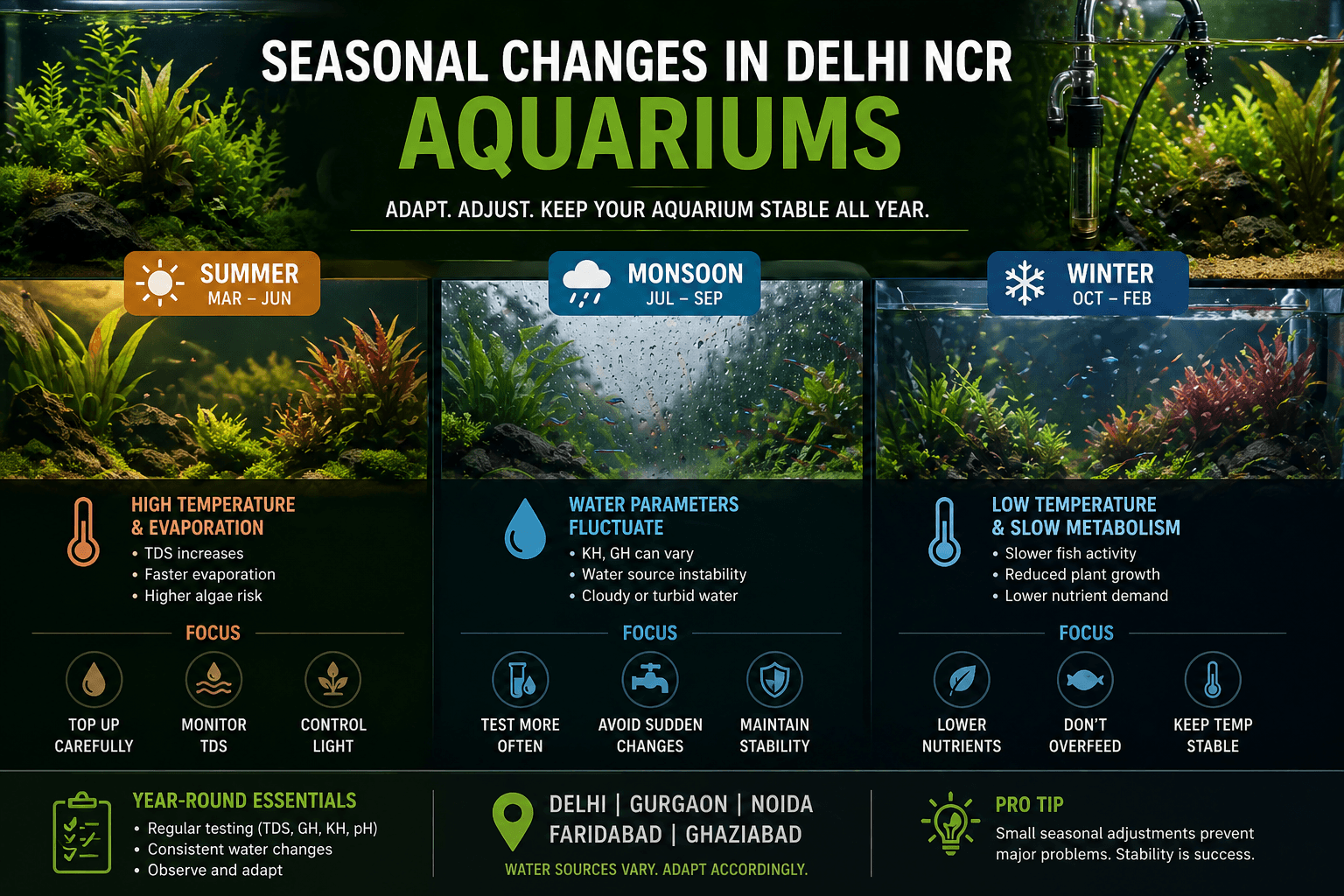
Aquarium stability in Delhi NCR depends on adjusting maintenance to seasonal changes. Summer increases TDS through evaporation, monsoon introduces variability in KH and GH, and winter stabilizes conditions but reduces biological activity. Systems must adapt before instability appears.
ProHobby Seasonal Variation Model
| Season | Water Change Pattern | System Impact |
|---|---|---|
| Summer | TDS increases | Concentration and stress |
| Monsoon | KH/GH fluctuate | Instability |
| Winter | Parameters stabilize | Reduced growth |
Seasonal shifts affect chemistry even when routine remains unchanged.
System Logic
During summer, rising TDS increases mineral concentration, requiring tighter control of feeding, lighting, and water change consistency. During monsoon, fluctuating KH and GH create instability, requiring avoidance of sudden parameter corrections. During winter, lower temperatures reduce biological demand, requiring slight reduction in nutrient input.
When seasonal changes are ignored, systems drift out of balance despite unchanged routines.
Summer Behavior (High Concentration Phase)
Evaporation concentrates dissolved solids, often increasing TDS by 50 to 150 ppm. This increases osmotic pressure and can trigger algae if plant mass does not keep pace. Top-ups with untreated water further increase mineral load.
Maintaining consistent TDS through controlled water changes becomes critical.
Monsoon Behavior (Variable Phase)
Water supply during monsoon often fluctuates due to mixing of sources. KH and GH can shift unpredictably, affecting buffering and plant response. Systems that were stable can become inconsistent without visible cause.
Maintaining consistency becomes more important than correction.
Winter Behavior (Stable Phase)
Lower temperatures slow biological processes. Plant growth reduces, nutrient demand decreases, and systems become more predictable. Overdosing nutrients during this phase can lead to imbalance.
Adjusting inputs to match reduced demand maintains stability.
Interaction with CO₂, Plants, and Fish
Seasonal changes alter CO₂ efficiency, plant growth rate, and fish metabolism. Higher summer temperatures increase metabolic demand while increasing instability risk. Winter reduces demand across all biological components.
For CO₂ behavior, see our CO2 in high KH aquarium guide. For plant response, refer to our aquarium plants Delhi NCR compatibility guide. For fish response, see our aquarium fish Delhi NCR guide.
Failure Patterns Linked to Season
Summer leads to rising algae due to increased concentration. Monsoon causes delayed instability due to parameter fluctuation. Winter leads to nutrient imbalance if routine is not adjusted.
These patterns align with system-level issues explained in our why aquariums fail systems diagnosis and hard water aquariums Delhi NCR guide.
Practical Seasonal Strategy
Maintenance should follow seasonal trends rather than fixed schedules. Water testing should increase during transition periods. Adjustments should be gradual and consistent. Systems that adapt remain stable; systems that remain static drift toward instability.
Seasonal impact varies across NCR. Gurgaon and Faridabad often experience stronger summer concentration due to higher baseline TDS. Noida and parts of Delhi may show more variability during monsoon due to supply shifts. Understanding local patterns improves system stability.
Frequently Asked Questions
Why does my aquarium become unstable in summer?
Evaporation increases TDS, raising mineral concentration.
Why do problems appear during monsoon?
Water source variability causes KH and GH fluctuation.
Do I need to change routine in winter?
Yes, reduce nutrient input due to lower biological demand.
Does season affect CO₂?
Yes, indirectly through temperature and plant activity.
Should I test water more often?
Yes, especially during seasonal transitions.
Closing Principle
Aquarium stability in Delhi NCR depends not only on correct setup but on adapting to seasonal change. Systems that adjust remain stable. Systems that do not drift toward imbalance.