
CO₂ performance in Delhi NCR aquariums is governed by buffering capacity (KH), not by equipment. Across Delhi, Gurgaon, Noida, Faridabad, and Ghaziabad, KH commonly ranges from 2 to 14 dKH. As KH rises, water resists pH change, reducing effective dissolved CO₂ at any given injection rate. The result is that identical CO₂ setups behave differently across homes, and generic “bubble-per-second” guidance fails.
CO₂ works efficiently in Delhi NCR only when matched to KH and kept stable. At KH below 4 dKH, small changes in injection produce large effects and require tight stability. At KH above 8 dKH, buffering reduces CO₂ effectiveness, requiring higher and more consistent injection or partial KH reduction. Stability of CO₂ matters more than absolute injection rate.
ProHobby CO₂ Response Model
| KH Range | CO₂ Behavior | System Outcome |
|---|---|---|
| 2–4 dKH | High responsiveness | Efficient but sensitive |
| 4–8 dKH | Moderate buffering | Predictable |
| 8–14 dKH | Strong buffering | Reduced effectiveness |
As KH increases, more CO₂ is required to achieve the same biological response. Efficiency decreases as buffering increases.
System Logic
When KH is greater than or equal to 8 dKH, buffering resists pH change and CO₂ becomes less effective, requiring higher and more stable injection. When KH is less than or equal to 4 dKH, CO₂ becomes highly effective but unstable if fluctuating, increasing algae risk. When CO₂ varies daily, plants experience stress regardless of KH. When CO₂ remains stable, plant growth improves even under moderate conditions.
CO₂ Delivery and Stability
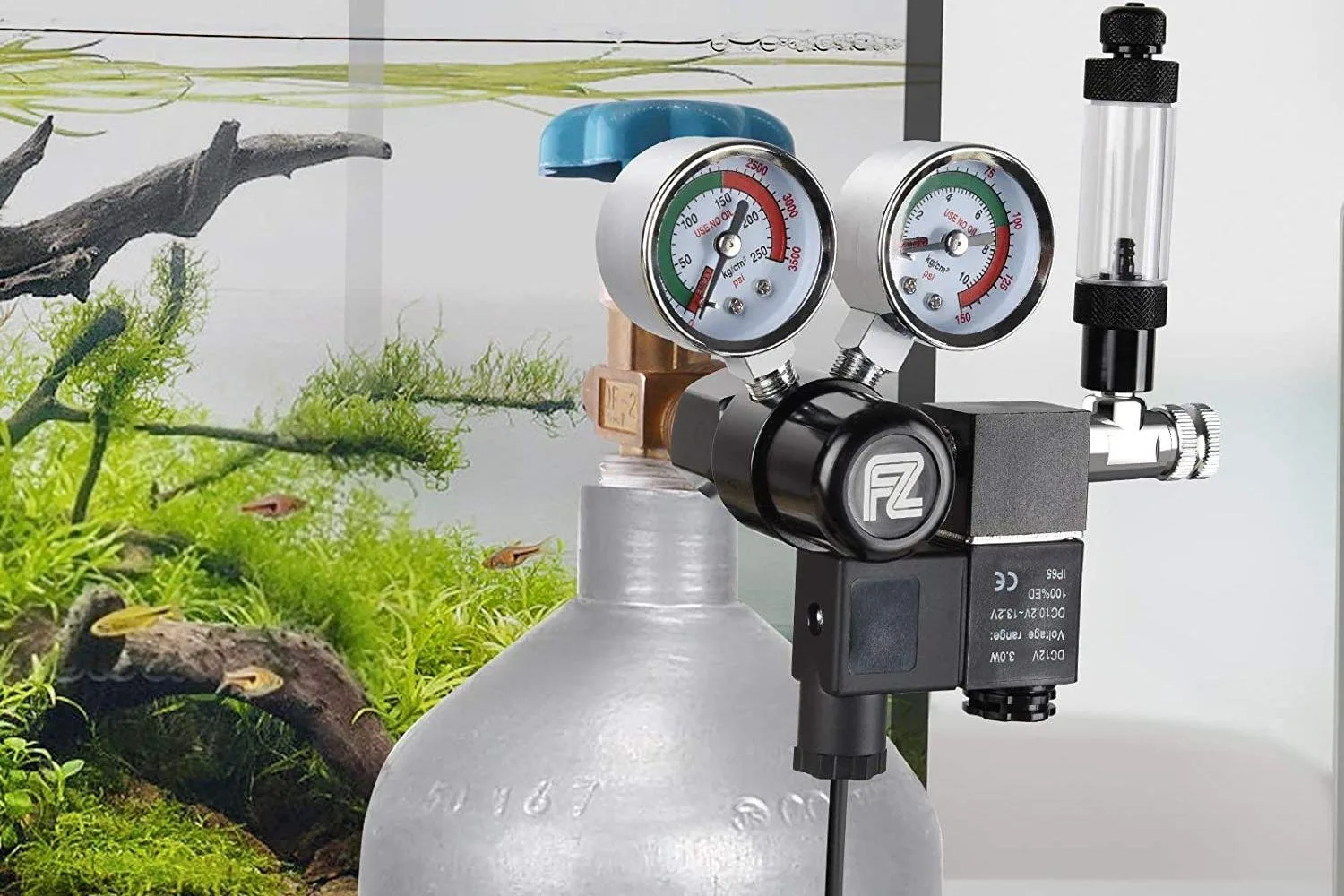
CO₂ effectiveness depends on delivery consistency, not just quantity. Stable injection throughout the photoperiod ensures predictable plant uptake. Variability in injection rate leads to imbalance and algae growth. Equipment quality matters less than consistency in output.
Drop checkers provide a visual reference but lag real-time changes. Plant response, particularly steady growth and reduced algae, is a more reliable indicator of correct CO₂ levels.
CO₂ and Plant Compatibility
Plants differ in carbon demand. Hardy species tolerate low or inconsistent CO₂. Stem and carpeting plants require stable and sufficient CO₂ levels. In high KH environments, high-demand plants struggle unless CO₂ input is increased or buffering is reduced.
For plant selection aligned with water chemistry, see our aquarium plants Delhi NCR compatibility guide.
CO₂ and Water Chemistry Interaction
CO₂ interacts with KH through buffering. High KH stabilizes pH but reduces CO₂ effectiveness. Lower KH increases CO₂ efficiency but reduces buffering stability. This tradeoff defines system behavior.
For water chemistry fundamentals, refer to our hard water aquariums Delhi NCR guide. For control strategies, see our RO water Delhi aquarium decision framework.
CO₂ Distribution and Flow
CO₂ must be distributed evenly throughout the aquarium. Poor circulation creates zones of low carbon availability even when injection is sufficient. Adequate flow ensures that dissolved CO₂ reaches all plant surfaces.
Dead zones reduce effectiveness and contribute to localized algae growth.
Failure Patterns in CO₂ Systems
Unstable CO₂ leads to algae, particularly black beard and staghorn. Insufficient CO₂ in high KH systems results in slow or stalled plant growth. Excessive CO₂ fluctuations stress both plants and fish. Inconsistent injection timing creates daily instability.
These patterns connect to broader system imbalance explained in our why aquariums fail systems diagnosis.
Practical CO₂ Strategy for Delhi NCR
CO₂ setup must begin with KH measurement. Injection should be adjusted based on buffering, not fixed rates. Stability across the photoperiod is essential. If KH is high, either increase CO₂ input or reduce KH through blending. If KH is low, maintain steady and moderate injection.
System performance should be evaluated through plant growth consistency rather than numerical targets alone.
CO₂ behavior varies across Delhi NCR depending on KH. Gurgaon and Faridabad often exhibit higher KH due to groundwater influence, requiring stronger CO₂ input. Noida and parts of Delhi may allow more efficient CO₂ use depending on supply source. Understanding local KH is essential before tuning CO₂ systems.
Frequently Asked Questions
Why is CO₂ not working in my Delhi aquarium?
High KH reduces CO₂ effectiveness, requiring higher and more stable injection.
Do I need CO₂ for all plants?
No, only for plants with higher carbon demand.
Can I rely on bubble count?
No, CO₂ performance depends on KH and system stability.
Does CO₂ cause algae?
No, instability in CO₂ causes algae.
Should I reduce KH for better CO₂?
Only when high KH limits plant growth or CO₂ efficiency.
Is CO₂ dangerous for fish?
Only if injected excessively without proper monitoring.
Closing Principle
CO₂ in Delhi NCR aquariums is a function of buffering and stability. Effective systems are not those with the highest injection, but those where CO₂ remains consistent and aligned with KH.