
By ProHobby™ | Ecological Systems Authority
Of every disease covered in this library, Amyloodinium ocellatum — marine velvet — is the one where the gap between “first noticed something wrong” and “fish is dead” is shortest. Where Cryptocaryon irritans (marine ich) typically gives a hobbyist days to notice symptoms and begin treatment, marine velvet can move from a barely visible dusting to catastrophic gill failure and death within 24–48 hours, and in severe cases faster still. Because the organism preferentially and often exclusively targets gill tissue in the early stages, many marine velvet deaths occur with minimal or no visible skin symptoms at all — a fish that was eating normally the previous evening is found dead or gasping at the surface the next morning, with nothing on the body to explain it. Understanding this organism’s biology, recognising the early warning signs before gill damage becomes irreversible, and knowing why standard “wait and watch” instincts are actively dangerous here is the difference between losing one fish and losing an entire tank.
Table of Contents
- Amyloodinium ocellatum — A Dinoflagellate, Not a Ciliate
- The Photosynthetic Parasite — Why This Organism Is Biologically Unique
- The Three-Stage Lifecycle
- Why Velvet Explodes Faster Than Cryptocaryon
- Symptoms — The Gold-Dust Sign and Why It’s Missed
- Gill-Only Presentation — The Silent Killer Pattern
- Marine Velvet vs Cryptocaryon — The Critical Speed Differential
- Copper Therapy for Velvet
- Why Hyposalinity Is Less Reliable Against Velvet
- Darkness as Supportive Therapy — The Photosynthesis Connection
- Tank Transfer Method for Velvet
- Emergency Response — What to Do in the First Hour
- Why Quarantine Matters Even More for Velvet Than Ich
- Species Susceptibility
- India — Sourcing and Practical Realities
- Frequently Asked Questions
1. Amyloodinium Ocellatum — A Dinoflagellate, Not a Ciliate
Marine velvet and marine ich are frequently discussed together, and often confused as variations of the same problem, but they belong to entirely different branches of the microbial world. Cryptocaryon irritans is a ciliate — a single-celled organism that moves and feeds using hair-like cilia. Amyloodinium ocellatum is a dinoflagellate — a taxonomically distinct group of organisms most commonly known to aquarists in a completely different context: dinoflagellates are the group responsible for coral zooxanthellae, the photosynthetic algae that live symbiotically inside coral tissue and give reef corals much of their colour and energy supply.
This shared ancestry between Amyloodinium and zooxanthellae is not a trivia point — it is the reason Amyloodinium retains functional chloroplasts and can photosynthesise, a genuinely unusual trait for a parasitic organism and one with direct, practical treatment implications covered in Section 10.
2. The Photosynthetic Parasite — Why This Organism Is Biologically Unique
No other organism covered in this disease library — not Cryptocaryon, not any of the freshwater ciliates and flagellates in the External Protozoan Parasites guide, not any bacterial or fungal pathogen — photosynthesises. Amyloodinium’s retained chloroplasts allow the trophont stage, while attached to and feeding on the fish, to supplement its energy from light in addition to the nutrients it draws from host tissue.
This single biological fact has two direct consequences for hobbyists. First, it means Amyloodinium populations can be more energetically self-sufficient than purely heterotrophic parasites, potentially contributing to how rapidly the organism can proliferate under favourable lighting conditions in a well-lit reef display — exactly the high-intensity lighting environment most reef tanks are designed to provide. Second, and far more practically useful, it means that reducing light exposure is a genuine, biologically grounded supportive measure during treatment, not a folk remedy — a point developed fully in Section 10.
3. The Three-Stage Lifecycle
Amyloodinium’s lifecycle parallels the general obligate-parasite structure seen in Cryptocaryon — a feeding stage on the fish, a reproductive stage off the fish, and a free-swimming infective stage — but differs in ways that directly explain why velvet outbreaks develop faster and more explosively.
Trophont stage (on the fish, feeding): The trophont attaches to gill and skin tissue using root-like structures called rhizoids that penetrate into host cells to draw nutrients — a more invasive feeding mechanism than Cryptocaryon’s, and one of the reasons Amyloodinium produces more severe tissue damage per organism than Cryptocaryon does. This feeding stage typically lasts 3–7 days, broadly similar in duration to Cryptocaryon’s trophont stage, but the tissue damage inflicted during this window — particularly to gill epithelium — is more functionally significant, which is central to why respiratory failure is the dominant cause of death in marine velvet.
Tomont stage (encysted, reproducing): Once feeding is complete, the trophont detaches and settles on substrate to encyst as a tomont, where it undergoes repeated division. This is the stage where Amyloodinium’s reproductive output becomes the critical differentiator from Cryptocaryon: a single Amyloodinium tomont can produce on the order of 200 or more daughter cells (dinospores), and multiple division cycles within a single encystment are possible, meaning the effective reproductive multiplication from a single successful trophont feeding event can be extremely high. Duration of this stage is typically 3–5 days under warm reef temperatures — notably shorter than Cryptocaryon’s tomont window, which further compresses the overall outbreak timeline.
Dinospore stage (free-swimming, infective): The tomont ruptures to release dinospores — motile, infective cells that must locate and attach to a fish host within a narrow window, generally understood to be shorter than Cryptocaryon’s roughly 24-hour theront survival window, though the dinospore’s motility and the sheer numbers released per tomont mean successful reinfection is highly efficient despite the tighter individual survival time. This dinospore stage is the only stage vulnerable to copper and, to a more limited extent, hyposalinity — the same fundamental treatment-timing logic that governs Cryptocaryon management in the marine ich guide applies here, with treatment needing to remain active continuously long enough to intercept every dinospore release wave.
4. Why Velvet Explodes Faster Than Cryptocaryon
Putting the lifecycle facts from Section 3 together explains the clinical reality every marine hobbyist needs to internalise: Amyloodinium combines a shorter tomont-to-dinospore cycle time with a substantially higher reproductive output per tomont than Cryptocaryon achieves. The practical result is that a marine velvet population in a tank can move from a small number of founding trophonts to an overwhelming dinospore release capable of infesting every fish in the system meaningfully faster than an equivalent starting Cryptocaryon population would. Combined with the more invasive rhizoid feeding mechanism causing disproportionate tissue damage per trophont — particularly to gill tissue that is directly essential to survival — the net effect is a disease that both spreads faster through a fish population and kills individual fish faster than marine ich typically does.
5. Symptoms — The Gold-Dust Sign and Why It’s Missed
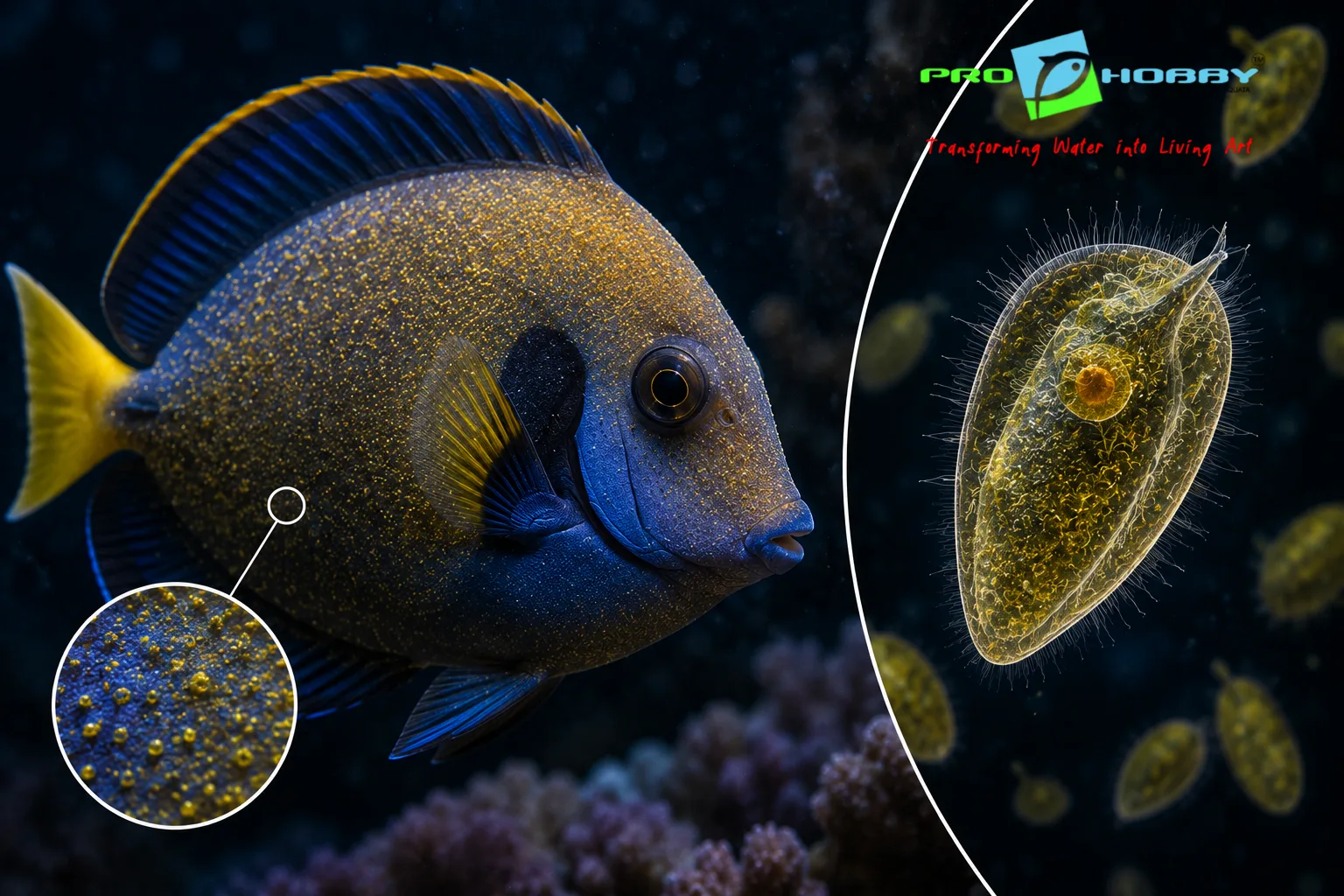
The characteristic “velvet” appearance: A fine, dust-like coating across the body, often described as gold, rust, or yellowish-brown, giving the skin a velvety or powdery texture rather than the discrete salt-grain spots of Cryptocaryon. This dust is dramatically finer than Cryptocaryon spots — individual trophonts are smaller and the coating can be genuinely subtle, particularly in early or light infestations.
Why it’s commonly missed: The gold dust is best seen using a torch or flashlight held at a low, raking angle to the fish’s body in a darkened room — direct overhead aquarium lighting frequently washes out the subtle sheen entirely. Many hobbyists only notice the characteristic dusting once infestation is already severe, or discover it only in retrospect after a fish has died and been examined more closely.
Rapid respiration and gasping: Given the preferential and often dominant gill involvement described in Section 6, rapid or laboured breathing is frequently the first and most reliable visible sign — often appearing before, or entirely without, visible body dusting.
Flashing and scratching: As with Cryptocaryon, fish rub against rock and substrate in response to trophont irritation.
Loss of appetite, clamped fins, lethargy, hiding: General and rapidly progressing illness behaviour.
Cloudy skin and rapid colour loss in advanced cases, alongside visibly increasing respiratory distress.
6. Gill-Only Presentation — The Silent Killer Pattern
This is the single most clinically important fact about marine velvet, and the reason it deserves particular caution beyond what its “velvet” nickname might suggest.
Because Amyloodinium trophonts preferentially colonise gill tissue — and in a meaningful proportion of cases infest gills heavily while producing minimal or no visible skin dusting — a fish can be in the advanced stages of a lethal velvet infestation with essentially nothing visible to the naked eye on its body. Gill tissue damage from trophont feeding directly impairs oxygen exchange, and because gills are functionally essential in a way skin tissue is not, gill-dominant velvet infestations progress to respiratory failure and death considerably faster and with far less external warning than skin-dominant infestations.
The practical implication: any newly introduced or recently stressed marine fish showing unexplained rapid or laboured breathing should be treated as a potential velvet emergency even in the complete absence of visible body dusting. Waiting for a visible gold-dust sign to confirm the diagnosis before beginning treatment can mean waiting until gill damage is already severe enough to be fatal regardless of subsequent treatment.
It is equally important to hold the reverse possibility in mind: not every case of unexplained rapid breathing in a marine fish is parasitic at all. A primary, non-parasitic bacterial gill condition can produce respiratory distress that is externally indistinguishable from gill-dominant velvet, and copper — the correct treatment for Amyloodinium — does nothing for it. The only fully reliable way to tell the two apart is direct examination of gill tissue, covered in full in Bacterial Gill Disease in Marine Fish — Complete Guide.
7. Marine Velvet vs Cryptocaryon — The Critical Speed Differential
| Feature | Marine Velvet (Amyloodinium) | Marine Ich (Cryptocaryon) |
|---|---|---|
| Organism type | Dinoflagellate | Ciliate |
| Photosynthetic | Yes | No |
| Visible appearance | Fine gold/rust dust, often subtle | Discrete 0.5–1mm white spots |
| Primary site | Gills (often dominant/exclusive) | Body, fins, gills |
| Tomont duration | ~3–5 days | 3–28 days (temperature dependent) |
| Dinospores/tomites per cyst | Very high (~200+) | Hundreds to over 1,000, but slower cycle |
| Time from symptoms to death | Can be 24–48 hours or less | Typically days, sometimes over a week |
| Darkness as supportive therapy | Genuinely helpful (photosynthetic organism) | No established benefit |
| Hyposalinity reliability | Less reliable | Well-established, reliable at correct SG |
The single most important operational takeaway from this comparison: any suspected marine parasite outbreak should be treated with velvet-level urgency until proven otherwise, because the cost of treating a Cryptocaryon case with velvet-appropriate urgency is minimal, while the cost of treating an actual velvet case with Cryptocaryon-appropriate patience can be a dead fish within a day.
Marine velvet is also frequently confused with Brooklynella hostilis, particularly in cases where gill involvement is prominent and body symptoms are minimal or absent on both counts. The distinguishing features: Brooklynella produces excessive, visible mucus and an apparent sloughing or slimy appearance to the skin, a diffuse whole-body pathology rather than the gill-concentrated feeding damage of Amyloodinium’s rhizoid-anchored trophonts, and responds to formalin rather than copper as first-line treatment. Given that both diseases can kill within 24 hours and both can present with minimal visible skin symptoms, a fish showing rapid respiratory distress with no clear gold-dust sign should be assessed for both possibilities simultaneously rather than assuming one diagnosis and treating accordingly — the full biology and differential detail is covered in Brooklynella hostilis — Complete Guide.
8. Copper Therapy for Velvet
Copper remains the most reliable pharmacological treatment for marine velvet, working through the same fundamental mechanism described in the Cryptocaryon guide — cellular toxicity to the free-swimming infective stage (dinospores here, rather than theronts).
Dosing and duration: Therapeutic ionic copper concentration and daily testing requirements are broadly similar to Cryptocaryon treatment, though given the shorter tomont cycle described in Section 3, some marine clinicians and experienced hobbyists treat velvet with a comparably aggressive minimum duration — 3–4 weeks of continuous, tested, maintained therapeutic copper — reflecting the same need to intercept every dinospore release wave from every tomont in the system, compressed into a faster-cycling timeline.
Speed of intervention matters more here than with Cryptocaryon. Given the gill-damage mechanism and rapid death timeline described in Sections 4 and 6, beginning copper treatment at the first suspicion of velvet — rather than waiting for definitive visual confirmation — meaningfully improves outcomes. The Ammonia in Aquariums monitoring framework applies directly during copper treatment, since copper’s toxicity to nitrifying bacteria creates the same biological filtration disruption risk covered in the Cryptocaryon guide.
Same reef-incompatibility applies. Copper is exactly as lethal to corals and invertebrates when treating velvet as when treating Cryptocaryon — display tank treatment is not an option in any system containing corals or invertebrates, for identical reasons to those detailed in Section 4 of the Cryptocaryon guide.
9. Why Hyposalinity Is Less Reliable Against Velvet
This is a genuinely important clinical distinction that is frequently glossed over in hobbyist discussion that treats “hyposalinity for marine parasites” as a single interchangeable protocol.
Hyposalinity’s mechanism against Cryptocaryon relies on osmotic disruption of the free-swimming theront stage at reduced specific gravity. Amyloodinium’s dinospore stage is generally understood to be somewhat more tolerant of reduced salinity than Cryptocaryon’s theront stage, meaning hyposalinity protocols that reliably eradicate Cryptocaryon do not carry the same reliability against Amyloodinium. Some marine disease references suggest hyposalinity has a supportive but not fully reliable standalone role against velvet, and copper therapy or Tank Transfer Method are generally regarded as the more dependable primary treatment choices for confirmed or strongly suspected velvet, with hyposalinity considered a secondary or combination measure rather than a standalone protocol of first choice.
10. Darkness as Supportive Therapy — The Photosynthesis Connection
This is the treatment dimension entirely unique to Amyloodinium among the parasites covered throughout this disease library, made possible directly by the biology described in Section 2.
The rationale: Because Amyloodinium trophonts retain functional chloroplasts and can photosynthesise, reducing the light available to the parasite removes one of its energy sources during the period it is attached to and feeding on the host fish. While darkness alone is not considered a sufficient standalone treatment for an established infestation, reducing tank lighting — or covering the tank entirely for a period — during active treatment is a widely practised supportive measure specifically for velvet, grounded in the organism’s genuinely unusual biology rather than folk tradition.
Practical application: During active copper treatment or Tank Transfer Method management of a velvet outbreak, reducing display and quarantine tank lighting to minimal levels, or covering the tank to exclude ambient room light, is a reasonable and biologically justified adjunct measure. This should be understood as supportive rather than curative — it does not replace copper, hyposalinity, or Tank Transfer Method as the primary treatment, but it is one of the few treatment adjuncts specific to this organism’s biology rather than general aquarium hygiene practice.
11. Tank Transfer Method for Velvet
The Tank Transfer Method described in full in the Cryptocaryon guide — moving the fish to a new, bare, sterile tank on a strict schedule to outrun the parasite’s reproductive cycle — applies to velvet with one important adjustment reflecting the shorter tomont duration established in Section 3.
Given Amyloodinium’s tomont stage typically completing in approximately 3–5 days compared to Cryptocaryon’s considerably longer and more temperature-variable window, some practitioners use a tighter transfer interval for velvet — every 2 days rather than every 3 — to ensure the transfer consistently occurs before tomont reproduction and dinospore release can complete, reflecting the same underlying principle of staying ahead of the parasite’s reproductive timeline discussed for Cryptocaryon, calibrated to velvet’s faster biology.
The general advantages and disadvantages of TTM — chemical-free, invertebrate-safe, but labour-intensive and requiring strict schedule discipline — apply identically to velvet management.
12. Emergency Response — What to Do in the First Hour
Given the genuine speed at which marine velvet can kill, a fish showing any combination of unexplained rapid breathing, flashing, lethargy, or visible fine dusting warrants immediate rather than cautious action.
Immediate steps:
- Move the affected fish to a bare, prepared hospital or quarantine tank immediately if one is available — do not wait to “see how it develops” given the timelines established in Sections 4 and 6
- Test water parameters in the display tank immediately — ammonia, nitrite, salinity, and temperature — to rule out or identify any concurrent water quality issue compounding respiratory stress, using the framework in the Complete Water Chemistry Guide
- Begin copper treatment in the isolated system as soon as practically possible rather than waiting for definitive visual confirmation of the diagnosis, given the asymmetric cost of early unnecessary treatment versus delayed necessary treatment discussed in Section 7
- Reduce lighting on both the display and treatment tank as a supportive measure per Section 10
- Do not delay based on the absence of visible body dusting — respiratory distress alone in a stressed or recently introduced marine fish is sufficient grounds for high suspicion given the gill-dominant presentation pattern in Section 6
- Once the fish stabilises, continue monitoring through the full recovery period rather than considering the crisis over as soon as symptoms resolve — trophont attachment and departure sites left behind by a resolving velvet infestation are exactly the kind of tissue damage that opportunistic secondary conditions exploit. Uronema marinum can establish as a “second wave” infection at these sites, and Vibriosis can colonise the same wounds with a bacterial infection requiring an entirely different antibiotic-based treatment approach
13. Why Quarantine Matters Even More for Velvet Than Ich
Everything established in the Cryptocaryon guide’s quarantine section about the impossibility of display tank treatment and the necessity of a minimum 4–6 week dedicated quarantine period applies to velvet with, if anything, greater force, given the faster kill timeline and the risk of a fish arriving into a mixed reef display already carrying a gill infestation that produces no visible warning sign before catastrophic failure.
The same stress-immunosuppression pathway in newly imported marine fish that predisposes fish to Cryptocaryon applies identically to velvet — the extended collection, holding, and shipping stress that most wild-caught marine ornamental fish experience is precisely the immune-suppressing event that allows subclinical Amyloodinium to establish active, potentially fatal infestation. The Science of Fish Stress covers this mechanism in full.
Given that velvet’s faster kill timeline means a quarantine-skipping mistake can be discovered as a dead fish before a hobbyist has even had time to consider treatment options, the case for unwavering quarantine discipline is, if anything, stronger for marine fishkeeping generally once velvet risk is properly understood — not just for the fish being quarantined, but for every other fish and every coral in the display it would otherwise have joined.
14. Species Susceptibility
Amyloodinium has an extremely broad host range across marine fish species and is generally considered less selective than Cryptocaryon in terms of which species are vulnerable — very few marine fish are considered notably resistant.
Particularly high-risk groups: Clownfish and other damselfish are frequently cited as showing high susceptibility and rapid, severe progression once infested. Given the popularity of clownfish specifically as an entry point species for new marine hobbyists, this susceptibility pattern means some of the most commonly kept marine fish are also among those most vulnerable to one of the fastest-killing marine diseases — reinforcing the quarantine argument in Section 13 particularly strongly for new marine keepers starting with clownfish.
15. India — Sourcing and Practical Realities
The general marine sourcing and quarantine infrastructure considerations detailed in the Cryptocaryon guide’s India section apply directly to velvet risk management — the longer transit chains typical of marine fish reaching the Indian market, the corresponding stress-immunosuppression risk, and the necessity of dedicated quarantine infrastructure independent of any display system.
Given velvet’s faster and less forgiving timeline, Indian marine hobbyists sourcing fish through any channel should treat the emergency-response protocol in Section 12 as standard operating knowledge rather than something to research only once a problem is already visible — the narrow window between first symptom and irreversible gill damage does not allow time for research during an actual outbreak. Aquarium Shop Delhi NCR — What a Specialist Looks Like covers the questions worth asking any marine livestock supplier regarding their quarantine practices before a fish ever reaches a buyer’s home.
The same hospital-tank infrastructure and stress-management discipline built for velvet management directly serves the rest of this marine disease cluster as well — Cryptocaryon, Brooklynella, Uronema, Vibriosis, bacterial gill disease, HLLE, and coral-specific marine flatworm risk are all managed through the same underlying quarantine, isolation, and water quality principles established throughout this guide.
Frequently Asked Questions
How is marine velvet different from marine ich? Marine velvet (Amyloodinium ocellatum) is a dinoflagellate; marine ich (Cryptocaryon irritans) is a ciliate — different organism classes entirely. Velvet produces a much finer gold-dust coating rather than discrete spots, frequently infests gills preferentially or exclusively with minimal visible body symptoms, and can kill within 24–48 hours compared to Cryptocaryon’s typically slower multi-day to week-long progression. Velvet should generally be treated with greater urgency given this speed differential.
Why did my fish die with no visible spots or dust? Marine velvet frequently colonises gill tissue preferentially, sometimes with minimal or no visible skin dusting, causing fatal respiratory failure before any obvious external sign appears. Rapid or laboured breathing in a stressed or recently introduced marine fish should be treated as a potential velvet emergency even without visible dust, given how commonly the gill-dominant presentation occurs.
Does darkness actually help treat marine velvet? As a supportive measure, yes, and uniquely so among common marine parasites. Amyloodinium retains functional chloroplasts and can photosynthesise, so reducing tank lighting removes one of the trophont’s energy sources during active infestation. Darkness supports but does not replace copper therapy or Tank Transfer Method as the primary treatment.
Is hyposalinity effective against marine velvet? Less reliably than against Cryptocaryon. Amyloodinium’s dinospore stage tolerates reduced salinity better than Cryptocaryon’s theront stage does, so hyposalinity protocols that reliably treat marine ich are not considered fully dependable as a standalone treatment for velvet. Copper therapy or Tank Transfer Method are generally regarded as more dependable primary treatment choices for confirmed velvet.
How fast does marine velvet kill fish? It can progress from first visible symptoms to death within 24–48 hours in severe cases, considerably faster than marine ich’s typical timeline. This speed is driven by the combination of a shorter parasite reproductive cycle, high reproductive output per cyst, and the disproportionate gill tissue damage caused by the parasite’s invasive rhizoid feeding structures.
Can marine velvet be treated in a reef tank with corals? No. Copper is lethal to corals and invertebrates at treatment concentrations, exactly as with Cryptocaryon. A confirmed or strongly suspected velvet outbreak in a reef display requires removing all fish to a dedicated treatment system while the display runs fish-free long enough for the parasite lifecycle to collapse without hosts.