
By ProHobby™ | Ecological Systems Authority
Caridina shrimp occupy the opposite end of the difficulty and water chemistry spectrum from Neocaridina cherry shrimp, and understanding exactly why is the entire foundation of keeping this group successfully. Where Neocaridina genuinely thrives in the hard, alkaline water that defines Delhi NCR and much of urban India, Caridina — the genus containing Crystal Red Shrimp, Crystal Black Shrimp, and the entire Taiwan Bee lineage that commands the highest prices and the most dedicated following in the global shrimp hobby — requires soft, acidic water at parameters Indian municipal supply simply does not provide naturally, at any concentration. This is not a species group that tolerates Indian tap water with minor adjustment. It requires a genuinely different water preparation approach from the ground up, and the gap between understanding this correctly before starting and discovering it after a collection has already crashed is the difference between a rewarding, genuinely advanced shrimp-keeping pursuit and an expensive, repeated failure.
Table of Contents
- Caridina vs Neocaridina — Why the Water Chemistry Difference Is Absolute, Not a Matter of Degree
- Crystal Red and Crystal Black Shrimp — The Foundation Species
- The Grading System — What S, SS and SSS Actually Mean
- Taiwan Bee Shrimp — The Premium Lineage
- Water Parameters — The Narrow Range That Defines Success
- Temperature — A Genuine Standalone Parameter, Not a Footnote
- Active Substrate — Why It Is Not Optional for This Genus
- RO Water and Remineralisation Specific to Caridina
- TDS as the Primary Daily Monitoring Tool
- Feeding
- Breeding and the Genetics of Grade
- Common Failure Modes and Why Caridina Crashes Happen
- Caridina Price and Why It Reflects Genuine Difficulty
- India — Why Delhi NCR Makes This the Most Technically Demanding Shrimp Keeping Niche
- Frequently Asked Questions
1. Caridina vs Neocaridina — Why the Water Chemistry Difference Is Absolute, Not a Matter of Degree
The Shrimp Tank Setup guide and Cherry Shrimp Care guide both establish that Neocaridina tolerates, and often genuinely prefers, moderately hard, neutral-to-slightly-alkaline water — a 30 to 40 percent RO blend with Delhi NCR tap water is generally sufficient to bring parameters into comfortable Neocaridina range. Caridina requires the opposite: soft, acidic water, generally in the pH 5.8 to 6.8 range with correspondingly low KH and GH, parameters that Delhi NCR and most Indian municipal tap water — sitting at pH 7.6 to 8.5 with KH commonly 8 to 12 dKH — cannot approach through partial blending in the way Neocaridina preparation allows.
The general hard water framework this section builds on is covered in full in Hard Water Aquariums in Delhi NCR. This is the single most important fact to understand before acquiring any Caridina shrimp: where Neocaridina keeping in hard water regions is a matter of degree — some RO blending improves outcomes, more RO blending improves them further, and even unmodified tap water produces workable results for many keepers — Caridina keeping in a hard water region is not a spectrum of increasingly good outcomes as more RO is added. It is a threshold requirement. Caridina kept in water anywhere near Delhi NCR’s natural hardness and alkalinity will not merely underperform; they will fail to moult successfully, fail to breed, and typically decline and die within a period of weeks to months, regardless of how well every other aspect of husbandry is managed. Water chemistry here is not one factor among several — it is the precondition every other factor depends on.
2. Crystal Red and Crystal Black Shrimp — The Foundation Species
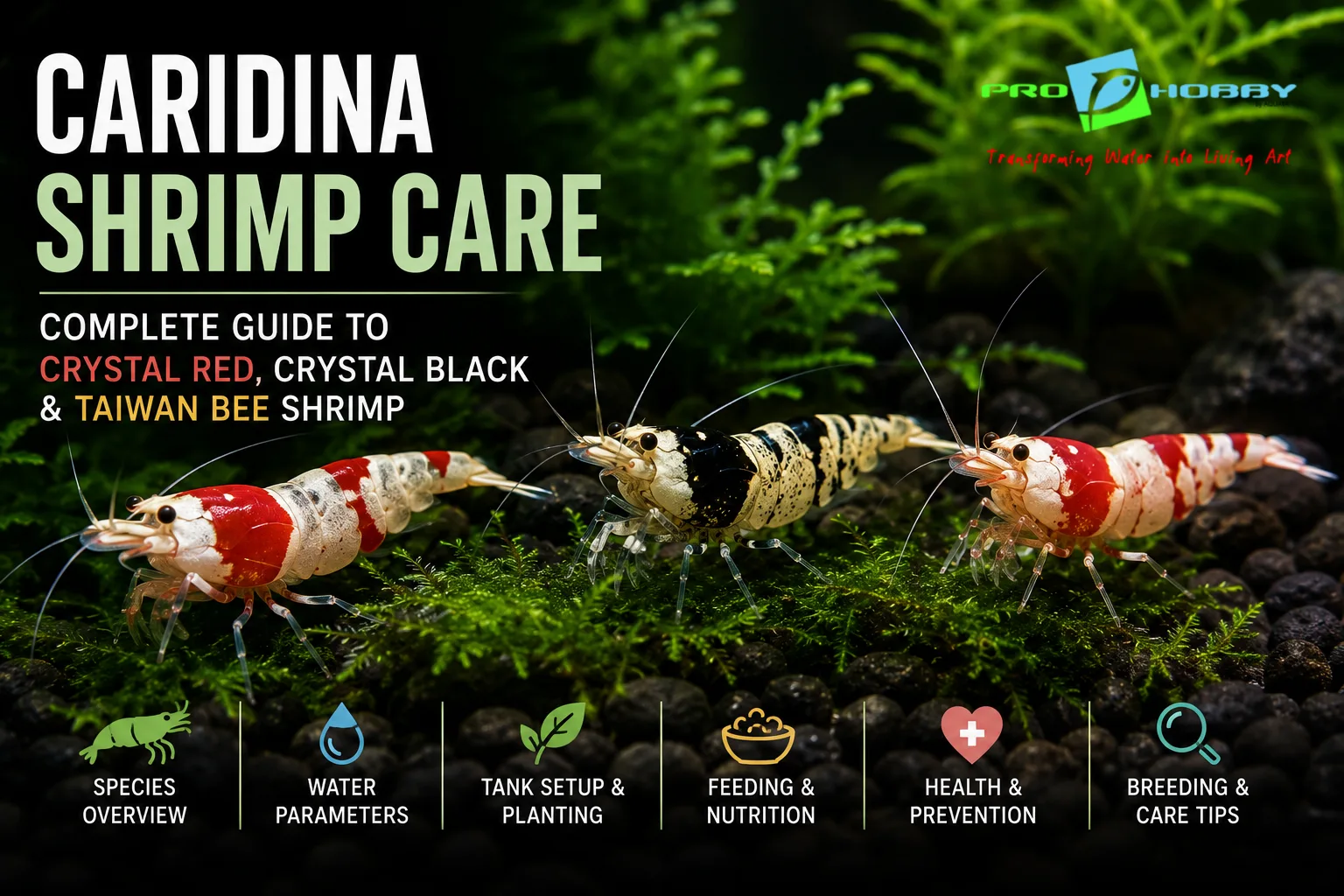
Crystal Red Shrimp (CRS) and Crystal Black Shrimp (CBS) are colour varieties of Caridina cantonensis, distinguished by red-and-white versus black-and-white banded patterning respectively, and represent the foundational, most widely kept species within the broader Caridina hobby — the entry point from which the more specialised Taiwan Bee lineage covered in Section 4 was subsequently developed through further selective breeding.
Both CRS and CBS display the same fundamental banded pattern — alternating bands of white and either red or black across the body — with quality and value within the hobby determined substantially by the proportion, evenness, and opacity of the white banding specifically, covered in full in the grading system established in Section 3. The two colour forms share essentially identical water chemistry, feeding, and general husbandry requirements, differing only in the specific pigment genetics producing red versus black colouration, meaning a keeper’s choice between CRS and CBS is overwhelmingly an aesthetic preference rather than a care-relevant decision.
3. The Grading System — What S, SS and SSS Actually Mean
Understanding CRS and CBS grading is essential both for making informed purchasing decisions and for understanding why price varies so dramatically within what appears, to an untrained eye, to be the same species.
Grading is based substantially on the proportion and quality of white colouration relative to the red or black banding, following a general hierarchy from lower to higher grade: C grade and B grade shrimp display predominantly red or black colouration with minimal white banding, representing lower-value, more affordable entry-level stock. A grade shrimp show a more balanced red/black-and-white pattern with cleaner banding. S grade shrimp display more white than colour, with the white banding becoming more extensive and better defined. SS grade and SSS grade — the highest standard grades — show even more extensive, purer white coverage with sharply defined banding and minimal colour bleeding between bands.
Beyond the standard S-grade hierarchy, specific named patterns command their own premium positioning within the grading culture — Mosura and Hinomaru patterns (specific high-white patterns with particular red or black placement, most notably a specific marking resembling the Japanese flag in Hinomaru shrimp) represent some of the most prized and expensive presentations within the CRS and CBS world specifically.
Why this grading precision matters practically: grade is not merely cosmetic vanity — within a breeding programme, grade is also a genetic indicator, and breeding two high-grade parents produces offspring with a meaningfully higher probability of high-grade patterning than breeding lower-grade stock, though as established in Section 10, grade outcomes in offspring are never fully guaranteed even from premium parent stock, reflecting the genuine polygenic complexity underlying this trait.
4. Taiwan Bee Shrimp — The Premium Lineage
Taiwan Bee shrimp represent a further selective breeding development beyond standard CRS and CBS, originating from breeding programmes — predominantly Taiwanese, as the name reflects — that introduced additional genetic lines to produce entirely new colour patterns beyond the red/black-and-white banding of the foundational varieties.
Black King Kong (BKK) and Red King Kong (RKK) display bold, solid black or red patches with white, a visually distinct pattern from the fine banding of standard CRS/CBS.
Blue Bolt displays a striking solid blue body colouration, one of the most recognisable and popular Taiwan Bee varieties.
Wine Red and Red Wine varieties display a deep, rich burgundy-red colouration distinct from the brighter red of standard CRS.
Panda shrimp display a distinctive black-and-white pattern with a specific placement resembling the animal the variety is named for.
Shadow Panda and Black Panda represent further refined variations within this same general pattern family.
Taiwan Bee varieties generally command meaningfully higher prices than standard CRS and CBS, covered further in Section 12, reflecting both the additional selective breeding investment behind these lines and, in many cases, a somewhat narrower tolerance for parameter deviation than even the already demanding standard Caridina requirement established throughout this guide — Taiwan Bee lines are frequently regarded within the hobby as requiring even more precise, more stable water chemistry management than foundational CRS and CBS, making them a genuinely advanced-tier keeping proposition rather than an appropriate entry point for a first-time Caridina keeper.
5. Water Parameters — The Narrow Range That Defines Success
| Parameter | Target Range |
|---|---|
| Temperature | 20–24°C |
| pH | 5.8–6.8 |
| KH | 0–2 dKH |
| GH | 4–6 dGH |
| TDS | 100–150 ppm |
| Ammonia | 0 ppm |
| Nitrite | 0 ppm |
| Nitrate | Below 20 ppm |
Compare this directly against the Neocaridina target range — pH 6.8 to 7.5, GH 6 to 10, TDS 150 to 250 — and the gap becomes immediately apparent: Caridina requires meaningfully lower pH, lower KH specifically (near zero, rather than Neocaridina’s 2 to 6 dKH tolerance), and generally lower overall TDS. The KH requirement specifically deserves emphasis — Caridina performs best with genuinely minimal carbonate buffering, in direct contrast to the moderate buffering Neocaridina tolerates comfortably, reflecting this species’ adaptation to naturally soft, poorly buffered wild habitat water. The underlying chemistry of both parameters is covered in full in Aquarium GH — General Hardness Complete Guide and Aquarium KH — Complete Guide to Carbonate Hardness and Buffering.
Temperature sits at the cooler end relative to many other commonly kept invertebrates and fish covered throughout this site, with Caridina generally performing best in the low-to-mid 20s Celsius rather than standard tropical community temperatures, a further consideration directly relevant to the Indian summer heat management challenge established in Section 13.
6. Temperature — A Genuine Standalone Parameter, Not a Footnote
Temperature deserves treatment as its own dedicated variable rather than a single row in the parameters table, because it interacts with Caridina biology through several distinct mechanisms that pH, GH, and KH management do not automatically cover, and because getting it wrong produces a genuinely different failure pattern from the chemistry-driven crashes established elsewhere in this guide.
The target range and why it sits where it does. Caridina performs best at 20 to 24°C, cooler than the range most tropical fish and even Neocaridina comfortably tolerate. This is a direct reflection of this genus’s origin in cooler mountain stream and spring-fed habitats across its native range, environments considerably less thermally variable and considerably cooler on average than the lowland tropical rivers many other commonly kept aquarium species originate from.
Metabolic rate and moult frequency. Temperature directly governs metabolic rate in shrimp as in most ectothermic invertebrates, and moult frequency — the periodic shedding and regrowth of the exoskeleton that every shrimp must complete successfully and repeatedly throughout its life — accelerates as temperature rises. Caridina kept persistently above their preferred range moult more frequently than is biologically ideal, placing sustained additional physiological demand on mineral reserves and increasing the population-wide frequency of failed or incomplete moults, a genuine and distinct stressor from the water chemistry instability covered elsewhere in this guide, even in a tank where pH, GH, and KH are otherwise perfectly maintained.
Dissolved oxygen interaction. Warmer water holds less dissolved oxygen, a relationship covered in general throughout this site’s dissolved oxygen guidance, and Caridina — kept in the comparatively dense, well-planted, biofilm-rich setups this genus is typically maintained in — are operating in systems with meaningful competing oxygen demand from plant respiration and biological filtration even under good conditions. Elevated temperature compounds reduced dissolved oxygen availability with elevated shrimp metabolic oxygen demand simultaneously, a double burden that is a frequently overlooked contributor to unexplained lethargy and mortality in warm Caridina tanks that test chemically normal on every other parameter.
The breeding relationship. Temperature also functions as a genuine breeding trigger and conditioning factor for this genus, with successful, consistent breeding activity generally associated with stable temperature within the preferred range rather than the warmer end of tolerance — a further reason sustained warm-water conditions undermine long-term colony health even when no single measurement crosses an acutely dangerous threshold.
Stability matters as much as the absolute number. As with every parameter covered throughout this guide, sudden temperature swings are considerably more stressful than a stable reading at the higher or lower edge of the acceptable range — a Caridina tank experiencing daily swings of several degrees from ambient room temperature fluctuation, even if the average sits within the target range, represents a genuinely less stable environment than a tank held consistently a degree or two outside ideal but with minimal day-to-day variation.
7. Active Substrate — Why It Is Not Optional for This Genus
The Shrimp Tank Setup guide establishes the general distinction between active/buffering substrate and inert substrate, and specifically recommends inert substrate for Neocaridina while noting active substrate is required for Caridina — this section develops exactly why that requirement is absolute rather than a general preference.
Active substrates — ADA Amazonia, Fluval Stratum, Controsoil, and similar products — actively lower and buffer pH toward the 6.0 to 6.8 range through ion exchange with the substrate material itself, simultaneously softening water hardness as part of the same underlying chemical process. For Caridina specifically, this buffering action is not a convenience that makes water preparation somewhat easier — it is frequently the only practical mechanism available to a hobbyist for reliably achieving and, critically, maintaining the narrow pH and KH range established in Section 5 over time, given how readily soft, poorly buffered water without active substrate support can swing in pH from minor influences that would be entirely inconsequential in a harder, better-buffered system.
The exhaustion timeline established generally in the Shrimp Tank Setup guide — active substrate buffering capacity typically exhausting over 12 to 18 months — carries particular weight for Caridina keepers specifically, since the consequence of substrate exhaustion for this genus is not a gradual, manageable drift toward less-optimal-but-still-workable parameters the way it might be for a more tolerant species, but a genuine return toward whatever the base water chemistry actually is — for an Indian keeper using heavily RO-treated water as established in Section 7, this means monitoring substrate age and planning for eventual resubstration as a genuine, recurring cost of long-term Caridina keeping rather than a one-time setup consideration.
8. RO Water and Remineralisation Specific to Caridina
The general decision framework for when and how much RO treatment a given system needs is covered in Should You Use RO Water in Delhi NCR Aquariums?. Given the water chemistry gap established in Section 1, RO water treatment for Caridina in a hard water region is not the same partial-blend approach appropriate for Neocaridina — it requires close to complete RO treatment, generally in the 80 to 100 percent RO range blended with minimal or no untreated tap water, followed by remineralisation specifically formulated for Caridina’s narrower target range rather than general-purpose or Neocaridina-oriented remineralising products.
Caridina-specific remineralisers — commercial products specifically formulated to restore GH to the Section 5 target range without introducing the KH and pH-elevating minerals that general-purpose or Neocaridina-oriented products may include — are the standard preparation method, since simply using a generic GH-boosting product without regard to its specific mineral composition risks reintroducing exactly the KH and pH elevation this entire preparation process is designed to avoid.
Consistency between water changes matters considerably more for Caridina than for the comparatively more tolerant Neocaridina — every water change represents a genuine opportunity to reintroduce parameter instability if the replacement water is not prepared with the same precision each time, making a consistent, ideally measured and repeatable RO-and-remineralisation process a core ongoing practice rather than a one-time setup task.
9. TDS as the Primary Daily Monitoring Tool
TDS (total dissolved solids) monitoring, covered generally throughout this site’s water chemistry guidance, takes on particular practical importance for Caridina keeping specifically, functioning as the most commonly used day-to-day stability indicator within the dedicated Caridina-keeping community.
Why TDS specifically, rather than testing pH, GH, and KH individually on a daily basis: a TDS meter provides an immediate, simple numerical readout that experienced Caridina keepers use as a proxy for overall water stability — a TDS reading drifting outside the established target range for a given tank is treated as an early warning sign warranting closer investigation of the underlying pH, GH, and KH parameters individually, considerably more practical for routine daily or near-daily monitoring than running a full parameter test panel with the same frequency.
Establishing a stable baseline TDS reading for a given tank once parameters are confirmed correct through full testing, and then monitoring for deviation from that established baseline going forward, is the practical workflow most experienced Caridina keepers use, rather than treating any single absolute TDS number as universally correct across every system regardless of that system’s specific substrate, water source, and stocking history.
10. Feeding
Caridina feeding follows broadly similar general principles to Neocaridina — a well-planted, biofilm-rich tank with an established colony requires relatively modest supplemental feeding, with shrimp-specific sinking pellets, blanched vegetables, and Indian almond leaves all serving the same function established for Neocaridina.
One meaningful difference: given Caridina’s narrower water chemistry tolerance and generally greater overall sensitivity established throughout this guide, overfeeding carries somewhat higher stakes for this genus — uneaten food degrading water quality in a system already operating within a narrow parameter margin compounds risk more than the equivalent overfeeding event would in a more chemically forgiving Neocaridina system, reinforcing conservative feeding (every other day maximum, removing uneaten food promptly) as a genuinely important practice rather than a general best-practice suggestion.
11. Breeding and the Genetics of Grade
Caridina breeding follows the same general biological process established for Neocaridina — berried females carrying and fanning eggs, direct development without a planktonic larval stage, independent juveniles emerging fully formed — but carries additional genetic complexity specific to the grading system established in Section 3 that deserves separate treatment.
Grade inheritance is polygenic and probabilistic, not deterministic. Breeding two high-grade (SS or SSS) parents produces a population of offspring with a meaningfully higher average grade distribution than breeding lower-grade stock, but does not guarantee that every, or even most, offspring will match or exceed the parents’ specific grade — a genuine spread of grades within a single spawn from even premium parent stock is normal and expected, reflecting the underlying genetic complexity of the white-patterning trait rather than indicating any husbandry failure.
Line breeding and selective culling — the practice of selecting only the highest-grade individuals from each generation to become the next generation’s breeding stock, while removing or separating lower-grade individuals — is standard practice among dedicated Caridina breeders working to establish or maintain a specific high-grade line over successive generations, a genuinely more involved and more deliberate breeding management approach than the largely passive population growth typical of casual Neocaridina keeping.
Colour reversion risk — the tendency for a population’s average grade to drift downward over successive generations without active selective breeding intervention — is a genuine, documented phenomenon in Caridina populations, meaning a hobbyist specifically wanting to maintain a high-grade colony over multiple generations, rather than simply enjoying whatever emerges from natural breeding, needs to actively practice the selective culling described above rather than assuming grade will maintain itself automatically.
12. Common Failure Modes and Why Caridina Crashes Happen
Sudden, unexplained colony crash is the most feared and most commonly reported Caridina failure pattern, and given the narrow parameter tolerance established throughout this guide, is overwhelmingly traceable to a water chemistry deviation — often a comparatively modest deviation that would be inconsequential for Neocaridina but crosses a genuine threshold for Caridina specifically — rather than disease in the infectious sense covered throughout most of this site’s disease library.
Substrate exhaustion drift, established in Section 6, is a common gradual crash cause specifically — a colony that has been stable for over a year, then begins declining without any obvious triggering event, frequently has an aging active substrate whose buffering capacity has quietly depleted, allowing pH and KH to drift upward toward the base water chemistry the substrate was previously masking.
Copper contamination, covered in full in the general Shrimp Tank Setup guide, applies identically to Caridina as to Neocaridina, with no genus-specific difference in copper sensitivity — the same fertiliser and medication vigilance established there is directly relevant here.
Inconsistent water change preparation, established in Section 7, is a frequently overlooked crash cause specific to the more demanding RO-and-remineralisation preparation Caridina requires — a single water change using improperly prepared replacement water can introduce a parameter swing significant enough to trigger a crash in a way that would be far less consequential for the comparatively more forgiving Neocaridina.
Temperature excursion, covered in full in Section 6, given Caridina’s comparatively narrower and cooler temperature preference than many other commonly kept invertebrates and fish, and particularly relevant given the Indian climate context established in Section 14.
13. Caridina Price and Why It Reflects Genuine Difficulty
Caridina shrimp, and CRS/CBS and Taiwan Bee varieties specifically, command meaningfully higher prices than Neocaridina across essentially every grade comparison, and this price differential reflects genuine underlying factors established throughout this guide rather than arbitrary market positioning.
Lower-grade CRS/CBS (C to A grade) typically command moderate prices, somewhat above equivalent-grade Neocaridina but not dramatically so. Higher-grade S, SS, and SSS specimens command substantially higher prices, reflecting both the breeding investment and selective culling effort established in Section 10 required to consistently produce high-grade offspring, and the genuine difficulty of successfully keeping and breeding this genus at all in many water conditions, which constrains overall supply relative to demand. Taiwan Bee varieties, particularly premium named patterns, command the highest prices within the group, reflecting the additional breeding programme investment and generally narrower keeping tolerance established in Section 4.
New stock should also be quarantined before introduction to an established colony, following the general biosecurity principles in Quarantine and Biosecurity in Aquariums — new shrimp of unknown water-chemistry and handling history represent both a disease introduction risk and, given the copper sensitivity established in the Shrimp Tank Setup guide, a risk of introducing shrimp already carrying sub-lethal contamination stress from a supplier’s own system into an otherwise stable, established colony. The practical purchasing implication: a hobbyist paying premium prices for high-grade Caridina without having first established genuinely correct, stable water chemistry per Sections 5 through 9 is placing a meaningful financial investment directly at risk — the standard, strongly recommended approach among experienced Caridina keepers is establishing and confirming stable target parameters in a fully cycled, appropriately substrated tank, ideally with a period of lower-cost test livestock or even simply extended water parameter monitoring, before investing in premium-grade specimens.
14. India — Why Delhi NCR Makes This the Most Technically Demanding Shrimp Keeping Niche
Given everything established throughout this guide, Caridina keeping in Delhi NCR and most of urban India represents a genuinely more demanding technical proposition than any other species group covered in this site’s fish and invertebrate care library — more demanding than discus, which at least tolerates a somewhat wider RO-blend range, and considerably more demanding than Neocaridina, which is directly compatible with Indian hard water through comparatively modest modification.
The 80 to 100 percent RO requirement established in Section 7, combined with the active substrate dependency established in Section 6 and the narrow ongoing TDS monitoring discipline established in Section 8, means Caridina keeping in Delhi NCR specifically requires committed, ongoing infrastructure investment — a reliable, adequately sized RO unit, Caridina-specific remineralising product maintained as standing stock, active substrate budgeted for periodic replacement, and a TDS meter used routinely — rather than a species that can be approached casually the way Neocaridina genuinely can be in this region.
Temperature management established in full in Section 6 adds a further Indian-specific consideration — Caridina’s cooler temperature preference, combined with the general Indian summer ambient heat challenge established throughout this site’s temperature management guidance, means active cooling consideration (fan-based evaporative cooling at minimum, a dedicated chiller for serious breeding operations) is a more central rather than occasional concern for Caridina relative to many other commonly kept species in Indian conditions.
The honest recommendation for Indian hobbyists new to shrimp keeping: establish genuine competence and a stable, well-understood system with Neocaridina cherry shrimp first, given the considerably more forgiving water chemistry relationship with Indian tap water that species offers, before attempting Caridina — the skills, equipment, and water preparation discipline developed through successful Neocaridina keeping transfer directly and meaningfully to Caridina, while attempting Caridina as a first shrimp-keeping experience in Delhi NCR specifically stacks the difficulty of the genus itself on top of the difficulty of learning basic shrimp husbandry simultaneously, a combination that accounts for a considerable proportion of reported Caridina failures among Indian hobbyists specifically.
Aquarium Shop Delhi NCR — What a Specialist Looks Like covers the broader supplier evaluation framework, with particular relevance for Caridina given how directly livestock health and grade quality reflect the water chemistry conditions a supplier has actually maintained their breeding stock in.
Frequently Asked Questions
Can I keep Caridina shrimp in Delhi NCR tap water? Not without extensive treatment. Unlike Neocaridina, which tolerates Delhi NCR hard water with modest RO blending, Caridina requires soft, acidic water (pH 5.8-6.8, near-zero KH) that Delhi NCR tap water cannot approach through partial blending. Caridina in Delhi NCR requires 80 to 100 percent RO water with specific remineralisation, active buffering substrate, and ongoing TDS monitoring as standard practice, not optional refinement.
What is the difference between CRS grades like S, SS and SSS? Grading is based substantially on the proportion, evenness, and opacity of white banding relative to red or black colouration, with grade increasing from C and B grade (predominantly coloured, minimal white) through A grade to S, SS, and SSS grade (increasingly extensive, purer white coverage). Higher grades command higher prices and reflect more selective breeding investment.
Why did my Caridina shrimp colony suddenly crash after being stable for over a year? The most common cause is active substrate exhaustion — buffering capacity typically depletes over 12 to 18 months, allowing pH and KH to drift upward toward the underlying base water chemistry the substrate was previously masking. Copper contamination and inconsistently prepared replacement water during water changes are the other most common crash causes.
Should I start with Caridina or Neocaridina shrimp as a beginner? Neocaridina, particularly for Indian hobbyists in hard water regions. Cherry shrimp tolerate Indian tap water with modest modification, while Caridina requires a genuinely more demanding water preparation infrastructure. Establishing competence with Neocaridina first builds the skills and equipment familiarity that transfer directly to Caridina, rather than attempting the more demanding genus as a first shrimp-keeping experience.
What substrate do I need for Caridina shrimp? Active/buffering substrate — ADA Amazonia, Fluval Stratum, Controsoil, or similar products — is required, not optional, for Caridina. Unlike Neocaridina, which does well on inert substrate, Caridina depends on active substrate’s pH-lowering and softening buffering action to reliably achieve and maintain its narrow target parameter range.