
By ProHobby™ | Ecological Systems Authority
Aquascaping is the art and science of designing aquatic landscapes — creating aesthetically intentional underwater environments that function as stable ecosystems. The term encompasses everything from minimalist Zen-inspired layouts of rock and sand to densely planted jungle tanks overflowing with diverse species. What unites them is intentionality: aquascaping starts with a design idea and builds the biological system to support it, rather than placing things randomly and hoping for the best.
For beginners, aquascaping can feel overwhelming — the reference images online show extraordinary results that seem to require years of expertise and expensive equipment. They do not. The principles behind successful aquascaping are learnable, and the most important one can be stated simply: hardscape first, plants second, chemistry third. Everything else follows from this.
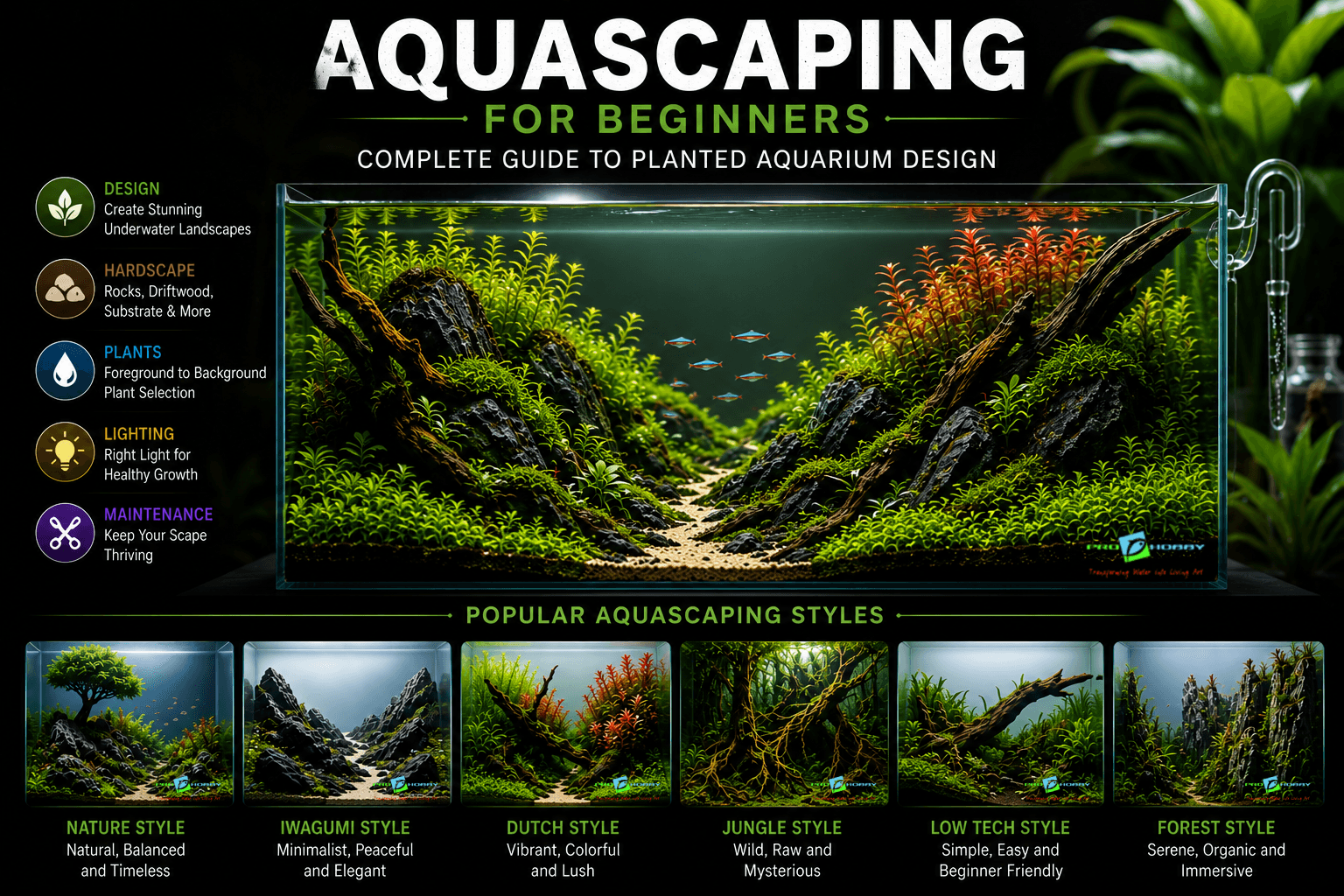
What Is Aquascaping — The Main Styles
Understanding the style you want to work toward helps make every subsequent decision — tank dimensions, substrate, plant selection, lighting — coherent rather than arbitrary.
Nature Aquarium Style (Takashi Amano)
The most influential aquascaping movement of the past 40 years, developed by Japanese photographer and aquarist Takashi Amano. Nature Aquarium style draws from Japanese garden aesthetics — wabi-sabi, ma (negative space), asymmetric balance. Hardscape (usually dragon stone or seiryu stone) creates the structural landscape; fine-textured carpeting plants (Hemianthus callitrichoides, Glossostigma) form a foreground; background plants provide depth and scale.
Characteristics: Clear focal point, deliberate negative space, asymmetric composition, high visual impact. Requires CO₂ injection and quality lighting for carpeting plants.
Iwagumi
A specific Nature Aquarium format using only rocks and a single foreground plant species — typically Hemianthus callitrichoides (HC Cuba) or similar. The rocks are arranged following a strict proportion system derived from Japanese stone garden design.
Characteristics: Extreme minimalism — 3 or 5 rocks, one plant species, negative space. Unforgiving — any algae or plant failure is completely visible. Technically demanding. Not recommended for beginners without experience in planted tank maintenance.
Dutch Style
Originating in the Netherlands in the 1930s. Dense planting of multiple species in distinct colour and texture bands — a “garden row” aesthetic applied underwater. Minimal hardscape; the design is entirely achieved through plant variety, arrangement, and contrast.
Characteristics: No rocks or wood visible; multiple species in distinct visual rows or terraces; colour contrast between species is the primary design tool. Very plant-heavy; requires good fertilisation and often CO₂.
Natural / Jungle Style
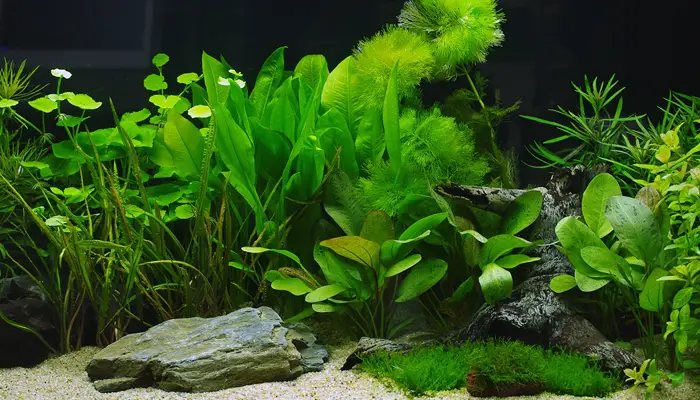
Less formal than Nature Aquarium; typically involves driftwood as the primary hardscape with dense, varied planting that creates an overgrown, organic appearance. Mosses on wood, epiphytes, fast-growing background plants.
Characteristics: More forgiving than Iwagumi or Dutch; accepts imperfection as part of the aesthetic; often works well without CO₂. Good beginner style.
Biotope
Accurately replicating a specific natural habitat — Amazonian blackwater, Southeast Asian hillstream, African Great Lake littoral zone — using only species and materials native to that location. More ecological than aesthetic in orientation.
The Hardscape-First Principle
The most common aquascaping mistake is planting first and placing hardscape second. This produces arrangements that look unnatural — the rocks and wood appear dropped onto the plants rather than emerging from the substrate.
In nature, rocks and wood are the landscape that plants grow into. This relationship should be reflected in the layout: place hardscape first, establish the landscape structure, and then plant around and through it.
The focal point rule: Every successful aquascape has one primary focal point — the largest rock, the most dramatic piece of driftwood, the densest plant cluster. Place this first, off-centre (using the rule of thirds — position the focal point at approximately one-third from the left or right, not in the centre). Everything else is arranged in visual relationship to this anchor.
The rule of thirds: Divide the tank visually into thirds horizontally and vertically. Place key elements at the intersection points, not at the centre. A centred composition reads as static; a thirds-based composition reads as dynamic and natural.
Odd numbers: Use odd numbers of rocks (3, 5, 7). Three rocks of different sizes creates the classic Iwagumi triad; five rocks of graduated sizes creates a more complex landscape. Even numbers of rocks read as symmetrical and artificial.
Substrate — The Foundation
Substrate selection determines what plants can be grown long-term and should be decided before purchasing any plants.
Active / Buffering Substrate
ADA Amazonia, Fluval Stratum, Controsoil, and similar products buffer pH to 6.0–6.8 and soften water. Essential for demanding plants and for Caridina shrimp. Exhausts buffering capacity after 12–18 months and requires resubstration.
When to use: High-tech planted tanks targeting soft-water plants (HC Cuba, Glossostigma, Rotala variants), tanks with Caridina shrimp, aquascape setups prioritising pH 6.5 or below.
Inert / Neutral Substrate
Natural gravel, sand, inert aquarium soils. Does not alter water chemistry. Requires nutrient supplementation through water column dosing or root tabs for plant nutrition.
When to use: Neocaridina shrimp tanks, tanks with fish requiring alkaline water, long-term setups where resubstration is impractical.
Substrate Slope Design
Rather than a flat substrate, sloping the substrate from front (2–3 cm) to back (7–10 cm) creates visual depth and perspective — the classic aquascape depth illusion. The extra substrate at the back provides root zone for tall background plants without the excess depth at the front that would look heavy.
Separating the hardscape area (no substrate planting, rocks sitting firmly on the tank bottom) from the planting areas is best achieved by placing hardscape before adding substrate — pour substrate around the rocks rather than placing rocks on top of substrate.
Full substrate science: The Science of Aquarium Substrates.
Plant Categories — The Three-Layer System
Successful planted aquariums use plants in three spatial categories that create visual depth and a natural layered appearance.
Foreground Plants
Low-growing, carpet-forming, or compact species placed at the front of the tank. These are the most visually impactful plants but often the most demanding.
- Hemianthus callitrichoides (HC Cuba): The classic aquascaping carpet plant. Tiny round leaves forming a dense lawn. Requires high light and CO₂. Demanding.
- Glossostigma elatinoides: Slightly more tolerant than HC Cuba. Low carpeting growth with small oval leaves.
- Eleocharis (dwarf hairgrass): Grass-like carpet. More tolerant of moderate light than HC Cuba; moderate CO₂ benefit. Achievable without CO₂ in bright light.
- Marsilea hirsuta: Very low carpeting growth. One of the most CO₂-tolerant carpet plants — achievable in low-tech setups.
- Cryptocoryne parva: The slowest-growing Cryptocoryne. Low foreground plant that eventually forms a dense carpet without CO₂.
Midground Plants
Medium-height plants positioned in the middle third of the tank. These provide the visual transition between the foreground and background.
- Anubias nana and Anubias nana petite: Slow-growing, very hardy, attached to hardscape. Biofilm provider for shrimp. No CO₂ required.
- Bucephalandra: Waxy, colourful leaves. Slow-growing, very hardy, attached to hardscape. Excellent for shrimp tanks.
- Cryptocoryne wendtii and C. undulata: Various colours and leaf forms. Tolerant of wide conditions. Classic midground Cryptocoryne.
- Java fern (various forms): Windelov, needle leaf, narrow — various forms provide textural interest.
Background Plants
Tall, fast-growing species that fill the back of the tank and provide depth.
- Vallisneria: Ribbon-like leaves reaching the surface. Very fast-growing, excellent nitrate absorption. Tolerates Indian hard water.
- Hygrophila polysperma: Hardy stem plant with rapid growth. Classic background filler.
- Rotala rotundifolia: Reddish colouration under high light, green under lower light. CO₂ and high light produce the best colour.
- Amazon sword (Echinodorus bleheri): Large, dramatic background anchor plant. Does not require CO₂.
Epiphytes
Plants attached to hardscape rather than planted in substrate — Java fern, Anubias, Bucephalandra. These define the naturalness of hardscape in a planted aquarium and can be used at any depth level.
CO₂ — Do You Need It?
The CO₂ decision determines which plants are achievable and defines the maintenance approach of the entire aquascape.
Low-tech (no CO₂ injection):
- Achievable plants: Anubias, Java fern, Bucephalandra, Vallisneria, Cryptocoryne, Java moss, hornwort, most stem plants at reduced growth rate
- Maintenance: simpler — no CO₂ equipment, lower fertiliser requirement
- Limitations: carpeting plants largely not achievable; colour in stem plants less vivid
- India-specific: no CO₂ injection is the recommended starting point for Delhi NCR hard water. The high KH of Delhi NCR tap water (8–12 dKH) absorbs CO₂ injection before it affects pH — making standard pH-drop CO₂ calibration unreliable and potentially dangerous. CO₂ in Delhi NCR Aquariums — High KH Strategy.
High-tech (CO₂ injection):
- Achievable plants: full range including carpeting plants, demanding stem plants, full colour expression
- Maintenance: more complex — CO₂ equipment, regular refilling, careful pH monitoring, higher nutrient demand
- Appropriate for: experienced planted tank keepers; beginners who understand the CO₂-pH-KH relationship
The beginner recommendation: Start low-tech. Master the biological principles — nutrient balance, algae management, plant selection — before adding CO₂ complexity. A beautiful aquascape is entirely achievable without CO₂.
Advanced CO₂ and nutrient chemistry: Advanced Nutrient Dynamics.
Lighting for Aquascaping
Duration: 8 hours per day for most planted tanks. See How Long to Run Aquarium Light Per Day for the complete photoperiod guide.
Intensity:
- Low-tech planted tanks: 20–40 PAR at substrate level
- High-tech CO₂-injected tanks: 50–100+ PAR at substrate level
Spectrum: Full-spectrum LED with strong representation in both blue (400–500nm, for chlorophyll b and plant structure) and red (600–700nm, for chlorophyll a and photosynthesis) produces best plant growth and colour rendition.
Algae and lighting: More light intensity without matching CO₂ and nutrients produces algae, not better plant growth. Balance all three factors. Why Algae Keeps Coming Back In Your Aquarium.
Fertilisation
Plants require macronutrients (nitrogen, phosphorus, potassium) and micronutrients (iron, manganese, zinc, and others including copper — critical for shrimp tank owners to note) for growth.
Inert substrate tanks: Dose liquid fertiliser weekly or as per product instructions. Root tabs provide localised nutrition for heavy root feeders (Amazon swords, large Cryptocoryne).
Active substrate tanks: Active substrate provides nutrients for the first 6–12 months; liquid fertilisation is typically needed as the substrate matures.
Avoid copper-containing fertilisers in any tank with shrimp, snails, or other invertebrates.
Maintenance — Trimming and Replanting
A planted aquascape requires regular trimming to maintain the intended design.
Stem plants (Rotala, Hygrophila, etc.) grow upward continuously — trim to the desired height and replant cuttings. Most stem plants propagate from cut sections replanted in the substrate.
Carpeting plants grow outward and thicken — thin with scissors, remove excess growth, maintain the carpet at the desired density.
Epiphytes (Java fern, Anubias) grow slowly — trim old leaves as they become covered in algae; the plant grows new leaves continuously.
Water column after trimming: Heavy trimming releases organic matter and can produce a temporary ammonia elevation — test water the day after a significant trim session.
India-Specific Plant Sourcing
Plants available in India: Most standard aquarium plants are available through local fish shops in major cities, with significantly more variety available through online communities (Facebook aquascaping groups, Aquascaping India community, specialist online retailers). Tissue culture plants (in sealed cups, free of algae and pests) are becoming more widely available in India and are strongly recommended for establishing a new aquascape without introducing algae.
Best Aquarium Plants for Delhi NCR Water — species-specific compatibility matrix for Delhi NCR conditions.
Common Beginner Aquascaping Mistakes
Planting before hardscape placement — produces an artificial-looking result. Choosing demanding plants without CO₂ — HC Cuba without CO₂ becomes a brown algae patch. Too little negative space — overplanting every centimetre removes visual focus. Symmetrical composition — placing key elements in the centre produces a static layout. Ignoring the back-to-front height gradient — flat planting removes depth. Not planning for mature size — plants purchased at 5 cm may reach 40 cm; research adult size before purchasing. Skipping the algae prevention phase — new planted tanks almost always experience an algae phase; managing through it rather than fighting it with chemicals is the sustainable approach.
Frequently Asked Questions
Can I aquascape without CO₂? Yes. Anubias, Java fern, Bucephalandra, Vallisneria, Cryptocoryne, Java moss, and most stem plants thrive without CO₂. Carpeting plants (HC Cuba, Glossostigma) generally require CO₂ for successful growth. Low-tech aquascaping is achievable and recommended as the starting point for beginners.
What is the best beginner aquascaping style? Natural/jungle style — driftwood hardscape with varied planting — is the most forgiving. It accepts imperfection aesthetically, works without CO₂, and allows iterative development as skills build.
How deep should aquascape substrate be? 2–3 cm at the front, 7–10 cm at the back for the slope effect. This creates visual depth and provides adequate root zone for background plants without unnecessary substrate depth at the front.
What plants grow best in Indian hard water? Vallisneria, Java fern, Anubias, Java moss, most Cryptocoryne species, hornwort, and water sprite all tolerate Indian hard water well. Plants requiring very soft acidic water (most demanding stem plants, Utricularia) require RO water treatment.