
By ProHobby™ | Ecological Systems Authority
Goldfish are cold water fish kept in a tropical country by hobbyists who treat them as tropical fish. Indian summer ambient temperatures regularly push room-temperature water above 30°C. Goldfish thrive at 18–22°C and become physiologically stressed above 25°C. Above 28°C, immune function collapses and dissolved oxygen availability drops below goldfish tolerance. This kills more goldfish in India than all diseases combined — not disease, not poor food, but heat.
Natural Habitat
Goldfish (Carassius auratus) are domesticated descendants of wild carp from temperate East Asia. Their natural environment ranges from near-freezing in winter to approximately 20–22°C in summer. Over 1,000 years of selective breeding has produced extraordinary variety, but the fundamental physiology — cold water adaptation, high oxygen demand, heavy waste production — remains unchanged.
Tank Requirements
Minimum tank size:
- Single fancy goldfish: 80–100 litres
- Each additional fancy goldfish: add 40 litres
- Common/comet goldfish: 150 litres minimum, outdoor pond preferred
Filtration: 6–10× tank volume turnover per hour. Goldfish produce more waste than almost any other commonly kept fish. Canister or external filters are preferred. Aquarium Filtration: The Backbone of a Healthy Aquarium.
Aeration: Surface agitation is essential. Goldfish have high oxygen demand and warm water holds less oxygen — see Aquarium Dissolved Oxygen.
Water Parameters
| Parameter | Target Range |
|---|---|
| Temperature | 16–22°C (max 24°C) |
| pH | 7.0–7.8 |
| KH | 4–8 dKH |
| GH | 6–12 dGH |
| Ammonia | 0 ppm |
| Nitrite | 0 ppm |
| Nitrate | Below 20 ppm |
Plants for a Goldfish Tank
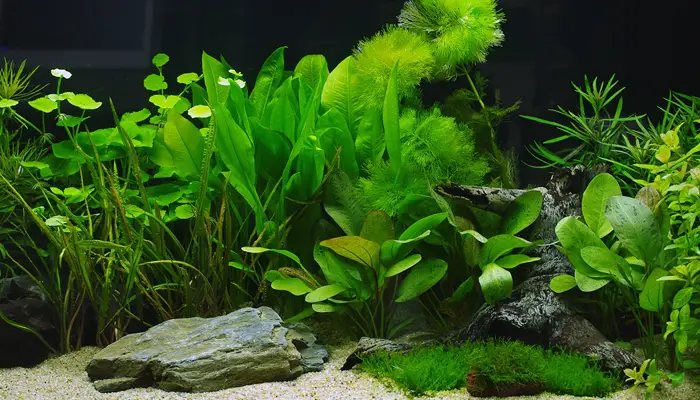
Goldfish eat most aquarium plants — this is the core challenge. They are constant grazers that uproot, shred, and consume soft-leafed plants within hours. However, planted goldfish tanks are achievable with the right species selection.
Plants goldfish tend to leave alone:
- Anubias: Thick, leathery leaves that goldfish find unpalatable. Attach to hardscape — goldfish will uproot any planted substrate item.
- Java fern: Mildly bitter taste most goldfish avoid. Attach to driftwood or rock.
- Vallisneria: Fast-growing enough to recover from grazing. Will be eaten but replacement rate can keep pace in a well-lit tank.
- Water sprite (Ceratopteris): Floated at the surface, goldfish rarely graze floating plants.
- Hornwort: Prickly texture that goldfish often avoid; fast enough to recover when grazed.
Plants goldfish will destroy: Any soft-leafed species — Amazon swords, most Echinodorus, cryptocorynes, bacopa.
The practical approach: dense planting with fast-growing, tough species, combined with feeding vegetables (so goldfish are less nutritionally motivated to eat plants), produces a planted goldfish tank that maintains itself.
Feeding
Goldfish are omnivores with high carbohydrate tolerance. Goldfish-specific pellets (lower protein, higher carbohydrate than tropical food) are the correct primary food.
Feeding amount: 2–3 times daily, only what is consumed in 2–3 minutes. Goldfish do not stop eating when full.
Vegetables: Blanched peas (shell removed), cucumber, leafy greens. Peas treat constipation-related swim bladder issues — an essential in any goldfish keeper’s toolkit. Fish Swimming Upside Down — Swim Bladder Disorders.
Sinking pellets: Preferred over floating pellets. Goldfish gulping air at the surface while eating floating pellets directly causes swim bladder dysfunction.
Goldfish not eating: Temperature is the first check — appetite suppresses significantly above 25°C and below 10°C. In Indian conditions, a goldfish not eating in summer is almost certainly too warm. Also check ammonia, ich, or constipation (fast 2–3 days then offer peas).
Male vs Female Goldfish
Sexing goldfish outside breeding season is difficult. During breeding season (when the water warms slightly in spring/early summer):
| Feature | Male | Female |
|---|---|---|
| Body shape | Slimmer | Rounder, abdomen swells with eggs |
| Pectoral fins | White raised tubercles (breeding stars) | Smooth |
| Behaviour | Chases female | Chased |
Outside breeding season, a slightly rounder abdomen in a well-conditioned fish is the most consistent indicator of female.
Breeding Goldfish
Goldfish breed readily in response to a temperature change simulating spring — a gradual drop of 3–5°C over several weeks, followed by gradual warming, triggers spawning behaviour. Males develop white pimple-like breeding tubercles on their gill covers and pectoral fins and chase the female persistently.
Eggs are scattered in fine-leafed plants or artificial spawning mops. Parents eat eggs immediately — remove adults after spawning or transfer eggs to a separate hatching container. Eggs hatch in 4–7 days at 20°C, longer at cooler temperatures. Fry begin free-swimming 3–4 days after hatching and should be fed infusoria, then micro-worm and crushed flake.
Goldfish with Other Fish
Goldfish cannot be kept with tropical fish. This is a temperature incompatibility, not a temperament issue. Tropical fish require 24–28°C; goldfish require 16–22°C. The overlap range (22–24°C) is too warm for goldfish long-term and too cool for most tropicals.
Two goldfish together: Goldfish are social and benefit from companions. Two fancy goldfish of similar size and variety coexist well. Avoid mixing common/comet goldfish with fancy varieties — the fast-moving common goldfish outcompetes slow fancy varieties for food.
Suitable tank mates: Other goldfish of similar size. White Cloud Mountain Minnows (cold water, peaceful, 18–22°C). Weather loaches. Avoid anything small enough to be ingested accidentally.
Fancy Goldfish Varieties in India
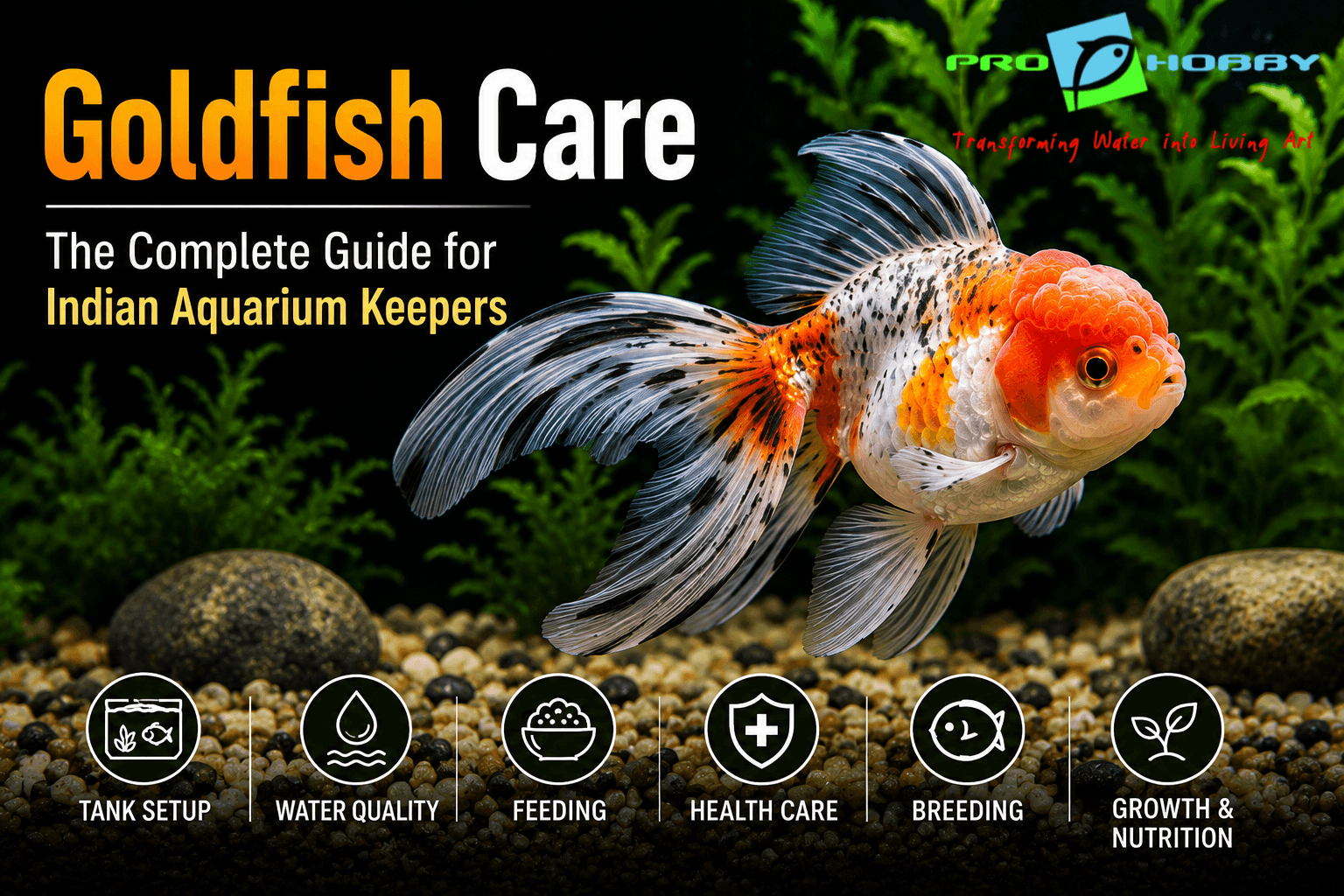
Ryukin: Deep-bodied, prominent dorsal hump, double tail. More robust of fancy varieties. Oranda: Fleshy wen on head. Beautiful but wen traps bacteria in poor water. Ranchu: No dorsal fin, arched back, prominent wen. Most challenging — buoyancy problems common. Telescope/Moor: Protruding eyes vulnerable to damage. Common/Comet: Single tail, fast, very large. Outdoor pond only; not compatible with fancy varieties.
Colour Change — What It Means
Turning white: Loss of carotenoid pigment from inadequate diet, lack of natural light, age, or genetics. Often benign in gold-to-white transitions in young fish. In combination with lethargy — investigate water quality.
Black patches appearing: Often ammonia burns healing — black is the healing response, not the injury. If black patches appear after an ammonia spike, they typically fade as the tissue heals.
Pale/faded overall: Stress, poor water quality, or illness. Test parameters.
Reddening of fins or body: Bacterial infection (haemorrhagic septicaemia), ammonia burn, or parasites. Test water and inspect closely.
Common Health Issues
Swim bladder disorder: Endemic in fancy goldfish due to body shape. Fish Swimming Upside Down. Ich: Very common after temperature drops. Ich — Treatment Guide. Fin rot: Water quality failure. Fin Rot — Treatment Guide. Dropsy: Kidney failure from sustained poor water quality. Dropsy — Treatment Guide.
All treatment through a hospital tank.
Goldfish Lifespan
10–15 years in correct conditions, with some reaching 20+ years. The typical lifespan in bowl conditions in India is 1–3 years from heat stress and water quality failure.
India-Specific Considerations
The summer temperature problem: Indian summer ambient temperatures regularly exceed 32–35°C. Options: air-conditioned room, aquarium chiller, shaded outdoor pond (October–March in Delhi NCR). Aquarium Water Temperature in Indian Summer.
Outdoor ponds: Winter months in Delhi NCR provide near-ideal goldfish temperatures. Koi Pond Setup in India — the same principles apply to goldfish ponds.
Delhi NCR tap water: GH 10–16 suits goldfish well. No modification required from a hardness perspective — focus on temperature management.
Frequently Asked Questions
What tank size do goldfish need? Minimum 80–100 litres for a single fancy goldfish, adding 40 litres per additional fish. Common/comet goldfish need 150 litres minimum and are better suited to outdoor ponds.
Can goldfish survive Indian summers? With management. Air conditioning, a chiller, or shaded outdoor pond during cooler months are the viable approaches. A bowl in an uncooled room during Delhi NCR summer will not survive May–June without intervention.
What is goldfish lifespan? 10–15 years in correct conditions. The typical lifespan in bowl conditions is 1–3 years.
Can goldfish live with tropical fish? No — the temperature requirements are incompatible. Tropical fish need 24–28°C; goldfish need 16–22°C. This is not a temperament issue but a fundamental physiological incompatibility.
Why is my goldfish changing colour? Gold-to-white transitions are often genetic and benign. Black patches after water quality problems are typically healing responses. Reddening of fins indicates bacterial infection or ammonia burn — test water immediately.