
By ProHobby™ | Ecological Systems Authority
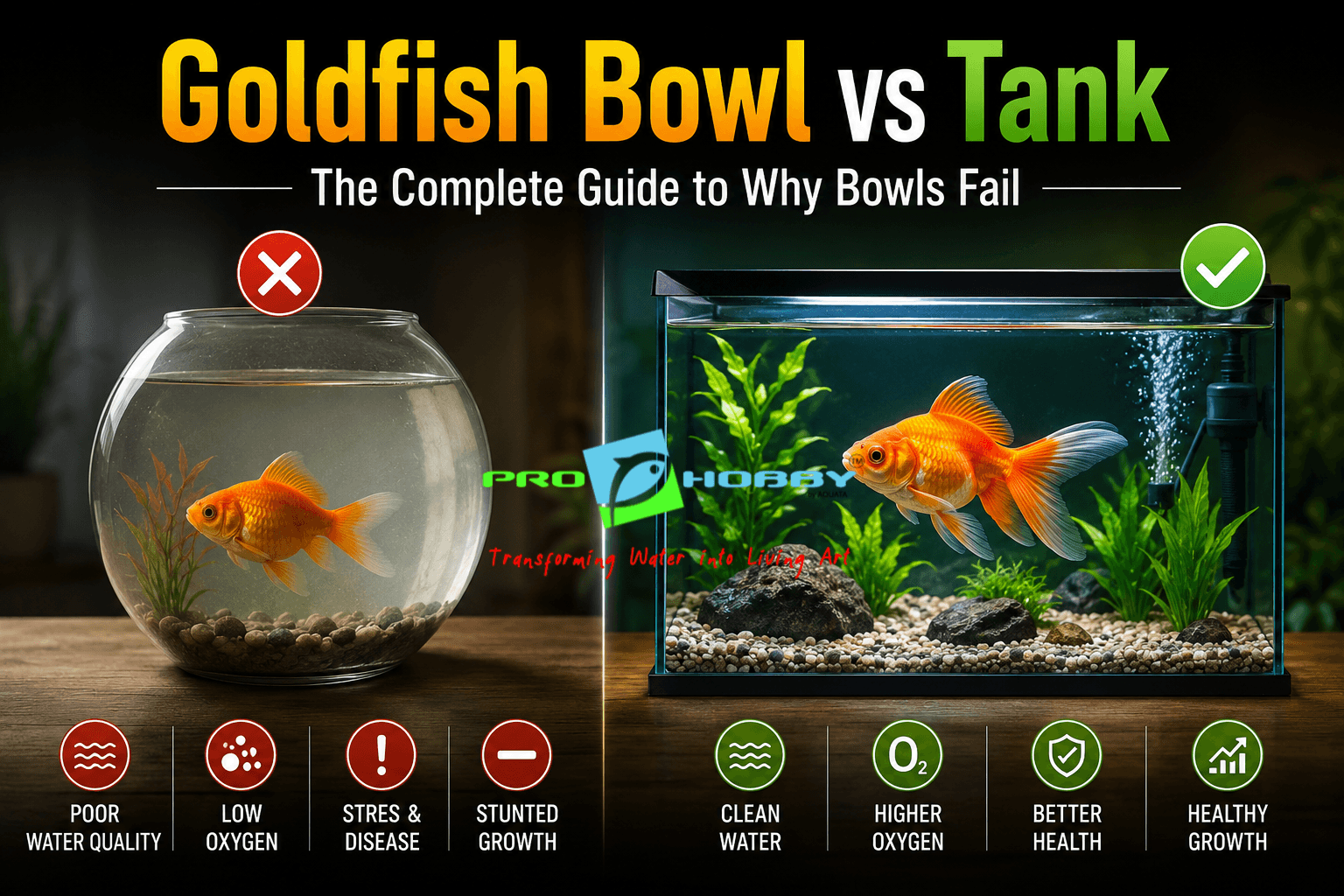
The goldfish bowl is the most persistent harmful myth in aquarium keeping. Goldfish survive in bowls — often for a year or two — and because they survive, hobbyists assume bowls are adequate. They are not. A goldfish surviving in a bowl is a goldfish under constant physiological stress: accumulating ammonia faster than bowl volume can dilute it, experiencing oxygen depletion from still water, and enduring temperature swings that chronically suppress immunity. The fish appears fine. The fish is not fine.
Understanding why bowls fail — the actual biology, not the generalisation — is the foundation for making informed decisions about goldfish care.
The History of the Goldfish Bowl — Why It Became Normal
Traditional Chinese goldfish keeping used large ceramic vessels — essentially barrel ponds — for display. These were high-volume containers far closer to outdoor ponds than the small glass spheres of the 20th century pet trade. The small glass goldfish bowl became standard through the pet trade’s need for a compact, cheap, visually appealing product. By the time goldfish biology was well understood, the bowl was culturally established. Generations of hobbyists kept goldfish in bowls because that is what everyone did — and because the goldfish, being exceptionally hardy cold-water fish, survived long enough to reinforce the assumption.
What Happens in a Bowl — The Three Mechanisms of Failure
1. Ammonia Accumulation
Without biological filtration (the nitrifying bacteria of the nitrogen cycle covered in How to Cycle a Fish Tank), ammonia produced by goldfish waste accumulates unchecked. A small fancy goldfish produces enough ammonia in a 10-litre bowl to reach 0.5–1.0 ppm within 24–48 hours of a water change.
At the pH found in Indian tap water (7.8–8.2), a significant fraction of this ammonia is in the toxic NH₃ form — more toxic than the test reading alone suggests. The complete ammonia toxicity mechanism is in Ammonia in Aquariums.
At 0.5 ppm total ammonia at pH 8.0: gill tissue damage reducing oxygen extraction efficiency, immune suppression opening the door to bacterial infection, and neurological irritation producing the listless hovering many bowl goldfish exhibit. This is not normal resting behaviour — it is chemical toxicity.
2. Oxygen Depletion
Bowl design compounds the oxygen problem. Rounded walls mean surface area decreases as the bowl fills. No aeration or filtration means no surface agitation. Goldfish have high oxygen demand and warm water holds less oxygen — a goldfish in a warm Indian room-temperature bowl in summer (water temperature 30–34°C) experiences dissolved oxygen levels significantly below the 7+ mg/L goldfish require. Aquarium Dissolved Oxygen.
3. Temperature Swings
A small water volume tracks ambient temperature rapidly. A bowl in a room going from 22°C at night to 34°C by afternoon has experienced a 12-degree swing. Daily swings exceeding 2–3°C are physiologically stressful. Daily swings of 8–12°C are significant immune suppressors that compound the ammonia and oxygen problems. In Indian summers, goldfish in room-temperature bowls experience sustained thermal stress from temperatures that exceed their cold-water optimal range (18–22°C). Aquarium Water Temperature in Indian Summer.
Goldfish Lifespan: Bowl vs Tank
| Condition | Average Lifespan |
|---|---|
| Small bowl (under 10L), no filter | 1–2 years |
| Medium bowl (15–20L), daily water changes | 2–4 years |
| Adequate tank (80–100L), filtered | 8–12 years |
| Optimal pond or large tank | 15–25 years |
The longest documented goldfish lifespan is 43 years (Tish, UK, 1956–1999) kept in a proper tank. The average Indian pet shop goldfish in a bowl lives 1–2 years and is replaced, perpetuating the perception that goldfish are short-lived. They are not. They are being killed slowly by inadequate conditions.
Can You Keep Two Goldfish in a Bowl?
No — not in any standard bowl. A single fancy goldfish requires 80–100 litres of filtered water. Two goldfish require 120–140 litres minimum. Two goldfish in a 10-litre bowl double the ammonia production in the same inadequate water volume, halving the already-short lifespan. Two goldfish in a bowl is not marginally worse than one — it is significantly more harmful.
Plants for a Goldfish Bowl
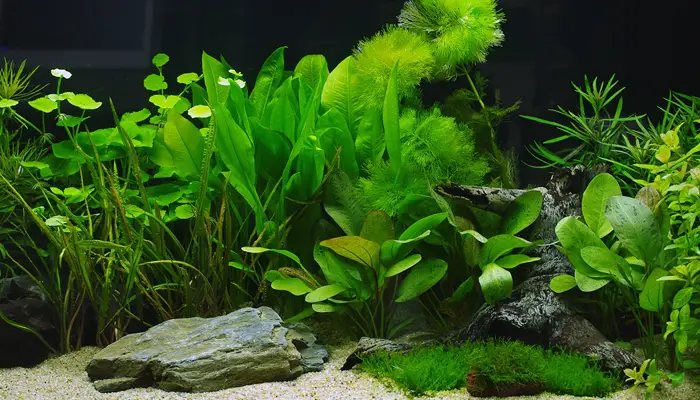
Plants provide two real benefits in a goldfish bowl: they absorb some ammonia and nitrate, improving water quality marginally; and they oxygenate the water during daylight hours through photosynthesis, partially offsetting the oxygen depletion problem.
Plants that work in goldfish bowls:
- Hornwort: Fast-growing, efficient at absorbing nitrate and ammonia, goldfish often leave it alone due to its prickly texture. Can be floated.
- Java fern: Mildly bitter, goldfish often avoid it. Can be weighted or attached to a small rock.
- Vallisneria: Fast-growing, regenerates from grazing.
- Anubias: Leathery leaves goldfish find unpalatable. Slow-growing but durable.
Important: Plants in a bowl do not substitute for filtration or water changes. They reduce the rate of ammonia and nitrate accumulation, not the fact of it. A heavily planted bowl still requires regular water changes.
Plants goldfish destroy: Any soft-leafed plant (Amazon swords, most Echinodorus, bacopa) will be eaten within hours.
Goldfish Bowl with Filter
A small internal filter dramatically improves bowl conditions — it is the single most impactful upgrade available for bowl goldfish keeping.
What a filter does:
- Establishes the nitrogen cycle, converting ammonia to nitrite then nitrate
- Creates gentle surface agitation that improves oxygenation
- Provides mechanical filtration removing solid waste particles
Suitable filters for bowls:
- Mini internal power filters (rated for 5–15 litres) — widely available in Indian pet shops
- Nano USB-powered sponge filters — very gentle flow, ideal for bowls
- Air-driven sponge filters — require a small air pump; quiet, biologically effective
Important: Even with a filter, a bowl is not an adequate goldfish habitat. A filtered bowl is significantly better than an unfiltered bowl, but the fundamental problems of volume (too little) and temperature management (no control) remain. A filtered bowl buys time and reduces suffering; it does not produce a healthy environment.
Fancy Goldfish vs Common Goldfish in Bowls
Common/comet goldfish grow to 30 cm+ and require 150+ litres of water. Keeping them in bowls is not a matter of degree but of categorical impossibility.
Fancy goldfish (orandas, ryukins, ranchus) grow to 15–20 cm and require 80–100 litres. They are marginally more manageable in larger containers but the same biological constraints apply.
Of the fancy varieties, the most compact (telescopes, small fantails) are the least inappropriate for larger bowl/container setups of 20+ litres — with the understanding that this represents minimally reduced harm, not adequate care.
The 3-Second Memory Myth
Goldfish have been demonstrated in controlled studies to have memory retention of months. They can be trained, recognise their owners, and navigate mazes learned weeks prior. The myth provides psychological cover for keeping an intelligent animal in inadequate conditions. It does not reflect fish biology.
If You Currently Have a Goldfish in a Bowl
Immediate harm-reduction measures:
25–30% water change daily with dechlorinated, temperature-matched water. This is the single most important action — it physically removes accumulating ammonia.
Add an airstone. A small air pump and airstone provides surface agitation that dramatically improves dissolved oxygen.
Install a small filter if the bowl is large enough. A mini internal filter for 5–15 litres transforms the water chemistry trajectory.
Position away from direct sunlight and heat sources. Temperature stability reduces immune suppression.
Feed minimally — only what is consumed in 60 seconds, once daily. Uneaten food is toxic in small, poorly filtered volumes.
These reduce harm. They do not make a bowl adequate.
The Correct Minimum Setup
Complete guidance in Goldfish Care — The Complete Guide. In brief:
- 80–100 litre tank
- External or internal filter with 6–10× tank volume turnover per hour
- Surface agitation for oxygen
- Temperature management — cool room, air conditioning in summer, or a chiller
- Weekly 30% water changes with How to Do a Water Change
Transitioning a Bowl Goldfish to a Tank
Move carefully — bowl water chemistry is likely very different from the tank.
- Float the bowl or container in the tank water for 15–20 minutes to equalise temperature
- Add small amounts of tank water to the bowl over 30–45 minutes before releasing the fish
- Monitor closely for 48 hours — some listlessness from bowl conditions is normal and resolves as the fish adjusts
Frequently Asked Questions
How often should I change water in a goldfish bowl? 25–30% daily in an unfiltered bowl under 20 litres. Weekly changes are insufficient — ammonia reaches toxic levels within 24–48 hours. With a small filter installed, 25–30% every 2–3 days is a minimum.
Can goldfish survive in a bowl? Yes, for 1–3 years typically. Survival is not the standard. In correct conditions, goldfish live 10–25 years. A goldfish surviving 2 years in a bowl has spent those years in chronic physiological stress.
Can I put plants in a goldfish bowl? Yes — hornwort, Java fern, Anubias, and Vallisneria survive goldfish grazing to varying degrees. Plants absorb some ammonia and nitrate and oxygenate during daylight. They reduce the rate of water quality deterioration but do not substitute for filtration or water changes.
Can I keep two goldfish in a bowl? No. Two goldfish double the ammonia load in the same inadequate volume. Two goldfish require 120–140 litres of filtered water. A second goldfish in a bowl significantly shortens the lifespan of both fish.
Do goldfish really have a 3-second memory? No. Controlled studies demonstrate goldfish memory of months. They can be trained, recognise owners, and navigate previously learned mazes. The myth exists as cultural cover for inadequate conditions.
What is the minimum bowl size for goldfish? 20 litres is the absolute minimum for a bowl with daily water changes and a small filter to be considered survivable. Below 10 litres — the most common size sold in Indian pet shops — ammonia accumulates faster than any realistic water change schedule can control.