
By ProHobby™ | Ecological Systems Authority
TDS (Total Dissolved Solids) is the parameter that generates the most confusion in aquarium hobby discussions — partly because TDS meters are inexpensive and widely used, partly because a single number appears deceptively simple, and partly because the same TDS reading can mean entirely different things in different tanks. For TDS in the context of all measurable water chemistry parameters as an integrated system, see the Complete Water Chemistry Guide.
A TDS of 300 ppm can be ideal for one setup and harmful for another. A TDS of 50 ppm can be correctly mineralised and safe, or dangerously demineralised and lethal, depending entirely on what is in it. Understanding TDS requires understanding what it measures, what it doesn’t measure, and why the composition behind the number matters far more than the number itself.
This article covers TDS completely: the chemistry, the correct interpretation framework, the species-specific relevance, the India and Delhi NCR context, and — critically — when TDS is a useful parameter to monitor and when it should be set aside in favour of more specific measurements.
Table of Contents
- What TDS Actually Measures — and What It Doesn’t
- How TDS is Measured — The Conductivity Relationship
- TDS vs GH vs KH — Why They’re Different
- When TDS Matters — Species and Situations Where It’s Relevant
- When TDS Doesn’t Matter — The Overused Parameter Problem
- What’s Actually in Your TDS Reading — Composition Determines Biology
- High TDS — When It’s a Problem and When It Isn’t
- Low TDS — When It’s a Problem and When It Isn’t
- TDS in Specific Tank Types
- Tap Water TDS — India and Delhi NCR Context
- RO Water, Remineralisation, and TDS Targets
- TDS Testing — Methods and Accuracy
- India and Delhi NCR — Specific Considerations
- Frequently Asked Questions
1. What TDS Actually Measures — and What It Doesn’t
TDS stands for Total Dissolved Solids. It measures the total concentration of all dissolved substances in the water — every ion, molecule, and compound that passes through a 2-micron filter and remains dissolved in solution.
In aquarium water, TDS includes:
- Calcium and magnesium ions (contributing to GH)
- Sodium and potassium ions
- Bicarbonate and carbonate ions (contributing to KH)
- Sulphate, chloride, and nitrate ions
- Dissolved organic compounds (from fish waste, decomposing matter, tannins)
- Trace elements (iron, zinc, copper, manganese)
- Medications, dechlorinators, and any other chemical additions
TDS is a sum — it adds all of these together and reports a single number in parts per million (ppm) or milligrams per litre (mg/L), which are numerically equivalent.
What TDS does not tell you:
- Which dissolved substances are present
- Whether the dissolved substances are beneficial or harmful
- Whether the mineral profile is appropriate for the fish being kept
- Whether the water is safe — because safety depends on composition, not total concentration
A TDS of 300 ppm could be 300 ppm of calcium carbonate (ideal hard water for African cichlids), 300 ppm of sodium chloride (osmotically very different), 300 ppm of dissolved organic compounds in a neglected tank (biologically harmful), or 300 ppm of appropriate minerals for planted shrimp (potentially ideal for the species). The number is identical; the biological implications are entirely different.
This is the fundamental limitation of TDS as a parameter: it is compositionally blind. It counts molecules without caring what those molecules are.
2. How TDS Is Measured — The Conductivity Relationship
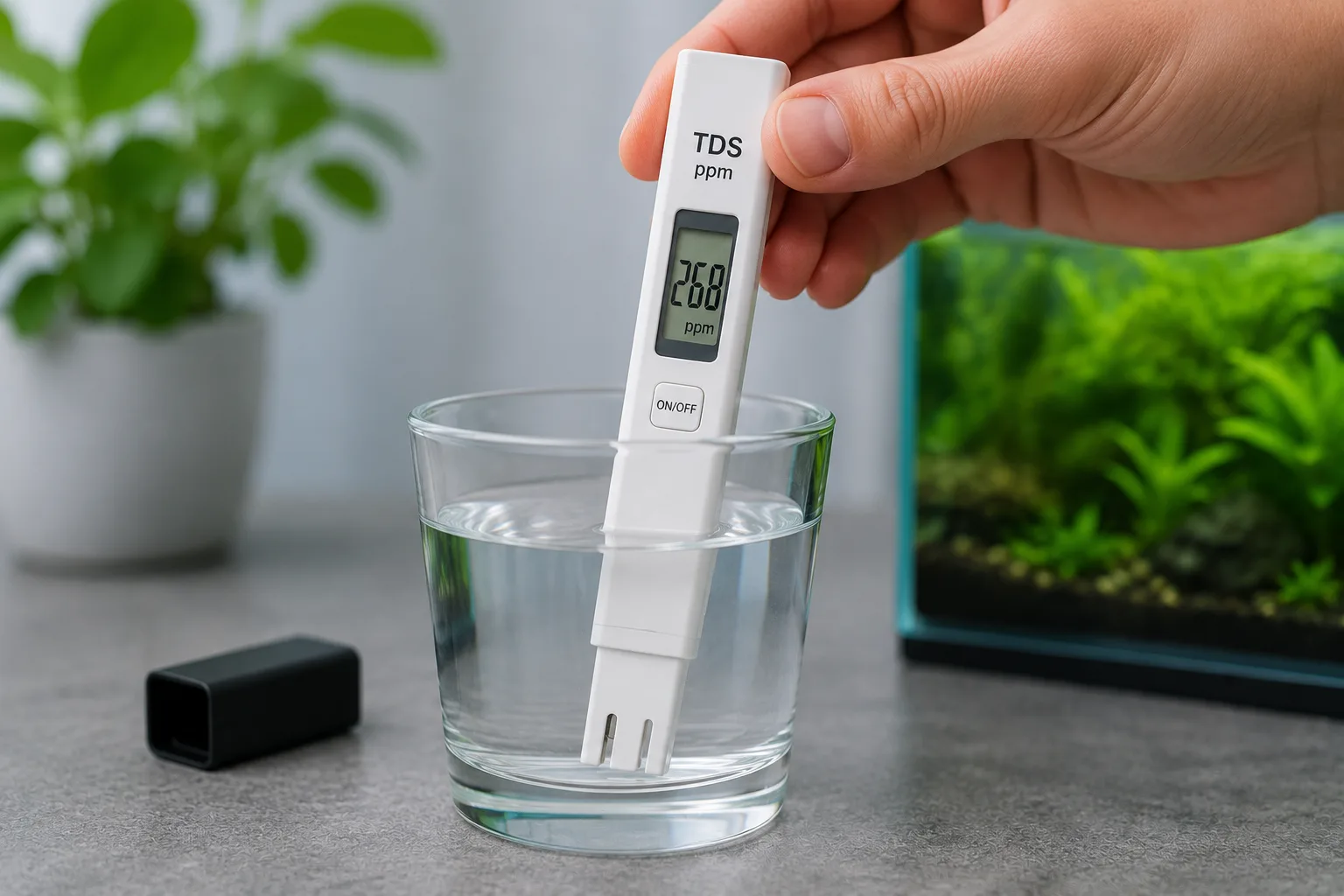
TDS meters do not directly measure dissolved solids. They measure electrical conductivity — the ability of the water to conduct an electric current — and convert this to a TDS estimate using a conversion factor.
Dissolved ions conduct electricity. Pure water (no ions) is a very poor conductor. Adding dissolved minerals increases conductivity in proportion to ion concentration. The meter applies a conversion factor (typically 0.5 or 0.7 ppm per µS/cm of conductivity, depending on the meter’s calibration standard) to convert conductivity to a TDS approximation.
The accuracy limitation: The conversion factor assumes a specific mineral composition typical of natural water (primarily calcium and magnesium bicarbonate). When the actual mineral composition differs significantly from this assumption, the TDS reading diverges from the true dissolved solids concentration.
Organic compounds conduct electricity less efficiently than mineral ions. A tank with 100 ppm of dissolved organic compounds may read lower TDS than the same tank with 100 ppm of mineral salts, even though both have the same true dissolved solids concentration. This means TDS meters systematically underestimate organic contamination relative to mineral content.
Specific ions conduct differently. Sodium conducts more electricity per milligram than calcium. A sodium-heavy water reads higher TDS than a calcium-heavy water at the same true dissolved solids concentration.
What this means practically: TDS readings are most useful as relative measurements (comparing before and after, or comparing to a known reference like tap water) rather than absolute values. Two meters from different manufacturers measuring the same water may read differently due to different conversion factors and calibration standards.
For the most accurate dissolved mineral assessment, specific ion tests (GH for calcium + magnesium, KH for bicarbonate, nitrate test for nitrate) provide more meaningful information than TDS for aquarium management decisions.
3. TDS vs GH vs KH — Why They’re Different
The relationship between TDS, GH, and KH is one of the most frequently confused topics in aquarium water chemistry.
TDS is the total. GH and KH are specific components that contribute to TDS.
GH (calcium + magnesium) and KH (bicarbonate + carbonate) together account for a significant portion of TDS in typical hard tap water. In Delhi NCR tap water at TDS 400 ppm:
- GH contribution: approximately 120–180 ppm (as calcium + magnesium ions)
- KH contribution: approximately 100–200 ppm (as bicarbonate ions)
- Remaining TDS: sodium, potassium, sulphate, chloride, nitrate, organic compounds
GH and KH together may represent 50–80% of TDS in hard water, with sodium, chloride, sulphate, and other compounds making up the remainder.
Why they diverge:
- Adding sodium bicarbonate raises KH and TDS but not GH (sodium is not measured by GH)
- Adding Epsom salt (magnesium sulphate) raises GH and TDS but not KH
- Dissolved organic compounds raise TDS but not GH or KH
- RO water contains near-zero of all three, but they can be raised independently through targeted mineral addition
The diagnostic consequence: When TDS is high but GH is low, the TDS is being driven by compounds other than calcium and magnesium — potentially sodium (from water treatment), chloride, sulphate, or organic load. High TDS with low GH does not mean the water is “hard” in the biologically relevant sense.
When TDS is low but all parameters are appropriate after remineralisation of RO water, the water is correctly mineralised despite a number that might appear “too low” by generic guidelines.
For complete coverage of GH see Aquarium GH — Complete Guide to General Hardness. For KH see Aquarium KH — Carbonate Hardness Complete Guide. How the KH component of TDS determines pH stability — and why KH is the most important single parameter for long-term pH management — is covered in Aquarium pH — Complete Diagnosis and Fix Guide.
4. When TDS Matters — Species and Situations Where It’s Relevant
TDS is genuinely useful in specific, defined situations. Understanding these situations prevents both under-use (ignoring TDS when it matters) and over-use (obsessing over TDS when it doesn’t).
Shrimp keeping — particularly Caridina
TDS is the most useful monitoring parameter for shrimp tanks, for two specific reasons:
First, shrimp are highly sensitive to total osmotic load. For Caridina (crystal, bee, and Taiwan bee shrimp), the target TDS range is narrow: 80–150 ppm for most species. For Neocaridina (cherry shrimp), 150–300 ppm. Within these ranges, the specific mineral composition also matters — but TDS provides a rapid, continuous monitoring proxy for osmotic conditions that a GH test cannot provide in real time.
Second, TDS tracks evaporation compensation. As tank water evaporates, dissolved minerals remain, and TDS rises. A TDS meter gives immediate feedback that the tank needs topping up with pure water (not tap water, which would further increase TDS). This is more responsive than intermittent GH or KH testing.
In shrimp tanks, TDS monitoring is closely linked to dissolved oxygen management — temperature rises that affect oxygen also concentrate TDS through increased evaporation. The complete oxygen management guide is Aquarium Dissolved Oxygen — Complete Guide.
RO water management
TDS is the primary verification tool for RO system performance. Pure RO output should read below 20–30 ppm. A reading above 50 ppm on RO output indicates membrane degradation, bypassing, or the need for membrane replacement. This use of TDS is valid and valuable — it is testing the RO system’s performance, not the biological suitability of the water.
After remineralisation, TDS provides a quick cross-check that the target mineral concentration has been achieved before adding the water to the tank.
Detecting contamination or sudden parameter change
TDS rises when unintended substances enter the water: medication overdose, leaching from new hardscape, contamination from household chemicals, or significant organic load from a dead fish not found quickly. A sudden unexplained TDS rise in an otherwise stable tank is a signal to investigate.
Water source comparison
When comparing water from different sources (tap, RO, well, stored), TDS provides a rapid relative comparison before more specific tests are warranted.
5. When TDS Doesn’t Matter — The Overused Parameter Problem
TDS is overused in aquarium hobby discussions. It is frequently cited as the primary diagnostic parameter in situations where it provides almost no useful information, and where specific parameter tests (GH, KH, nitrate, pH) would be far more informative.
“My TDS is 350 ppm — is that okay for my community fish?” This question cannot be answered from TDS alone. 350 ppm of calcium bicarbonate hard water is appropriate for a community of livebearers. 350 ppm of dissolved organic compounds from a neglected tank is dangerous. 350 ppm of remineralised RO water correctly proportioned for mineral content may be ideal. The number tells you nothing about suitability without knowing the composition. If TDS is rising faster than water changes export it, verify that stocking is within sustainable limits using the Aquarium Stocking Calculator.
“My TDS has risen from 300 to 350 ppm since last week — should I do a water change?” Maybe, maybe not. If the rise reflects nitrate accumulation from stocking, a water change is appropriate. If it reflects normal evaporation concentration, topping up with RO water is appropriate. If it reflects beneficial mineral accumulation from substrate, nothing is needed. TDS alone cannot distinguish these scenarios.
“I need to match the TDS from the fish store’s bag to my tank.” This is the acclimation instruction where TDS is most commonly misapplied. The reasoning is that matching TDS reduces osmotic shock during introduction. In reality, matching GH and temperature is more physiologically relevant than matching TDS — a specific TDS can represent dramatically different osmotic conditions depending on composition.
Fish health diagnosis: If fish are showing stress symptoms, TDS is not a useful first diagnostic tool. Test ammonia, nitrite, pH, and GH/KH. These parameters have direct biological mechanisms and interpretable values. TDS is compositionally blind and cannot identify which dissolved substance (if any) is causing the problem.
The temptation to rely on TDS comes from the meter’s convenience — it provides an instant reading without chemical reagents. But a parameter that is easy to measure is not necessarily the most informative one to measure. Specific tests for specific parameters provide diagnostic information that TDS cannot.
6. What’s Actually in Your TDS Reading — Composition Determines Biology
The same TDS reading means different things depending on the composition behind it. This section helps interpret TDS in context of what is likely contributing to the reading.
In hard tap water (Delhi NCR and similar): TDS of 300–600 ppm consists primarily of calcium (30–40% of TDS), bicarbonate/carbonate (30–45%), magnesium (5–15%), sodium and potassium (5–10%), sulphate and chloride (5–15%), nitrate (2–8%), and trace elements. This composition is biologically appropriate for hard water fish and produces high GH and KH readings alongside the elevated TDS.
In an established planted tank: TDS includes all the above from tap water contributions, minus what plants, substrate, and water changes have removed, plus dissolved organic compounds from biological activity (typically 10–30 ppm additional), any fertiliser additions, CO₂ contribution (minimal, as CO₂ rapidly converts to bicarbonate at aquarium pH), and accumulated nitrate.
In a new or disrupted tank during cycling: In a cycling tank or after filter disruption, elevated TDS may reflect ammonia or nitrite accumulation — the most common cause of filter disruption is incorrect cleaning, covered in How to Clean an Aquarium Filter Without Killing Bacteria. Elevated TDS may also reflect ammonia or nitrite accumulation rather than mineral content — and unlike mineral TDS, both are acutely toxic. A TDS meter cannot distinguish beneficial minerals from dangerous nitrogen compounds; always test ammonia and nitrite directly in any new or recently disrupted tank.
In RO water: TDS near zero means near-zero of everything — calcium, magnesium, bicarbonate, sodium, and all other ions. This is not “clean” water in the biologically relevant sense; it is water lacking the mineral content that fish require for normal physiology. TDS of 5 ppm on RO water is correct and confirms the membrane is working. TDS of 5 ppm on water that has not been remineralised and is about to be added to fish is dangerous.
In a tank with medication: Many medications raise TDS significantly — antibiotics, salt treatments, and water conditioners all add dissolved compounds. TDS monitoring during and after treatment tracks residual medication concentration approximately, though specific tests are more accurate. After a full water change cycle post-treatment, TDS returning to baseline is a rough indicator that most medication has been exported.
7. High TDS — When It’s a Problem and When It Isn’t
When High TDS Is Not a Problem
Hard water for appropriate species. African Rift Lake cichlids, livebearers, goldfish, and most general community fish tolerate TDS of 300–800 ppm when the composition is primarily calcium and magnesium bicarbonate. These species evolved in or have adapted to high-mineral water. A TDS of 500 ppm representing hard water appropriate for these species is not a problem.
Planted tanks with appropriate mineral content. A planted tank at TDS 350 ppm with correct GH (6–10 dGH), correct KH (4–6 dKH), appropriate nitrate (5–20 ppm), and the remainder as beneficial trace elements and organic compounds is balanced and productive, not problematic.
After mineral supplementation. Adding crushed coral, remineralisation products, or Epsom salt raises TDS alongside GH or KH. If the addition was deliberate and the target parameters are now in appropriate range, the associated TDS rise is not a concern.
When High TDS Is a Problem
For softwater species in hard water. Discus, cardinal tetras, and Caridina shrimp have specific TDS tolerances that reflect their natural water chemistry. Caridina shrimp in TDS above 200 ppm (at inappropriate mineral composition) experience osmoregulatory stress. Discus in TDS above 150 ppm may fail to breed and show chronic immune suppression.
When TDS rise is unexplained. A sudden TDS rise not accounted for by recent additions (minerals, medications, water change with harder water) suggests contamination — decomposing organic matter, leaching from new hardscape or substrate, or introduction of a foreign substance. Investigate the cause rather than simply accepting the elevated reading. An unexplained sudden TDS rise in an otherwise stable tank is a system stability signal — the framework for understanding what these signals indicate is in the Stability and Collapse in Aquarium Ecosystems cornerstone.
When TDS rises between water changes without corresponding parameter rises. If TDS rises 50 ppm between weekly water changes but GH, KH, and nitrate do not rise proportionally, the additional TDS is from dissolved organic compounds — indicating either overfeeding, inadequate mechanical filtration, or biological load exceeding processing capacity.
8. Low TDS — When It’s a Problem and When It Isn’t
When Low TDS Is Not a Problem
RO water that has been correctly remineralised. RO output at TDS 5 ppm becomes appropriate aquarium water at TDS 80–150 ppm after remineralisation with the correct GH and KH for the target species. The low pre-remineralisation TDS is correct and expected.
Softwater species setups. Discus tanks targeting TDS 50–80 ppm, Caridina tanks at 80–150 ppm, and cardinal tetra breeding tanks at TDS below 100 ppm are all intentionally low-TDS setups designed to replicate natural soft water chemistry. Low TDS here is the goal, not a problem.
When Low TDS Is a Problem
Unmineralised RO water added directly to fish. The most dangerous low-TDS scenario. TDS of near-zero means near-zero of all minerals required for fish physiology. Acute osmotic shock from sudden exposure to very low TDS water can kill fish within hours through cellular swelling and fluid imbalance. Always remineralise before use.
Gradual demineralisation through incorrect topping up. If tank evaporation is compensated with tap water (correct) in hard water areas, TDS is maintained. If evaporation is incorrectly compensated with RO or distilled water in a tank already at appropriate parameters, each top-up dilutes mineral concentration. Over weeks, GH and KH gradually fall alongside TDS. This is detectable as a steady TDS decline between water changes without a corresponding drop in nitrate.
Below minimum mineralisation for fish physiology. GH below 3 dGH (approximately 50 ppm contribution from calcium and magnesium) fails to provide sufficient calcium and magnesium for normal fish physiological function — regardless of what the remaining TDS consists of.
9. TDS in Specific Tank Types
Community Freshwater Tanks
TDS monitoring is largely unnecessary for community tanks that receive regular water changes with consistent tap water. Parameters of direct biological relevance (GH, KH, nitrate, pH) are more informative. TDS may be useful as a cross-check when tank chemistry seems unusual — a TDS significantly higher than expected from tap water and stocking alone suggests additional dissolved load from organic accumulation or medication residue.
Target TDS range for most community freshwater: 100–400 ppm, depending on tap water source and species.
Planted Tanks
TDS is moderately useful in planted tanks as a quick check on overall mineral status. In established planted tanks, TDS should be relatively stable between water changes (modest rise of 10–30 ppm from biological activity). Large TDS swings suggest either organic overload or mineral imbalance.
After fertiliser dosing, TDS rises by the amount of mineral mass added — use this as a cross-check on dosing accuracy. The Fertilizer Dosing Calculator calibrates fertiliser additions to tank volume; checking TDS before and after confirms approximately how much was added.
Shrimp Tanks
TDS is most useful here among all freshwater tank types. For Neocaridina (cherry shrimp): target TDS 150–300 ppm. For Caridina (crystal/bee/Taiwan bee shrimp): target 80–150 ppm for most species.
Use a calibrated TDS meter to monitor daily or every few days. Evaporation concentrates dissolved solids — top up with RO or distilled water (not tap water) when TDS rises above the target ceiling. Water change replacement water should be pre-mixed to match current tank TDS before adding, to avoid osmotic shock.
Track TDS before and after water changes to confirm the change brought parameters within target range, and to understand how quickly the tank’s biology raises TDS between changes.
Marine Systems
TDS is not used in marine aquarium management. Marine systems are managed by salinity (specific gravity or actual salinity in parts per thousand), with calcium, alkalinity (KH), magnesium, and other specific parameters managed individually. Marine TDS would reflect primarily salt content and is not a meaningful management tool for saltwater systems.
10. Tap Water TDS — India and Delhi NCR Context
Delhi NCR tap water TDS varies significantly by area and season:
| Area | Typical TDS Range | Dominant Mineral Profile |
|---|---|---|
| Central Delhi (municipal supply) | 200–400 ppm | Calcium bicarbonate, moderate sodium |
| South Delhi (mixed sources) | 250–450 ppm | Similar to central, variable |
| Gurgaon (primarily groundwater) | 300–700 ppm | Higher calcium, variable sulphate |
| Noida (mixed Ganga canal + groundwater) | 200–500 ppm | Variable; canal water lower in summer |
| Faridabad | 300–600 ppm | Often higher; groundwater-dependent |
| Ghaziabad | 250–450 ppm | Mixed surface and groundwater |
Seasonal variation is significant in Delhi NCR. During monsoon, canal water dilutes groundwater contributions, lowering TDS in areas using mixed sources. By March–April, pre-monsoon drawdown increases groundwater proportion and TDS rises. Test tap water TDS at the start of each season rather than relying on annual averages.
Implications:
For general community tanks: Delhi NCR tap water TDS of 300–500 ppm is appropriate for most hardy tropical community fish without any modification. Test GH and KH specifically to confirm mineral profile, but TDS alone in this range for community fish is not a concern.
For planted tanks: TDS in this range provides adequate mineral baseline. Delhi NCR-specific challenges (Ca:Mg imbalance, iron availability at high pH) are better addressed through GH/KH management and fertiliser adjustment than through TDS reduction.
For softwater species: Delhi NCR tap water at 300–600 ppm TDS is incompatible with discus, cardinal tetras, and Caridina shrimp without significant RO blending. The TDS number confirms what GH and KH tests will show — the water is substantially harder and more mineralised than these species require.
The complete Delhi NCR water chemistry profile — seasonal variation, area-by-area ranges, and the management strategy for each type of aquarium — is in Hard Water Aquariums in Delhi NCR.
11. RO Water, Remineralisation, and TDS Targets
RO water management is the most practically important application of TDS monitoring in the aquarium hobby. The protocol is:
Step 1: Verify RO output TDS Pure RO output should read below 20–30 ppm on a calibrated meter. Above 30 ppm indicates membrane degradation or bypassing. Below 10 ppm is excellent. This verification protects against using water that has not actually been fully demineralised.
Step 2: Blend if required For tanks targeting intermediate TDS (community fish in moderate hard water), blend RO with tap water to achieve the target TDS. A 50/50 blend produces approximately half the tap water TDS. The Aquarium Volume Calculator calculates actual tank volume needed for accurate blending calculations. Use the Water Change Calculator to determine the correct volume and frequency of water changes for your stocking level and TDS management target.
Step 3: Remineralise to species-specific targets For tanks requiring specific mineral composition (shrimp tanks, softwater fish tanks, general community on full RO):
- Add remineralisation product to RO water in a separate container before adding to tank
- Test TDS of prepared water to confirm target range
- Test GH and KH of prepared water to confirm mineral profile
- Allow water to reach tank temperature before adding
Step 4: Monitor tank TDS to track evaporation Check tank TDS every few days in shrimp tanks. A rise above target ceiling indicates evaporation has concentrated dissolved minerals — top up with pure RO water (not tap water) in small amounts to return to target.
Target TDS ranges by remineralisation product type:
| Setup | Target Tank TDS | Remineralisation Product Type |
|---|---|---|
| Neocaridina shrimp | 150–300 ppm | GH+KH products or tap water blend |
| Caridina shrimp (most species) | 80–150 ppm | Dedicated Caridina GH+ products only |
| Discus | 50–120 ppm | GH-only products, minimal KH |
| Community fish on RO | 100–250 ppm | GH+KH balanced products |
| High-tech planted on RO | 100–200 ppm | GH+KH balanced with appropriate ratio |
The complete water change protocol — including how to add remineralised water correctly to avoid osmotic shock — is in How to Do a Water Change.
12. TDS Testing — Methods and Accuracy
Digital TDS Meters (Pen Meters)
The standard and most practical tool for TDS measurement. Available for ₹300–2,000 depending on quality and calibration features. Better meters include automatic temperature compensation (ATC), which adjusts for the fact that conductivity increases with temperature — without ATC, the same water reads higher TDS at 30°C than at 20°C.
Calibration: Quality TDS meters should be calibrated with a known reference solution (usually 342 ppm or 1382 ppm NaCl solution, provided with better meters). Calibrate on first use and verify calibration monthly or when results seem inconsistent.
Usage: Rinse the probe in RO water before testing. Allow the reading to stabilise (5–10 seconds). Shake off excess water after use and store dry — mineral deposits on the probe affect accuracy.
Common accuracy issues:
- Probe contamination from previous test (rinse thoroughly between tests)
- Battery depletion producing unstable readings
- Calibration drift from extended use
- Temperature variation without ATC compensation
Conductivity Meters
More precise than basic TDS meters and used in scientific contexts. Measure in µS/cm (microsiemens per centimetre) or mS/cm, which can be converted to approximate TDS using standard conversion factors (÷ 1.56 for the 0.64 conversion factor common in aquarium meters, or ÷ 2 for the 0.5 factor). Rarely necessary for hobby aquarium use.
13. India and Delhi NCR — Specific Considerations
Domestic RO systems and aquarium use
Delhi NCR homes widely use domestic under-sink or countertop RO purifiers for drinking water. The quality of these systems varies significantly. Reject (waste) water from domestic RO units at 10–20% of input TDS — not the near-zero of proper aquarium-grade membranes. The purified output typically reads 30–80 ppm TDS rather than the ideal below 20 ppm of a well-functioning membrane.
Before using domestic RO output for aquarium applications requiring low TDS (shrimp tanks, softwater species), test the actual output TDS. If above 50 ppm, the membrane is marginal for aquarium use. For critical low-TDS applications, a dedicated aquarium RO unit with verified membrane quality provides more reliable results.
Bore well water in Gurgaon and Faridabad
Some areas of Gurgaon and Faridabad draw on bore well water rather than canal-derived municipal supply. Bore well water in these areas can reach TDS of 800–1500 ppm — well above the range manageable for most aquarium fish without blending. Test bore well water TDS before use and blend with RO water to bring to appropriate range. High-TDS bore well water often has elevated sulphate and fluoride concentrations not present in canal water, which can affect taste for fish (reduced appetite) and in extreme cases cause toxicity concerns.
Monsoon water chemistry shifts
During monsoon, Delhi NCR tap water TDS typically drops 30–100 ppm as canal water dilutes the system. For tanks carefully calibrated to a specific TDS range, this seasonal drop can shift water chemistry outside shrimp target ranges without any change in aquarium management. Monitor TDS at the start of monsoon season and adjust blending ratios for RO-dependent setups accordingly.
Power cuts and TDS monitoring
During extended power cuts, domestic RO system storage tanks (elevated tanks often used in Indian homes) may see TDS rise from bacterial action and mineral precipitation in the warm stored water. After extended power cuts, test stored RO water TDS before use — particularly for sensitive shrimp or breeding setups.
Frequently Asked Questions
What is TDS in an aquarium?
TDS (Total Dissolved Solids) measures the total concentration of all dissolved substances in aquarium water — including minerals (calcium, magnesium, sodium, bicarbonate), nitrate, organic compounds, and any other dissolved material — expressed as parts per million (ppm). It is measured by a probe that detects electrical conductivity and converts this to an estimated dissolved solid concentration. TDS tells you how much is dissolved but not what is dissolved — composition determines whether that TDS is beneficial or harmful for the fish being kept.
What should TDS be in an aquarium?
It depends entirely on the species being kept. For most community freshwater fish, TDS of 100–400 ppm is appropriate. For African Rift Lake cichlids and livebearers, 200–600 ppm. For discus and softwater species, 50–120 ppm. For Neocaridina (cherry) shrimp, 150–300 ppm. For Caridina (crystal/bee) shrimp, 80–150 ppm. There is no universal correct TDS — the appropriate range depends on the species’ natural water chemistry and the mineral composition behind the TDS number.
Does high TDS harm aquarium fish?
Not necessarily — high TDS is only a problem if the dissolved substances are harmful or if total osmotic load is outside the species’ tolerance. Hard water fish (African cichlids, livebearers) thrive in TDS of 300–600 ppm because the dissolved substances are appropriate minerals. The same TDS from organic contamination or sodium chloride would be harmful. TDS number alone cannot determine harm — you need to know what is in it.
Why is my aquarium TDS rising between water changes?
Normal TDS rise between water changes reflects accumulation of nitrate, dissolved organic compounds from biological activity, and mineral concentration from evaporation. A modest rise of 20–40 ppm between weekly water changes in a moderately stocked tank is expected. A large rise (100+ ppm) suggests either significant evaporation without top-up, excessive organic load from overfeeding or decomposing matter, or heavy stocking producing rapid nitrate accumulation. Test specific parameters (nitrate, ammonia) to identify which component is rising.
Is TDS the same as water hardness?
No. Water hardness refers specifically to calcium and magnesium concentration — GH (general hardness) measures these minerals specifically. KH measures bicarbonate (carbonate hardness, which provides pH buffering). TDS includes GH and KH contributions but also includes sodium, potassium, nitrate, organic compounds, and everything else dissolved in the water. Hard water (high GH) typically has high TDS, but high TDS does not necessarily mean the water is hard in the calcium/magnesium sense.
What TDS should RO water be before using it in the aquarium?
RO output should read below 20–30 ppm — this confirms the membrane is removing dissolved minerals effectively. Water at this TDS is not safe for direct aquarium use; it must be remineralised to add calcium, magnesium, and bicarbonate appropriate for the target species before adding to the tank. The remineralised water TDS should match the species-specific target range: 80–150 ppm for Caridina shrimp, 100–250 ppm for most community fish, as examples.
My TDS meter reads differently every time — is it broken?
Variable readings are usually caused by: probe contamination (rinse thoroughly in RO water between readings), temperature variation without ATC compensation (the same water reads differently at 20°C and 30°C), battery depletion, or calibration drift. Clean the probe, check the battery, allow the reading to stabilise for 10 seconds before recording, and verify calibration with a known reference solution. If readings remain inconsistent after these steps, the meter likely needs replacement — quality TDS meters are inexpensive and an unreliable meter provides worse information than no measurement at all.
Should I match TDS when adding new fish to a tank?
Matching temperature is essential. Matching the general water type (hard/soft) is important for sensitive species. Precisely matching TDS is generally less critical than matching GH and temperature for fish acclimation — TDS is compositionally blind and matching TDS does not ensure matching mineral profile. For hardy community fish, drip acclimation over 30–60 minutes handles most water chemistry differences. For sensitive species like discus or Caridina shrimp, gradual acclimation over 2–4 hours through repeated small additions of tank water is more effective than TDS matching alone.