
by ProHobby™ | Ecological Systems Authority
Most guides on community fish for beginners are ranked lists: ten fish with a care difficulty rating, a temperature range, and a note about minimum tank size. Read three of them and you will find largely the same fish in a slightly different order — neon tetras, goldfish, cardinal tetras somewhere near the top — presented as if selecting fish for an aquarium works the same way as selecting items from a menu.
Here is what those guides do not tell you: neon tetras, cardinal tetras, and goldfish are three of the most widely recommended beginner fish in the hobby, and all three are wrong recommendations for most beginners. Neon and cardinal tetras require soft, acidic water that the majority of hobbyists — in hard-water cities across India, the UK, Germany, the US Midwest — cannot provide from the tap without significant water treatment. Goldfish are cold-water fish with a waste production that overwhelms beginner filtration and a size that outgrows beginner tanks. They tolerate neglect well, which is not the same as being easy to keep correctly. Beginners are sold these fish because they are widely available, visually appealing, and sell well — not because they suit the conditions most beginners are actually working with.
This guide states these things plainly and then builds a better framework. A community aquarium is not a collection of individually selected fish that happen to share water — it is an ecosystem, a set of interacting organisms occupying different ecological roles, competing for different resources, and collectively shaping the chemistry and biology of the space they inhabit. A community built without understanding this will be unstable regardless of whether each individual species is technically labelled “easy.” A community built with this framework will be resilient, visually coherent, and far easier to maintain than one assembled from a popularity list.
Before recommending a single species, this guide establishes the ecological framework and addresses the variable that virtually every beginner guide ignores entirely: your tap water. The fish you can keep successfully are determined in large part by the water that comes out of your tap before you do anything to it. Choosing fish incompatible with your local water chemistry is the most common cause of beginner failure, and it is almost never mentioned at the point of sale.
This is the third article in the Beginner Setup & First Tanks series. If you are setting up your first tank or have not yet cycled it, start with How to Set Up a Fish Tank for Beginners and How to Cycle a Fish Tank before returning here.
Table of Contents
- The Ecological Framework: What a Community Actually Is
- The Most Important Variable No List Tells You: Your Tap Water
- Neon Tetras, Cardinal Tetras, and Goldfish Are Wrong for Most Beginners
- Building the Community: Ecological Layers and Roles
- 4a. Surface and Upper-Water Layer
- 4b. Mid-Water Schooling Layer
- 4c. Bottom and Substrate Layer
- 4d. Algae Management Layer
- Species Profiles — Honest Assessments for Real Conditions
- 5a. Hard Water Compatible (pH 7.0–8.2, GH 10–25)
- 5b. Soft-to-Moderate Water (pH 6.5–7.5, GH 4–12)
- 5c. Nano Tank Species (tanks under 40 litres)
- Starter Community Blueprints
- 6a. Hard Water 60L Community
- 6b. Soft Water 60L Community
- 6c. Nano 20–30L Community
- 6d. Planted 100L Community
- The Stocking Sequence: Why Order Matters
- Compatibility Charts Lie — What They Do Not Tell You
- Common Community-Building Mistakes
- Frequently Asked Questions
1. The Ecological Framework: What a Community Actually Is
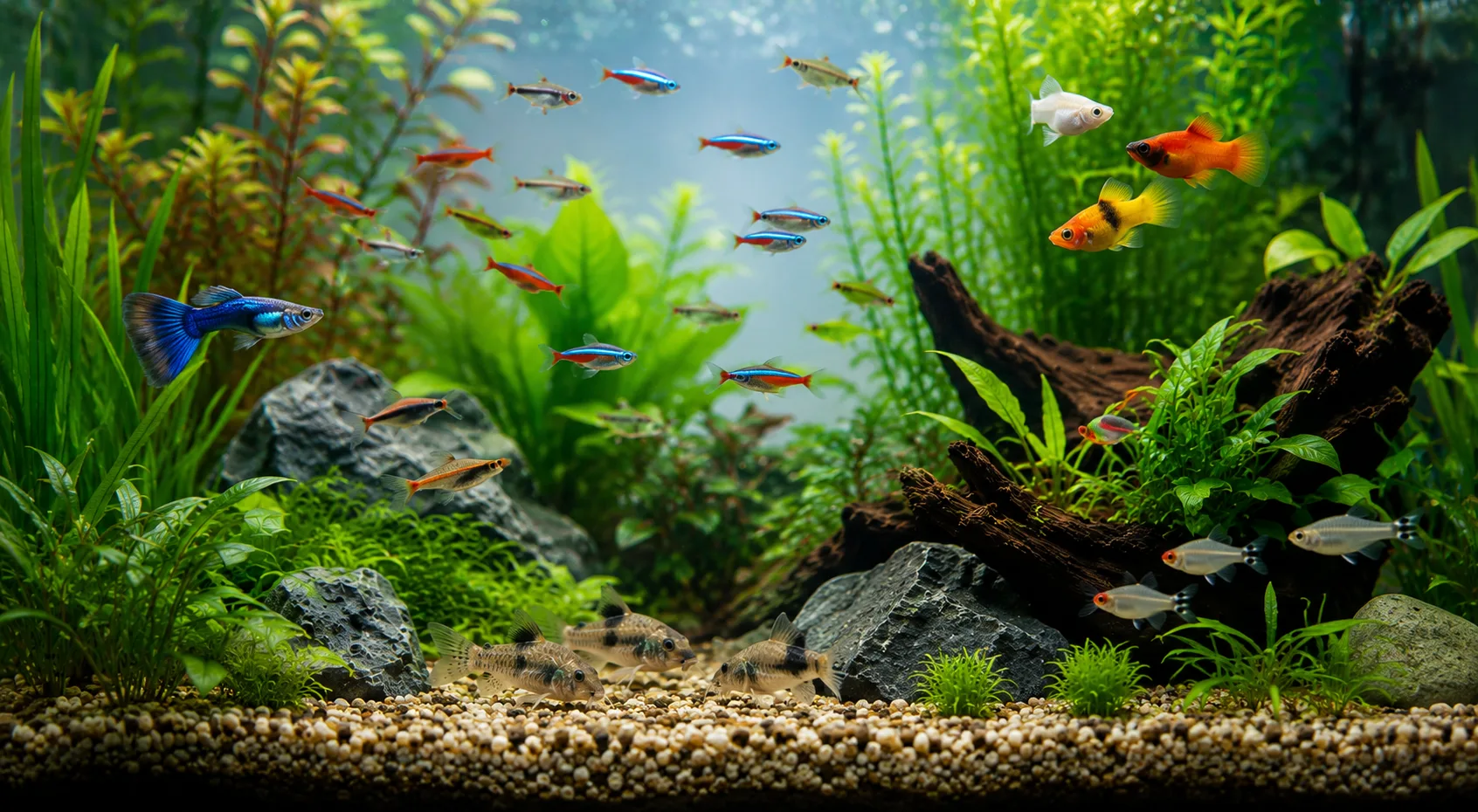
In natural aquatic environments, different fish species occupy different physical and ecological niches. Surface-dwelling species feed on insects that fall onto the water surface. Mid-water species school in open water, feeding on zooplankton and small invertebrates. Bottom-dwelling species scavenge along the substrate, processing organic matter that settles from above. These roles are not arbitrary — they reflect millions of years of niche partitioning that allows multiple species to coexist in the same body of water without competing directly for the same resources.
A well-designed aquarium community mirrors this structure. When different species occupy different physical zones and feeding roles, competition is minimised, the full water column is utilised, and each species behaves naturally rather than being crowded out of its ecological position by another. The result is a visually dynamic tank where activity occurs at every level, and a functionally stable one where no single species monopolises food or territory.
This does not mean you need to replicate a specific natural ecosystem exactly — biotope aquariums, covered in a separate guide, pursue that goal specifically. It means that the principle of ecological complementarity should guide your species selection more than colour preference or individual popularity. The deeper science of how aquarium communities achieve stability — and the failure cascades that occur when ecological balance is disrupted — is the subject of the Aquarium Stability Is Not Balance cornerstone article, which provides the systems-level framework behind the practical choices in this guide.
The three questions that should guide every community tank decision:
- Does this species occupy a niche that is currently unfilled in this community?
- Is this species compatible with my actual water parameters, not the idealised parameters on a care sheet?
- What is this species’ natural behaviour, and does the community provide the conditions for it to express that behaviour without stress?
2. The Most Important Variable No List Tells You: Your Tap Water
Before you look at a single species profile, test your tap water. Specifically, measure pH, GH (general hardness), and KH (carbonate hardness / alkalinity). A basic liquid test kit covers pH; GH and KH test kits are sold separately or as part of expanded test kit packages. A TDS (total dissolved solids) meter provides a useful additional measurement.
Why this matters more than any compatibility chart:
Freshwater fish evolved in remarkably diverse water chemistry conditions. The soft, acidic blackwater rivers of the Amazon and Southeast Asia are chemically almost the opposite of the hard, alkaline lakes of the East African Rift Valley, which are in turn different from the moderate, well-buffered rivers of Central Europe. The physiological systems of each species — their osmoregulation, their breeding triggers, their immune function — are calibrated to the water chemistry of their evolutionary origin.
When a fish is kept in water significantly different from its parameters of origin, it is under chronic physiological stress even if it appears healthy and is eating normally. Immune function is suppressed, colours are muted, lifespan is shortened, and breeding rarely occurs. The fish survives but does not thrive. Because this stress is chronic rather than acute, it rarely triggers alarm — the fish just has a shorter, duller life than it should.
What your tap water tells you:
Hard water (GH above 12, KH above 6, pH 7.4–8.4): Most of North India including Delhi NCR, Rajasthan, Haryana, and Punjab. Also common across the UK, Germany, the US Midwest and Southwest, and parts of Australia. Hard water is ideal for live-bearers (platies, mollies, swordtails, guppies), danios, barbs, Corydoras, and many African cichlids. It is challenging for most tetras, most rasboras, and poor for discus, cardinal tetras, and Southeast Asian soft-water species.
Soft water (GH below 8, KH below 4, pH 6.0–7.2): Coastal South India, parts of Northeast India, parts of Southeast Asia, Scotland, Scandinavia, the US Pacific Northwest, and much of South America. Soft water is ideal for tetras, rasboras, smaller gouramis, and most planted tank species. It requires more careful management for live-bearers, which need some mineral content, and is unsuitable for mollies without supplementation.
Moderate water (GH 8–14, KH 4–8, pH 7.0–7.8): The most versatile range for a community tank. Many species from both soft and hard water backgrounds adapt to moderate water, particularly captive-bred strains that have been maintained in varied conditions for many generations.
If you have hard tap water and are reading a beginner guide written for a global audience — or for the US hobbyist market, which skews toward moderate water assumptions — the recommendations you are receiving may be systematically wrong for your conditions. This is not a small problem. It is the primary reason beginners in hard-water regions experience recurring unexplained losses of “easy” species.
For a detailed treatment of hard water aquariums and how to work with rather than against your tap water chemistry, see the Hard Water Aquariums guide. For a framework on when RO water is genuinely necessary versus when it is an unnecessary complication, see Should You Use RO Water in Your Aquarium. For a complete reference on pH, KH, GH, and TDS and how they interact, see the Complete Water Chemistry Guide. And because water chemistry is not static — it shifts seasonally with municipal treatment changes and temperature — the Seasonal Water Changes guide covers how to adjust your maintenance routine accordingly.
3. Neon Tetras, Cardinal Tetras, and Goldfish Are Wrong for Most Beginners
Three species are recommended to beginners more than any other globally: neon tetras, cardinal tetras, and goldfish. All three are the wrong recommendation for most beginners. This is not a contrarian position — it is what the failure rates and the biology consistently show. The problem is not that these are bad fish. It is that they are recommended without the context that makes them either appropriate or inappropriate, and that omission is responsible for a substantial proportion of beginner failures worldwide.
Neon Tetra (Paracheirodon innesi) — wrong for most beginners
The neon tetra is the world’s most sold aquarium fish. It is also one of the first fish most beginners lose — and the reason is almost never disease or mishandling. It is water chemistry, and no one mentioned it at the point of sale.
Neon tetras evolved in the soft, acidic blackwater streams of the western Amazon basin, where pH runs 4.5–6.5 and GH is often below 3. Their physiology is calibrated to that environment. In hard, alkaline tap water at pH 7.8 or above — which is the reality for the majority of hobbyists across North India, the UK, Germany, and large parts of the US Midwest — neon tetras are under permanent physiological stress from the moment they enter the tank. They eat. They swim. They appear fine. And they die within months, usually after developing “neon tetra disease” — a parasitic condition that is in practice an opportunistic infection triggered by a suppressed immune system, not a standalone disease the fish unluckily contracted. Their natural lifespan is 5–8 years. Most beginners in hard-water areas get months.
Every beginner who loses neon tetras in hard tap water and concludes they are bad at this hobby has been failed by advice that treated a water-chemistry-dependent species as universally easy. Neon tetras are genuinely beautiful and long-lived in soft-water conditions. They are a predictable casualty in hard-water conditions. Most beginners have hard-water conditions.
Cardinal Tetra (Paracheirodon axelrodi) — wrong for most beginners, more so than neons
Cardinal tetras carry every limitation of neon tetras and add stricter requirements on top. They need pH consistently below 6.8 and GH below 8. Their natural habitat in the Rio Negro runs at pH as low as 4.0. In hard, alkaline tap water they are shorter-lived than neons under equivalent conditions. They are more expensive, less forgiving of new-tank instability, and strictly require RO water blending in hard-water areas. They are not beginner fish. They are intermediate fish for hobbyists who have already demonstrated the ability to maintain stable soft-water conditions.
That cardinal tetras appear regularly on beginner recommendation lists is a reliable signal that the guide recommending them was written without reference to the water chemistry of the majority of its readers.
Goldfish (Carassius auratus) — wrong because they are the wrong species category entirely
Goldfish are cold-water fish. They require 15–22°C. Every tropical community fish in this guide requires 22–28°C. These ranges do not overlap. Keeping goldfish with tropical community fish is not a compatibility decision — it is a category error. One of them is always in the wrong temperature range.
Beyond temperature: goldfish produce more waste per unit of body mass than almost any commonly kept aquarium species. A pair of fancy goldfish requires a minimum of 120–160 litres and high-capacity filtration. They destroy planted tanks systematically. Their bioload crashes the filtration of any tank that fits their body size comfortably.
The reason goldfish appear on beginner lists is that they tolerate neglect better than sensitive tropical species — they survive poor conditions that would kill tetras within days. Surviving neglect and being easy to keep well are not the same thing. A goldfish in a 30-litre bowl at 28°C is not thriving; it is slowly failing in conditions that are wrong on every measurable axis. Goldfish are a long-term commitment requiring specific cold-water conditions, substantial space, and high filtration capacity. They are consistently the wrong recommendation as a first fish for a tropical community tank.
Betta (Betta splendens) in community tanks
The betta is an extraordinary fish kept poorly by the vast majority of hobbyists. The male betta is not a community fish — it cannot be kept with other male bettas, fin-nipping species, or fish resembling bettas in body shape or fin profile. It can be integrated into certain carefully selected communities, but this requires species knowledge that a beginner does not yet have. A betta kept alone in a properly maintained tank of 20 litres or more is a rewarding and manageable fish. A betta added to a random community tank because it looked good in the shop is a setup for conflict that beginners cannot reliably predict or diagnose.
Discus (Symphysodon spp.)
Discus appear in some beginner guides under headings like “beautiful fish for your first tank.” They require soft, warm, acidic water (pH 6.0–6.8, GH below 8, temperature 28–31°C), extremely high water quality with frequent large water changes, and exclusively peaceful, similarly-sized tankmates. They are among the most demanding freshwater fish in the hobby. The appearance of discus on any beginner recommendation list is a reliable signal that the guide prioritises visual appeal over practical accuracy.
Common Pleco (Pterygoplichthys pardalis)
Sold as “algae eaters” at 4–5cm, common plecos grow to 40–50cm and produce enormous amounts of waste. They outgrow standard beginner tanks within 18 months, become difficult to rehome, and the algae-eating behaviour that prompted the purchase diminishes significantly as they mature and shift to a more omnivorous diet. The beginner is sold a solution to their algae; they are actually acquiring a large waste producer that will eventually require 400 litres or more. Bristlenose plecos (Ancistrus sp.) serve the same algae-eating function and stay under 15cm — they are the correct choice for almost every community tank.
4. Building the Community: Ecological Layers and Roles
4a. Surface and Upper-Water Layer
Surface-dwelling species occupy the top third of the water column, often hanging just below the surface or actively breaking it. In a community tank, this layer provides visual interest at eye level and ensures that food delivered at the surface is consumed efficiently.
Species naturally inhabiting this zone include hatchetfish, halfbeaks, killifish, and some danio species when swimming actively. Most live-bearers — guppies, endlers, platies — are upper-to-mid water and spend significant time near the surface.
A practical note on surface coverage: most natural upper-water species feel exposed in a tank with no surface cover. Floating plants — Salvinia, Pistia, or Ceratopteris — provide shade and visual shelter that dramatically reduces surface-dwelling fish stress and encourages natural behaviour. This is not mandatory for platies and guppies, which are highly adaptable, but makes a meaningful difference for more sensitive surface species.
4b. Mid-Water Schooling Layer
The mid-water layer is where the visual centrepiece of most community tanks lives — the schooling species. Schooling behaviour in fish is a sophisticated collective response to predation pressure: individuals in a school benefit from the confusion effect (a predator targeting a group of similar-moving fish has difficulty isolating a single target), from the many-eyes advantage (more individuals watching for threats), and from hydrodynamic drafting effects during sustained swimming.
In an aquarium, a school of fish that is too small — below approximately six individuals for obligate schoolers, and ideally ten or more for tight-schooling species — does not produce the coordinated schooling behaviour visible in nature. Instead, you get a loose, anxious cluster of fish that never fully relax. Beyond the welfare dimension, undersized schools simply look wrong — five neon tetras drifting separately do not create the visual impact of fifteen moving as a unit.
The minimum school size rule: For any species described as a schooling fish, keep at least six. For species like harlequin rasboras and rummy-nose tetras that school tightly in nature, aim for ten or more if the tank size permits.
4c. Bottom and Substrate Layer
The substrate layer is ecologically essential and visually neglected in many beginner tanks. Bottom-dwelling species process the organic material that settles from above — unconsumed food, fish waste, decomposing plant matter — performing a maintenance function that reduces the waste load on the filter. They also signal overall tank health acutely: Corydoras catfish are highly sensitive to substrate conditions and will show visible stress (surface-gasping, erratic swimming) in response to dirty substrate, low oxygen near the bottom, or salt in the water long before other species show equivalent symptoms. Experienced hobbyists use Corydoras behaviour as a live parameter indicator.
A practical point on substrate: Corydoras evolved over sandy riverbeds. Their barbels — the whisker-like sensory organs around their mouths — erode and become infected on sharp gravel, which causes chronic pain and secondary bacterial infection. Any tank housing Corydoras should have fine sand substrate, or smooth rounded gravel with no sharp edges, for at least a portion of the tank floor. For a detailed guide on substrate selection and its role in both fish welfare and plant root zones, see the Substrate Strategy guide.
4d. Algae Management Layer
Most established community tanks develop some level of algae growth. Rather than treating algae as a problem to be chemically suppressed, a well-designed community includes species that graze algae as part of their natural feeding behaviour, providing ongoing biological management.
Species serving this role fall into two categories: true algae grazers (bristlenose pleco, otocinclus, nerite snails, amano shrimp) and incidental algae consumers (many livebearers and some barbs that graze on biofilm). Their capacity should be matched to the algae production of the tank — a single bristlenose pleco cannot manage heavy algae growth in a high-light tank; it will contribute to algae management in a moderate-light tank. For a deeper treatment of the ecological dynamics of algae in aquariums, the Why Algae Keeps Coming Back guide provides a complete framework.
5. Species Profiles — Honest Assessments for Real Conditions
5a. Hard Water Compatible Species (pH 7.0–8.2, GH 10–25)
These species are appropriate for hobbyists with hard, alkaline tap water and represent the recommended starting point for most of North India, much of the UK, Central Europe, and the US Midwest.
Platy (Xiphophorus maculatus / X. variatus)
Water parameters: pH 7.0–8.2 | GH 10–28 | Temperature 20–28°C
Ecological role: Upper-mid water | Omnivore feeding at all levels | Live-bearer
Why they work for beginners: Platies have the broadest parameter tolerance of any commonly kept tropical fish. They thrive in the hard, alkaline water that challenges most tetras and rasboras, are extremely disease-resistant in appropriate conditions, and are hardy enough to survive the parameter fluctuations of a maturing tank. They breed readily in captivity — which requires planning, since a male-to-female ratio of 1:2 or 1:3 should be maintained to prevent male harassment of females.
Honest caveats: They breed so readily that population management becomes a practical consideration within a few months. Keep only males if breeding is unwanted, or maintain the ratio and accept occasional fry. They are not tight schoolers and do not produce the coordinated schooling visual of some tetras.
Minimum group: 5–6, with more females than males.
Endler’s Livebearer (Poecilia wingei)
Water parameters: pH 7.0–8.5 | GH 10–30 | Temperature 22–30°C
Ecological role: Surface to upper mid-water | Micro-omnivore
Why they work for beginners: Endlers are among the hardiest fish in the hobby and are particularly well-suited to hard, alkaline water. Males are brilliantly coloured at 2–3cm; females are larger at 4–5cm. They are ideal for nano tanks and work beautifully in planted setups. Their small size means the waste load per fish is minimal.
Honest caveats: Like platies, they breed prolifically. Pure Endlers should not be kept with guppies if line purity matters — they hybridise freely. In a community context this is not a concern.
Minimum group: 6–8 in a nano; 12+ in a standard community.
Zebra Danio (Danio rerio) and Pearl Danio (Danio albolineatus)
Water parameters: pH 6.5–8.0 | GH 5–20 | Temperature 18–28°C
Ecological role: Upper-mid water active schooler | Omnivore
Why they work for beginners: Danios have been the gold standard beginner fish for decades for good reason. Their parameter tolerance is exceptional — they are genuinely adaptable to almost any tap water and are robust enough to survive the conditions of a cycling or maturing tank better than almost any other species. They are active, entertaining, and shoal visibly. Zebra danios in particular are fast, perpetually in motion, and bring energy to the upper water column of any tank.
Honest caveats: Their activity level can stress slower, more timid tankmates. They are fin-nippers in undersized schools — keep at minimum eight, preferably twelve, to redirect the nipping behaviour toward each other rather than other species. They are not a soft, gentle community fish — they are robust and energetic, which is a virtue in some communities and a mismatch in others.
Minimum group: 8, ideally 12+.
Cherry Barb (Puntius titteya)
Water parameters: pH 6.5–7.8 | GH 6–15 | Temperature 23–27°C
Ecological role: Mid-water | Omnivore | Less aggressive than most barbs
Why they work for beginners: Cherry barbs are the peaceful end of the barb family — they lack the fin-nipping aggression of tiger barbs and are appropriate for mixed community tanks with slower-moving or long-finned species. Males develop intense cherry-red colouration in good conditions, which makes them one of the more visually rewarding beginner species. They adapt reasonably well to moderate hard water, making them viable for a wider range of tap water conditions than most tetras.
Honest caveats: They are more subdued than danios and do not school as tightly. A tank with only cherry barbs in the mid-water layer can look sparse in terms of movement. They pair well with danios in the upper layer and Corydoras at the bottom.
Minimum group: 8, with a mix of males and females.
Corydoras Catfish (Corydoras spp.)
Water parameters: Species-dependent, but most common species: pH 6.5–7.8 | GH 5–15 | Temperature 22–27°C
Ecological role: Substrate layer | Benthic omnivore/scavenger
Why they work for beginners: No community tank is truly complete without a Corydoras group. They occupy the substrate layer that most other community fish ignore, they are peaceful and social, they have an endearing personality, and their behaviour serves as an active indicator of substrate and water quality conditions. Common species for hard-to-moderate water include C. aeneus (bronze Corydoras) and C. paleatus (peppered Corydoras), both of which tolerate a wider parameter range than more sensitive species.
Honest caveats: They are social fish that suffer in isolation or very small groups. They are sensitive to substrate conditions — sharp gravel damages their barbels over time. Salt should never be added to a tank housing Corydoras; they have no scales and absorb it directly. They need to be fed specifically at the substrate level — sinking pellets or wafers, not flake food that is consumed before it reaches the bottom.
Minimum group: 6, same species. Different Corydoras species do not school with each other with the same cohesion.
Bristlenose Pleco (Ancistrus sp.)
Water parameters: pH 6.5–8.0 | GH 5–25 | Temperature 22–28°C
Ecological role: Substrate and glass surfaces | Aufwuchs and algae grazer
Why they work for beginners: The bristlenose is the correct pleco for almost every community tank. It stays under 15cm, is hardy across a wide parameter range, provides meaningful algae management on glass and hardscape surfaces, and is peaceful with virtually all tankmates. Males develop the characteristic bristle growths on the snout at maturity, which make them visually distinctive.
Honest caveats: They require supplemental feeding with sinking wafers or blanched vegetables — algae alone, especially in a newer tank, is insufficient. They are territorial with each other; a single specimen is appropriate for most community tanks. They are nocturnal and will spend much of the day hidden, becoming more active after lights-out.
One per tank for most community setups.
Harlequin Rasbora (Trigonostigma heteromorpha)
Water parameters: pH 6.0–7.5 | GH 4–12 | Temperature 22–27°C
Ecological role: Mid-water schooler | Micro-omnivore
Why they work for beginners (with caveats): Harlequin rasboras are one of the most reliably peaceful, visually distinctive mid-water schooling fish available. The black triangular patch on a copper-orange body creates immediate visual impact in a school. They are calmer and more cohesive swimmers than danios, making them appropriate for mixed communities that include timid species.
Honest caveats: They sit in the moderate-water zone — they are significantly more comfortable at GH 8–10 and pH 6.8–7.2 than in very hard water. In hard-water cities, keeping harlequin rasboras without some RO water blending may result in the same chronic-stress pattern described for neon tetras. Test your water before choosing them. If your GH is above 15, danios or cherry barbs are more reliable mid-water choices.
Minimum group: 8, ideally 10–12.
5b. Soft-to-Moderate Water Species (pH 6.5–7.5, GH 4–12)
These species thrive in the conditions natural to soft-water tap regions and are appropriate for moderate-water areas where some parameter flexibility exists.
Neon Tetra (Paracheirodon innesi)
Water parameters: pH 5.5–7.0 | GH 1–10 | Temperature 20–26°C
Honest assessment: Yes, they are beginner-appropriate — but only in soft water conditions. In areas with hard tap water, neon tetras are not a beginner fish. In soft water, they are long-lived (5–8 years), visually spectacular in a large school, and peaceful with virtually all similarly-sized species. The classic combination of neon tetras, cardinal tetras, and rummy-nose tetras in a soft-water planted tank is one of the most visually refined aquarium communities in the hobby.
Minimum group: 12 minimum; 20+ for the full schooling effect.
Cardinal Tetra (Paracheirodon axelrodi)
Water parameters: pH 4.5–6.8 | GH 1–8 | Temperature 24–29°C
Honest assessment: More demanding than neon tetras — they require more consistently soft and acidic water. In appropriate conditions, the full-length red stripe (versus the half-stripe of neons) makes cardinals visually superior. They are more expensive to buy and slower to adapt to new conditions. Strictly soft-water only; not suitable without RO blending in hard-water regions.
Minimum group: 10+.
Honey Gourami (Trichogaster chuna)
Water parameters: pH 6.5–7.5 | GH 4–15 | Temperature 22–28°C
Ecological role: Upper-to-mid water | Insectivore/omnivore | Labyrinth breather
Why they work for beginners: Honey gouramis are one of the gentlest mid-to-large fish available for community tanks. Males develop rich amber-to-orange colouration at maturity. They are labyrinth fish — they breathe atmospheric air from the surface and are therefore tolerant of lower dissolved oxygen levels than gill-breathing species. They are peaceful enough to be kept with small, timid species.
Honest caveats: They are significantly more peaceful and less robust than the closely related three-spot gourami (T. trichopterus), which is aggressive and should not be in beginner community tanks. Species confusion at point of sale is common — confirm the species before purchase. Males can be territorial with each other; keep one male with one or two females, or keep only females if aggression is a concern.
Group: 1 male, 1–2 females, or 2–3 females only.
Rummy-Nose Tetra (Hemigrammus rhodostomus)
Water parameters: pH 5.8–7.2 | GH 2–10 | Temperature 24–28°C
Ecological role: Mid-water tight schooler
Why they work for experienced beginners: Rummy-nose tetras are among the tightest schooling tetras available — in a large group they move as a single organism in a way that few other species match. The red head and black-and-white tail pattern is distinctive and striking. Their school cohesion makes them the most visually impactful schooling choice for a soft-water planted tank.
Honest caveats: They are more parameter-sensitive than neons and noticeably less forgiving of water quality lapses. They are appropriate for a second or third tank rather than a first — after the hobbyist has experience maintaining stable soft-water conditions. The red colour of the nose intensifies in good conditions and fades visibly in poor conditions, making them an excellent live health indicator.
Minimum group: 10, ideally 15+.
5c. Nano Tank Species (tanks 20–40 litres)
Small tanks under 40 litres present specific challenges: limited water volume means parameters swing faster, temperature is harder to stabilise, and the available species are constrained by adult body size.
Pygmy Corydoras (Corydoras pygmaeus, C. hastatus, C. habrosus)
Why for nano: True nano Corydoras at 2–3cm. Provide the bottom-layer function of standard Corydoras in a fraction of the space. C. pygmaeus in particular swims in the mid-water column rather than being strictly benthic, making it unusual among Corydoras. Groups of 8–10 in a 25-litre nano are visually charming and ecologically appropriate.
Chili Rasbora (Boraras brigittae)
Water parameters: pH 4.5–7.0 | GH 1–8 | Temperature 22–28°C
Why for nano: At 1.5–2cm, chili rasboras are appropriate for tanks from 15 litres upward. Their intense red colouration in good soft-water conditions is disproportionate to their size. Strictly soft-water; not appropriate for hard-water tap without RO blending.
Minimum group: 8–10.
Least Killifish (Heterandria formosa)
Water parameters: pH 7.0–8.0 | GH 8–20 | Temperature 18–26°C
Why for nano: One of the smallest live-bearing fish available, appropriate for hard water, peaceful, and suitable for tanks from 15 litres. They are unusual in producing very small numbers of large fry (rather than many small fry), which makes population management more practical than with guppies or endlers in a nano context.
6. Starter Community Blueprints
These blueprints are not prescriptions — they are illustrative frameworks showing how the ecological layering principle works in practice. Stocking density assumes a fully cycled, adequately filtered tank. Before applying any blueprint to your specific tank, confirm its actual water volume using the Aquarium Volume Calculator — dimensions don’t always translate to expected litre volumes once substrate, hardscape, and equipment are accounted for. For the scientific framework behind how many fish these blueprints can realistically sustain and the four biological constraints that determine it, the next article in this series — How Many Fish Can an Aquarium Support — provides the complete analysis.
6a. Hard Water 60L Community
Suitable for: most of North India, UK, Germany, US Midwest
| Layer | Species | Quantity |
|---|---|---|
| Upper-mid | Platies (mixed colour forms) | 8 (2M : 6F) |
| Mid | Cherry barbs | 8 |
| Bottom | Bronze Corydoras (C. aeneus) | 6 |
| Algae | Bristlenose pleco | 1 |
This community occupies all three ecological layers, is compatible with hard alkaline tap water, requires no RO blending, and provides a mix of active schooling behaviour, visible foraging at the substrate, and algae management. The platy-to-cherry barb contrast in colour and body shape creates visual variety without complexity.
6b. Soft Water 60L Community
Suitable for: coastal South India, parts of Northeast India, Scotland, Scandinavia, US Pacific Northwest
| Layer | Species | Quantity |
|---|---|---|
| Upper | Honey gourami | 1M + 2F |
| Mid | Neon tetras | 15 |
| Bottom | Pygmy Corydoras | 8 |
| Algae | Amano shrimp | 5 |
This community is quieter and more visually refined than the hard water blueprint — the neon school under the gouramis creates a layered aesthetic that rewards patient observation. The amano shrimp are effective algae managers that also add movement at the substrate level without competing with the Corydoras for food.
6c. Nano 20–30L Community
Water parameter flexible — adjust species to match your tap water
Hard water version:
| Layer | Species | Quantity |
|---|---|---|
| Upper-mid | Endler’s livebearers | 8 (2M : 6F) |
| Bottom | Pygmy Corydoras | 6 |
| Algae | Nerite snail | 2 |
Soft water version:
| Layer | Species | Quantity |
|---|---|---|
| Mid | Chili rasboras | 10 |
| Bottom | Pygmy Corydoras | 6 |
| Algae | Amano shrimp | 3 |
6d. Planted 100L Community
Moderate to soft water; RO blending beneficial
| Layer | Species | Quantity |
|---|---|---|
| Upper | Rummy-nose tetras | 15 |
| Mid | Harlequin rasboras | 12 |
| Bottom | Sterbai Corydoras (C. sterbai) | 8 |
| Algae | Bristlenose pleco | 1 |
| Algae | Amano shrimp | 8 |
Sterbai Corydoras are specified rather than C. aeneus here because they are comfortable at the slightly higher temperatures (26–28°C) that planted tanks with CO₂ injection often run at — most Corydoras species prefer cooler temperatures. This is a detail absent from most community fish guides but consequential for long-term health. For the ecological model behind why each species in a blueprint occupies a carrying capacity position — and how bioload, oxygen, territory and maintenance together determine the real ceiling — see Carrying Capacity in Aquariums.
7. The Stocking Sequence: Why Order Matters
The order in which you add fish to a new community tank is not arbitrary. Territory formation in many species is influenced by who arrives first and what space is available at the time of arrival. A fish that arrives in an empty tank has unlimited territory to establish; the same fish added to an occupied tank must negotiate for space.
The general principle: Add bottom-dwellers first, mid-water schoolers second, and upper-water or larger characterful species last.
Why bottom-dwellers first: Corydoras and plecos are substrate territorial only insofar as they need access to the bottom layer. Adding them first allows them to establish foraging patterns without competition or overhead harassment from mid-water species that have already claimed the space.
Why schooling fish second: Mid-water schooling fish in an established tank with bottom-dwellers present immediately recognise the tank as an occupied environment and form tighter schools — a behavioural response to the perceived presence of an ecosystem rather than an empty space. The school cohesion visible from early introduction is visually superior to adding them to a bare tank.
Why characterful or semi-aggressive species last: A gourami, or a species with any mild territorial tendency, added to a tank where other species are already established will be entering occupied territory rather than claiming it. This reverses the typical dynamic where the first-arrival species claims everything, and results in more evenly distributed space use.
One practical exception: If adding live-bearers, introduce males and females in the correct ratio from the start. Adding females to an established tank with male live-bearers already present results in disproportionate harassment of the new females while the males reassert hierarchy.
8. Compatibility Charts Lie — What They Do Not Tell You
Compatibility charts — the grids showing green, yellow, or red for pairings between species — are useful as a first filter but misleading as a final decision tool. Here is what they consistently fail to capture:
Size at maturity versus size at purchase: A fish sold at 3cm that reaches 15cm at maturity is not compatible with fish it would eat or bully as an adult, regardless of what a chart shows for juvenile compatibility. Always research adult size, not purchase size. Common examples: common plecos, oscars, red-tailed sharks, and various cichlid species sold as community fish at juvenile sizes.
Group size effects on behaviour: Tiger barbs in a group of four are habitual fin-nippers that will harass slow-moving tankmates. Tiger barbs in a group of twelve redirect their nipping behaviour within the group and become a coherent, functional schooling species. The compatibility chart rates tiger barbs as a single species without reference to group size — the behaviour the chart is evaluating does not exist at the group size that makes the species manageable.
Feeding competition: Two species rated as compatible may compete intensely at feeding time. A fast-moving danio and a slow Corydoras may be flagged as compatible on every chart, but if flake food is dropped at the surface and the danios consume it all before any settles, the Corydoras starve slowly in a tank that shows no obvious signs of a problem. Feeding at multiple levels with different food types eliminates this — but the chart cannot tell you this.
Nocturnal behaviour: Some species that are perfectly civil during the day behave differently at night. Certain loaches, catfish, and even some barbs become more active and more aggressive after lights-out. In a diurnal community tank where night behaviour is invisible to the hobbyist, chronic nocturnal stress can manifest as unexplained daytime lethargy, fin damage with no observed cause, or population decline in a “compatible” tank. Understanding the nocturnal behaviour of species before adding them is more important than their daytime chart rating.
Water chemistry compatibility versus long-term parameter tolerance: A chart may flag two species as compatible because neither will actively attack the other. It does not flag that one species needs pH 6.5 and the other needs pH 8.0, and keeping both at pH 7.2 puts both under mild chronic stress permanently.
9. Common Community-Building Mistakes
Adding too many fish too quickly. A newly cycled tank has a bacterial population calibrated to the ammonia load it was seeded with, not the full intended stocking. Adding all fish at once risks a temporary cycle crash as the bacterial population scrambles to catch up. Add fish in stages over several weeks, testing parameters between additions. For a broader look at how common aquarium advice fails in real-world conditions, see Myths vs Reality in Aquarium Advice. Before finalising any stocking plan, run it through the Aquarium Stocking Calculator — it calculates capacity against your actual tank volume, species bioload, and filter sizing rather than generic rules.
Buying fish based on colour in the shop. The colours of fish under retail lighting, often with heavy blue or white LED enhancement, are not the colours those fish will display in your tank under different lighting. Some fish are genuinely more colourful in appropriate conditions than they appear in a shop; many others are the reverse. Research the expected colouration of species in home aquariums before purchasing based on appearance in retail conditions.
Underestimating adult size. Already addressed in the compatibility section — always research adult size. Many fish sold at 2–3cm reach 10–15cm at maturity within 12–18 months.
Keeping schooling fish in insufficient numbers. A school of four tetras is not a school — it is four stressed fish that spend their lives in low-level anxiety. The visual effect and the welfare benefit of schooling both require minimum group sizes. Fewer, larger schools of the right number are always preferable to many species with inadequate group sizes.
Ignoring temperature compatibility. A Corydoras species rated for 20–24°C and a discus requiring 28–31°C are not compatible tankmates regardless of what any other chart says. Temperature ranges on care sheets are not arbitrary — they reflect physiological tolerance ranges, and chronic temperature stress outside that range suppresses immune function and shortens life. For the science behind how temperature affects fish physiology and immunity, see The Science of Fish Stress. For how temperature interacts with seasonal management in Indian conditions specifically, see Aquarium Water Temperature in Indian Summer.
Adding a “cleaner” fish to solve a problem. Plecos, snails, and shrimp do not clean tanks — they are living organisms with their own waste production and care requirements. A bristlenose pleco will graze algae from glass and hardscape, but it will not compensate for overfeeding, inadequate filtration, or excessive light. Adding a cleaner species to a tank with underlying problems treats the symptom rather than the cause and adds to the biological load of an already stressed system.
Neglecting quarantine. Every new fish added to an established community is a potential disease vector. A quarantine period of 2–4 weeks in a separate tank before introduction to the main display tank is the single most effective disease prevention measure available to hobbyists. For the complete framework on why medication fails when quarantine is skipped — and how to run an effective quarantine without a permanent second tank — see Quarantine vs Medication.
10. Frequently Asked Questions
How many fish can I keep in my tank? The old rule of “one inch of fish per gallon” is an oversimplification that fails badly in almost every application. Fish bioload — the waste they produce — depends on species metabolism, feeding rate, and body mass, not body length. A more useful framework: calculate the adult bioload of your intended stocking, match it to your filter’s biological capacity, and maintain a substantial safety margin. For a newly cycled tank, start at 50% of intended stocking and build up over several weeks with testing between additions.
Can I mix tropical and cold-water fish? No. Temperature requirements reflect physiological adaptation, not preference. A goldfish at 26°C and a tropical community fish at 18°C are both under thermal stress. Tropical communities (24–28°C) and cold-water communities (16–20°C) should be maintained in separate tanks.
Can I keep a betta with community fish? Carefully, and not as a beginner’s first attempt. Male bettas can coexist with fast-moving mid-water species that don’t resemble bettas (danios work well) and peaceful bottom-dwellers (Corydoras). They cannot be kept with fin-nipping species, with other male bettas, or with species that have long flowing fins that bettas may mistake for competitors. Research specific pairings rather than relying on general “betta community” advice.
My fish are hiding all the time — is something wrong? Possibly. Check parameters first: ammonia, nitrite, and pH. If parameters are normal, consider whether the species you have are providing adequate cover — many fish that hide in open tanks with no plants or structure will school visibly in a planted tank with driftwood and hiding spots. Also consider schooling numbers — undersized groups of schooling fish often hide collectively rather than swimming openly.
Do I need live plants? No, but they help significantly. Live plants consume ammonia and nitrate directly, oxygenate the water through photosynthesis during the day, provide cover that reduces fish stress, and compete with algae for nutrients. A planted tank is generally more stable than a bare one for reasons beyond aesthetics. For beginner-appropriate plants that tolerate hard water and low-maintenance conditions, the Best Aquarium Plants for Delhi NCR Water guide provides a compatibility matrix applicable beyond the Delhi region.
How often should I feed my community tank? Once daily, an amount consumed within two to three minutes, is appropriate for most community tanks. Overfeeding is one of the primary drivers of water quality problems in beginner tanks — uneaten food decomposes and drives ammonia spikes that can destabilise a maturing tank. For bottom-feeding species like Corydoras, add sinking food specifically for them after lights-off or at the same time as surface feeding, since they compete poorly for food delivered at the surface.
My fish are dying one by one but the tank looks fine — what is happening? This pattern — slow, sequential loss rather than sudden die-off — usually points to one of three causes: chronic parameter stress (water chemistry outside the species’ viable range, slowly accumulating over weeks), inadequate group size causing chronic social stress in schooling species, or slow disease progression, often bacterial or parasitic. Test all parameters, research the specific requirements of the affected species against your actual water chemistry, and consider quarantine and treatment if a disease is suspected. The article Why Most Aquarium Deaths Are Environmental, Not Disease-Related explains this pattern in detail and is worth reading before concluding disease is the cause. For a stage-by-stage diagnostic framework that identifies root causes by the timing and pattern of deaths — the fifth article in this series — see Why Do My Aquarium Fish Keep Dying.
My tank seemed fine for weeks then suddenly destabilised — why? This is one of the most common and most misunderstood patterns in the hobby. A tank that appears stable in its first 4–8 weeks is not yet ecologically mature — it has completed the nitrogen cycle but the broader microbial and biological community is still establishing. Disruptions that a mature tank would absorb without visible effect — a slightly larger feeding, a water temperature fluctuation, a single fish death — can cascade in a newly established tank. The Role of Time in Aquariums covers the maturation process in full and explains why patience is a more powerful tool than any intervention in the first few months.