
by ProHobby™ | Ecological Systems Authority
The most common answer to this question is one inch of fish per gallon of water. It is also wrong — not partially wrong, not wrong in edge cases, but structurally wrong in a way that fails almost every tank it is applied to. It does not account for the actual mechanisms that limit how many fish a tank can support, treats all fish as equivalent regardless of metabolism or behaviour, and produces answers that are too high for sensitive systems and too low for well-managed planted tanks.
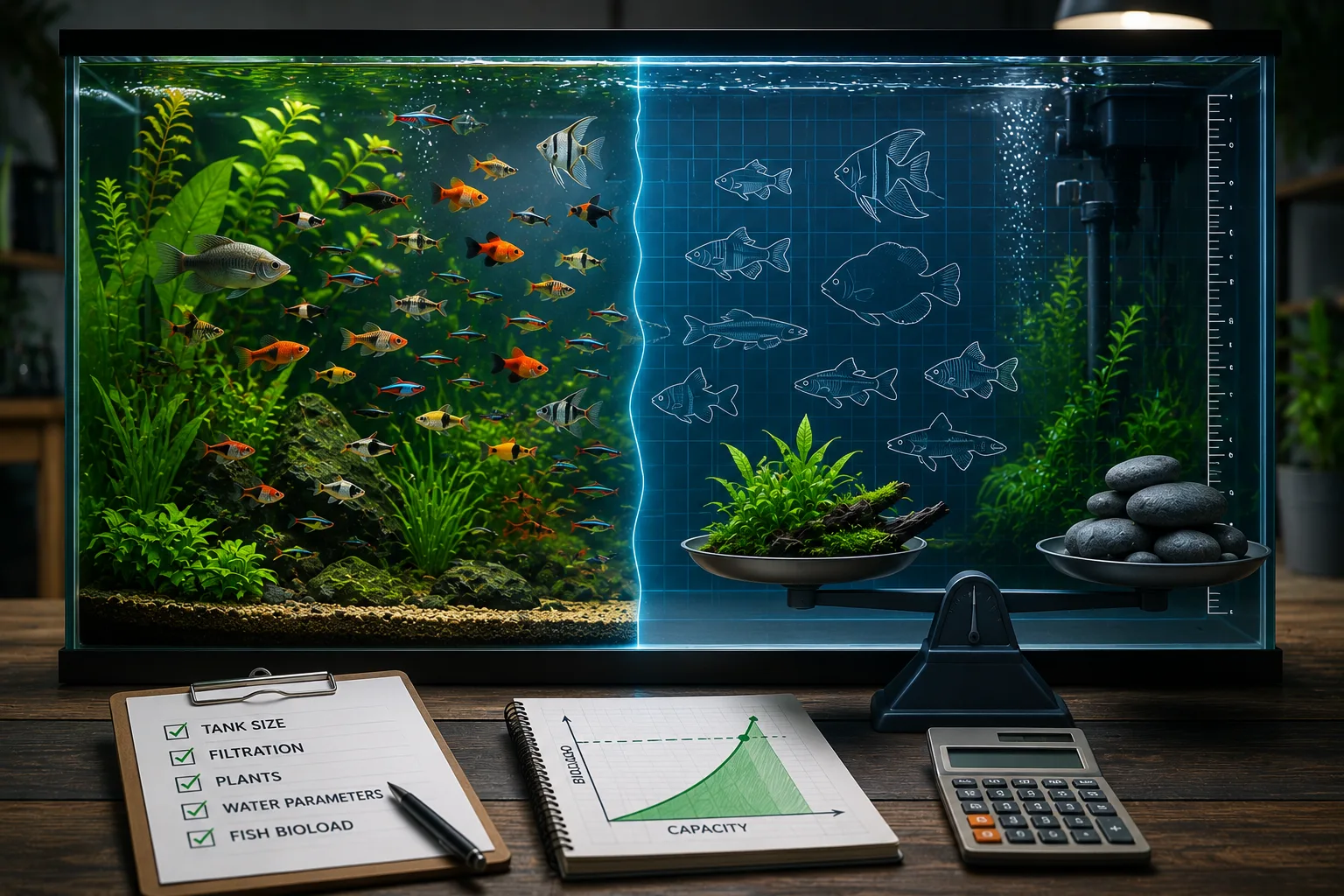
The real question is not “how many fish” — it is “what are the actual constraints that limit how many fish this specific tank, with this specific equipment, maintained at this specific level, can sustain indefinitely without degrading water quality, fish health, or system stability?” That question has a more complex answer than a single number, but it is also a more useful one. A tank’s carrying capacity — borrowed from ecology, where it means the maximum population an environment can sustainably support — is determined by multiple factors operating simultaneously. The binding constraint is whichever limit is reached first.
This guide works through all of them.
Table of Contents
- The 1 Inch Per Gallon Rule: A Complete Autopsy
- Carrying Capacity: The Ecological Framework Applied to Aquariums
- The Four Real Constraints
- 3a. Biological Filtration Capacity
- 3b. Dissolved Oxygen
- 3c. Physical and Territorial Space
- 3d. Waste Accumulation Rate and Water Change Frequency
- Bioload: What It Actually Is and Why Body Length Is the Wrong Measure
- The Maintenance Multiplier: How Husbandry Shifts the Limits
- Dynamic Capacity: How a Tank’s Limit Grows Over Time
- System-Specific Stocking Constraints
- 7a. Planted Tanks
- 7b. Marine and Reef Systems
- 7c. Nano Tanks
- 7d. Shrimp and Invertebrate Systems
- A Practical Framework for Estimating Your Tank’s Capacity
- Warning Signs You Are Approaching or Exceeding Capacity
- Frequently Asked Questions
1. The 1 Inch Per Gallon Rule: A Complete Autopsy
The one-inch-per-gallon rule originated as a simplified heuristic for fish shop staff to give customers a quick answer that was better than no answer at all. It was never presented as scientifically grounded and was understood within the trade as a rough ceiling, not a target. Over decades it migrated from shorthand to doctrine, appearing in beginner guides and care sheets as if it were a biological law.
Here is what it actually assumes and why each assumption fails:
It assumes all fish produce waste proportionally to their body length. A 10cm goldfish and a 10cm neon tetra are not remotely comparable in bioload. Goldfish are prolific waste producers with fast metabolisms and large digestive output. Neon tetras are small, lightly built fish with minimal metabolic waste. The rule treats them identically.
It assumes body shape is irrelevant. A 10cm severum cichlid has a deep, disc-shaped body. A 10cm pencilfish has a laterally thin, needle-like profile. The severum has perhaps five to seven times the body mass of the pencilfish. Mass — not length — drives metabolic rate and waste production. The rule ignores this completely.
It assumes metabolic rate is constant across all species. It is not. High-metabolism, active species — danios, barbs, many live-bearers — produce more waste per gram of body weight than sedentary, low-metabolism species — loaches, many catfish at rest. Feeding behaviour compounds this: a fish that actively hunts and consumes more food per day produces more ammonia per day regardless of body length.
It ignores dissolved oxygen entirely. Fish respire continuously. They consume dissolved oxygen and exhale CO₂. Dissolved oxygen availability is determined by surface area, temperature, and surface agitation — not tank volume. A deep, narrow tank with poor surface agitation will hit an oxygen ceiling far below what the volume calculation suggests.
It ignores territory and behaviour. A tank holding ten small fish that are highly territorial may be behaviourally overstocked even if the water quality is excellent. The rule has no mechanism to capture this.
It produces dangerous outputs for nano tanks. A 20-litre nano tank, by the rule, supports roughly 5cm of fish — barely a single small fish. Real nano tanks, well-filtered and maintained, support communities of small species at higher density. The rule is least accurate precisely where beginners are most likely to apply it.
It produces dangerous outputs in the other direction for large tanks. A 500-litre tank, by the rule, supports 125cm of fish. At adult size, that could be one large oscar, five medium cichlids, or dozens of small tetras. The rule cannot distinguish between these situations and produces equally meaningless guidance for all of them.
The one-inch-per-gallon rule should be understood as a historical artifact of retail trade, not a biological framework. It is presented here to be retired, not applied.
2. Carrying Capacity: The Ecological Framework Applied to Aquariums
In ecology, carrying capacity (K) is the maximum population size of a species that an environment can sustain indefinitely, given the available resources — food, space, oxygen, shelter, and the removal of waste products. When a population exceeds K, resources become limiting, competition intensifies, stress increases, immune function degrades, and mortality rises until the population returns to or below K.
This framework maps precisely onto aquarium stocking. The “resources” in an aquarium are biological filtration capacity, dissolved oxygen, physical space, and the waste removal provided by water changes. When the fish population exceeds the tank’s carrying capacity on any of these axes, the system begins to degrade — water quality declines, fish experience chronic stress, immunity is suppressed, and losses begin.
The key insight from ecological carrying capacity that most aquarium guides miss: K is not fixed. In nature, carrying capacity fluctuates with seasons, resource availability, and environmental change. In an aquarium, carrying capacity is actively managed — it increases when you add better filtration, increase water change frequency, add live plants, or improve surface agitation. It decreases when filtration degrades, maintenance lapses, or seasonal temperature rises reduce dissolved oxygen.
A tank’s capacity is also different at six weeks, six months, and two years after setup. A newly cycled tank has the minimum viable biological filtration capacity. A mature tank with years of diverse biofilm development, deep substrate communities, and established microbial ecology has substantially higher effective capacity. Understanding this explains why experienced hobbyists successfully maintain fish densities that would crash a newer tank with identical hardware.
The ecological science underpinning carrying capacity in closed aquatic systems — including how biomass, metabolism, and resource limitation interact — is covered in depth in the Carrying Capacity in Aquariums pillar article. For the broader framework of how these dynamics connect to ecosystem stability and failure, the Aquarium Stability Is Not Balance cornerstone article is the reference point.
3. The Four Real Constraints
A tank’s effective carrying capacity is the minimum of four independently operating constraints. Exceeding any one of them degrades the system regardless of what the others indicate. The binding constraint is the weakest link — and identifying your weakest link is the key practical output of this analysis.
3a. Biological Filtration Capacity
The primary waste product of fish is ammonia — excreted directly through the gills and produced by the decomposition of uneaten food and faeces. Ammonia is acutely toxic, and in an established tank it is processed by the nitrifying biofilm communities in the filter media and substrate. The complete science of this process is covered in the How to Cycle a Fish Tank guide.
Biological filtration capacity is determined by the surface area and density of the nitrifying biofilm — specifically, how much ammonia per day it can oxidise completely to nitrate before any accumulates in the water column. This is a measurable, finite quantity. When the daily ammonia load produced by the fish exceeds the filter’s processing capacity, ammonia begins to accumulate. The cycle does not fail dramatically — it simply lags, and chronic low-level ammonia exposure begins to suppress fish immune function.
What determines biological filtration capacity:
- Volume and type of biological media in the filter. Surface area is the primary variable — sintered glass and ceramic biological media provide orders of magnitude more colonisable surface than mechanical sponge of equivalent volume
- Maturity and diversity of the biofilm community — an established filter processes ammonia more efficiently than a newly cycled one. This maturation effect is significant and is one reason experienced hobbyists can sustain higher densities than beginners with identical hardware
- Temperature — nitrification accelerates toward 28–30°C and slows significantly below 20°C
- Oxygen levels — nitrifying bacteria are strict aerobes; poor oxygenation reduces processing capacity
- Maintenance history — a filter cleaned in tap water loses most of its biological capacity immediately
The practical implication: Filter sizing is biological capacity sizing. A filter rated for a 100-litre tank is rated for average stocking in a moderately maintained tank. A heavily stocked tank needs filtration rated for significantly more than the actual tank volume. Biological capacity scales with media volume, not flow rate. For a detailed treatment of filter sizing and biological media selection, see Aquarium Filtration: The Backbone of a Healthy Aquarium. For the microbial science of why surface area determines biological capacity — and why biofilm structure matters more than bacterial species — see Biofilms — The Invisible Engine of Every Aquarium. The Aquarium Flow and Filtration Calculator provides a sizing estimate for your specific tank volume and stocking level.
3b. Dissolved Oxygen
This constraint is almost completely absent from mainstream stocking discussions, yet it is the most immediately lethal when exceeded. Fish require dissolved oxygen continuously. They consume it through gill respiration and produce CO₂ as a metabolic waste product. Dissolved oxygen in aquarium water replenishes through gas exchange at the water surface — oxygen enters, CO₂ exits. Surface agitation accelerates this exchange.
At 26°C, freshwater holds approximately 8mg/L of dissolved oxygen at saturation. This is the ceiling — water cannot hold more than this under normal conditions at this temperature. As temperature rises, this solubility drops: at 30°C, approximately 7.5mg/L; at 34°C, approximately 7mg/L. Fish metabolism simultaneously increases with temperature — more oxygen consumed per fish per hour, while less is available in the water. This compound effect is why Indian summer is a stocking-stress multiplier, covered in full in the Aquarium Water Temperature in Indian Summer guide.
What limits the oxygen constraint:
- Water surface area — the gas exchange zone. A tall, narrow tank with the same volume as a wide, shallow tank has significantly less oxygen exchange capacity
- Surface agitation — a still surface exchanges gas slowly; strong agitation dramatically accelerates it
- Number and activity level of fish — active species consume more oxygen than sedentary ones
- Temperature — higher temperature means lower maximum dissolved oxygen and higher metabolic demand simultaneously
- Plant photosynthesis — in a well-lit planted tank during daylight hours, plants produce net oxygen. After lights-out, all organisms consume oxygen — in a heavily planted, heavily stocked tank, nighttime dissolved oxygen depletion can be significant
3c. Physical and Territorial Space
Water quality can be perfect and a tank can still be meaningfully overstocked — when the physical and psychological space available is insufficient for the fish it contains.
Fish have spatial requirements beyond enough room to swim. Many species establish and defend territories. Schooling species require sufficient visual separation to behave naturally. Bottom-dwellers require access to specific substrate zones for foraging, resting, or shelter. Species with strong hierarchical structures need adequate subordinate escape routes to prevent dominant individuals from harassing subordinates into chronic exhaustion.
When physical space is insufficient for the behavioural needs of the stocking, the consequences are chronic stress — even in chemically pristine water. Chronically stressed fish show immune suppression, colour loss, reduced feeding, and shortened lifespan. Parameters look fine. Fish deteriorate. This is the invisible dimension of overstocking that water chemistry testing cannot reveal. The physiological mechanism of how stress degrades fish health over time is covered in detail in The Science of Fish Stress.
The practical implication: Species with territorial behaviour need adequate space and sight-line breaks. Dense planting and physical hardscape dividers reduce this constraint substantially. Species selection that avoids territorial overlap between dominant individuals is the most effective way to manage this ceiling without reducing fish numbers.
3d. Waste Accumulation Rate and Water Change Frequency
Even a perfectly functioning nitrogen cycle does not remove nutrients from the aquarium — it converts ammonia to nitrite to nitrate, and nitrate accumulates continuously. Water changes are the primary mechanism for removing nitrate and other dissolved waste products that the nitrogen cycle does not address — dissolved organics, phosphate, hormones, and pheromones that build up over time.
The rate at which nitrate accumulates is a direct function of bioload. A heavily stocked tank accumulates nitrate faster than a lightly stocked one. A tank maintained with weekly 30% water changes can sustain a higher bioload than an identical tank maintained with monthly 20% water changes — not because the fish or filter differ, but because the waste export rate is higher.
This means carrying capacity scales directly with maintenance frequency — one of the most practically important relationships in aquarium stocking and one almost never made explicit. It also means that stocking advice given without reference to the intended maintenance regime is incomplete. It also means that stocking advice given without reference to the intended maintenance regime is incomplete. For the full framework of how water chemistry management interacts with stocking, the Complete Water Chemistry Guide provides the reference detail. The Aquarium Water Change Calculator lets you model the exact volume and frequency needed to hold nitrate below target at a given bioload — a practical way to test whether your maintenance commitment matches your intended stocking level before adding fish.
4. Bioload: What It Actually Is and Why Body Length Is the Wrong Measure
Bioload is the total metabolic waste load that the fish population imposes on the system per unit of time. It is driven by three factors:
Body mass, not body length. Fish mass scales with the cube of length — a 10cm fish has approximately eight times the body mass of a 5cm fish of the same species, not twice. A goldfish at 20cm has the body mass of roughly 60–80 neon tetras at 3.5cm. Their proportional bioload relationship is similar. No length-based rule captures this.
Metabolic rate. Different species at the same body mass produce different amounts of waste, driven by metabolic rate. High-metabolism, active species produce more ammonia per gram per day than sedentary species. Water temperature compounds this: the same fish at 28°C produces measurably more ammonia than at 22°C, as metabolic rate scales with temperature.
Feeding rate. The more a fish eats, the more it excretes. Species fed heavily produce proportionally more waste regardless of body size. This is relevant when fish are being fed aggressively for growth or conditioning — their effective bioload during that period exceeds calculations based on resting body size. For how overfeeding interacts with waste accumulation and water quality, see Common Aquarium Issues: Overfeeding and Nutritional Imbalances.
Approximate relative bioload by species type (rough guidance, not a formula):
| Species Type | Relative Bioload per cm Adult Length |
|---|---|
| Goldfish / large cyprinids | Very high (4–6×) |
| Cichlids (medium–large) | High (2–3×) |
| Live-bearers (guppies, platies) | Moderate-high (1.5–2×) |
| Active schooling fish (danios, barbs) | Moderate (1–1.5×) |
| Small tetras, rasboras | Low-moderate (0.8–1×) |
| Corydoras catfish | Low (0.5–0.8×) |
| Bristlenose pleco | Low-moderate (0.7–1×) |
| Freshwater shrimp | Very low (0.05–0.1×) |
This table illustrates why a tank of goldfish and a tank of neon tetras of equivalent total body length are not equivalent biological systems — and why any rule that treats them as such is not a meaningful tool.
5. The Maintenance Multiplier: How Husbandry Shifts the Limits
Carrying capacity is not an intrinsic property of a tank — it is a property of the tank-plus-maintenance system. The same 120-litre tank maintained at two different husbandry levels has two meaningfully different carrying capacities.
What shifts carrying capacity upward:
- Increasing water change frequency and volume — a tank receiving 40% weekly water changes can sustain approximately double the bioload of the same tank receiving 15% fortnightly changes, as waste export rate is proportionally higher
- Adding biological filter media — more surface area for biofilm directly raises the biological filtration ceiling
- Adding live plants — actively growing vegetation consumes ammonia and nitrate directly, functioning as a parallel processing system alongside the filter
- Improving surface agitation — raising the dissolved oxygen ceiling permits higher sustained fish density
- Reducing feeding slightly — a tank fed once every 36 hours rather than twice daily reduces waste input measurably without stressing healthy fish
What shifts carrying capacity downward:
- Reducing water change frequency or volume
- Filter maintenance lapses — a partially clogged filter has reduced flow and reduced biological surface contact
- Summer temperature rise — reduces dissolved oxygen solubility while increasing metabolic waste production simultaneously
- Adding a high-bioload fish without commensurate maintenance adjustment
The implication: When you read that an experienced hobbyist keeps more fish per litre than the rules suggest, the unstated variable is almost always maintenance intensity combined with system maturity. Their tank sustains that density because they perform large, frequent water changes and have a mature, high-capacity biofilm community. For most hobbyists with realistic maintenance schedules, the ceiling is lower — which is appropriate and should be planned for honestly.
6. Dynamic Capacity: How a Tank’s Limit Grows Over Time
A newly cycled tank has the minimum viable biological filtration capacity — enough to prevent acute ammonia toxicity at the stocked level, with limited reserve. As a tank matures over months and years, several processes increase its effective carrying capacity:
Biofilm maturation and diversification. The nitrifying community grows denser and more efficient. More importantly, the broader microbial ecosystem — heterotrophic decomposers, protozoa that feed on bacteria, microinvertebrates — develops and diversifies. This broader community processes organic waste more completely, reducing the load that reaches the nitrifying community. A two-year-old filter processes waste more efficiently than a two-month-old filter with identical media. The successional stages of this development — and why the community that exists at month 2 is qualitatively different from the community at month 18 — are covered in Microbial Succession in Aquariums.
Substrate community development. In established tanks with fine substrate, complex microbial communities develop in deeper anaerobic zones that can partially denitrify — converting nitrate back to nitrogen gas. This process is slow and partial in most freshwater substrates but measurable in a deeply established system. For how substrate choice affects long-term biological community development, see the Substrate Strategy guide.
Plant establishment. If live plants are present, root systems expand and total biomass increases over the first 3–6 months, consuming proportionally more nutrients in steady state than newly introduced plants.
Resilience to perturbation. A mature tank’s microbial community is not just larger but more robust — it recovers from disruptions faster and absorbs shocks that destabilise younger systems. For the full treatment of how tank ecology develops over time, see The Role of Time in Aquariums.
The new tank safety margin: For the first 3–4 months after completing the nitrogen cycle, stock at 60–70% of your estimated target carrying capacity. Build to full intended stocking gradually as the system matures, monitoring parameters at each stage.
7. System-Specific Stocking Constraints
7a. Planted Tanks
A densely planted tank with actively growing vegetation and adequate light can sustain a meaningfully higher fish density than an equivalent unplanted tank. Plants consume ammonia directly and preferentially, consume nitrate, consume phosphate, and sequester nutrients into biomass growth — functioning as a parallel processing system alongside the filter.
However, the benefit is conditional:
Plants must be actively growing. A planted tank where plants are struggling — insufficient light, wrong water chemistry, damage from fish — provides negligible additional carrying capacity. Nutrients are only processed when plants are photosynthesising vigorously.
Nighttime oxygen depletion is a real constraint. During the photoperiod, a well-lit planted tank produces net oxygen. After lights-out, photosynthesis stops and all organisms respire, consuming oxygen. In a heavily planted, heavily stocked tank, dissolved oxygen can drop significantly overnight. Fish gasping at the surface in the morning but fine during the day is the diagnostic sign. Supplementary aeration running overnight resolves it.
The planted tank advantage is real but bounded. Plants do not raise the filter’s biological capacity, do not eliminate the dissolved oxygen constraint after dark, and do not change territorial space requirements. The advantage is most pronounced in nitrate management — well-planted tanks require less frequent water changes to maintain equivalent nitrate levels. For how CO₂ and water chemistry interact with plant performance in harder water conditions, see the CO₂ in Delhi NCR Aquariums guide.
7b. Marine and Reef Systems
Marine systems are the most demanding aquarium type with respect to stocking density, for compounding reasons.
Dissolved oxygen solubility is lower in saltwater than freshwater at equivalent temperatures — seawater at 26°C holds approximately 6.7mg/L compared to 8mg/L for freshwater, reducing oxygen headroom from the outset. Biological filtration matures more slowly in marine systems. Marine fish are generally larger and higher metabolism than the small schooling species that form the basis of most freshwater communities. And coral and invertebrate sensitivity to dissolved organics and nitrate is high — reef systems should maintain nitrate below 5–10ppm, far lower than the 20–40ppm most freshwater fish tolerate. This means waste must be processed and exported far more aggressively, through protein skimmers, refugiums with macroalgae, and deep sand beds.
A conservative stocking target for a fish-only marine system is approximately one small-to-medium fish per 80–100 litres. For a reef system with sensitive corals, one fish per 150–200 litres is a more appropriate starting target.
7c. Nano Tanks
Tanks under 40 litres present constraints that make standard calculations even less reliable:
Parameter swing speed. In a small water volume, a single piece of uneaten food or one fish death causes proportionally larger parameter shifts than in a large tank. A 20-litre tank has almost no buffer against mistakes — an ammonia spike that a 200-litre tank absorbs without visible effect can spike a nano tank within hours.
Temperature instability. Small water volumes heat and cool faster, which matters significantly in Indian conditions where a nano tank without active cooling can spike several degrees above ambient during the afternoon.
Filtration capacity is often undersized. Nano filters marketed for specific volumes frequently have insufficient biological media for a fully stocked tank at that volume. The practical solution: choose a filter with more biological media than the rated capacity, or supplement with a small sponge filter run in parallel.
The practical nano approach: Stock cautiously, choosing species under 3cm adult length, maintaining appropriate group sizes, and using more frequent small water changes rather than less frequent large ones. For appropriate nano species and group sizes, see the Best Community Fish for Beginners guide.
7d. Shrimp and Invertebrate Systems
Freshwater shrimp have extremely low bioload relative to their apparent population density — a colony of 30 cherry shrimp in a 30-litre tank produces less waste than two small tetras. The constraints for shrimp tanks are not bioload or dissolved oxygen but parameter stability and water chemistry precision.
Shrimp are sensitive to ammonia at concentrations fish would survive without visible effect. In shrimp systems, the target is permanent zero ammonia rather than “processed within 24 hours.” This requires a well-matured filter, not merely a cycled one.
TDS creep — the slow concentration of dissolved minerals as water evaporates — stresses shrimp even when individual parameter readings appear normal. Top up with RO or distilled water exclusively to avoid this. A mature, stable 30-litre shrimp tank can support 50–80 cherry shrimp without meaningful water quality concerns. The constraint is stability and chemistry, not raw bioload.
8. A Practical Framework for Estimating Your Tank’s Capacity
Rather than applying a single rule, estimate your tank’s capacity by calculating each of the four constraints and identifying which is limiting your specific setup.
Step 1 — Biological filtration ceiling. Before beginning, confirm your tank’s actual water volume using the Aquarium Volume Calculator — the filled volume accounting for substrate, hardscape, and equipment is often 10–15% lower than the gross dimension calculation suggests, and that difference affects every subsequent step. Then count the volume of dedicated biological media in your filter in litres. As a rough working benchmark, one litre of quality sintered glass or ceramic biological media in a mature, well-oxygenated filter can process the waste from approximately 5–8 small tropical fish (3–5cm adult length) under normal maintenance. Multiply your media volume by this figure. If your filter is mostly mechanical sponge with minimal biological media, this ceiling is significantly lower. Adding dedicated biological media is the highest-leverage single action to raise this constraint.
Step 2 — Dissolved oxygen ceiling. Calculate your tank’s surface area in cm² (length × width). For a tank with strong surface agitation, a rough working figure is one small-to-medium tropical fish per 100cm² of surface area. Without surface agitation, reduce this by 40–50%. In summer months with temperatures consistently above 28°C, apply a further 15–20% reduction.
Step 3 — Territorial space assessment. This constraint requires species knowledge rather than calculation. Does any intended species establish and defend territory? Does any species need a minimum group size to behave normally? Are there adequate sight-line breaks and shelter provided? If highly territorial species are included, reduce your estimated capacity proportionally to the space those territorial requirements consume.
Step 4 — Waste accumulation ceiling. As a working guide for a fish-only freshwater tank targeting nitrate below 20ppm: a 30% weekly water change allows approximately twice the sustainable bioload of a 15% weekly water change. Assess your realistic maintenance commitment honestly and calibrate your target accordingly.
Take the lowest output of all four steps. Stock to 75–80% of that figure initially, monitor ammonia, nitrite, and nitrate weekly for the first month, and adjust gradually from there.
For a guided application of these principles to your specific tank, the ProHobby™ Aquarium Stocking Calculator provides an interactive tool incorporating dimensions, filter setup, species selection, and maintenance frequency.
9. Warning Signs You Are Approaching or Exceeding Capacity
Parameters are a lagging indicator of stocking stress — by the time ammonia or nitrite registers in a cycled tank, the system has been struggling for some time. These are the earlier signals:
Behavioural changes before water quality changes:
- Increased aggression or fin-nipping in species not previously exhibiting it — territorial stress from crowding
- Reduced feeding in certain individuals — typically subordinates being outcompeted for food or space
- Fish spending unusual time at the water surface — approaching dissolved oxygen constraint, particularly noticeable in the morning before lights-on when plant oxygen production has been absent overnight
- Colour fading without visible disease — chronic stress from crowding suppresses pigmentation before other symptoms appear
Water quality signals:
- Ammonia reading above zero in a fully cycled tank, however briefly — production is occasionally exceeding processing capacity
- Nitrate climbing faster between water changes than the established baseline
- pH dropping faster than previously — accumulating dissolved CO₂ and organic acids from elevated biological activity
- Water clarity declining without an obvious cause — elevated dissolved organics from a high-bioload system
Recurring disease patterns: A cycled, maintained tank that repeatedly develops bacterial infections, fungal outbreaks, or where fish consistently recover slowly from minor injuries is often a chronically overstressed system where immune suppression is the underlying cause. For the full framework on why most aquarium losses are environmental rather than directly pathogenic, see Why Most Aquarium Deaths Are Environmental, Not Disease-Related. For a systems-level diagnostic framework when things keep going wrong despite apparent parameter stability, see Why Aquariums Fail in Delhi NCR. For a stage-by-stage diagnosis of fish death patterns — including the specific signs that distinguish overstocking stress from disease — the next article in this series, Why Do My Aquarium Fish Keep Dying, covers the complete framework.
10. Frequently Asked Questions
What is the most fish I can keep in a 100-litre tank? There is no single correct answer — it depends on species bioload, filter biological capacity, surface agitation, maintenance frequency, and whether live plants are present. A 100-litre tank with good filtration, strong surface agitation, weekly 30% water changes, and small species like pygmy Corydoras and small tetras can sustainably support 25–35 small fish. The same tank with medium-large cichlids is appropriate for 3–4 individuals. The species, not just the number, determines the answer.
Does a bigger filter mean I can keep more fish? A filter with more biological media does raise the biological filtration constraint. But it does not raise the dissolved oxygen ceiling, the territorial space ceiling, or the waste accumulation rate. A bigger filter is one tool among four. It also does not compensate for neglected maintenance — a large, poorly maintained filter can have lower effective biological capacity than a small, well-maintained one.
My water tests perfect — does that mean I am not overstocked? Not necessarily. Parameters test the biological filtration and waste accumulation constraints but not dissolved oxygen (unless tested specifically) and not the territorial and behavioural space constraint at all. A tank can test perfect while fish experience chronic stress from territorial crowding or nighttime oxygen depletion. Test results are necessary but not sufficient evidence of appropriate stocking.
Can I increase my tank’s carrying capacity without buying a bigger tank? Yes. In order of impact: increase water change frequency and volume; add quality biological filter media; improve surface agitation; add live plants with adequate light; reduce feeding slightly. Each raises one or more of the four constraints. Together they can substantially increase a tank’s sustainable carrying capacity within its existing dimensions.
How do live plants affect how many fish I can keep? Actively growing plants in good light raise the waste accumulation ceiling — they consume ammonia and nitrate directly and reduce the load on the filter. A densely planted, well-lit tank can sustain perhaps 20–30% more bioload than an equivalent unplanted tank under similar maintenance. They do not raise the filter’s peak-load biological capacity, and they reduce dissolved oxygen after dark if stocking is high.
Why can experienced hobbyists keep more fish than the rules allow? Usually two compounding reasons: their tanks are mature (higher biological capacity through established biofilm communities) and their maintenance is intensive (frequent, substantial water changes). Both factors raise carrying capacity above the baseline that rules are written for. Rules are calculated for average conditions and average maintenance — experienced hobbyists often operate significantly above average on both axes.
What happens if I overstock? Not an immediate crash in a cycled tank, but a slow degradation. Chronic low-level ammonia or nitrite exposure suppresses fish immune function over weeks and months. Fish become more susceptible to opportunistic infections. Growth slows. Colours fade. Subordinate individuals decline before others. The system does not announce overstocking — it reveals it gradually through declining fish health. By the time disease appears, the stocking problem has been ongoing for some time. The systems-level pattern of how aquariums fail under chronic stress is covered in Why Aquariums Fail: A Systems-Level Diagnosis.
Is there a formula I can use to calculate exactly how many fish I can keep? Exact calculation requires measuring your filter’s biofilm processing capacity, your water’s dissolved oxygen at your typical temperature, your precise maintenance schedule, and your species’ specific bioload and territorial requirements — most of which require estimation rather than direct measurement. Practical stocking assessment uses frameworks and monitoring rather than precise calculation. The four-constraint framework in Section 8 above is the recommended starting point. Apply it conservatively, monitor parameters for the first four to six weeks, and adjust gradually based on how the system responds.