
By ProHobby™ | Ecological Systems Authority
Almost every hobbyist who searches for how to get rid of snails in their aquarium is asking the wrong first question. The real question is not how to remove the snails currently visible on the glass — that is trivial, achievable in an afternoon with a net. The real question is why a tank that had no visible snails a month ago now has dozens, and why removing all of them today does nothing to prevent the same population explosion within weeks. Snails are not, in the overwhelming majority of cases, introduced to an aquarium as adult animals that a hobbyist somehow failed to notice. They arrive as eggs or juveniles too small to see, on plants, on decor, in bags of fish — and then they sit at a low, unnoticed population for weeks or months until something in the tank changes to make that population explode. Understanding what that something is, is the actual solution. Everything else — manual removal, assassin snails, chemical treatment — is management of a symptom whose cause most guides never explain.
This guide also addresses the opposite confusion that trips up an equally large number of hobbyists: not every snail is a pest, and at least one commonly kept species — mystery and apple snails — is deliberately purchased and actively cared for, yet is routinely lumped in with genuine pests by search engines and general guides that fail to make the distinction clear.
Table of Contents
- Snails Are Not Introduced — They Are Already There
- Why Populations Explode — The Actual Biological Trigger
- The Self-Fertilisation Problem — Why One Snail Is Enough
- Identification — The Species That Actually Matter
- Snails Eating My Plants — Which Species Actually Do This
- Are Snails Actually Pests? The Honest Ecological Case
- Malaysian Trumpet Snails — The Special Case
- Mystery and Apple Snails — Deliberately Kept, Not Pests
- Is My Snail Dead or Just Resting? — The Diagnostic Guide
- Manual Removal — Techniques That Actually Work
- Assassin Snails — What They Actually Do and Don’t Do
- Predatory Fish — A More Reliable Biological Control
- Chemical Treatment — The Toxin Release Problem
- Copper-Based Products — Why They Are Dangerous in Planted and Shrimp Tanks
- Snail Eggs — Identification and Removal
- Prevention — Where Snails Actually Come From
- The Population Ceiling Principle — Why You Cannot Fully Eliminate Them
- When Snail Overpopulation Signals a Bigger Problem
- India — Sourcing, Availability and Practical Realities
- Frequently Asked Questions
1. Snails Are Not Introduced — They Are Already There
The dominant hobbyist narrative is that snails “got into” the tank from a specific contaminated source — a new plant, most commonly — and this is broadly correct as far as it goes. What it misses is the timeline. A snail egg mass or a single juvenile snail small enough to be invisible to the naked eye, arriving attached to a plant leaf or hidden in the crevice of a piece of driftwood, does not produce a visible infestation the following week. It produces nothing visible for a period that can run from several weeks to several months, during which the snail or the small number of snails that hatched are present in the tank at a population so low that a hobbyist doing normal maintenance genuinely does not see them.
This matters because it means the moment a hobbyist first notices snails is very rarely the moment snails were introduced. By the time snails are visible in meaningful numbers, the population has already been present and breeding, unnoticed, for a period long enough that the actual introduction event — the plant, the decor, the fish bag — is usually long forgotten and impossible to trace with any confidence. The practical implication, developed fully in Section 16, is that prevention has to happen at the point of introduction, before any snail is visible, because by the time snails are visible the preventive window has already closed.
2. Why Populations Explode — The Actual Biological Trigger
This is the single most important concept in this entire guide, and the piece of information almost no snail-control guide actually explains: snail population size in an aquarium is not determined primarily by how many snails were originally introduced. It is determined by food availability, and specifically by the amount of decaying organic matter, uneaten food, and algae film present in the tank at any given time.
Snails are detritivores and grazers. Their reproductive rate, like that of nearly every opportunistic organism covered throughout this site’s disease and pest library, responds directly to resource availability — more food supports more successful reproduction and juvenile survival, less food constrains population growth regardless of how many adult snails are present to breed. A tank with one or two snails and consistently minimal excess food and organic waste will tend to sustain a correspondingly small, often barely visible snail population indefinitely. The exact same tank, following a period of overfeeding, a missed water change, or a decaying plant leaf left to rot in a corner, can see that same small founding population explode into dozens or hundreds of visible snails within a matter of weeks, entirely without any new snails being introduced from outside.
This is why removing every visible snail so rarely solves the underlying problem. If the food surplus that allowed the population to explode in the first place remains unaddressed, the small number of snails or eggs inevitably missed during manual removal — and some are always missed, given how effectively snails hide in substrate and decor — simply repeats the same explosion once again. Common Aquarium Issues: Overfeeding and Nutritional Imbalances covers the broader water quality and husbandry consequences of the same overfeeding pattern that drives snail population explosions specifically.
3. The Self-Fertilisation Problem — Why One Snail Is Enough
Most freshwater pest snail species relevant to this guide — bladder snails, pond snails, and ramshorn snails in particular — are simultaneous hermaphrodites, possessing both male and female reproductive organs at once. Several of the most common pest species, bladder snails (Physidae) especially, are additionally capable of self-fertilisation, meaning a single individual snail, with no mate present at all, can produce viable offspring on its own.
This single biological fact is the reason the common hobbyist assumption — “I only have one or two snails, they can’t be breeding” — is simply incorrect for several of the most commonly encountered pest species. A single bladder snail arriving on a new plant is, on its own, a fully sufficient founding population for an eventual infestation, requiring no second snail to arrive from anywhere. Combined with the food-driven population dynamics established in Section 2, this means that eliminating “the” snail seen on day one, while satisfying in the moment, provides no meaningful assurance that eggs it has already laid are not already present and developing in the substrate.
4. Identification — The Species That Actually Matter
Correct identification changes the entire management approach, because the species most commonly labelled “pest snails” as a single undifferentiated category actually have meaningfully different biology, different roles in the tank, and in some cases — covered fully in Sections 7 and 8 — arguably do not deserve the “pest” label at all.
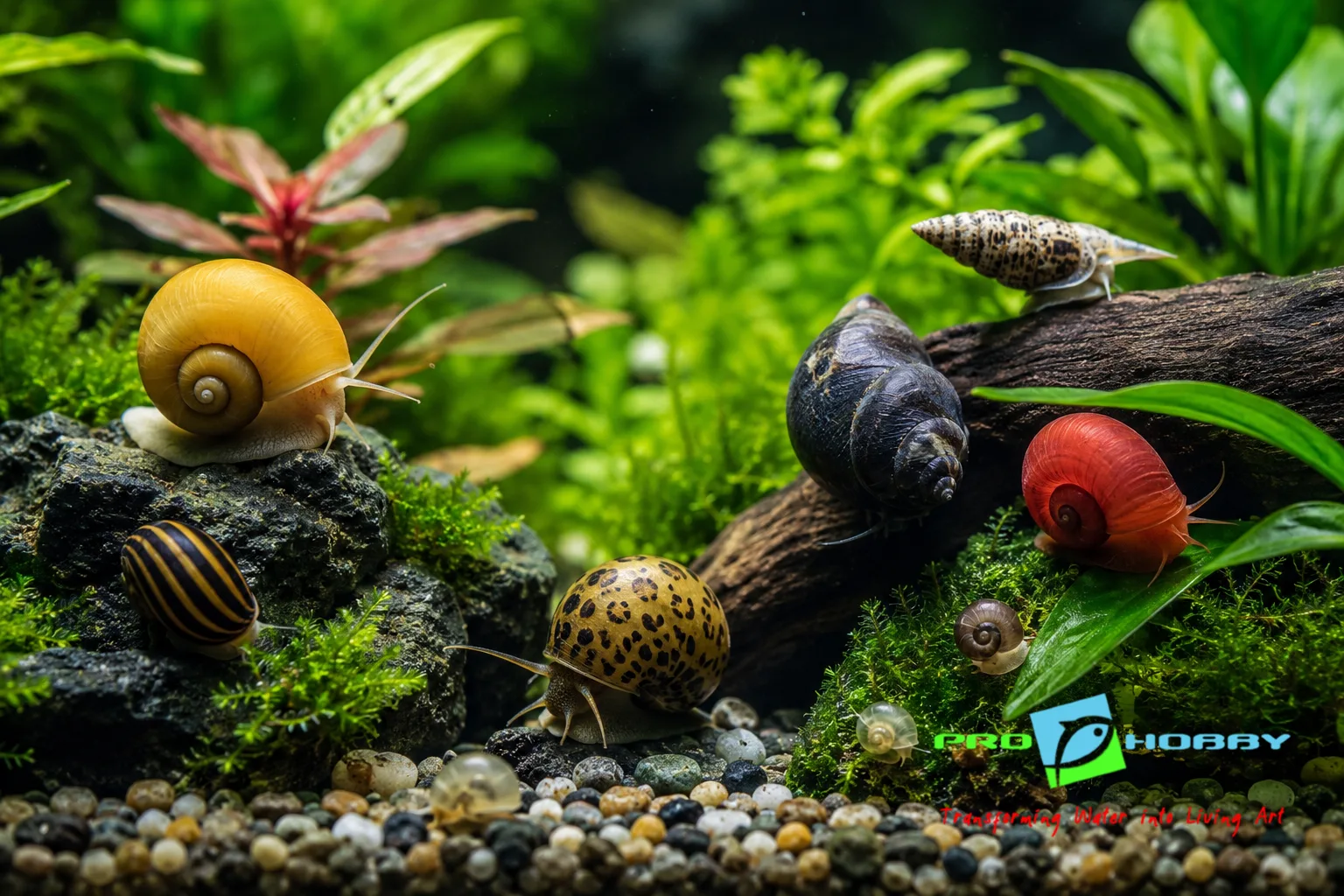
Pond snails (Lymnaeidae): Elongated, pointed shell, typically brown or olive. Voracious plant eaters relative to other common species, and the group most likely to cause genuine damage to soft-leafed live plants rather than confining themselves to detritus and algae. Prolific breeders, laying visible gelatinous egg masses on glass, decor, and plant leaves.
Bladder snails (Physidae): Small, thin-shelled, sinistral (left-coiling, distinguishable from ramshorn snails which coil in the same direction but have a flatter, disc-like shell shape). The species most associated with the self-fertilisation trait described in Section 3, and consequently one of the fastest-exploding populations of any common pest species.
Ramshorn snails (Planorbidae): Flat, coiled, disc-shaped shell, commonly red, brown, or blue depending on variety. Primarily algae and detritus grazers with a lower tendency toward live plant damage than pond snails, and consequently sometimes deliberately kept as a beneficial clean-up species rather than treated as a pest at all.
Malaysian Trumpet Snails (Melanoides tuberculata): Elongated, conical shell, burrows through substrate rather than grazing surfaces. Live-bearing rather than egg-laying, distinguishing their reproduction and identification from every other species in this list. Covered in a dedicated section given how frequently this species is misclassified as a straightforward pest when its actual ecological role is considerably more nuanced — see Section 7.
Mystery and apple snails (Pomacea and related genera): Considerably larger than any of the species above, often reaching several centimetres in shell diameter, and unlike every other species covered in this section, deliberately purchased and kept as a display animal in their own right rather than tolerated as an unwanted hitchhiker — covered in full in Section 8, since the management approach for this species is close to the opposite of everything else in this guide.
Nerite snails: Not a pest species in the context of this guide at all — nerite snails are widely and deliberately kept for algae control and are incapable of reproducing in freshwater aquariums (their larvae require brackish or marine conditions to develop), meaning nerite populations never explode the way the species above do. Mentioned here specifically so hobbyists do not mistake a deliberately introduced nerite for one of the problem species covered throughout the rest of this guide. The brackish-to-marine salinity requirement behind this reproductive quirk is covered in full in Marine and Reef Snails — Complete Guide, which also covers the fully marine clean-up crew species — Nassarius, Cerith, Astrea, and Turbo snails — relevant to any hobbyist keeping or transitioning toward a brackish or marine system.
5. Snails Eating My Plants — Which Species Actually Do This
This is one of the most commonly searched snail-related concerns, and the honest answer is more specific than most guides allow: genuine, significant live plant damage is overwhelmingly the work of pond snails specifically, not a general trait shared uniformly across every species covered in this guide.
Pond snails possess a radula — the rasping, tongue-like feeding structure common to all snails — adapted to processing plant tissue efficiently, and a substantial pond snail population in a heavily planted tank can produce genuinely visible, ragged feeding damage to soft-leafed species, particularly on younger, more tender growth and on plants already stressed or weakened by other factors.
Ramshorn and bladder snails, by contrast, are predominantly algae and detritus grazers, and while they will opportunistically feed on already-damaged, dying, or decaying plant tissue, they are not generally responsible for actively damaging healthy plant leaves the way pond snails are, meaning a ramshorn or bladder snail population is often incorrectly blamed for plant damage that either predates their presence or has an entirely separate cause.
The more common misdiagnosis: plant damage attributed to snails frequently has a different underlying cause entirely — nutrient deficiency, inadequate lighting, or the natural transition melt covered in Why Aquarium Plants Melt After Planting — with snails observed feeding on the already-compromised leaf tissue being mistaken for the cause of the damage rather than correctly identified as opportunistic feeders exploiting tissue that was already dying for unrelated reasons. Before assuming snails are responsible for plant health problems, ruling out these more common underlying causes, and specifically identifying whether pond snails are present in meaningful numbers as opposed to the generally plant-safe ramshorn, bladder, or Malaysian Trumpet Snail populations, produces a considerably more accurate diagnosis.
If pond snails are confirmed as the cause: the manual removal, biological control, and prevention approaches covered in Sections 10 through 16 apply directly, with pond snails specifically being one of the priority targets for active population reduction given the genuine plant-damage risk established in this section, distinguishing the urgency of their control from the generally more benign ramshorn, bladder, and Malaysian Trumpet Snail populations.
6. Are Snails Actually Pests? The Honest Ecological Case
This deserves to be addressed directly rather than assumed, because the honest answer is more nuanced than either the “snails are always a problem” or “snails are always fine” camps typically present.
The case that snails are not actually pests, ecologically speaking: every species covered in Section 4 aside from pond snails is overwhelmingly a detritivore and algae grazer, consuming uneaten food, decaying plant matter, and algae film that would otherwise accumulate and degrade water quality. In this sense, snails perform a genuinely useful clean-up function comparable to the role played by shrimp and other invertebrate clean-up crew species, and a moderate, stable snail population is, in ecological terms, a sign that the tank has established a detritus-processing pathway rather than a sign that something has gone wrong.
The genuine case against them: the objection is rarely ecological — it is aesthetic and, in the specific case of pond snails established in Section 5, a real risk to soft-leafed live plants. A tank with visible dozens of snails on every glass surface is unattractive to most hobbyists regardless of the ecological service those snails are providing, and this aesthetic objection is entirely legitimate and does not require any ecological justification to be a valid reason for control.
The practical synthesis: most hobbyists reaching for snail control are, whether they frame it this way or not, managing population density and visual presentation rather than eliminating a genuine ecological threat — which reframes the goal from eradication (extremely difficult to achieve completely, as established in Section 17) toward population management at a density the hobbyist finds acceptable, a considerably more achievable and sustainable target.
7. Malaysian Trumpet Snails — The Special Case
Malaysian Trumpet Snails deserve treatment separate from the general pest snail category because their ecological role is close to unambiguously beneficial, and the instinct to eliminate them the same way one would eliminate a pond snail infestation is, in most cases, working against the hobbyist’s own interests.
MTS burrow continuously through substrate as part of their normal feeding and movement behaviour, and this burrowing activity provides genuine substrate aeration — preventing the anaerobic dead zones and hydrogen sulphide pocket formation that can develop in undisturbed substrate over time, a mechanism covered in ecological depth in Aquarium Substrate Biogeochemistry. A substrate with an active MTS population is, in a genuine and measurable sense, healthier than the same substrate without them, particularly in deeper substrate setups or tanks that go extended periods between substantial substrate disturbance from other maintenance.
MTS are also primarily nocturnal and substrate-dwelling, meaning even a substantial population is considerably less visually obtrusive than the same population size of pond snails or ramshorn snails grazing openly on glass and plant leaves during the day — a population that is functionally controlling itself in terms of visual impact even without active management.
The practical recommendation: unless MTS population density has become genuinely excessive — visible during daytime in large numbers, a sign that population has outstripped even the fairly generous ecological niche this species occupies — active elimination of MTS specifically is rarely the correct response, and the manual removal, assassin snail, and chemical treatment methods covered in Sections 10 through 13 are generally better reserved for pond snails, bladder snails, and excessive ramshorn populations rather than applied indiscriminately to MTS as well.
8. Mystery and Apple Snails — Deliberately Kept, Not Pests
This section exists specifically to correct a search and identification error that catches a genuinely large number of hobbyists: mystery snails and the broader apple snail group (Pomacea species) are almost always deliberately purchased and kept as a display animal, not an unwanted pest, and treating a search for “mystery snail care” the same way as a search for pest snail removal produces exactly the wrong guidance.
Identification and the naming confusion: “mystery snail” and “apple snail” are terms applied, sometimes inconsistently across different retailers and regions, to a range of Pomacea species and their close relatives — considerably larger than any pest species covered in Section 4, often reaching 3–5 centimetres in shell diameter or more, and available in a range of deliberately bred colour varieties (gold, blue, ivory, and others) that immediately distinguish them from the plain-shelled pond, bladder, and ramshorn species they are occasionally confused with by hobbyists unfamiliar with the size and colour difference.
Care requirements distinct from pest species: unlike the largely self-sufficient pest species covered elsewhere in this guide, mystery and apple snails benefit from deliberate supplemental feeding (blanched vegetables, dedicated snail or shrimp-safe pellets) and specifically benefit from adequate calcium availability in the water to maintain healthy shell development — a genuine care consideration in soft or poorly mineralised water that is far less relevant to hardier pest species, and one directly connected to the general water hardness framework covered in Aquarium GH — General Hardness Complete Guide.
Breeding and population management: mystery and apple snails lay distinctive egg clutches above the waterline — a hard, calcified cluster typically deposited on the inside of a tank lid or on emergent decor, visually entirely different from the soft, gelatinous underwater egg masses of pond and ramshorn snails covered in Section 15 — and a hobbyist specifically not wishing to breed this species should remove and dispose of these above-waterline egg clutches before they hatch, since a mature mystery or apple snail population, given their larger individual size, can represent a more substantial bioload addition to a tank than an equivalent population of smaller pest species would.
The practical distinction that matters most: none of the population-reduction techniques covered in Sections 10 through 14 — manual trapping, assassin snails, chemical molluscicide treatment — should be applied to a tank containing deliberately kept mystery or apple snails without specifically excluding this species from any control effort, since chemical molluscicide treatment in particular does not discriminate between a genuine pest species and a deliberately kept display animal.
9. Is My Snail Dead or Just Resting? — The Diagnostic Guide
This is among the most commonly searched snail-related concerns and deserves a direct, practical answer, since snails — pest species and deliberately kept species alike — genuinely do spend extended periods motionless or withdrawn into their shell during normal, healthy behaviour, making the distinction between resting and dead a genuine and reasonable point of confusion.
Normal resting and aestivation: snails commonly remain still, fully or partially withdrawn into the shell, for extended periods as part of normal behaviour, particularly following a water parameter change, a period of lower water temperature, or simply as part of normal daily activity cycling — this alone is not a sign of illness or death and does not warrant immediate intervention.
The smell test: a dead snail decomposing in water produces a distinctive, strong, unpleasant odour within a relatively short period, often the single most reliable and immediate indicator available to a hobbyist without specialist equipment — a snail producing no detectable odour, even after remaining motionless for an extended period, is more likely resting than deceased.
The operculum and shell-gape test, where applicable: species with an operculum (a hard covering that seals the shell opening, present in nerite snails and Malaysian Trumpet Snails among others, though notably absent in ramshorn and pond snails) that remains tightly closed when gently touched or disturbed generally indicates a living animal maintaining normal defensive response — an operculum that has fallen away or a shell that hangs open and unresponsive to gentle stimulation is a stronger indicator of death. For species without an operculum, gently touching the exposed soft tissue and observing for any retraction response serves a broadly similar diagnostic function.
Floating as a specific sign: a snail floating persistently at the water surface, particularly one that has been submerged and active previously, can indicate gas buildup associated with internal decomposition and is generally a more reliable indicator of death than motionlessness on the substrate or glass alone, though some healthy snail species do use surface floating as a normal means of locomotion, meaning this sign is best interpreted alongside the smell and touch-response tests above rather than in isolation.
When in doubt: removing a snail suspected of being dead to a separate container of tank water for closer, unhurried observation — checking for smell, touch response, and any movement over a period of 15–30 minutes — is a more reliable approach than attempting to make the determination in situ, and errs toward the safer outcome given the water quality risk of leaving a genuinely dead snail decomposing in the main tank, covered further in the chemical treatment context in Section 13.
10. Manual Removal — Techniques That Actually Work
Manual removal is the lowest-risk, zero-toxin intervention available and should generally be the first response to any pest snail population before considering the biological or chemical controls covered in subsequent sections, both because it carries none of the toxin-release risk detailed in Section 13 and because it directly addresses visible adult population without requiring any waiting period for a biological control to establish.
Hand removal: Straightforward physical picking of visible snails from glass, decor, and plant leaves, most effective as a nightly routine over 1–2 weeks given that most pest species are most active after lights-out — a single removal session, however thorough, will always miss individuals sheltering in substrate or decor crevices during daylight.
Trap-based removal: Commercial snail traps, or a simple improvised trap using a piece of blanched vegetable (lettuce, cucumber, or courgette) weighted down overnight, exploit snails’ strong attraction to fresh food sources — snails congregating on the bait can then be removed en masse the following morning, considerably more efficient than individual hand-picking for larger populations. This method should be repeated over several consecutive nights, since a single trapping session, like hand removal, will not capture snails that were sheltering rather than actively foraging on the night in question.
Substrate disturbance and inspection: For species that burrow or shelter in substrate — MTS specifically, though excessive removal of this generally beneficial species should be reconsidered per Section 7 — periodic substrate stirring during maintenance brings sheltering individuals to the surface where they become visible and removable, alongside providing the substrate aeration benefit MTS naturally provide as part of normal maintenance regardless of removal intent.
The persistent limitation of manual removal alone: given the egg-laying biology covered in Section 15 and the population dynamics established in Section 2, manual removal without also addressing the underlying food surplus driving population growth will reliably see the population rebuild from missed individuals and unhatched eggs, regardless of how thorough any individual removal session was.
11. Assassin Snails — What They Actually Do and Don’t Do
Assassin snails (Clea helena) are widely marketed and sold specifically as a biological pest snail control solution, and they are genuinely effective within a specific, limited scope that is worth understanding clearly rather than assuming they represent a complete or instant solution.
What they actually do: Assassin snails are predatory, actively hunting and consuming other snail species, including the eggs of some species, and an established assassin snail population will measurably suppress pond snail, bladder snail, and ramshorn snail populations over a period of weeks to months as the predators work through the existing population.
What they don’t do — the limitations that matter:
Assassin snails breed considerably more slowly than the pest species they are intended to control — they lay eggs individually rather than in the large gelatinous masses typical of pond and ramshorn snails, and juvenile assassin snails take substantially longer to reach a size capable of preying on adult pest snails than pest snail populations take to rebound from any given reduction. This means assassin snails control an existing population gradually rather than eliminating it quickly, and a severe existing infestation should be expected to take weeks to months to bring under control through assassin snails alone, not days.
Assassin snails are considerably less effective against Malaysian Trumpet Snails specifically than against surface-dwelling species, given MTS’s substrate-burrowing behaviour described in Section 7 provides genuine refuge from predation that pond and ramshorn snails grazing openly on visible surfaces do not have — a further reason MTS populations often persist even in tanks with an established, otherwise effective assassin snail population, and a further reason to reconsider whether MTS elimination is actually the correct goal per Section 7.
Assassin snails will also predate on juvenile mystery or apple snails and, given the size difference established in Section 8, are best not introduced to a tank where breeding mystery or apple snails specifically is a deliberate goal.
Assassin snails are themselves snails, will reproduce and establish their own ongoing population once introduced, and require the same food-availability consideration established in Section 2 — an assassin snail population introduced to a tank that has already had its underlying overfeeding or organic waste problem corrected will have a limited food supply of their own once the pest population they were introduced to control has been substantially reduced, and population size will self-limit accordingly rather than continuing to expand indefinitely.
Assassin snails are not universally reef- or invertebrate-tank-compatible — they will also predate on shrimp, particularly vulnerable moulting or juvenile shrimp, meaning introduction to an established shrimp colony, covered in the Shrimp Tank Setup and Cherry Shrimp Care guides, warrants caution and is not automatically compatible simply because both are commonly kept invertebrates.
12. Predatory Fish — A More Reliable Biological Control
Several commonly kept fish species are genuine, effective snail predators and represent an alternative or complementary biological control approach to assassin snails, generally offering faster population reduction given fish’s typically higher food intake and metabolic rate relative to a predatory snail.
Clown loaches, yoyo loaches, and other Botia species are among the most effective and most commonly recommended snail-predating fish, actively hunting and consuming snails as a significant part of their natural diet, though their eventual substantial adult size and social/schooling requirements mean they are a considered, deliberate stocking decision rather than a snail-control tool to be added casually to any tank.
Pufferfish species, where their overall care requirements and compatibility with the rest of a given system permit their inclusion, are highly effective snail predators, with the specialised beak-like dental structure characteristic of the family being specifically adapted to crushing shelled prey including snails.
Certain gourami and other omnivorous species will opportunistically consume snails, particularly smaller individuals and juveniles, as a supplementary rather than primary predation source, offering a lower-intensity population check compared to dedicated predators like loaches or puffers.
The general consideration that applies to introducing any predatory fish specifically for snail control: this is a genuine stocking decision with implications for tank size, social compatibility, and long-term care commitment well beyond the immediate snail population, and should be evaluated on those broader terms rather than treated as a disposable pest-control tool.
13. Chemical Treatment — The Toxin Release Problem
Chemical molluscicide treatments — products formulated specifically to kill snails, typically through copper-based or other targeted toxic mechanisms — are available and can achieve rapid, near-complete population reduction where manual and biological methods would take considerably longer. They also carry a risk that is frequently underappreciated: mass snail die-off from chemical treatment releases decomposing organic matter into the water column in a concentrated, rapid pulse that can itself cause a significant ammonia spike and water quality crisis, precisely the same fundamental risk pattern established for marine flatworm mass die-off elsewhere on this site — the treatment intended to solve one problem creating an acute new one if not properly managed.
Managing this risk if chemical treatment is used:
Treat in stages rather than attempting complete population elimination in a single application, particularly for severe, well-established infestations where the total organic mass involved in a complete die-off is substantial.
Increase aeration and surface agitation throughout and immediately following treatment to support the elevated oxygen demand of increased bacterial decomposition activity processing the dead snail biomass.
Monitor ammonia closely for several days following any chemical treatment, using the framework established in Ammonia in Aquariums, and be prepared to perform prompt water changes if levels rise.
Physically remove dead snail shells and tissue where accessible, reducing the organic decomposition load the biological filtration must otherwise process entirely on its own — the smell and observation techniques established in Section 9 for identifying a dead snail apply directly here as part of post-treatment cleanup.
14. Copper-Based Products — Why They Are Dangerous in Planted and Shrimp Tanks
This warrants specific, emphatic treatment given how frequently it is either not mentioned at all or mentioned only in passing in general snail-control guidance: many chemical molluscicide products rely on copper as the active toxic agent against snails, and copper is severely toxic to shrimp and other invertebrates at concentrations far below what most fish tolerate without issue — the identical fundamental toxicity principle established in the Shrimp Tank Setup guide regarding fertilisers and medications.
Any tank containing shrimp, or any other invertebrate the hobbyist wishes to keep alive, should not be treated with a copper-based snail product under any circumstances, regardless of how the product is marketed or what dosing instructions are provided, since therapeutic snail-killing copper concentrations are lethal territory for shrimp populations that a hobbyist may be simultaneously trying to protect and grow. A hobbyist running a planted shrimp tank experiencing a pest snail problem should default to the manual removal, assassin snail, or predatory fish approaches covered in Sections 10 through 12, reserving copper-based chemical treatment exclusively for systems with no shrimp or other copper-sensitive invertebrates present at all.
Copper-based treatments also carry meaningful risk to some plant species and to the biological filtration bacteria populations that maintain the nitrogen cycle, a further reason to treat chemical molluscicide use as a considered, system-wide decision rather than a routine first response.
15. Snail Eggs — Identification and Removal
Recognising and removing snail eggs is a meaningfully more effective population-control lever than removing adult snails alone, since a single missed egg mass can restart a population explosion that days of adult removal effort had otherwise brought under control.
Pond snail and ramshorn snail eggs appear as clear or translucent gelatinous masses, typically laid on the underside of leaves, on glass, or on hard decor surfaces, containing multiple visible individual eggs within the jelly-like coating — readily visible once a hobbyist knows to look for this specific appearance, and straightforward to remove by scraping directly from the surface they are attached to.
Bladder snail eggs are similar in general gelatinous-mass appearance but typically smaller and less immediately conspicuous than pond or ramshorn egg masses, contributing to how easily this species’ rapid population growth, discussed in Section 3, goes unnoticed until well established.
Mystery and apple snail eggs, by contrast, are laid above the waterline as a hard, calcified cluster — visually entirely distinct from every other species in this list, and covered in full in Section 8, including the practical point that these eggs should be specifically identified and left alone if breeding this deliberately kept species is desired, rather than assumed to be a pest egg mass requiring removal.
Malaysian Trumpet Snails do not lay visible egg masses at all, being live-bearing rather than egg-laying as noted in Section 4 — a further practical distinction from the other species covered in this guide, since there is no external egg stage to search for or remove with this species regardless of population management goals.
Routine inspection practice: incorporating a specific check for egg masses on the underside of plant leaves and on glass surfaces into regular maintenance, rather than only during an active population-control effort, catches new egg-laying events before they contribute to visible population growth and is a meaningfully more effective ongoing prevention practice than periodic adult-removal efforts alone.
16. Prevention — Where Snails Actually Come From
Given the introduction-timeline point established in Section 1, prevention has to be aimed specifically at the point of introduction rather than at any point after snails have already become established and visible.
New plants are overwhelmingly the primary introduction vector. Snail eggs and juveniles readily attach to and hide within plant material, and this is directly connected to the broader plant-sourcing quality issue covered in Why Aquarium Plants Melt After Planting and the submerged-versus-emersed growing discussion in Aquarium Shop Delhi NCR — tissue culture plants, grown in a sterile laboratory medium and sealed before sale, are specifically free of pest snail eggs and hitchhikers in a way conventionally grown plants from general retail sources are not, making tissue culture sourcing a genuine, direct snail-prevention measure alongside its other benefits.
Plant quarantine and dipping before introducing any new plant material to an established tank — a brief bleach or alum dip following established plant-quarantine protocols, or simply a dedicated quarantine period in a separate container before main-tank introduction — is the single most effective preventive measure available, mirroring the same quarantine logic established throughout this site’s fish and coral disease guides, from Quarantine and Biosecurity in Aquariums to marine flatworm coral quarantine.
New decor, driftwood, and substrate from unquarantined or wild-collected sources are a secondary but genuine introduction vector, particularly for eggs adhered to porous or textured surfaces that are difficult to fully inspect visually.
Fish transport water and bags occasionally carry snail eggs or juveniles, though this is a considerably less significant vector than plant material given the shorter duration and smaller surface area involved relative to a plant that may have spent weeks or months in a snail-populated grow-out or holding system before sale.
17. The Population Ceiling Principle — Why You Cannot Fully Eliminate Them
This is worth stating plainly as a realistic expectation-setting point: given the biology established throughout Sections 1 through 3 — eggs invisible to the naked eye, self-fertilisation capability in key species, and population size governed by ongoing food availability rather than a fixed starting number — genuinely complete, permanent elimination of pest snails from an established planted tank is rarely achievable and is arguably not the correct goal to pursue in the first place.
A more realistic and, in practice, more sustainable goal is population management: reducing visible population to a level the hobbyist finds aesthetically acceptable, and maintaining it there through the combination of moderate ongoing food-availability control (addressing overfeeding and excess organic waste, per Section 2), routine removal, and egg removal as part of regular maintenance, and where appropriate, an established biological control population of assassin snails or predatory fish providing ongoing background suppression. This reframing — population management rather than eradication — is both more achievable and, given the genuine ecological detritus-processing role most of these species play as established in Section 6, arguably the more appropriate goal even where complete elimination were somehow achievable.
18. When Snail Overpopulation Signals a Bigger Problem
Because snail population size tracks food availability and organic waste so directly, as established in Section 2, a sudden or severe snail population explosion is frequently a visible symptom of an underlying water quality or husbandry issue that deserves investigation in its own right, independent of the snail population itself.
A tank experiencing rapid snail population growth should prompt review of feeding practices (is more food being provided than fish are actually consuming), water change frequency and thoroughness (is organic waste being adequately exported), and general maintenance consistency (is decaying plant matter or uneaten food being allowed to accumulate rather than being removed promptly). In this sense, treating a snail explosion purely as a pest problem to be solved with a trap or a chemical product, without investigating why the population had the resources to explode in the first place, risks missing a genuine early warning sign of broader system imbalance that, left unaddressed, has implications well beyond snail population alone — precisely the kind of environmental root-cause thinking established throughout Why Aquariums Fail — A Systems-Level Diagnosis.
19. India — Sourcing, Availability and Practical Realities
Plant sourcing and hitchhiker risk in the Indian market follows the same general pattern established in Section 16, with the added consideration that conventionally grown aquarium plants sourced through general Indian retail channels — as opposed to sealed tissue culture products, which remain less universally available through general retail than through specialist suppliers — carry meaningful pest snail introduction risk given typical growing and holding conditions. Aquarium Shop Delhi NCR — What a Specialist Looks Like covers the broader submerged-growing and tissue-culture sourcing considerations directly relevant to reducing this specific risk.
Chemical molluscicide availability varies across the Indian retail market, and where copper-based products are used, the invertebrate-toxicity caution established in Section 14 applies with particular relevance given the growing popularity of shrimp keeping in India specifically — Shrimp Tank Setup and Cherry Shrimp Care cover the broader copper-sensitivity picture for Indian shrimp keepers who may be simultaneously managing a snail population in the same system.
Assassin snails and predatory loach species are both reasonably available through the Indian aquarium trade, making biological control per Sections 11 and 12 a practical option for most Indian hobbyists rather than requiring specialist importation. Mystery and apple snails, covered in Section 8, are also widely available and popular in the Indian market specifically for their size, colour varieties, and ease of dedicated care, and Delhi NCR’s generally hard water — covered in depth in Hard Water Aquariums in Delhi NCR — is generally favourable for the healthy shell development this species benefits from given the calcium availability point established in Section 8.
Frequently Asked Questions
How do I get rid of snails in my aquarium? Start with manual removal (hand-picking and trapping with blanched vegetables) combined with addressing the underlying overfeeding or organic waste that allowed the population to grow in the first place — removing snails without correcting food availability produces only temporary reduction. Assassin snails and predatory fish provide gradual ongoing biological control. Chemical treatment achieves faster results but carries a genuine ammonia-spike risk from mass die-off and is unsafe for shrimp and other invertebrates if copper-based.
Are snails eating my plants? Possibly, but only certain species. Pond snails are genuinely capable of significant live plant damage. Ramshorn, bladder, and Malaysian Trumpet Snails are predominantly algae and detritus grazers and are rarely responsible for damaging healthy plant tissue, though they will feed on leaves already dying from other causes like nutrient deficiency or the normal transition melt. Confirm which species are actually present before assuming snails are the cause of plant health problems.
Why do I suddenly have so many snails when I only had one or two before? Snail population size is driven primarily by food availability — excess uneaten food, decaying plant matter, and algae — rather than by how many snails were originally present. A small, unnoticed founding population can explode rapidly following a period of overfeeding or reduced maintenance, and several common pest species are capable of self-fertilisation, meaning even a single snail is a sufficient founding population without any second snail arriving from elsewhere.
Is my mystery snail the same as a pest snail? No. Mystery and apple snails (Pomacea species) are considerably larger, available in deliberately bred colour varieties, and are almost always purchased and kept intentionally as a display animal rather than tolerated as an unwanted pest. They lay distinctive hard-shelled egg clutches above the waterline, unlike the soft gelatinous underwater egg masses of true pest species, and benefit from deliberate supplemental feeding and adequate water calcium for healthy shell development.
How do I know if my snail is dead or just resting? Check for a strong, unpleasant odour, which develops relatively quickly in a genuinely dead, decomposing snail. Gently touch the exposed soft tissue or check whether the operculum, where present, remains tightly closed — a living snail will generally show some retraction or resistance response. A snail floating persistently at the surface after previously being active on the substrate is also a stronger indicator of death than motionlessness alone. When uncertain, isolate the snail in a separate container of tank water and observe for 15–30 minutes before concluding it is dead.
Are aquarium snails actually harmful? Most common pest species — ramshorn, bladder, and Malaysian Trumpet Snails specifically — are primarily beneficial detritivores and algae grazers rather than genuinely harmful, and objections to their presence are usually aesthetic rather than ecological. Pond snails are the exception, posing a genuine risk to soft-leafed live plants beyond aesthetic concerns.
Can I completely eliminate snails from my aquarium? Genuinely complete, permanent elimination is rarely achievable in an established planted tank, given how easily eggs are missed and how quickly populations rebuild given available food. A more realistic and sustainable goal is population management — reducing numbers to an acceptable level and maintaining that through ongoing food-availability control, routine removal, and biological control, rather than pursuing complete eradication.