
By ProHobby™ | Ecological Systems Authority
Ich is the most commonly encountered disease in the aquarium hobby and the one most frequently treated incorrectly. Not because the treatments are ineffective — temperature elevation, salt, and commercial medications all work reliably when used correctly — but because the biological reason behind the treatment protocol is almost never explained. Hobbyists stop treatment when the white spots disappear. The spots disappear three to four days into treatment. The disease returns seven days later. The cycle repeats.
Understanding the lifecycle of Ichthyophthirius multifiliis — the parasite responsible for white spot disease — makes every treatment decision logical rather than arbitrary. This guide covers the complete lifecycle, every treatment method honestly assessed, species-specific sensitivities, and the prevention framework that keeps ich from establishing in the first place.
Table of Contents
- What Ich Is — The Parasite and Its Biology
- The Lifecycle That Determines Treatment
- Why Ich Appears “Suddenly” After Weeks of Apparent Health
- Recognising Ich — Symptoms and Differential Diagnosis
- Treatment Methods — Every Option Honestly Assessed
- The Treatment Protocol — Step by Step
- Treating Ich in Different Tank Types
- Species Sensitivity — What Cannot Tolerate Standard Treatment
- After Treatment — Preventing Recurrence
- India and Delhi NCR — Specific Considerations
- Frequently Asked Questions
1. What Ich Is — The Parasite and Its Biology
Ichthyophthirius multifiliis (ich, or white spot) is an obligate ectoparasite — it can only complete its lifecycle on or near a fish host and cannot survive indefinitely in a tank without fish. It is a ciliated protozoan, not a bacterium or fungus, which determines which treatments are effective against it.
Ich is present at subclinical levels in virtually every aquarium fish population. It does not cause disease in immune-competent fish — it establishes clinical infection when fish immunity is suppressed, creating the vulnerability window during which the parasite population grows faster than the fish’s immune response can suppress it. The mechanism of stress-driven immune suppression that allows ich to establish — and why it is fundamentally a stress disease rather than a contagion — is in The Science of Fish Stress and Quarantine vs Medication in Aquariums.
2. The Lifecycle That Determines Treatment
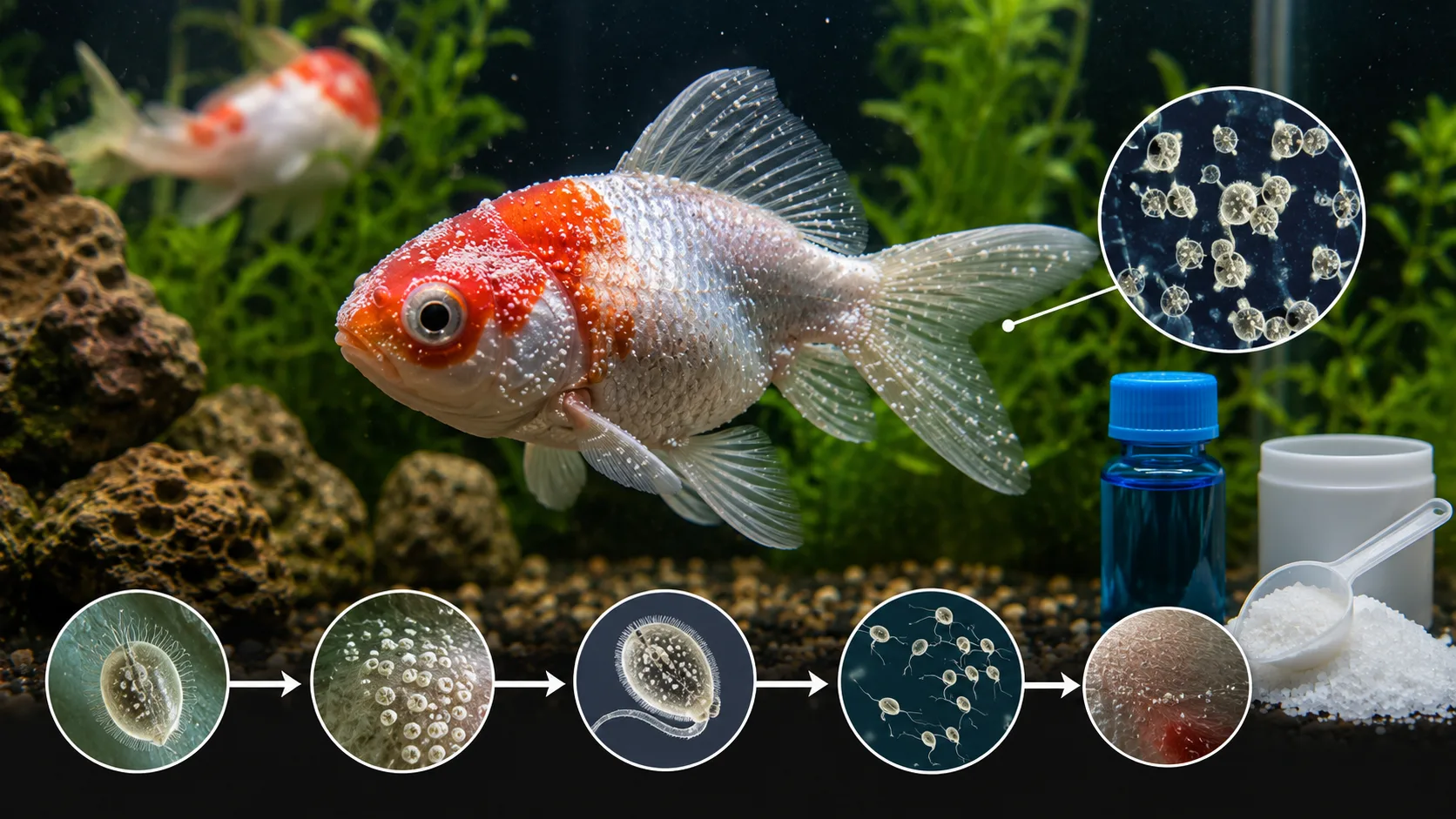
This is the section that makes every treatment decision clear. Ich has a three-stage lifecycle, and only one stage is vulnerable to medication.
Stage 1: Trophont (on the fish) The parasite burrows beneath the fish’s epithelium (outer skin layer) and feeds. This is what you see as the white spots — each spot is a single parasite encased within the fish’s tissue. The trophont is completely protected from medication by the surrounding fish tissue. It cannot be killed by any treatment at this stage. The trophont feeds for 4–7 days at typical tropical temperatures before maturing and leaving the fish.
Stage 2: Protomont and Tomont (leaving the fish, encystment on substrate) The mature trophont ruptures through the fish’s skin and falls to the substrate, where it rapidly encysts as a tomont. Inside the cyst, it divides repeatedly, producing up to 1,000 daughter cells (theronts). The cyst is highly resistant to medication — it cannot be reliably killed by any treatment at normal doses. The tomont stage lasts 3–28 days depending on temperature. At 25°C, this stage takes approximately 8–10 days. At 30°C, it takes approximately 3–5 days.
Stage 3: Theront (free-swimming — the only vulnerable stage) Theronts hatch from the substrate cysts and swim freely in the water column, searching for a fish host. They must find a host within 24–48 hours or die. This free-swimming stage is the only point in the lifecycle where ich is vulnerable to medication, salt, and temperature treatment. If no treatment is present during this stage, theronts attach to fish and the cycle begins again.
What this means for treatment: When white spots appear on fish, those spots are Stage 1 trophonts — completely protected from medication. Meanwhile, Stage 2 cysts are in the substrate producing thousands of new theronts. The spots disappear after 4–7 days as trophonts leave the fish — but the substrate cysts are still producing theronts for up to 28 days.
This is why treatment must continue for the full lifecycle period after the last visible spot disappears, not when spots are no longer visible. Stopping treatment when spots disappear leaves an active cyst population in the substrate that will produce a second wave of theronts within days.
Temperature and lifecycle speed: This relationship is the basis for heat treatment. Raising temperature to 28–30°C accelerates the lifecycle, moving the parasite through the protected stages faster and into the vulnerable theront stage more quickly. It also shortens the tomont stage dramatically — cysts that would take 10 days to hatch at 25°C hatch in 3–4 days at 30°C. Combined with medication, this means the treatment period can be shortened from 3–4 weeks to 7–10 days while being more effective.
3. Why Ich Appears “Suddenly” After Weeks of Apparent Health
This is the most confusing aspect of ich for hobbyists who believe they introduced healthy fish into a healthy tank. The fish looked fine for three weeks and then suddenly developed heavy ich — how?
The answer is the stress-immunity relationship. Ich is present at subclinical levels in most fish populations. The parasite cannot establish visible infection in immune-competent fish — the immune response limits the trophont population before it becomes visible. When fish experience a stress event that suppresses immunity — transport, water chemistry change, temperature fluctuation, aggression, new fish introduction, filter maintenance — cortisol rises, immune function falls, and the subclinical ich population gains the competitive window it needs to establish visibly.
The most common scenario: fish are purchased, introduced to the tank, appear healthy for 2–3 weeks while recovering from transport stress, and then develop visible ich in weeks 2–4 as the transport-induced immune suppression window closes and the ich population that established during that window becomes visible. The ich was not introduced by the new fish — it was already present in the tank, held subclinical by the existing fish’s immunity, and the new fish’s immune suppression during transport recovery created the establishment event.
This is why quarantine — a 4-week observation period in a stable, stress-free environment before main tank introduction — catches ich before it reaches the display tank. The complete quarantine protocol is in Quarantine and Biosecurity in Aquariums.
4. Recognising Ich — Symptoms and Differential Diagnosis
Classic presentation: Small white spots, each approximately 0.5–1mm in diameter, appearing on the body surface and fins. The spots are uniform in size (this distinguishes ich from several conditions where lesions vary in size) and have a slightly raised, granular texture. Infected fish scratch against substrate, rocks, and décor (flashing) as the burrowing trophonts cause skin irritation. Gill involvement produces rapid gill movement and surface orientation as gas exchange is impaired.
Progression: Ich typically appears on the fins first, then spreads to the body surface. Heavy infection produces a white dusty appearance across the body — at this stage the parasite population is enormous and treatment urgency is high.
Differential diagnosis:
Velvet (Oodinium): Much finer dusting than ich — gold, rust, or yellow-tinted rather than white, and requires a torch in dim light to see clearly. Progression is much faster than ich. See Velvet Disease — Complete Treatment Guide.
Gill flukes (Dactylogyrus/Gyrodactylus): Cause persistent flashing and scratching — often mistaken for ich — but without the discrete 1mm white spots. If a fish flashes repeatedly with no visible spots, test for gill flukes before treating for ich.
Lymphocystis: Cauliflower-like white growths, typically on fins. Much larger than ich spots and irregular in texture. Viral, not parasitic — no medication is effective.
Epistylis: Raised white tufts, often at wound sites. Bacterial/protozoan secondary infection, not ich.
Fungal infection: White cottony growths, typically at wound sites. Does not produce the uniform small-dot pattern of ich. The cottony appearance is more consistent with Columnaris (bacterial) than true fungal infection in most cases.
Physical damage: Single or few white marks at specific damage points. Ich produces multiple uniform spots across multiple body areas and fins.
5. Treatment Methods — Every Option Honestly Assessed
Temperature Elevation
Mechanism: Accelerates the ich lifecycle, moving the parasite through protected stages faster and shortening the required treatment period. Also directly kills theronts faster at higher temperatures.
Protocol: Raise temperature gradually — no more than 1°C per hour — to 28–30°C. Maintain for the full treatment period. Increase surface agitation significantly as warmer water holds less dissolved oxygen. The complete dissolved oxygen management guide — essential reading before heat treatment — is in Aquarium Dissolved Oxygen — Complete Guide.
Effectiveness: High as a standalone treatment in mild infections and for species intolerant of salt or medications. Most effective when combined with salt or commercial medication.
Limitations: Some ich strains show apparent heat tolerance. Above 30°C, many tropical fish show heat stress. Coldwater species (goldfish, koi) cannot tolerate tropical treatment temperatures.
Aquarium Salt (Sodium Chloride)
Mechanism: Raises water salinity, disrupting the osmotic balance that theronts require to survive. Salt does not kill trophonts or tomont cysts — it targets the free-swimming theront stage exclusively.
Protocol: 1–3g per litre, dissolved in tank water before adding, introduced gradually over 24 hours. Maintain throughout the treatment period with partial replacement at each water change.
Effectiveness: Moderate as standalone, high in combination with heat. Significantly reduces theront survival and slows reinfection while other lifecycle stages complete.
Limitations: Harmful to freshwater plants at therapeutic concentrations (above 1.5g/L). Toxic to scaleless fish (loaches, many catfish species) at standard doses. Reduces effectiveness of some commercial ich medications by altering water chemistry. Do not use in tanks with shrimp or snails.
Commercial Ich Medications
Mechanism: Active ingredients (typically malachite green, formalin, acriflavine, or combinations) are toxic to the free-swimming theront stage. They do not kill trophonts on the fish or tomont cysts in the substrate.
Protocol: Follow manufacturer instructions precisely. Remove activated carbon from the filter before treatment — carbon adsorbs medication and renders it ineffective. Complete the full recommended course — typically 7–10 days minimum — regardless of when spots disappear.
Important: Commercial ich medications destroy biological filtration to varying degrees. Treating in a hospital tank protects the main tank’s biofilm. If treating the main tank, monitor ammonia and nitrite daily and perform water changes if either rises. The filter cleaning guide — How to Clean an Aquarium Filter Without Killing Bacteria — covers biofilm protection during treatment events.
Effectiveness: High when used correctly for the full treatment period. Resistance to some commercial formulations has been documented in some geographical populations.
Copper (Marine and Hospital Tank Only)
Copper sulphate and chelated copper products are highly effective against ich theronts and are the standard treatment in marine systems. Copper is lethal to invertebrates at therapeutic concentrations and must never be used in reef tanks or tanks containing invertebrates. In freshwater, commercial medications are generally preferred over copper due to safer toxicity profiles.
6. The Treatment Protocol — Step by Step
Step 1: Confirm diagnosis Verify the white spots are ich (uniform size, scratching behaviour, multiple fins and body areas) rather than one of the differential diagnoses above.
Step 2: Set up or prepare treatment environment Ideally treat in a hospital tank. If treating the main tank: remove activated carbon, prepare for daily ammonia testing, notify yourself that biological filtration may be disrupted.
Step 3: Raise temperature Increase temperature to 28°C over 24 hours. Increase surface agitation to compensate for reduced oxygen capacity at higher temperature.
Step 4: Add salt or medication For freshwater community tanks: 2g/L salt dissolved in tank water, added gradually. For species intolerant of salt: commercial ich medication at label dose. For the fastest resolution: both heat and salt together.
Step 5: Maintain treatment Perform 25–30% water changes every 2–3 days throughout treatment. Replace salt removed by water changes. Re-dose medication as directed. The Water Change Calculator helps calculate correct replacement volumes.
Step 6: Continue for the full lifecycle period At 28–30°C: minimum 10 days after the last visible spot disappears. At 25°C: minimum 14 days after last visible spot. At temperatures below 25°C: up to 28 days — this is why temperature elevation significantly reduces treatment duration.
Step 7: Return to normal Gradually reduce temperature (1°C per day) to normal. Remove salt through water changes with unsalted replacement water. Re-introduce activated carbon if used. Monitor ammonia and nitrite as biological filtration recovers. See Ammonia in Aquariums and Aquarium Nitrite for recovery monitoring.
7. Treating Ich in Different Tank Types
Planted Freshwater Tanks
Salt at therapeutic concentrations (2–3g/L) damages most freshwater plants. Options: use commercial medication at half-dose with extended treatment period, use heat alone (most effective in warm planted tanks already running 26–28°C), or remove fish to a bare quarantine tank for treatment. Malachite green-based medications stain silicone and certain décor permanently at full dose.
Goldfish and Coldwater Tanks
Goldfish cannot tolerate temperatures above 24–25°C safely. Heat treatment to 28–30°C is not appropriate. Salt at 2–3g/L is well-tolerated by goldfish. Commercial medications formulated specifically for coldwater fish and extended treatment periods (up to 28 days at 22°C) are required. The longer lifecycle at lower temperatures means goldfish ich treatment takes significantly longer than tropical ich treatment.
Tanks with Scaleless Fish
Loaches (Botia, Chromobotia, Yasuhikotakia species), many catfish (Corydoras, Synodontis, plecos), and knife fish are extremely sensitive to malachite green and most commercial ich medications. Use half-dose and monitor closely. Salt at standard doses is also poorly tolerated by scaleless species. The safest option: heat treatment alone to 28–30°C with increased aeration, extended for the full lifecycle period at treatment temperature.
Invertebrate-Containing Tanks
Remove shrimp and snails to a separate container before any chemical treatment. Salt is harmful to invertebrates. Copper is lethal. Heat treatment alone is the only option compatible with keeping invertebrates in the treatment tank.
8. Species Sensitivity
Highly sensitive (use half-dose or heat-only): All Loach species, most scaleless catfish, mormyrids (elephant nose fish), most eels, knife fish
Salt-sensitive (do not use salt): All live aquatic plants, freshwater invertebrates (shrimp, snails, crayfish), scaleless species above
Heat-sensitive (do not raise above 26°C): Goldfish, koi, white cloud mountain minnows, other coldwater species; discus and other very sensitive tropicals (though these tolerate 29–30°C better than coldwater species)
9. After Treatment — Preventing Recurrence
Ich recurrence in treated tanks almost always reflects incomplete treatment (treatment stopped when spots disappeared rather than at the end of the full lifecycle period) or an ongoing stress condition that maintains the immune suppression window allowing ich to re-establish from subclinical levels.
Prevent recurrence through:
Quarantine all new fish for 4 weeks before main tank introduction — the most effective single prevention measure. Quarantine and Biosecurity in Aquariums covers the complete protocol.
Maintain stable water chemistry — pH fluctuation, ammonia exposure, and water chemistry changes all suppress immunity. The Complete Water Chemistry Guide provides the stability framework.
Avoid overstocking — crowding creates chronic cortisol elevation that permanently suppresses immunity. Aquarium Stocking Calculator for sustainable limits.
Maintain water temperature stability — sudden temperature drops are among the most reliable ich triggers.
10. India and Delhi NCR — Specific Considerations
Elevated baseline temperatures accelerate lifecycle and reduce treatment time. Delhi NCR summer tank temperatures of 28–32°C mean the ich lifecycle is already running faster than in tanks in cooler climates. At 30°C, the complete lifecycle from trophont to new theront is approximately 7–10 days — meaning a properly maintained 14-day treatment at elevated temperature is more than adequate.
Power cuts during treatment are a serious risk. A power cut that drops temperature during treatment slows the ich lifecycle, potentially extending the required treatment period, while simultaneously stressing already-compromised fish. Battery-powered aeration during treatment is essential for both oxygen maintenance and temperature stability support. See Aquarium Water Temperature in Indian Summer.
Supply chain stress creates ich windows. As covered in Hard Water Aquariums in Delhi NCR and the quarantine articles, fish arriving through Delhi NCR’s long import supply chain carry high cortisol from transport stress. This post-purchase window (2–4 weeks) is when ich most commonly establishes from subclinical levels. Quarantine is more important in this market than in markets with shorter supply chains.
Frequently Asked Questions
How long does ich treatment take? At 28–30°C: minimum 10–14 days total treatment, continuing for at least 10 days after the last visible spot. At 25°C: minimum 21 days. At temperatures below 23°C: up to 28–35 days. The lifecycle temperature relationship is why raising temperature is the most effective way to shorten required treatment time.
The white spots have disappeared — can I stop treatment? No. Spots disappearing means trophonts have left the fish to encyst on the substrate — it does not mean ich is gone. The substrate cysts are producing thousands of theronts that will reinfect the fish within days if treatment stops. Continue for the full lifecycle period at your treatment temperature after the last spot disappears.
Can ich kill fish? Yes. Heavy infestations cause severe gill damage, secondary bacterial infections, and physiological stress that is directly lethal. Unchecked ich in a population of immune-suppressed fish can cause total tank losses within 1–2 weeks. Early treatment is critical.
My fish has ich but I have shrimp in the tank — what can I do? Heat treatment alone (28–30°C) is the only option safe for shrimp. Do not use salt or commercial medications. Increase aeration significantly for the elevated temperature period. Continue for the full lifecycle period. Alternatively, temporarily move shrimp to a separate container for the treatment period.
Why does ich keep coming back in my tank? Either treatment was stopped before the full lifecycle was complete (substrate cysts produced a second wave of theronts after treatment ended), or an ongoing stress condition is keeping fish immune function suppressed, allowing subclinical ich to re-establish after each treatment. Identify and correct the stress source — water chemistry instability, overcrowding, aggression, poor nutrition — rather than repeatedly treating the symptom. The diagnostic framework for recurrent disease is in Quarantine vs Medication in Aquariums.
Is ich the same as velvet? No. They are distinct parasites with different visual presentations, progression rates, and treatment requirements. Ich (Ichthyophthirius multifiliis) produces uniform 1mm white spots and progresses over 1–3 weeks. Velvet (Oodinium/Amyloodinium) produces a much finer gold or rust-coloured dust and can kill fish within 3–5 days. Velvet requires immediate treatment; the same urgency applies to ich but velvet has less margin for delay. See Velvet Disease — Complete Treatment Guide.
Is ich the same as velvet? No. They are distinct parasites with different visual presentations, progression rates, and treatment requirements. Ich (Ichthyophthirius multifiliis) produces uniform 1mm white spots and progresses over 1–3 weeks. Velvet (Oodinium/Amyloodinium) produces a much finer gold or rust-coloured dust and can kill fish within 3–5 days. Velvet requires immediate treatment; the same urgency applies to ich but velvet has less margin for delay. See Velvet Disease — Complete Treatment Guide.