
by ProHobby™ | Ecological Systems Authority
Ammonia is the most common cause of fish death in aquariums, the most misunderstood parameter in hobby testing, and the one variable that connects almost every failure mode a tank can experience. Yet most ammonia guides reduce the subject to a single action: do a water change and add Prime. That advice is correct as far as it goes — it simply does not go far enough to explain why ammonia behaves so differently in different tanks, why the same test reading is an emergency in one situation and manageable in another, or why some tanks with perfectly normal test results are slowly poisoning their fish.
This guide covers ammonia in full: the chemistry that determines actual toxicity, the difference between acute poisoning and chronic sub-lethal exposure, every cause of ammonia spikes including several that mainstream guides miss, and an honest assessment of every treatment option — including the ones that do not work despite being widely recommended.
Table of Contents
- What Ammonia Is and Where It Comes From
- The Critical Variable Nobody Mentions: pH and the Toxic Fraction
- Acute vs Chronic Toxicity — The Effects Most Guides Miss
- Ammonia Poisoning: How to Recognise It
- Why Ammonia Spikes Happen — Every Cause
- 5a. New and Uncycled Tanks
- 5b. Overstocking and Overfeeding
- 5c. Biofilter Damage or Disruption
- 5d. Dead Fish and Decomposing Organic Matter
- 5e. Ammonia in Tap Water
- 5f. Temperature Shifts Changing Existing Ammonia Toxicity
- 5g. Medication Damage to Biological Filtration
- 5h. Power Cuts and Oxygen Starvation of Biofilter
- Testing Ammonia: What Your Test Kit Tells You and What It Doesn’t
- How to Lower Ammonia — Every Method Honestly Assessed
- 7a. Emergency Water Changes
- 7b. Water Conditioners: Prime and Equivalents
- 7c. Zeolite
- 7d. Increased Aeration
- 7e. Live Plants
- 7f. Biofilter Improvement
- 7g. Reducing Feeding and Stocking
- 7h. Salt: The Persistent Myth
- The Only Long-Term Solution: Protecting Biological Filtration
- India-Specific Ammonia Risk Factors
- Frequently Asked Questions
1. What Ammonia Is and Where It Comes From
Ammonia (chemical formula NH₃ / NH₄⁺) is the primary nitrogenous waste product of aquatic animals. Fish excrete it continuously and directly — predominantly through their gills as they breathe, with a smaller amount excreted through urine. Unlike mammals that convert nitrogen waste to urea before excretion, fish release it as ammonia because the surrounding water provides unlimited dilution in a natural environment. In an aquarium, that dilution is absent.
Ammonia is the entry point of the nitrogen cycle — the biological process by which nitrogenous waste moves through the aquarium ecosystem, from excretion through oxidation to export. Understanding ammonia in full requires understanding the broader nutrient cycle of which it is the first stage. Ammonia is the first stage of the nitrogen cycle. The endpoint — nitrate accumulation and its chronic toxicity — is covered in Aquarium Nitrate. The Nutrient Cycles in Nature and Captivity cornerstone article provides that complete framework across aquatic, terrestrial, and hybrid ecosystems.
Sources of ammonia in an aquarium, ranked by typical contribution:
Fish excretion through the gills — the primary and continuous source in any stocked tank. A fish excretes ammonia proportional to its metabolic rate and feeding level. Higher temperature, more feeding, and more active species all increase ammonia excretion rate. This source never stops while fish are alive.
Decomposition of uneaten food — uneaten food begins decomposing within minutes of entering the water, releasing ammonia as organic nitrogen is broken down by bacteria. The faster this is removed, the lower the contribution. At elevated summer temperatures, decomposition is dramatically faster than in cooler months.
Fish and organism death — a dead fish, snail, or invertebrate decomposes rapidly and can produce an ammonia spike large enough to crash a cycled tank’s biological capacity within 12–24 hours if not found and removed.
Decomposition of plant matter — dead leaves and dying plant tissue release ammonia as they decompose. A planted tank going through a major melt event (such as when newly introduced plants shed tissue to adapt) can produce a significant ammonia load.
Tap water — relevant in areas using chloramine rather than chlorine for municipal water treatment. Chloramine is chlorine chemically bonded to ammonia. Standard sodium thiosulfate dechlorinators break the bond and neutralise the chlorine component — but leave the ammonia behind. Every water change using standard dechlorinator in a chloramine-treated supply adds a measurable ammonia dose to the tank. This source is often completely overlooked in ammonia diagnosis.
Fish waste and faeces — faeces contain organic compounds that decompose over time to release ammonia. Well-maintained substrate and regular water changes manage this. In an overstocked or undermaintained tank, accumulated substrate waste becomes a significant secondary ammonia source.
2. The Critical Variable Nobody Mentions: pH and the Toxic Fraction
This is the most important section in this guide for understanding why ammonia behaves so inconsistently across different tanks and why the same test reading can be safe in one tank and lethal in another.
Ammonia in water exists in two chemical forms simultaneously:
- Un-ionised ammonia (NH₃) — the acutely toxic form. Crosses cell membranes freely, disrupts the electrochemical gradients essential to cell function, and causes direct damage to gill tissue and the central nervous system.
- Ammonium ion (NH₄⁺) — the relatively harmless form. Ionised, cannot cross cell membranes effectively, and at equivalent concentrations produces little or no acute toxicity.
Your test kit measures the total of both forms — it cannot tell you which is which.
The ratio between toxic NH₃ and harmless NH₄⁺ is determined almost entirely by pH and temperature. As pH rises, the equilibrium shifts dramatically toward the toxic NH₃ form. As temperature rises, it shifts further in the same direction.
What this means practically:
| Total Ammonia Reading | pH 7.0 | pH 7.5 | pH 8.0 | pH 8.5 |
|---|---|---|---|---|
| 0.25 ppm | ~0.002 ppm toxic | ~0.006 ppm toxic | ~0.018 ppm toxic | ~0.055 ppm toxic |
| 0.5 ppm | ~0.004 ppm toxic | ~0.012 ppm toxic | ~0.036 ppm toxic | ~0.110 ppm toxic |
| 1.0 ppm | ~0.008 ppm toxic | ~0.023 ppm toxic | ~0.071 ppm toxic | ~0.218 ppm toxic |
| 2.0 ppm | ~0.016 ppm toxic | ~0.046 ppm toxic | ~0.142 ppm toxic | ~0.437 ppm toxic |
Approximate values at 26°C. At higher temperatures, toxic fraction increases further.
The numbers in this table explain phenomena that mystify hobbyists every day:
Why do neon tetras die in a tank reading 0.25 ppm ammonia when the aquarium shop’s test said that was “barely detectable”? Because if the tank is at pH 8.0 — common in hard-water areas — 0.25 ppm total ammonia contains approximately 0.018 ppm of the acutely toxic form, which is a meaningful chronic exposure for a sensitive soft-water species.
Why does a pond keeper in a soft-water area seem less worried about a 0.5 ppm reading than an Indian hobbyist? Because at pH 6.8, that 0.5 ppm contains only 0.003 ppm of the toxic form — nearly negligible. At pH 8.2, which describes most of North India’s municipal water, the same reading contains 0.057 ppm of the toxic form — a significant chronic exposure.
The implication for every ammonia test reading: Interpret it in the context of your pH. Always test pH alongside ammonia. A reading of 0.5 ppm in a soft-water planted tank at pH 6.8 is different in its biological significance from the same reading in a Delhi tap-water tank at pH 8.0. The number on the test strip tells you total ammonia; only pH tells you actual toxicity.
For a complete reference on pH, KH, GH and how they interact in Indian aquarium water conditions, see the Complete Water Chemistry Guide. The reason pH matters so critically for ammonia toxicity — at pH 8.0, the same ammonia reading is ten times more dangerous than at pH 7.0 — is explained in full in Aquarium pH — Complete Diagnosis and Fix Guide. The KH depletion that causes pH crashes is particularly dangerous when ammonia is present, because falling pH paradoxically reduces the most acutely toxic form of ammonia — but the pH crash itself is a separate crisis. The relationship between KH, pH, and ammonia toxicity is in Aquarium KH — Carbonate Hardness.
3. Acute vs Chronic Toxicity — The Effects Most Guides Miss
Most ammonia guides focus on acute poisoning — the rapid fish deaths that occur at high ammonia concentrations. This is important but it represents only one end of the toxicity spectrum. Sub-lethal chronic ammonia exposure is equally significant and is responsible for a large proportion of aquarium losses that are attributed to disease, “bad luck,” or unexplained decline.
Acute toxicity (typical threshold above 0.5–1.0 ppm NH₃, varies by species and pH):
At high ammonia concentrations, fish experience rapid neurological dysfunction — ammonia disrupts neurotransmitter function and sodium-potassium membrane transport, causing loss of swimming coordination, surface gasping, convulsions, and death. Gill tissue is simultaneously damaged at the lamellae level, reducing the gas exchange capacity that fish need for both oxygen uptake and CO₂ removal. Acute ammonia toxicity kills quickly, typically within hours to days at high concentrations.
Chronic sub-lethal toxicity (exposure below the acute threshold, as low as 0.025–0.1 ppm NH₃):
This is the invisible damage that causes the most long-term harm in established tanks and is almost never discussed in ammonia guides. Fish exposed continuously to low-level ammonia — below the acute threshold where behavioural symptoms appear — experience:
- Chronic gill damage: Ammonia causes proliferation of gill epithelial cells (lamellar hyperplasia) that reduces the effective gas-exchange surface area. Fish with damaged gills are chronically oxygen-depleted even in well-aerated water. This manifests as unexplained lethargy, reduced activity, and susceptibility to bacterial gill disease. Ammonia-damaged gill tissue reduces oxygen extraction efficiency — fish may continue gasping long after ammonia has been corrected because the gill damage persists. The complete oxygen dynamics, including how to assess and improve dissolved oxygen during ammonia recovery, are in Aquarium Dissolved Oxygen — Complete Guide.
- Immune suppression: Chronic ammonia stress elevates cortisol production, which has well-documented immunosuppressive effects across teleost fish. The mechanism is covered in detail in The Science of Fish Stress. Fish under chronic sub-lethal ammonia exposure are immunocompromised without showing the acute symptoms that would alert a hobbyist to a problem.
- Increased vulnerability to opportunistic pathogens: The pathogens responsible for most aquarium disease — bacterial infections, ich, external parasites — are present in every tank at all times. Whether they establish disease depends on whether the fish’s immune system is suppressing them. Chronic ammonia damage to immunity removes this suppression.
This pathway explains why a tank can “suddenly” experience an outbreak of fin rot, ich, or bacterial infection after weeks of apparent normalcy. The ammonia was never zero; it was at a chronic sub-lethal level that suppressed immunity over weeks until the fish were no longer able to resist pathogens they had been carrying all along.
Ammonia is the first stage of the nitrogen cycle. The endpoint compound — nitrate — accumulates gradually and requires ongoing management through water changes. The complete nitrate guide is Aquarium Nitrate. For the complete analysis of how environmental causes produce disease outcomes, see Why Most Aquarium Deaths Are Environmental, Not Disease-Related.
The practical implication: Zero ammonia is the target, not “low ammonia.” Any detectable ammonia in a stocked established tank is a problem — its severity depends on pH, temperature, and the duration of exposure.
4. Ammonia Poisoning: How to Recognise It
Early signs (typically 0.25–0.5 ppm total ammonia at moderate pH):
- Reduced activity and increased time spent resting on the substrate or hovering in one position
- Mild surface-oriented behaviour — fish spending more time near the surface than usual, which increases in parallel with ammonia rise
- Slightly reduced feeding interest
- In some species, early colour changes — general dulling of pigmentation, or in species like goldfish, reddish streaking at the base of fins from capillary congestion
Moderate signs (0.5–2.0 ppm total ammonia at moderate pH, or lower readings at high pH):
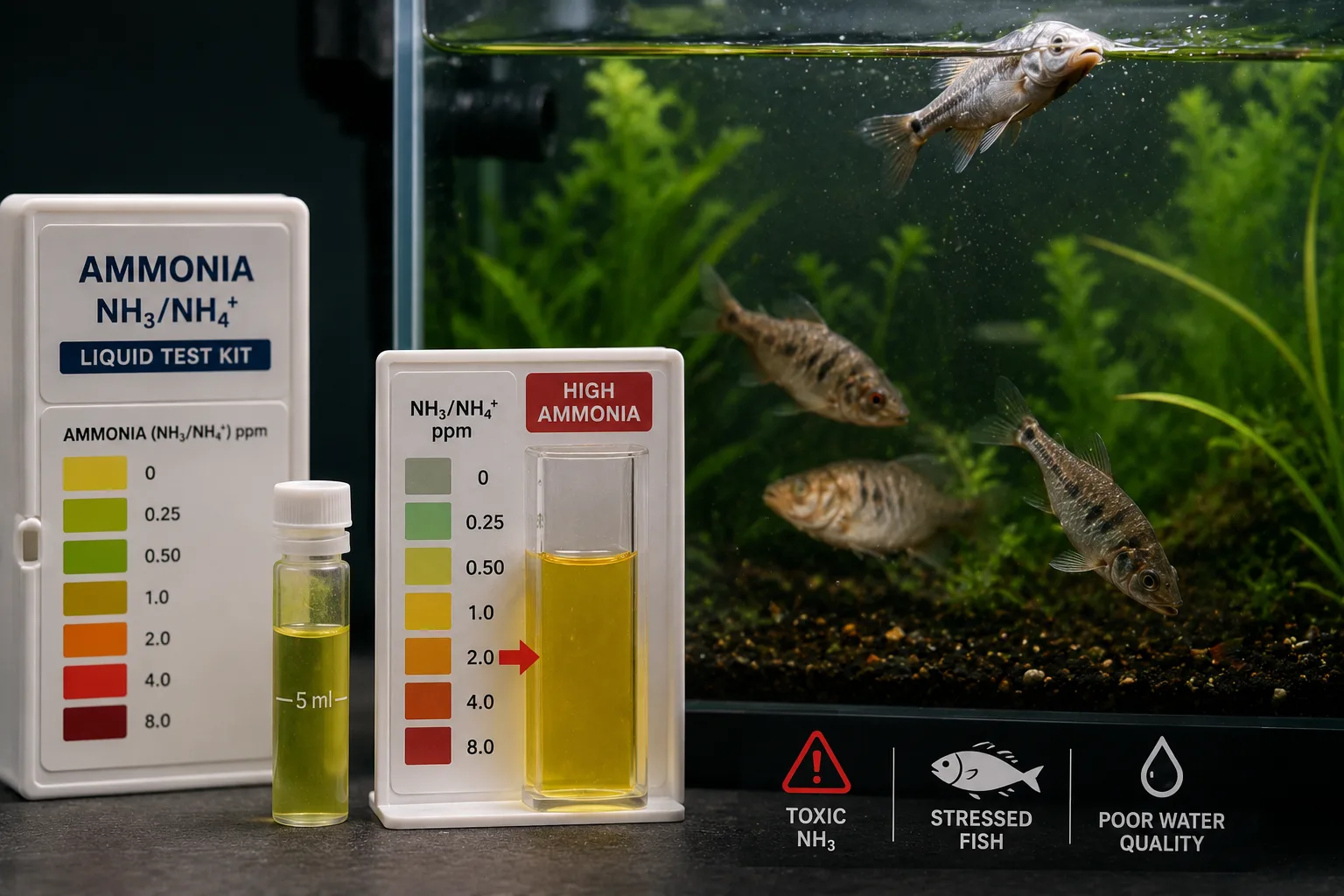
- Visible gasping at the water surface — a direct response to gill damage reducing oxygen uptake capacity
- Rapid gill movement visible through glass — the fish is working hard to extract oxygen from water its damaged gills can no longer process efficiently
- Loss of swimming coordination — ammonia affects neurotransmitter function; fish may appear “wobbly” or unable to maintain normal swimming position
- Pronounced colour loss
- Active avoidance behaviour — fish trying to jump out of the tank, pressing against glass, unusually erratic movement
Severe signs (above 2.0 ppm at moderate pH, lower at high pH):
- Lethargy to the point of lying on the substrate or floating listlessly
- Severe gasping with laboured gill movement
- Redness at gill covers and base of fins — haemorrhaging from ammonia-induced vascular damage
- Loss of orientation — fish unable to maintain upright position
- Death within hours
The diagnostic challenge: All of these symptoms can be produced by other causes — oxygen depletion, disease, other parameter failures. The presence of ammonia on a test kit alongside these symptoms confirms the diagnosis. The absence of ammonia does not rule out chronic sub-lethal exposure as a contributing factor to unexplained lethargy or recurring disease.
5. Why Ammonia Spikes Happen — Every Cause
5a. New and Uncycled Tanks
The most common cause globally. A new tank has no established nitrifying biofilm community to process ammonia from fish waste. Ammonia accumulates from the moment fish are added. New tank syndrome is entirely predictable and entirely preventable by establishing the biological cycle before adding fish — the complete process is covered in How to Cycle a Fish Tank. If fish are already dying in a new tank, Why Fish Keep Dying in a New Aquarium provides the stage-by-stage diagnosis.
5b. Overstocking and Overfeeding
In an established tank, ammonia spikes most commonly result from the ammonia production rate exceeding the biofilter’s processing capacity. Adding more fish than the filter can process, or overfeeding to the point where uneaten food and elevated fish excretion together exceed processing capacity, produces the same result as an uncycled tank — ammonia accumulation — in a tank that has been running stably for months. The four-constraint framework for calculating actual biological carrying capacity before it becomes an ammonia problem is in Carrying Capacity in Aquariums. For the complete guide to feeding quantities, schedules, and the direct relationship between feeding decisions and ammonia load, see How Often to Feed Fish.
5c. Biofilter Damage or Disruption
An established biofilter can lose its capacity through several mechanisms:
Filter cleaning in tap water — rinsing filter media in untreated tap water destroys the biofilm community. Chlorine and chloramine are biocidal by design. A filter thoroughly rinsed in tap water can lose 80–90% of its biological capacity within minutes. Always rinse filter media in tank water only, and only rinse one section of a multi-stage filter at a time.
Filter power interruption — the nitrifying biofilm in the filter is aerobic. Without water flow providing oxygenated water, the biofilm begins dying within hours. Extended power cuts in India can damage biological filtration significantly. After a power cut exceeding six to eight hours, test ammonia daily for the following week and feed minimally while the biofilm recovers.
pH crash — nitrifying bacteria are largely inactive below pH 6.5. A tank whose pH drops due to insufficient buffering capacity (low KH) will experience an apparent cycle crash that is actually the biofilter shutting down due to pH, not biological failure. Restoring pH restores the filter function within 24–48 hours.
Temperature extremes — biological filtration effectively stops above approximately 35°C and below 10°C. Tanks reaching extreme temperatures during Indian summer without cooling will experience reduced biofilter capacity precisely when ammonia production from fish is highest.
For the complete science of biofilm communities and their response to environmental disruption, see Biofilms — The Invisible Engine of Every Aquarium.
5d. Dead Fish and Decomposing Organic Matter
A dead fish in an established tank is a significant ammonia source. A medium-sized fish decomposing over 24–48 hours can produce enough ammonia to overwhelm the biological filtration of a tank that handles its normal stocking load without issue. Perform regular headcounts, particularly in planted tanks or tanks with many hiding spots. Remove dead fish immediately.
Accumulation of organic material in substrate dead zones, behind decorations, and in filter pockets produces a sustained baseline ammonia contribution that elevates gradually over time. Regular substrate vacuuming and filter maintenance prevents this from becoming significant.
5e. Ammonia in Tap Water
Often completely overlooked in ammonia diagnosis. Municipal water authorities in India and many other countries use chloramine — chlorine bonded to ammonia — rather than free chlorine for water treatment. Chloramine is more stable in the distribution network and does not off-gas like free chlorine.
Standard dechlorinators (sodium thiosulfate, the active ingredient in most basic dechlorinators) break the chloramine bond and neutralise the chlorine — but the ammonia released in this process remains in the water. Every water change using a basic dechlorinator in a chloramine-supply area adds ammonia to the tank with each change.
The solution is a full-spectrum water conditioner that specifically states it neutralises both chlorine and chloramine — including the ammonia component of chloramine. Seachem Prime is the most widely available example, but several other products handle this. Check the label specifically for chloramine neutralisation, not just chlorine.
Test your tap water for ammonia directly if you suspect this is a contributing factor. Run tap water through a basic dechlorinator into a clean container and test it — if ammonia registers, your supply uses chloramine and you need a different dechlorinator.
5f. Temperature Shifts Changing Existing Ammonia Toxicity
As covered in Section 2, temperature shifts the equilibrium between toxic NH₃ and harmless NH₄⁺. A tank sitting at an acceptable 0.5 ppm total ammonia at 26°C can move to dangerous acute territory if the temperature rises to 32°C, because more of that existing ammonia exists in the toxic form at higher temperature.
This means that a summer heat event can make existing low-level ammonia suddenly lethal — without any new ammonia being added to the tank. If fish show distress during a heat wave in a tank that tested fine the week before, check ammonia at the current elevated temperature rather than assuming parameters are unchanged.
5g. Medication Damage to Biological Filtration
Many aquarium medications — particularly broad-spectrum antibiotics and some antiparasitic treatments — are either directly toxic to nitrifying bacteria or damage them indirectly by reducing dissolved oxygen during treatment. Running a full antibiotic course in the display tank without protecting the biofilter can effectively un-cycle an established tank over the treatment period.
During any antibiotic or broad-spectrum treatment: remove biological media to a separate container of aerated, dechlorinated tank water for the duration; test ammonia daily during treatment; or quarantine and treat sick fish separately to protect the display tank’s biological filtration entirely. The quarantine approach is covered in Quarantine vs Medication.
5h. Power Cuts and Oxygen Starvation of Biofilter
Specific to Indian conditions but relevant wherever power reliability is poor. The nitrifying biofilm in your filter is aerobic — it requires a continuous supply of oxygenated water flowing through the media. When power cuts and the filter stops, the biofilm community begins to die from oxygen starvation. Short cuts (under one hour) produce minimal biological damage. Extended cuts (four to eight hours or more) can substantially reduce biological capacity, particularly in warm summer conditions where oxygen depletion is faster.
After any extended power cut, feed minimally for the following 24–48 hours and test ammonia daily for a week. The biofilm will recover if given adequate time without being overwhelmed by a full normal feeding and biological load. Summer power cut protocols are covered in full in Aquarium Water Temperature in Indian Summer.
6. Testing Ammonia: What Your Test Kit Tells You and What It Doesn’t
Liquid test kits vs test strips: Liquid test kits (API, Salifert, Sera) are significantly more accurate than test strips. For ammonia specifically — where the difference between 0 ppm and 0.25 ppm is meaningful — test strips do not provide sufficient resolution. Use liquid kits for all ammonia testing.
What your test tells you: Total ammonia — the sum of NH₃ and NH₄⁺. This is the number the test reads. Combined with your current pH and temperature, it tells you the actual toxic ammonia load using the relationship described in Section 2.
What your test does not tell you:
It cannot distinguish between detoxified and active ammonia. Seachem Prime and similar full-spectrum conditioners temporarily convert free ammonia into a non-toxic bound form (reportedly by converting to ammonium chloride or ammonium sulphate depending on the product). This bound form is still detectable by API-style Nessler and salicylate test kits — the test reads positive even though the ammonia has been rendered temporarily non-toxic. This causes significant confusion when hobbyists add Prime to address an ammonia spike, retest immediately, and find the same reading.
The practical rule: if you have added Prime within the last 24–48 hours, a positive ammonia test does not necessarily mean the situation is worsening. It means ammonia was present when Prime was added. Test again 24 hours after the next water change to get an unmodified reading.
It does not tell you whether the reading is rising or falling. A single test result has no trend information. Test daily during any ammonia event and record readings to identify whether the biofilter is recovering (ammonia falling) or the situation is worsening (ammonia rising or stable).
7. How to Lower Ammonia — Every Method Honestly Assessed
7a. Emergency Water Changes
Effectiveness: High. The most reliable immediate intervention.
A 30–50% water change with dechlorinated, temperature-matched water dilutes ammonia by the percentage of water changed. A 50% water change on a tank reading 2.0 ppm brings it to approximately 1.0 ppm, a 30% change brings it to approximately 1.4 ppm. Multiple changes over 24 hours reduce it further.
Water changes do not fix the underlying problem — an uncycled tank or an overwhelmed biofilter — but they keep fish alive while the biological system establishes or recovers. For acute emergencies, this is the priority action before any other intervention.
Important for Indian conditions: In hard-water areas with alkaline tap water, water changes also temporarily reduce pH buffering as high-KH tap water dilutes tank water. Monitor pH after large water changes in heavily stocked tanks.
7b. Water Conditioners: Prime and Equivalents
Effectiveness: Moderate short-term, zero long-term.
Products like Seachem Prime temporarily detoxify ammonia by converting it to a less harmful bound form for 24–48 hours. They do not remove ammonia from the tank. They are a bridge — buying the biofilter time to process the ammonia — not a solution. Used correctly, they are valuable for crisis management in conjunction with water changes. Used as a substitute for water changes and biofilter development, they provide a false sense of control while the underlying problem persists.
Dose at the rate recommended for the water volume being treated, not the full tank volume. Re-dose every 24–48 hours if ammonia remains elevated. Do not rely on them beyond a week — if ammonia is still elevated after a week of Prime dosing and partial water changes, the root cause (uncycled tank, overwhelmed biofilter, overfeeding, dead fish) must be identified and addressed.
7c. Zeolite
Effectiveness: Limited, specific conditions only.
Zeolite is a mineral that adsorbs ammonium ions (NH₄⁺) from the water through ion exchange. It can rapidly reduce total ammonia readings in an emergency. However:
- It adsorbs NH₄⁺, not NH₃ — the harmless form, not the toxic one. In a high-pH tank where the equilibrium has shifted toward the toxic NH₃ form, zeolite provides less protection than its ammonia reduction readings suggest
- It becomes saturated quickly in heavily stocked or heavily fed tanks and must be replaced or recharged regularly
- It does not work in salt water — the high ionic concentration of salt water prevents effective ion exchange
- It does not address the underlying cause and can give false confidence when test readings drop
Useful as an emergency adjunct in low-pH freshwater tanks. Not suitable as a long-term filtration component or as a substitute for biological filtration.
7d. Increased Aeration
Effectiveness: Indirect but genuinely useful.
Aeration does not remove ammonia but it affects ammonia toxicity in two ways. First, the higher the dissolved oxygen in the water, the better fish can tolerate ammonia stress — their oxygen intake is not simultaneously compromised by gill damage. Second, nitrifying bacteria are aerobic — higher dissolved oxygen in the filter media supports faster biological processing of ammonia. Increasing surface agitation during an ammonia event is a useful supportive measure.
At very high pH with low carbonate hardness, increased surface aeration can also reduce CO₂ (which naturally lowers pH slightly) — and even a small pH reduction meaningfully reduces the proportion of ammonia in the toxic NH₃ form.
7e. Live Plants
Effectiveness: Moderate, specific conditions.
Aquatic plants consume ammonia directly and preferentially, competing with nitrifying bacteria for the same substrate. In a densely planted tank with active plant growth and adequate light, plants can process a meaningful portion of the daily ammonia load — supplementing the biofilter rather than replacing it.
The limitation: plants only consume ammonia actively during the light period and when growing vigorously. A planted tank with struggling plants provides minimal ammonia processing. At night, plants do not consume ammonia at all. Plants are a useful long-term buffer for ammonia management in appropriate systems but are not an emergency intervention.
7f. Biofilter Improvement
Effectiveness: High long-term, zero short-term.
Adding biological filter media increases the surface area available for biofilm colonisation and therefore the biological processing capacity of the tank. This is the only intervention that addresses the root cause of most ammonia problems — insufficient biofilter capacity. In an emergency, adding additional biological media to the filter (or a secondary filter like a hang-on-back or additional sponge filter) begins building capacity, but biological colonisation takes days to weeks to become meaningful. For the complete guide to filter media types, biological capacity, and sizing your filtration to your actual stocking level, see Aquarium Filtration: The Backbone of a Healthy Aquarium.
For chronic low-level ammonia in an established tank, adding biological media is the correct long-term response alongside reducing feeding. For acute spikes, address the immediate toxicity with water changes first.
7g. Reducing Feeding and Stocking
Effectiveness: High long-term, moderate short-term.
Every reduction in feeding immediately reduces the ammonia input into the system. In an established tank experiencing chronic low-level ammonia, reducing feeding by 30–40% for two to four weeks allows the biofilter to catch up with the reduced load. This is often the most effective intervention for chronically elevated ammonia in established tanks that are not obviously uncycled.
Reducing stocking — removing some fish — provides the same benefit permanently. This is the appropriate response for an overstocked tank experiencing recurring ammonia issues.
7h. Salt: The Persistent Myth
Effectiveness: Zero for ammonia reduction.
Non-iodised salt (sodium chloride) is widely recommended in aquarium hobby communities for “ammonia treatment.” It does not reduce ammonia concentration, does not convert ammonia to less toxic forms, and does not accelerate biological processing. Salt can reduce nitrite toxicity through competitive inhibition at gill chloride channels — but this is a different problem with a different mechanism.
The persistent recommendation of salt for ammonia treatment appears to originate from confusion between nitrite treatment (where salt has a real mechanism) and ammonia treatment (where it does not). Adding salt to a tank with elevated ammonia addresses nothing regarding the ammonia while adding osmotic stress that may be harmful to scaleless species, plants, and invertebrates.
8. The Only Long-Term Solution: Protecting Biological Filtration
Every intervention in Section 7 addresses symptoms. The underlying cause of ammonia in any established, properly stocked tank is always insufficient or disrupted biological filtration. The only long-term solution is a mature, robust biofilm community in the filter media and substrate that can process the daily ammonia load of the stocking without lag.
This community takes 4–6 weeks to establish from scratch and 6–12 months to reach mature resilience. Protecting it requires:
- Never rinsing filter media in tap water — always in tank water, always one section at a time
- Never using antibiotics or broad-spectrum medication in the display tank — quarantine and treat sick fish separately
- Maintaining stable temperature and pH — both of which govern biofilm function
- Not overstocking or overfeeding relative to biological capacity
- Maintaining oxygenation — the biofilm is aerobic and is the first thing to die in a power cut
The stability and resilience of a tank’s biological filtration is the central theme of the Aquarium Stability Is Not Balance cornerstone article, which provides the full systems-level framework for understanding why aquarium ecosystems maintain equilibrium or collapse.
9. India-Specific Ammonia Risk Factors
Hard, alkaline tap water amplifies toxicity at every concentration.
Most of North India’s municipal water supply runs at pH 7.8–8.4, GH above 15, and KH above 6. As the table in Section 2 shows, this pH range places a significantly larger proportion of total ammonia in the toxic NH₃ form compared to softer, more acidic water. A reading that would be a minor concern in a soft-water tank in coastal South India or a European aquarium is a genuine emergency in a Delhi or Rajasthan tank at the same value.
This means that the standard global ammonia tolerance thresholds — often quoted as “anything below 0.5 ppm is acceptable” — are wrong for Indian hard-water conditions. In a tank at pH 8.2, any detectable ammonia should be taken seriously and addressed. The complete framework for managing water chemistry in Delhi’s specific tap water conditions is in Hard Water Aquariums in Delhi NCR.
Summer heat compounds both production and toxicity.
Indian summer creates a double pressure on ammonia management: fish metabolisms accelerate at higher temperatures, producing more ammonia per fish per day, while higher temperatures simultaneously shift more of that ammonia toward the toxic NH₃ form. An established tank that handles its normal load at 26°C may develop detectable ammonia at 31°C from the same fish — not because anything changed other than temperature.
Chloramine in municipal water supply.
Most Indian municipal water supplies, particularly in metros, have shifted to chloramine from free chlorine. Every water change using a basic sodium thiosulfate dechlorinator in a chloramine supply area adds ammonia to the tank. If your ammonia never quite reaches zero despite a cycled tank, established filtration, and appropriate stocking, this is the most likely cause that goes undiagnosed. Switch to a product that explicitly neutralises chloramine (including the ammonia component) and retest.
10. Frequently Asked Questions
What level of ammonia is dangerous in an aquarium? The answer depends on pH and temperature, not just the number. In neutral water (pH 7.0, 26°C), readings below 0.5 ppm total ammonia represent minimal acute risk though chronic sub-lethal effects remain. In hard Indian tap water at pH 8.0–8.2 and summer temperatures of 30°C, any detectable ammonia above approximately 0.1 ppm represents meaningful chronic exposure, and readings above 0.5 ppm represent an acute emergency. Always interpret ammonia readings in the context of your pH.
Why does my ammonia keep coming back? Recurring ammonia in an established tank usually has one of four causes: the biofilter capacity is insufficient for the stocking level; overfeeding is providing more organic input than the biofilter can process; the tap water supply contains ammonia from chloramine breakdown; or a dead fish or large amount of decomposing organic matter is providing a sustained ammonia source. Identify and remove the source rather than repeatedly treating the symptom with water conditioners.
My tank has been cycled for months. Why is there ammonia? A cycled tank developing ammonia after months of stability indicates something changed: a large organic input (dead fish, significant overfeeding, new heavily stocked addition), a biofilter disruption (filter rinsed in tap water, medication added, power cut), or the stocking or feeding level gradually crossed the biofilter’s capacity threshold. Identify what changed in the preceding days and address the specific cause.
Can I use Seachem Prime every day to manage ammonia? Prime can be dosed daily as a crisis management tool for up to two weeks while the underlying problem is addressed. Daily dosing without addressing the root cause is not a long-term management strategy — it detoxifies ammonia temporarily but does not remove it or accelerate the biofilter. After two weeks of daily Prime with persistent ammonia, the root cause investigation is overdue.
Is zero ammonia achievable in a stocked tank? Yes, and it should be the target. An established, appropriately stocked, adequately filtered tank with appropriate maintenance should read zero ammonia every time it is tested. Ammonia is produced continuously by fish but should be processed continuously by the biofilter — at matching rates, leaving zero residual in the water column. Zero ammonia is normal for a healthy established tank, not an unrealistically high standard.
Why did my fish die even though the ammonia read zero? Zero total ammonia on a test kit does not guarantee the fish were not affected by ammonia. Chronic sub-lethal exposure over weeks — even at levels too low to register on most hobby test kits — suppresses immunity over time and leads to deaths attributed to disease rather than the underlying environmental cause. Additionally, if Prime was dosed recently, the test may be reading detoxified ammonia as zero when active ammonia was present earlier. And as covered in Section 2, zero total ammonia does not mean there was no toxic NH₃ historically — past exposure damages gill tissue that does not repair immediately. For a complete diagnostic framework for fish deaths with normal parameters, see Why Do My Aquarium Fish Keep Dying.
How do I lower ammonia fast? For an acute emergency: 30–50% water change immediately with dechlorinated, temperature-matched water; dose a full-spectrum water conditioner like Prime to detoxify remaining ammonia; increase surface agitation to maximise dissolved oxygen; stop feeding entirely for 24–48 hours. Retest after two hours. If still elevated, repeat the water change. For fish showing acute distress, the water change is the priority — it takes effect in minutes where conditioners take hours.
Does ammonia testing work the same in saltwater? Salifert and similar reef-grade test kits work accurately in saltwater. API freshwater ammonia tests give inaccurate results in saltwater due to the high ion content interfering with the chemistry. Use a saltwater-specific test kit. Zeolite, as noted in Section 7c, does not work in saltwater.