
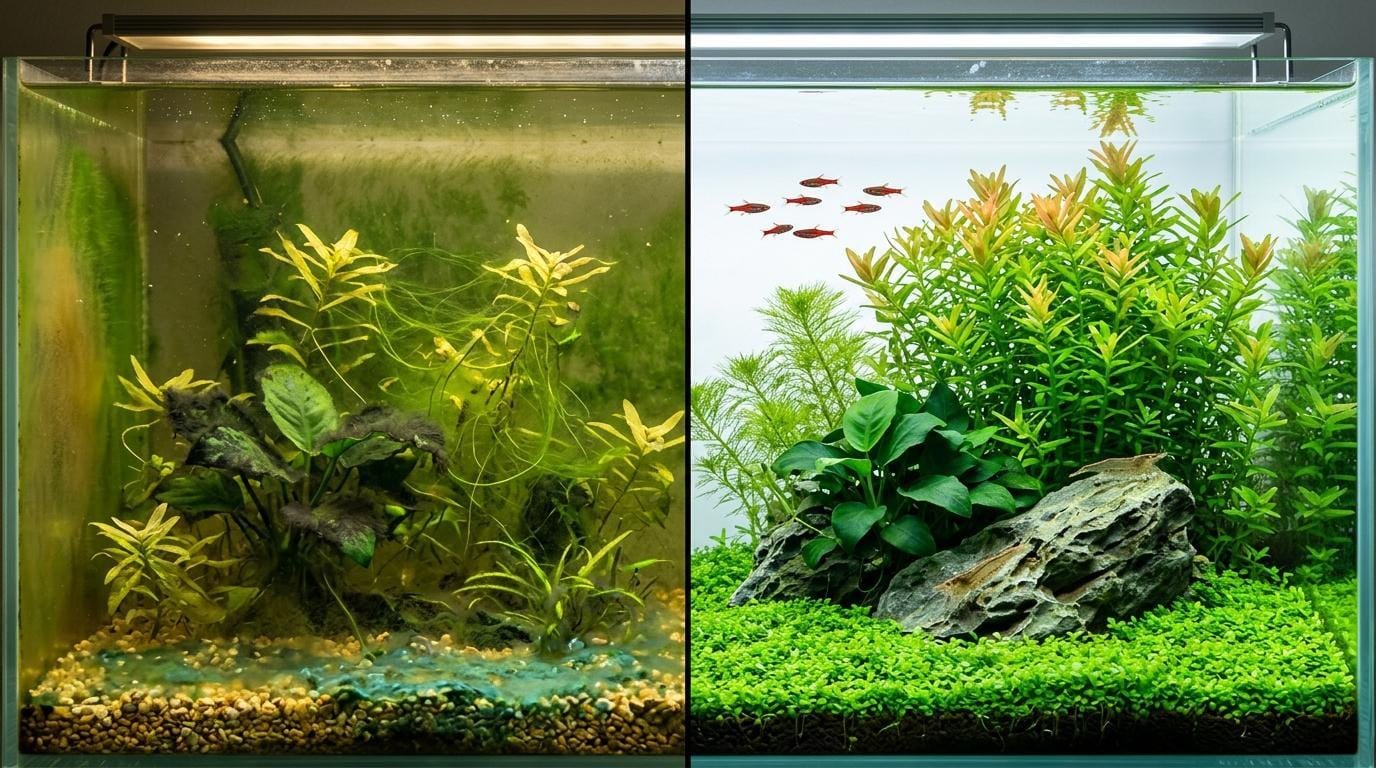
Aquarium failure in Delhi NCR is not random. Across Delhi, Gurgaon, Noida, Faridabad, and Ghaziabad, most failures follow repeatable patterns driven by water chemistry, instability, and mismatch between system design and environmental conditions. With TDS ranging from 180 to 900 ppm, GH between 4 and 18 dGH, and KH between 2 and 14 dKH, systems fail when these variables are ignored or inconsistently managed.
Aquariums fail in Delhi NCR due to instability, not lack of effort. The most common causes are inconsistent CO₂, mismatch between plants or fish and water chemistry, improper use of RO water, and failure to adapt to seasonal changes.
ProHobby Failure Model
| Failure Type | Root Cause | Result |
|---|---|---|
| Algae dominance | CO₂ instability | Imbalance |
| Plant melt | Incompatible water chemistry | Growth failure |
| Fish stress | Wrong species for water | Decline |
| System instability | Parameter fluctuation | Collapse |
Failures are predictable outcomes of system mismatch.
System Logic
When CO₂ fluctuates, algae appears regardless of other conditions. When plant species do not match water chemistry, growth fails despite proper lighting and fertilization. When fish are incompatible with hardness and buffering, long-term stress occurs. When parameters change inconsistently, systems destabilize even if individual values are acceptable.
Stability is the primary requirement across all successful systems.
Failure Pattern 1 — CO₂ Instability
Inconsistent CO₂ causes the most common failures in planted aquariums. High KH reduces CO₂ effectiveness, leading to overcompensation or fluctuation. Plants cannot adapt to daily variation, resulting in algae growth.
See CO2 in high KH aquarium conditions for system correction.
Failure Pattern 2 — Plant Mismatch
Sensitive plants fail in high TDS and high KH water. Attempting to grow incompatible species leads to repeated failure cycles.
See aquarium plants Delhi NCR compatibility guide.
Failure Pattern 3 — Fish Incompatibility
Soft-water fish kept in hard water show long-term stress and reduced lifespan. Mixed tolerance communities create invisible instability.
See aquarium fish Delhi NCR guide.
Failure Pattern 4 — RO Misuse
Inconsistent RO blending creates parameter swings. Sudden TDS drops cause osmotic stress. Systems become less stable than untreated tap water setups.
See RO water Delhi aquarium decision framework.
Failure Pattern 5 — Ignoring Seasonal Change
Systems that remain static while water conditions change become unstable. Summer concentration, monsoon fluctuation, and winter slowdown must be accounted for.
See aquarium seasonal changes Delhi NCR guide.
Failure Pattern 6 — Substrate Misunderstanding
Expecting substrate to compensate for unsuitable water leads to instability. Active substrates lose influence in high KH systems.
See aquarium substrate Delhi NCR guide.
Integrated Diagnosis Framework
| Symptom | Likely Cause | Correction |
|---|---|---|
| Algae outbreak | CO₂ instability | Stabilize injection |
| Plant melt | Water mismatch | Change species or water |
| Fish stress | Wrong compatibility | Adjust stocking |
| Recurring instability | Parameter fluctuation | Improve consistency |
Diagnosis must identify the root cause, not just the symptom.
System Correction Strategy
Correction requires aligning all components of the system. Water chemistry defines the environment. CO₂ defines plant growth potential. Substrate supports but does not override water. Fish and plants must match conditions. Seasonal adjustments maintain stability.
For full system context, see hard water aquariums Delhi NCR guide.
Failure patterns vary slightly across NCR due to water variation. Gurgaon and Faridabad show higher mineral load, increasing plant and CO₂ challenges. Noida and parts of Delhi may show more variability due to supply changes. These differences affect system stability and must be accounted for.
Frequently Asked Questions
Why do aquariums fail in Delhi NCR?
Due to instability, water mismatch, and inconsistent system management.
Is algae always due to poor maintenance?
No, it is usually due to CO₂ instability.
Can I fix plant issues with fertilizers?
No, water chemistry must match plant requirements.
Why do fish die despite stable readings?
Because species are incompatible with water conditions.
Does RO solve all problems?
No, incorrect use creates more instability.
Closing Principle
Aquarium failure in Delhi NCR is not random. It is the result of mismatch and instability. Systems succeed when all components align with water chemistry and remain consistent over time.