
By ProHobby™ | Ecological Systems Authority
Fish leeches occupy a genuinely underexplained corner of freshwater fish pest management — visually alarming enough that almost every hobbyist who encounters one instinctively understands something needs to be done, yet consistently under-treated as “just a leech, pull it off” rather than understood as what it actually is: a wound-inflicting external parasite that, exactly like the crustacean parasites covered elsewhere on this site, opens the door to secondary bacterial infection, and — considerably more significantly than most hobbyist guidance acknowledges — a documented biological vector capable of transmitting blood parasites between fish during normal feeding activity. Piscicola geometra and related freshwater fish leech species are most commonly encountered on pond-kept fish, particularly koi and goldfish, given the outdoor pond environment’s greater exposure to the wild leech populations and intermediate hosts this parasite’s full lifecycle depends on, though aquarium fish sourced from pond environments or wild-caught stock can introduce them to indoor systems as well.
Table of Contents
- What Piscicola Actually Is
- Why Leeches Are More Than a Cosmetic Problem — The Vector Risk
- The Lifecycle — Why Pond Environments Are the Primary Risk
- Symptoms and Identification
- Piscicola vs Anchor Worm vs Fish Lice — The Full External Parasite Differential
- Removal — Technique Matters More Than With Any Other External Parasite
- Chemical and Salt Treatment
- Wound Care After Removal
- Secondary Infection Risk — What to Watch For
- Prevention — Why Pond Fish Specifically Need Vigilance
- India — Pond Sourcing and Seasonal Realities
- Frequently Asked Questions
1. What Piscicola Actually Is
Piscicola geometra, and related species within the broader Piscicolidae family of fish leeches, are external parasitic annelids — segmented worms, genuinely distinct in body plan and biology from every other external parasite covered throughout this site’s disease library, including the crustacean parasites Argulus (fish lice) and Lernaea (anchor worm), despite sharing a superficially similar general ecological role as blood- and tissue-fluid-feeding external parasites.
Fish leeches attach to the host using specialised sucker structures at both ends of their elongated, segmented body, feed on blood and tissue fluids through a piercing and anticoagulant-secreting feeding mechanism broadly analogous in function, though not in underlying biology, to Argulus’s feeding stylet, and — unlike the crustacean parasites covered elsewhere on this site — are capable of detaching and moving considerable distances away from any host fish entirely, surviving as free-living predators and scavengers in pond substrate and vegetation between feeding events.
2. Why Leeches Are More Than a Cosmetic Problem — The Vector Risk
This is the single most important and most consistently underemphasised fact about fish leeches, and the reason this guide treats them with considerably more clinical seriousness than the “just pull it off” folk wisdom that dominates most casual hobbyist discussion of this parasite.
Piscicola and related fish leech species are documented biological vectors for blood parasites affecting fish, most notably certain trypanosome species — blood-borne protozoan parasites transmitted between fish hosts specifically through the leech’s blood-feeding activity, in a transmission relationship directly analogous to the well-established role mosquitoes play in transmitting blood-borne parasites between vertebrate hosts in a terrestrial context. A leech feeding on an infected fish and subsequently feeding on a second, previously uninfected fish is a documented mechanism for introducing blood parasite infection to a fish that had no other exposure route to that pathogen.
The practical consequence: a single leech population in an outdoor koi pond represents not just a direct wound and blood-loss risk to whichever individual fish it happens to be feeding on at any given time, but a potential ongoing transmission pathway spreading blood parasite infection across the entire pond population over time, considerably raising the priority of prompt, thorough leech control relative to treating this parasite as a purely cosmetic or minor nuisance issue.
3. The Lifecycle — Why Pond Environments Are the Primary Risk
Fish leeches lay egg cocoons attached to submerged vegetation, rocks, and other substrate surfaces, from which juvenile leeches hatch and subsequently seek out a fish host to begin feeding — a lifecycle with an obligate substrate-associated reproductive stage broadly conceptually similar, though biologically distinct, from the substrate-encystment stages established for Argulus and anchor worm elsewhere in this site’s parasite coverage.
Why outdoor ponds specifically carry the primary risk: established outdoor pond ecosystems, with their natural substrate, submerged and marginal vegetation, and typically less intensively controlled biosecurity relative to a closed indoor aquarium, provide considerably more favourable conditions for a self-sustaining wild leech population to establish and persist than a typical indoor tank environment does. Wild waterfowl and other animals visiting or inhabiting pond environments can also introduce leeches or leech eggs from other water bodies, an introduction pathway with no direct equivalent for most indoor aquarium setups.
Leeches are capable of surviving extended periods without a fish host present, feeding opportunistically on other available prey or simply persisting at reduced metabolic activity, meaning a leech population can establish and persist in a pond even during periods when fish stocking is temporarily reduced or absent, and can then rapidly resume feeding on fish once stocking resumes or new fish are introduced.
4. Symptoms and Identification
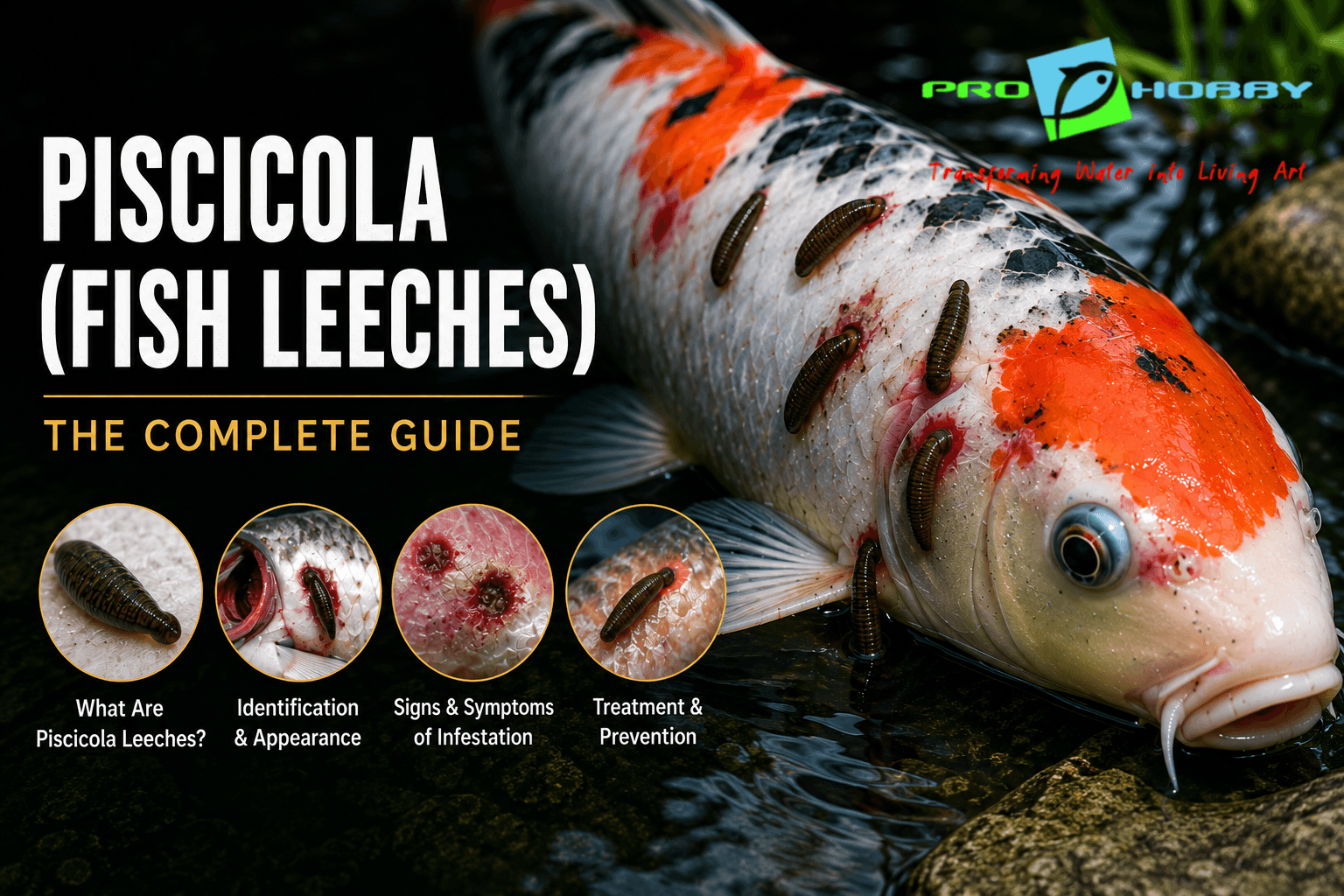
Direct visual identification is generally straightforward once a hobbyist knows what to look for — elongated, segmented, worm-like parasites, typically brown, olive, or grey in colouration, visible attached to the fish’s body surface, fins, or gill area, with a flattened, somewhat leaf-like body shape when at rest and a distinctive looping, inchworm-like movement pattern when actively relocating across the fish’s body or through open water, distinguishing their movement from the fixed, embedded anchor worm and the flat, disc-like Argulus covered in Section 5.
Feeding site wounds — small puncture or erosion marks at leech attachment points, sometimes with visible localised redness or haemorrhaging reflecting the blood-feeding mechanism and anticoagulant secretion established in Section 1.
Behavioural signs including flashing, rubbing, and general restlessness reflecting the physical irritation of an attached, actively feeding leech, alongside potential lethargy and reduced activity in cases of significant cumulative blood loss from heavy infestation, particularly relevant for smaller or juvenile fish where even a modest leech burden represents a proportionally larger blood volume loss.
Anaemia and pale gill colouration in cases of severe, sustained leech burden, reflecting significant cumulative blood loss — a presentation that, in advanced cases, can resemble the anaemic presentation associated with heavy Argulus infestation covered elsewhere on this site, given the shared underlying blood-loss mechanism despite the different parasite biology producing it.
5. Piscicola vs Anchor Worm vs Fish Lice — The Full External Parasite Differential
| Feature | Piscicola (leech) | Anchor Worm (Lernaea) | Fish Lice (Argulus) |
|---|---|---|---|
| Body type | Segmented worm (annelid) | Crustacean, embedded anchor structure | Crustacean, flat disc |
| Movement | Active, looping, can detach and travel far | Fixed at one embedded site once mature | Moves freely, suction disc attachment |
| Attachment | Sucker at both ends | Anchor structure penetrating muscle | Suction discs |
| Substrate reproductive stage | Egg cocoons on vegetation/substrate | Eggs on host tail, larvae free-swimming | Eggs laid on hard substrate surfaces |
| Documented disease vector role | Yes — blood parasites (trypanosomes) | No comparable documented vector role | No comparable documented vector role |
| Primary environment | Overwhelmingly outdoor pond | Both pond and aquarium | Both pond and aquarium |
Full biology and treatment detail for the comparison parasites in this table: Anchor Worm — Complete Treatment Guide and Fish Lice (Argulus) — Complete Treatment Guide.
6. Removal — Technique Matters More Than With Any Other External Parasite
This deserves particular emphasis because incorrect removal technique with fish leeches carries a genuine, specific additional risk beyond the general wound-care concerns established for other external parasites covered elsewhere on this site.
Never simply grip and pull a feeding leech directly off the fish. Doing so risks the leech’s mouthparts and feeding apparatus remaining embedded in the wound site even as the visible body of the parasite is removed, creating a retained foreign material wound considerably more prone to the secondary infection risk established in Section 9 than a clean, fully removed parasite site.
Correct removal technique involves first encouraging the leech to release its own grip voluntarily — applying a small amount of salt, a dilute vinegar solution, or a gentle flame or heat source briefly and carefully near the leech’s attachment point (well away from the fish’s own tissue) is a widely used approach that prompts the leech to detach on its own rather than requiring mechanical force, considerably reducing the retained-mouthpart risk. Only once the leech has visibly loosened or begun to detach on its own should gentle mechanical assistance, if needed at all, be applied.
Brief sedation of the fish with dilute clove oil, following the same general handling-stress-reduction principle established throughout this site’s parasite removal guidance including anchor worm removal, reduces both the fish’s stress during the removal process and the practical difficulty of working carefully and precisely at the attachment site.
Full pond or tank inspection, not just the initially spotted individual — given leeches’ capacity to detach and relocate established in Section 1, and their active, mobile nature relative to more fixed parasites like anchor worm, a single visible leech on one fish is not reliable evidence that the same individual, or others from the same population, are not present on other fish in the same system, warranting a systematic check of the full stocked population rather than treating the visibly affected individual in isolation.
7. Chemical and Salt Treatment
Salt treatment at concentrations broadly similar to those used for other external parasite management throughout this site’s disease library provides both a direct osmotic stress on leeches present in the water and supports wound healing at removal sites, functioning as a reasonable adjunct to manual removal rather than a complete standalone solution given leeches’ relative tolerance and their capacity to avoid open water exposure by remaining attached to a host or sheltering in substrate.
Organophosphate-based treatments, where available and appropriately licensed for aquaculture use, are used in more severe pond infestations following similar general principles to their use against Argulus covered elsewhere on this site, though product-specific dosing guidance and appropriate use in a given jurisdiction should be confirmed before application given the potency and environmental considerations these products carry.
Whole-pond treatment consideration given the substrate-associated reproductive stage established in Section 3 — treatment focused only on fish, without any consideration of the egg cocoons and free-living leech population present in pond substrate and vegetation, will predictably see the population re-establish from untreated reservoir individuals and unhatched eggs, following the identical lifecycle-based treatment-failure pattern established for Argulus and anchor worm elsewhere in this site’s external parasite coverage.
8. Wound Care After Removal
Direct topical treatment of the leech attachment wound with diluted povidone-iodine, following the same general wound-care principle established throughout this site’s parasite removal guidance, supports healing and reduces the secondary bacterial infection risk covered in full in Section 9.
Close observation of the wound site over the following days for any sign of expanding redness, discolouration, or tissue erosion — the early warning signs of secondary bacterial colonisation — allows prompt intervention before a minor feeding wound develops into a more significant secondary infection requiring the fuller antibiotic treatment protocols established elsewhere in this site’s disease library.
9. Secondary Infection Risk — What to Watch For
Leech feeding wounds, like the wound sites left by anchor worm removal and fish lice feeding activity covered elsewhere on this site, are genuine entry points for the same opportunistic gram-negative bacteria responsible for fin rot and scale rot throughout this site’s freshwater disease library — a leech-fed fish showing expanding redness, tissue erosion, or a spreading discoloured margin at the former attachment site beyond what would be expected from the initial wound alone should be assessed and treated for secondary bacterial infection following the standard gram-negative antibiotic protocol established throughout those guides, administered in a hospital tank where feasible.
Given the additional documented blood-parasite vector risk established in Section 2, a fish that has experienced significant leech burden and subsequently shows signs of chronic lethargy, pale gill colouration beyond what would be explained by direct blood loss alone, or other non-specific systemic illness signs in the weeks following leech exposure warrants consideration of blood parasite infection as a differential, alongside the more immediately visible wound-site bacterial infection risk.
10. Prevention — Why Pond Fish Specifically Need Vigilance
Given the overwhelming outdoor-pond association established in Section 3, prevention for pond-kept koi and goldfish specifically deserves particular emphasis relative to indoor aquarium contexts.
Quarantine of all new pond fish before introduction to an established pond, following the same general biosecurity principle established throughout this site’s disease library, with specific visual inspection for attached leeches as part of that quarantine intake examination, given how readily visible an attached leech typically is on direct inspection.
Careful sourcing of pond plants and decor from wild or unquarantined sources, given the substrate-associated leech cocoon reproductive stage established in Section 3, mirroring the general plant and decor quarantine principle established for other external parasites and for pest snail prevention covered in Aquarium Snails — Complete Guide to Pest Control.
Periodic visual inspection of established pond fish, particularly following any period of known wild waterfowl or other animal activity in or around the pond, given the wild-introduction pathway established in Section 3 that has no direct equivalent for most indoor aquarium biosecurity considerations.
11. India — Pond Sourcing and Seasonal Realities
Fish leeches are a genuine consideration for the substantial outdoor koi and pond fish keeping community in India, given the outdoor-pond-associated risk profile established throughout this guide, and the general pond fish sourcing and quarantine considerations established in Koi Fish Care in India and Koi Pond Setup in India apply directly to leech biosecurity alongside the other pond health considerations those guides address.
Indian pond keepers should incorporate leech-specific visual inspection into routine seasonal pond maintenance, particularly given the documented blood-parasite vector risk established in Section 2 that elevates the stakes of thorough, prompt leech control considerably above a purely cosmetic concern — this is directly relevant background for any pond keeper simultaneously managing the broader seasonal disease risk picture established in the companion KHV and SVC guides, since a pond experiencing a leech population alongside seasonal viral disease risk windows represents a genuinely compounded health management picture warranting integrated, rather than siloed, attention across all three concerns simultaneously.
Frequently Asked Questions
Are fish leeches dangerous or just unpleasant to look at? Genuinely dangerous, not merely cosmetic. Beyond direct blood loss and wound risk, fish leeches are documented vectors for blood parasites including trypanosomes, capable of transmitting infection between fish during normal feeding activity. Leech wounds also carry the same secondary bacterial infection risk as any other external parasite feeding site.
How do I safely remove a leech from my fish? Never grip and pull a feeding leech directly off — this risks leaving mouthparts embedded in the wound. Instead, encourage the leech to detach voluntarily using a small amount of salt, dilute vinegar, or brief careful heat near its attachment point away from the fish’s tissue, then apply gentle assistance only once it has begun releasing on its own.
Why do I keep finding leeches on my pond fish even after removing them? Leeches lay egg cocoons on submerged vegetation and substrate, and can also detach and survive independently of any fish host for extended periods. Treating only the fish, without addressing the pond’s substrate and vegetation where the reproductive and free-living stages persist, allows the population to re-establish.
Can fish leeches spread disease between my koi? Yes. This is one of the most significant and underappreciated risks of fish leech infestation — they are documented vectors for blood parasites, meaning a single leech population can spread infection across an entire pond population over time through normal feeding activity on multiple fish.
Do indoor aquarium fish get leeches, or is this only a pond problem? Fish leeches are overwhelmingly associated with outdoor pond environments given their substrate-associated reproductive stage and wild introduction pathways via waterfowl and other animals. Indoor aquarium fish can occasionally be affected if sourced from pond or wild-caught stock, but established indoor tank leech populations are considerably less common than pond infestations.